A realistic GHK-Cu before and after shows calmer, less reactive skin within the first month and changes in texture and tone over two to three, not a different face. Most GHK-Cu before and after images circulating in peptide communities compress a longer story than the caption admits, and several of them are not documenting GHK-Cu alone at all. Understanding what the compound plausibly does, and in what order, is the difference between a fair assessment and a disappointment.
GHK-Cu is a naturally occurring copper-binding tripeptide. Topically it has decades of cosmetic use behind it. Injected, it is a research compound with far less human data.
What the compound plausibly does to skin
Four mechanisms, all reasonably well supported in dermatological research:
Anti-inflammatory activity. GHK-Cu downregulates inflammatory signalling. Since redness, reactivity and much of what people dislike about their skin is inflammation-driven, this is the effect that shows up first and most reliably.
Collagen and elastin synthesis. It stimulates fibroblast activity, which is the machinery that rebuilds the skin's structural proteins. This is slow work by nature and is why texture changes lag behind redness changes by weeks.
Antioxidant support. Copper is a cofactor for superoxide dismutase, one of the body's primary defences against free radical damage.
Wound repair. GHK-Cu was studied as a wound healing compound long before it was a cosmetic ingredient, and damaged or reactive skin engages the same repair pathways.
The combination matters. Reducing inflammation without rebuilding structure gives a temporary result; rebuilding structure in an inflamed environment is slow.
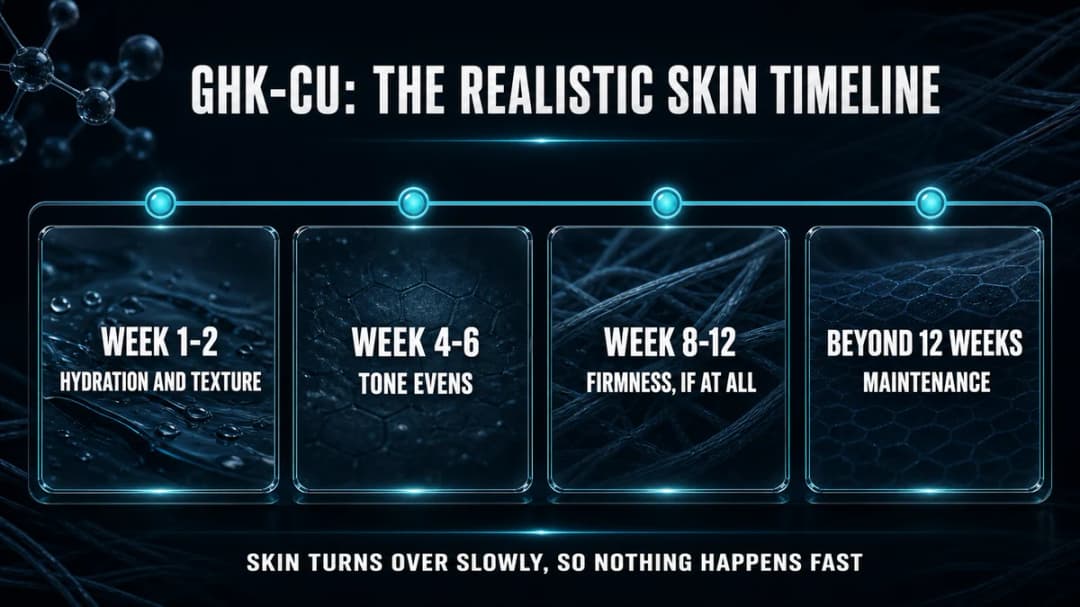
GHK-Cu before and after: the realistic timeline
| Period | What people report | What is plausibly happening |
|---|---|---|
| Weeks 2 to 4 | Less redness, skin feels less reactive. Some acne-prone users see an initial flare | Inflammatory signalling settling |
| Weeks 4 to 8 | Texture improves, pores look smaller, fine lines slightly softer | Early matrix changes |
| Weeks 8 to 12 | Tone evens out. Chronic redness cases show the most change in this window | Collagen remodelling becoming visible |
| 3 to 6 months | The point where sustained differences appear | A full remodelling cycle |
Notice the shape. Everything fast is inflammatory and everything slow is structural. Anyone reporting a dramatic structural change at week three is describing reduced redness, better lighting, or something else in their routine.
Why the community photographs overstate the case
The images that circulate under this search term deserve more scepticism than they get, and not because the people posting them are dishonest.
Lighting and angle do most of the work. Redness photographs very differently under warm indoor light than under a window. A before shot taken at the end of a bad day and an after taken in the morning are not comparable images.
Almost nobody changes one variable. People who start a copper peptide serum usually also start being gentler with their skin, using sunscreen more consistently, dropping an irritating product, or treating an underlying condition. Any of those alone explains a good deal.
Skin conditions fluctuate on their own. Rosacea and acne both flare and settle in cycles measured in weeks. A photograph taken at a flare and another at a remission shows the cycle, not the treatment.
Timelines are frequently missing or estimated. An image captioned as GHK-Cu with no stated duration is not evidence of anything.
The claims outrun the evidence. GHK-Cu has genuine dermatological research behind it, mostly in the context of wound healing and cosmetic outcomes over weeks to months. It does not have controlled trial evidence for treating rosacea or acne, and images presented as though it does are making a claim the literature has not supported.
None of this means the compound does nothing. It means an unverified photo pair is the weakest form of evidence available, and it is the form this topic runs on.
How to document your own before and after properly
If you are going to try it, make the result readable:
- Take the before photo in daylight, at a fixed distance, with the same expression and no makeup, and repeat those conditions exactly every two weeks.
- Photograph from three angles, since redness distributes unevenly and a single front-on shot hides changes at the jaw and temples.
- Change nothing else for the first eight weeks. No new actives, no new cleanser, no new sunscreen.
- Write down what else you are doing, including sleep, alcohol, and any medication.
- Judge at week eight, not week two. The early change is inflammatory and can reverse.
The week-eight comparison against a properly taken week-zero photograph is the only before and after worth anything.
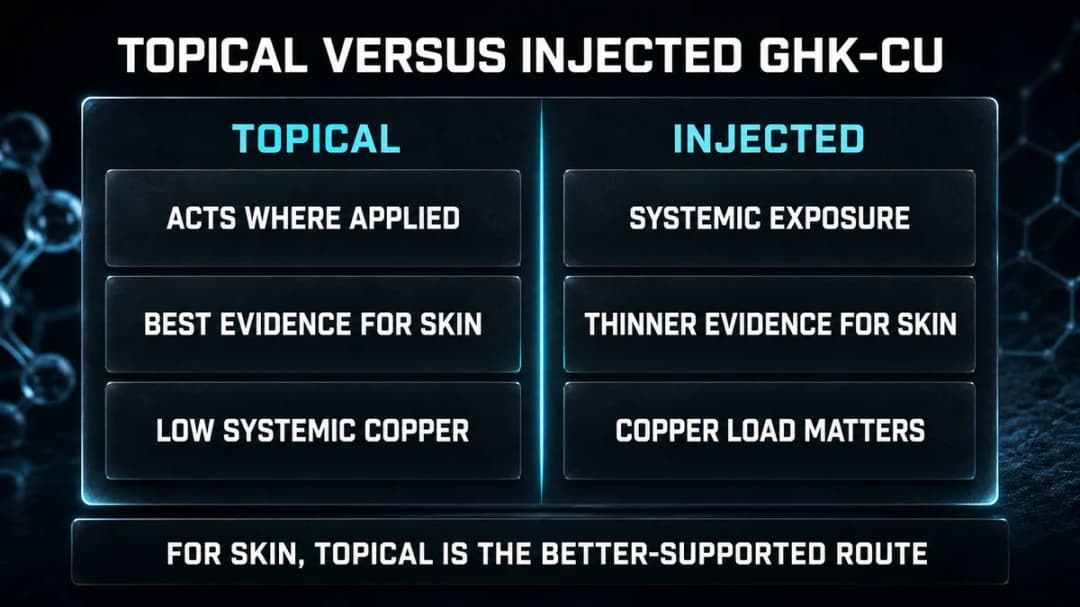
Topical or injected
For skin specifically, topical is the better-reasoned route. The target tissue is the tissue the serum touches, and the entire cosmetic evidence base for GHK-Cu is topical. Typical facial concentrations used are in the region of 0.1% to 0.5%, with higher concentrations used on the scalp.
Injected GHK-Cu is used for systemic purposes, and people combining both routes are usually chasing broader anti-ageing effects rather than a facial result. The injectable route has far less human evidence and adds injection-related risks for a benefit that, for skin, the topical route already delivers more directly. If that is the route you are taking, our GHK-Cu for sale page covers vial specs and how to verify a batch.
Our GHK-Cu for skin and hair page goes further into the application side, and the GHK-Cu guide covers the compound itself.
What it will not do
It will not resolve structural vascular changes such as established broken capillaries, which respond to laser rather than to topicals. It will not treat active infection or a diagnosed skin disease in place of proper treatment. It will not produce the change seen in the most dramatic circulating photographs in five weeks, whatever the caption says. And it will not compensate for sun exposure, which remains by a wide margin the largest modifiable input into how skin ages.
FAQ
How long does GHK-Cu take to show results?
Redness and reactivity usually change first, in the two to four week range. Texture and fine lines take eight to twelve weeks, and the most substantial differences reported come from use past three months. Anything dramatic inside a month is more likely inflammation settling than structure changing.
Are GHK-Cu before and after photos reliable?
Generally not. Most are uncontrolled, with different lighting, no stated duration, and other routine changes happening at the same time. They are worth reading as anecdote rather than evidence, and your own properly standardised photos are more informative than any of them.
Does GHK-Cu help rosacea?
It is frequently reported to reduce the redness component, which fits its anti-inflammatory mechanism, but no controlled trial supports it as a rosacea treatment. Rosacea also has structural vascular features that a topical peptide does not address, and it is a condition worth having diagnosed properly.
Can GHK-Cu be used with retinol or vitamin C?
Retinol is generally used alongside it without problems. High-strength ascorbic acid is the one worth separating, since vitamin C and copper can interact through oxidation, so applying them at different times of day is the common approach.
Does GHK-Cu work for hair?
There is separate research on hair follicle stimulation, and scalp application at higher concentration is the usual approach. Results take longer than for skin, typically three months or more, and the evidence is thinner than for the dermal effects.
Is topical or injected better for skin?
Topical, for skin specifically. The target is the tissue the serum contacts, and essentially all the cosmetic evidence is topical. Injection is used for systemic purposes and carries additional risks without a clear advantage for facial outcomes.