GHK-Cu is one of the most studied copper peptides on the market, and one of the easiest to fake. The compound is cheap to list and expensive to test properly, which is exactly why so many vendors skip the part that matters.
If you've been searching where to buy GHK-Cu, this guide gives you the version most buyer's pages won't: where copper peptide is actually sold, what a legitimate certificate of analysis looks like, what fair pricing runs in 2026, and the red flags that separate a tested research-grade vial from blue powder with a markup. GHK-Cu is sold as a research compound, not an FDA-approved drug, so the burden of verifying quality falls entirely on you.
Key Takeaways
- GHK-Cu is NOT an FDA-approved drug. The lyophilized/injectable form is sold for research use only; the topical cosmetic form (Copper Tripeptide-1) is sold over the counter
- Ascension Peptides is our top-rated vendor: every batch independently tested by a third-party lab, certificates showing >98% HPLC purity, and batch-specific certificates published in a public library
- Always demand a batch-specific COA tied to your lot number, not a generic product certificate. For injectable use, look for endotoxin and sterility results too
- Fair pricing in 2026 runs roughly $0.75–$1.80 per mg. Anything dramatically cheaper usually means underdosed or untested
- A faint blue tint is normal for copper peptide. Cloudiness, sediment, or deep green is not
What GHK-Cu Actually Is
GHK-Cu is a copper complex of the tripeptide glycyl-L-histidyl-L-lysine. It occurs naturally in human plasma, saliva, and urine, and was first isolated by Loren Pickart in the 1970s. One of the most cited facts about it is that circulating levels fall with age, from roughly 200 ng/mL around age 20 to about 80 ng/mL by age 60, which is part of why it draws so much research interest in tissue remodeling and aging (Pickart & Margolina, Int J Mol Sci 2018).
In research settings, GHK-Cu is studied for skin remodeling and collagen synthesis, wound and tissue repair, antioxidant activity, and hair follicle effects (Pickart, Vasquez-Soltero & Margolina, Biomed Res Int 2015). None of this is the same as FDA approval. The copper tripeptide you see in cosmetic serums is the same molecule sold without restriction, while the research-grade lyophilized powder is the form most peptide vendors stock. If you want the science rather than the sourcing, our GHK-Cu for skin and hair breakdown covers what the studies actually show, and the GHK-Cu capsules guide looks at the oral format.
Where to Buy GHK-Cu in 2026
There is no pharmacy counter for research-grade GHK-Cu and no insurance pathway, because it isn't an approved drug. That leaves three realistic lanes, and they are not equal.
Cosmetic Topicals (Copper Tripeptide-1)
Sold openly as serums and creams, usually at 0.5–5% concentration, under the INCI name Copper Tripeptide-1. This is the only fully retail, no-questions-asked option. It's legal, widely available, and aimed at skin use. The tradeoff is low and variable systemic delivery and concentrations that are rarely disclosed precisely. Skin Biology, the company founded by GHK-Cu's discoverer, is the best-known name here.
Research-Grade Peptide Vendors
This is where most people searching for GHK-Cu for sale end up. Dozens of online vendors sell lyophilized GHK-Cu in 50mg, 100mg, and 200mg vials for research use. No prescription is involved. Quality ranges from genuinely excellent, with published third-party COAs, to vials of unknown copper-to-peptide ratio with a recycled certificate. Vendor selection is the entire game in this lane, and it's the part of the "where to buy GHK-Cu" question that actually determines what you receive.
Compounding Pharmacies and Clinics
Some wellness clinics and compounders prepare copper peptide formulations. This route involves a consult and higher cost, and quality control varies. It is the least common path for GHK-Cu specifically, since the research-vendor market is so established.
Best Place to Buy GHK-Cu: Ascension Peptides
Ascension Peptides is the vendor we recommend for research-grade copper peptide, and not because of commission. They do the verification work that most of this market skips.
Batch testing you can actually check. Every Ascension batch is independently tested by a third-party lab, currently Kovera Labs (older batches by MZ Biolabs in Tucson). The certificates cover HPLC purity, LC-MS identity, net content per vial, endotoxin, a rapid sterility screen and heavy metals, and 85 batch-specific certificates sit in a public library, so matching the vial in your hand to its paperwork doesn't take an email thread. We checked one Kovera report against the lab's own records, and it matched.
Purity that holds up. The certificate pass mark is >98% by HPLC, and recent batches have tested between 98.9% and 99.9%. Plenty of cheaper listings hover lower or never disclose a number at all.
Clear pricing and terms. Supply gaps are common in this space. Ascension sells GHK-Cu as a 100mg vial: $59.00 USD in a 3mL vial or $69.00 USD in a 10mL vial. It ships within the United States only, with free shipping on orders over $250. All sales are final, though damaged or incorrect items are replaced if reported quickly. New customers get 50% off with code PEPTIDEDECK.
Honest positioning. Ascension sells GHK-Cu, like the rest of its 41-product catalogue, for research use only. That consistency is a quality signal in itself.
How to Verify GHK-Cu Quality: The COA
Most guides tell you to "look for third-party testing" and stop there. Here is what actually matters for a copper peptide.
Batch-Specific, Not Product-Level
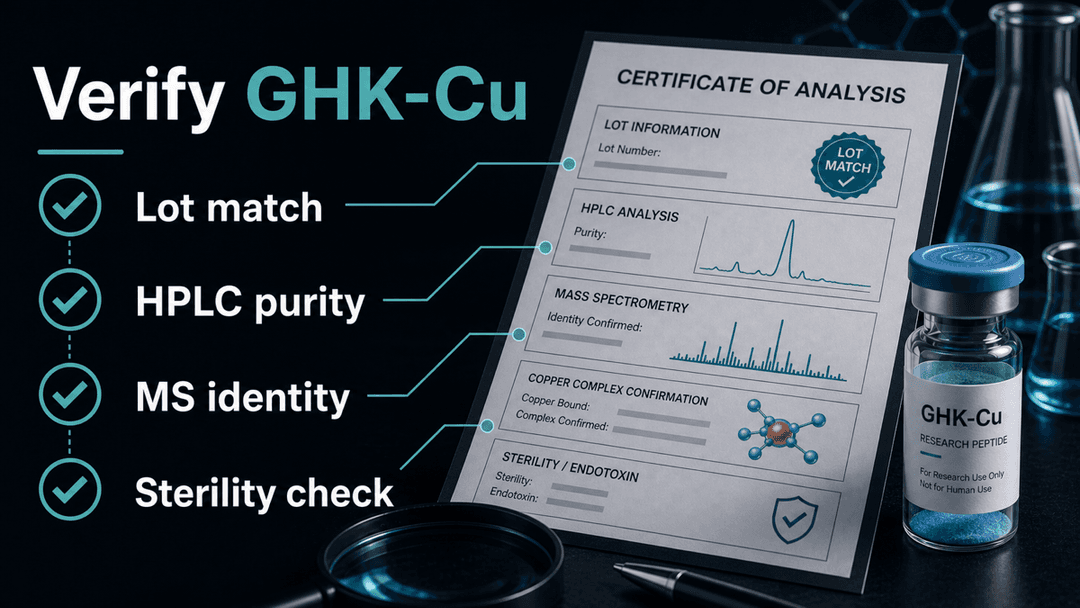
A product-level COA covers a product line and could reflect a synthesis run from months ago. A batch-specific COA references the exact lot number printed on your vial, with a testing date and matching results. Only the second one means anything. When your vial arrives, the lot number should match the certificate.
What the COA Should Show
- HPLC purity ≥98%, ideally with the chromatogram attached, not just a stated percentage
- Mass spectrometry confirming identity and that the copper chelation is real, not just free GHK peptide
- Endotoxin and sterility results if you're sourcing for injectable research, since purity alone says nothing about pyrogens
- A verifiable lab name. Janoshik is the most common independent peptide lab and has a portal to confirm certificate IDs. Eternal Peptides and several others publish Janoshik results
If a vendor can't produce a lot-matched COA, treat the vial as unverified regardless of the number on the label.
What GHK-Cu Costs in 2026
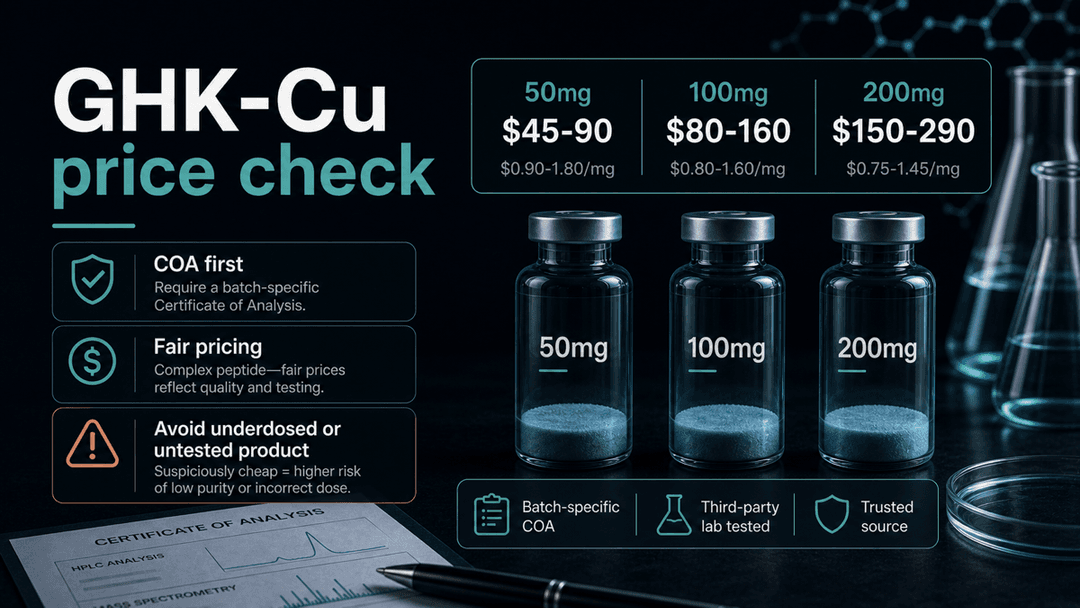
Pricing is fairly stable across reputable vendors, which makes outliers easy to spot.
- 50mg: roughly $45–$90 (commonly $55–$64). Standard first-order size
- 100mg: roughly $80–$160 (commonly around $80). The most popular reorder size and best mainstream value
- 200mg: roughly $150–$290. Lowest per-mg cost, but only worth it if testing is solid
That works out to about $0.75–$1.80 per milligram. Anything priced well under $0.50/mg should make you suspicious, not excited. Copper peptide is inexpensive to synthesize compared to large GLP-1 peptides, so a rock-bottom price more often signals skipped testing than a generous vendor.
Red Flags to Avoid
- No COA, or a generic product-level COA only. The single most common tell
- Prices far below the ranges above. Cheap usually means untested or underdosed
- No endotoxin testing on a vial marketed for injectable research
- Wrong color. A faint blue is expected from copper. Deep green, cloudiness, or visible particles suggest degradation or contamination
- Vague "made in USA" claims that describe packaging, not synthesis
- Medical or dosing claims for human use sitting next to a "research only" disclaimer. Vendors talking out of both sides of their mouth tend to cut corners elsewhere
- No verifiable address, no reviews, no community footprint. Check Reddit and peptide forums before trusting an unknown name
How to Get GHK-Cu
For the research-grade form, there's no prescription step. The practical process looks like this:
- Pick a vetted vendor with batch-specific COAs and a published HPLC purity figure, such as Ascension Peptides.
- Choose your vial size based on your protocol. A 50mg vial is a sensible first order; 100mg is the better value for ongoing work.
- Pay by card when possible. Credit cards give chargeback protection that crypto does not, which matters with an unfamiliar vendor.
- Verify on arrival. Match the lot number to the COA, and inspect the powder. It should be a dry, faintly tinted cake with no discoloration.
- Reconstitute and store correctly. GHK-Cu ships as a lyophilized powder. It's reconstituted with bacteriostatic water, kept refrigerated at 2–8°C after mixing, used within about 28 days, and protected from light. Store unmixed vials cold, ideally frozen, until use.
If you're researching GHK-Cu alongside other repair peptides, our Wolverine stack overview covers how copper peptide is commonly paired with BPC-157 and TB-500 in recovery-focused protocols.
Vendor Comparison Table
Top Vendors
Ranked by purity, third-party testing, COA availability, and price.
>98% HPLC (pass mark) · Kovera Labs, every batch · US only, free over $250
≥99% · Janoshik · US, free over $200
Listed · Published COA · US shipping
Listed · LC/MS shown · US shipping
≥99% · Published COA · US shipping
Cosmetic only · N/A (topical) · US/international
Prices are approximate and change often. Always confirm current pricing and COA availability before buying.
Related Buying Guides
Use these next if you are comparing adjacent research-peptide sourcing decisions:
Frequently Asked Questions
Where can I buy GHK-Cu?
Research-grade GHK-Cu is sold by online peptide vendors as a lyophilized powder for research use. Our top pick is Ascension Peptides, which has every batch independently tested by a third-party lab, publishes batch-specific certificates in a public library, and ships within the United States only. The cosmetic topical form (Copper Tripeptide-1) is also sold over the counter in serums and creams without restriction.
Is GHK-Cu legal to buy?
Yes, in the US GHK-Cu is legal to purchase. It is not a controlled or scheduled substance. The research-grade form is sold for laboratory research use only and is not approved by the FDA for human consumption, while cosmetic copper tripeptide products are sold over the counter for topical use. Laws vary by country, so check your local rules.
How much does GHK-Cu cost?
In 2026, expect roughly $45–$90 for a 50mg vial, around $80–$160 for 100mg, and $150–$290 for 200mg, which works out to about $0.75–$1.80 per milligram. Prices far below this range are a red flag for underdosed or untested product.
How do I know GHK-Cu is real and high purity?
Ask for a batch-specific COA that matches your vial's lot number, showing ≥98% HPLC purity and mass spectrometry confirmation of identity. For injectable research, look for endotoxin and sterility results too. A verifiable independent lab such as Janoshik is a strong sign. A faint blue color is normal for copper peptide; cloudiness or sediment is not.
Do I need a prescription for GHK-Cu?
No. Research-grade GHK-Cu is sold without a prescription as a research compound, and cosmetic copper peptide topicals are sold over the counter. It is not available as a prescription drug because it isn't FDA-approved for human use.
Why is my GHK-Cu solution blue?
A faint blue or blue-tinted appearance is expected, because the copper in the complex carries that color. It is one way to visually confirm copper is present. What you don't want to see is deep green, cloudiness, or particles, which can indicate degradation or contamination.
The Bottom Line
If you came here to figure out where to buy GHK-Cu, the framework is simple: COA first, vendor reputation second, price last. The molecule itself is well characterized and inexpensive to make, which is good news for buyers but also why the market is full of vials that were never properly tested. Insist on a lot-matched COA at ≥98% HPLC, expect to pay somewhere around a dollar or two per milligram, and walk away from anything cheaper than that with no paperwork.
Ascension Peptides clears those bars, which is why it's where we'd start.
Medical Disclaimer: This article is for informational purposes only and is not medical advice. GHK-Cu is not FDA-approved and is not intended to diagnose, treat, cure, or prevent any disease. Research-grade peptides are sold for laboratory research use only. Always consult a qualified healthcare provider before using any new compound, and understand that purchasing and using research peptides carries legal and health risks that vary by jurisdiction.