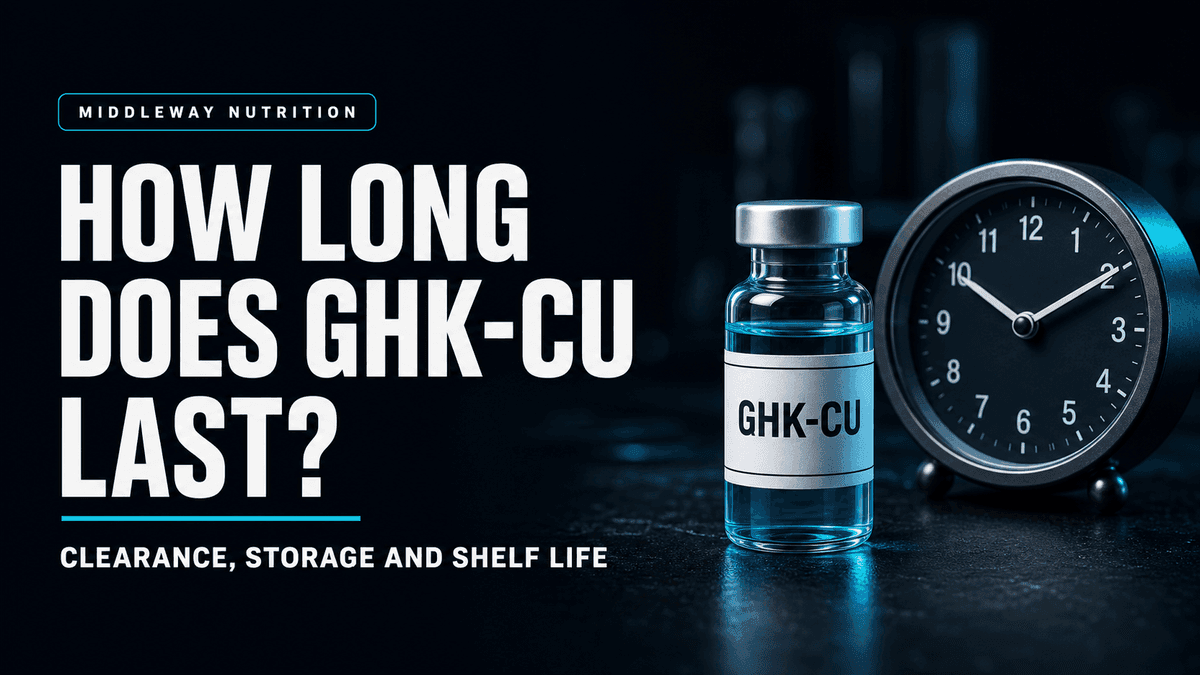
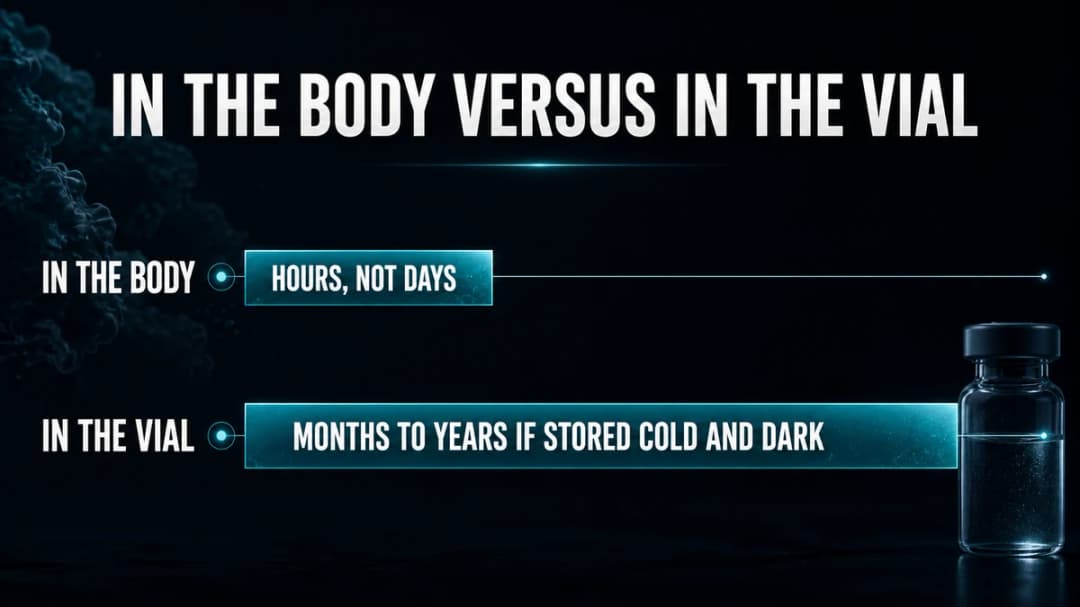
How long does GHK-Cu last? The question hides two clocks running at very different speeds. Inside you, the free tripeptide is gone in anything from a few minutes to a couple of hours. Inside a sealed vial of freeze dried powder, it can still be potent a year or two later. Anyone asking how long GHK-Cu lasts tends to want one of those answers and get handed the other, so it is worth taking them apart before the storage table.
The short version: short in the body, long in the vial, and a few weeks once you add water.
How Long Does GHK-Cu Last? In the body, hours not days
Structurally this is glycyl-histidyl-lysine holding a copper ion. Three amino acids is about as small as a peptide gets, and the enzymes patrolling your bloodstream make short work of molecules that size.
Rats given GHK intravenously converted it almost immediately into the dipeptide histidyl-lysine, and that fragment disappeared quickly in turn. There is a revealing footnote to that work: getting a usable plasma measurement required adding a protective agent to the samples, because otherwise the peptide fell apart before anyone could read it. Contact with serum enzymes and decomposition are effectively the same event.
Three things follow from that. Repeated doses do not stack up in the body. No loading phase applies. And with nothing persisting in circulation, whatever GHK-Cu achieves happens at the site where it went in rather than through the blood. Applying it to skin is a sensible response to that fact rather than a compromise.
The other clock: your own GHK declines with age
A much slower version of the same question exists. Natural plasma GHK drops considerably over a lifetime, and the figures usually quoted put a twenty-something near 200 ng/mL and a sixty-year-old near 80. In the body it sits bound up inside collagen and other matrix proteins until proteases cut it loose at an injury, where it takes part in organising the repair.
People point at that decline to justify topping the peptide up. It is worth being careful with the logic. What it describes is a trend across a population, not an instruction for an individual, and no trial has demonstrated that pushing the number back up delivers a clinical benefit.
In the vial: months to years
Freeze dried powder is how nearly all research GHK-Cu arrives, and there is nothing accidental about that. Water is where peptides fall apart fastest, so drying them into a solid is the manufacturing answer to an otherwise unworkable shelf life.
Dry powder
Dry, sealed and cold is peak stability for this compound. Hydrolysis needs free water and there is barely any, while cold temperatures slow the remaining chemistry down. Kept frozen in the dark with a desiccant, freeze dried peptide will typically hold its potency across one to two years, sometimes considerably longer. Keep it in the fridge instead and several months is the sensible expectation.
Anything you will not open in the near future belongs sealed in the freezer.
Reconstituted solution
Water starts a much faster clock. Dissolving is not the difficulty, since GHK-Cu is strongly water-loving and goes into solution without complaint, but being dissolved is exactly what exposes it to the reactions that break it down.
In clean laboratory conditions the molecule holds up surprisingly well. Preformulation work kept GHK intact in water and in buffers between roughly pH 4.5 and 7.4 for a fortnight at 60 degrees C, conditions no domestic fridge comes close to. Your vial is not a laboratory. It gets opened over and over, meets light and air each time, and swings in temperature. Hence the cautious convention: 2 to 8 degrees C, finished inside a few weeks. Sterility is as much the reason for that as potency is.
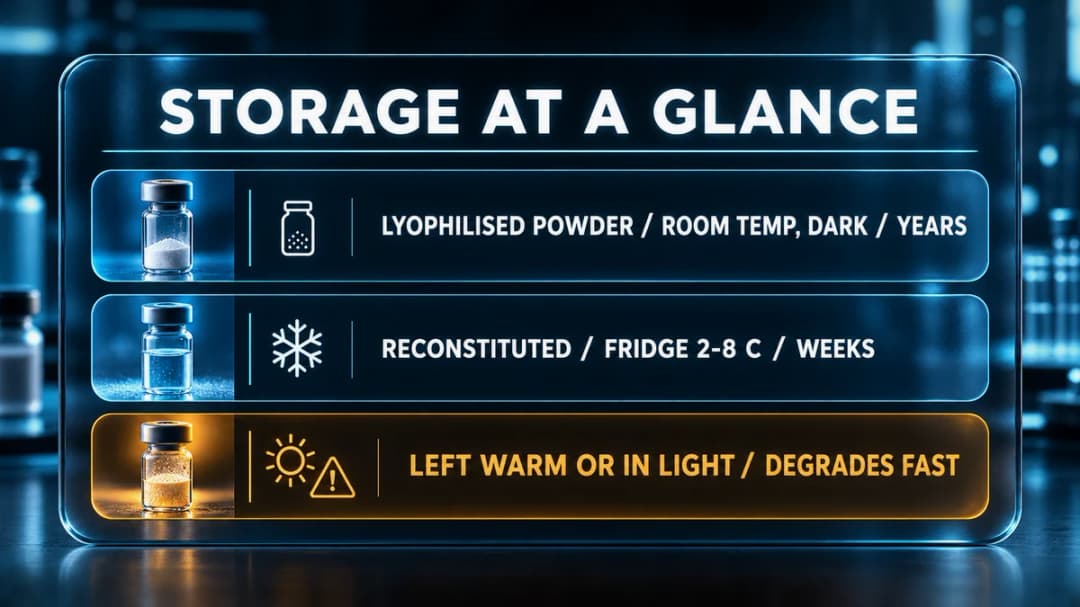
Storage at a glance
| State | Where to keep it | Realistic usable window | What degrades it |
|---|---|---|---|
| Sealed powder, long term | Freezer around -20°C, dark and dry | 1 to 2 years or more | Moisture, heat, light |
| Sealed powder, short term | Fridge, 2 to 8°C, dark | Several months | Moisture, heat, light |
| Reconstituted, in use | Fridge, 2 to 8°C, away from light | A few weeks | Oxidation, high pH, heat, bacteria |
| Reconstituted, frozen aliquots | Freezer, single-use portions | Longer, but thaw once only | Freeze-thaw stress |
| Room temperature | Transit only | Hours to a few days | Heat, oxidation, light |
Those reconstituted numbers are cautious defaults. Nobody is guaranteeing them.
What actually degrades it
Push the peptide deliberately in stability testing and the weak points show up in a clear order. Alkaline conditions and oxidative stress cause the most hydrolytic cleavage, acid does less damage, and the loss follows first-order kinetics throughout. Translated into things you control, the enemies are oxygen, an alkaline environment and warmth.
Light and air. Since oxidation is one of the main routes out, a vial belongs in its carton or something else opaque. Draw the dose and close it again rather than leaving it standing open on the counter.
Heat. Warmth accelerates every reaction in there without exception. Parked cars, windowsills in sun and anywhere near a hob are all disqualified.
Freeze-thaw cycles. Solution kept frozen does last longer, but thawing puts the molecule under stress each time, and the act of freezing carries its own risk of damage. Anyone freezing a reconstituted batch should divide it first, one portion per use, so nothing gets thawed twice. Dry powder has none of this ambiguity: freezing it is simply the right call.
Colour and clarity as a signal. Blue is what a copper peptide solution should look like. If that blue has visibly darkened, or the liquid has gone hazy, or anything is floating in it, the vial goes. This is not a judgement call to talk yourself out of.
Travelling with it
An insulated bag and a cold pack will hold a mixed vial in the right range over a short journey. For anything longer, take advantage of the fact that undissolved powder copes with several days at ordinary temperatures in a way that solution simply does not, and travel with sealed vials to mix once you get there. Sunlight, engine heat and the boot of a car are all worth avoiding, and nothing should ever be left sitting in a parked vehicle.
Why this matters more than an expiry date
Printed dates presume a standard of storage that real households rarely hit. Look after a vial and it will often still be good past the date on it. Leave one in a steamy bathroom cabinet and the date becomes meaningless in the other direction. What you do with it counts for more than what is stamped on it.
For related reading, see our GHK-Cu guide for the compound itself, and the reconstitution calculator for mixing volumes. If you are weighing up sources, our guide on where to buy GHK-Cu covers vendor checks, certificate red flags and what to expect from a legitimate seller.
FAQ
How quickly is GHK-Cu cleared from the body?
Very quickly. In animal pharmacokinetics, GHK given intravenously turned into a smaller fragment almost at once, and that fragment left the system rapidly as well. Read together, those results put clearance in the minutes to couple of hours range instead of anything measured in days, and they explain why repeat dosing does not build a level.
Once mixed, how long can I keep it in the fridge?
Give yourself a few weeks, held between 2 and 8 degrees C, out of the light. Chemically the peptide could probably tolerate more, but a vial you keep going back into faces oxidation and contamination that a sealed one does not. The short window is protecting sterility as much as strength.
And the powder, unmixed?
Sealed, dry and in the freezer, one to two years is the standard expectation and often more. Move it to the fridge and think in months instead. Water is the thing to keep away from it, which means keeping the seal intact and not letting a cold vial sweat once it comes out.
Is freezing mixed solution a good idea?
It buys time, though every thaw takes something out of the peptide. The workaround is to portion it before freezing, so each container is opened once and never refrozen. None of this applies to dry powder, which freezes without penalty.
What does spoiled GHK-Cu look like?
Your eyes are the only instrument available here. A copper peptide solution should be blue and clear, so a colour that has shifted noticeably, any haze, or particles drifting in it all mean the vial is done. Potency cannot be checked at home, which leaves appearance and good handling as the whole of your quality control.
Does GHK-Cu build up in the body over time?
No. It is cleared too quickly to accumulate, which is why dosing schedules for it are about maintaining a local effect rather than building a level. The changes people are looking for come from repeated exposure of tissue, not from a rising concentration in blood.