GHRP-6 vs GHRP-2 peptide is the oldest comparison in the growth hormone secretagogue category, and the answer is narrower than the length of most articles about it suggests. Both are six amino acid peptides, both bind the same ghrelin receptor, and both trigger a strong pulse of growth hormone. The GHRP-6 vs GHRP-2 peptide question comes down almost entirely to appetite: GHRP-6 produces a powerful hunger signal and GHRP-2 produces much less of one.
Everything else, including the small difference in potency, is secondary to that.
What Each One Is
GHRP-6 is a synthetic hexapeptide with the sequence His-D-Trp-Ala-Trp-D-Phe-Lys. Two D-form amino acids in that sequence protect it from being broken down immediately, giving a half-life measured in tens of minutes. It was the first compound in this class to be studied in humans, with pharmacokinetic work going back to the early 1990s. It is structurally derived from met-enkephalin but has no opioid activity.
GHRP-2, also called pralmorelin, came out of the same line of research. Also a hexapeptide, also a ghrelin receptor agonist, slightly more potent at releasing growth hormone and considerably milder on appetite.
Both act on GHS-R1a, the receptor the body's own ghrelin uses. Because ghrelin's natural job includes both stimulating hunger and amplifying growth hormone release, any compound that copies it inherits both effects to some degree. The difference between these two is how much of the appetite half comes along.
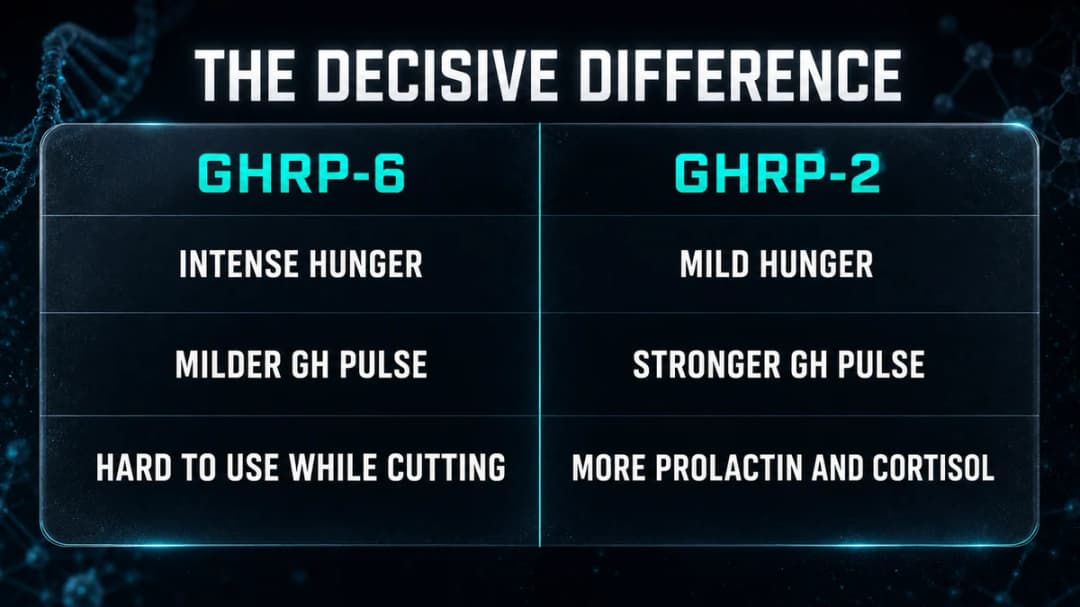
GHRP-6 vs GHRP-2 Peptide: The Decisive Difference
| Factor | GHRP-6 | GHRP-2 |
|---|---|---|
| Class | Ghrelin receptor agonist, hexapeptide | Ghrelin receptor agonist, hexapeptide |
| Receptor | GHS-R1a | GHS-R1a |
| Growth hormone release | Strong | Slightly stronger |
| Appetite stimulation | Very strong, the defining feature | Mild to moderate |
| Cortisol | Moderately raised | Moderately raised |
| Prolactin | Moderately raised | Moderately raised |
| Half-life | Roughly 15 to 60 minutes | Similar |
| Reported dose | 100 to 300 mcg | 100 to 300 mcg |
| Frequency | One to three times daily | One to three times daily |
| Suits | Bulking, where appetite is wanted | Body recomposition, where it is not |
The practical decision follows directly. Someone struggling to eat enough during a mass phase has a genuine use for GHRP-6, and the hunger is a feature they are paying for. Someone in a deficit trying to hold muscle would be fighting their own protocol.
What Both Do That Neither Should
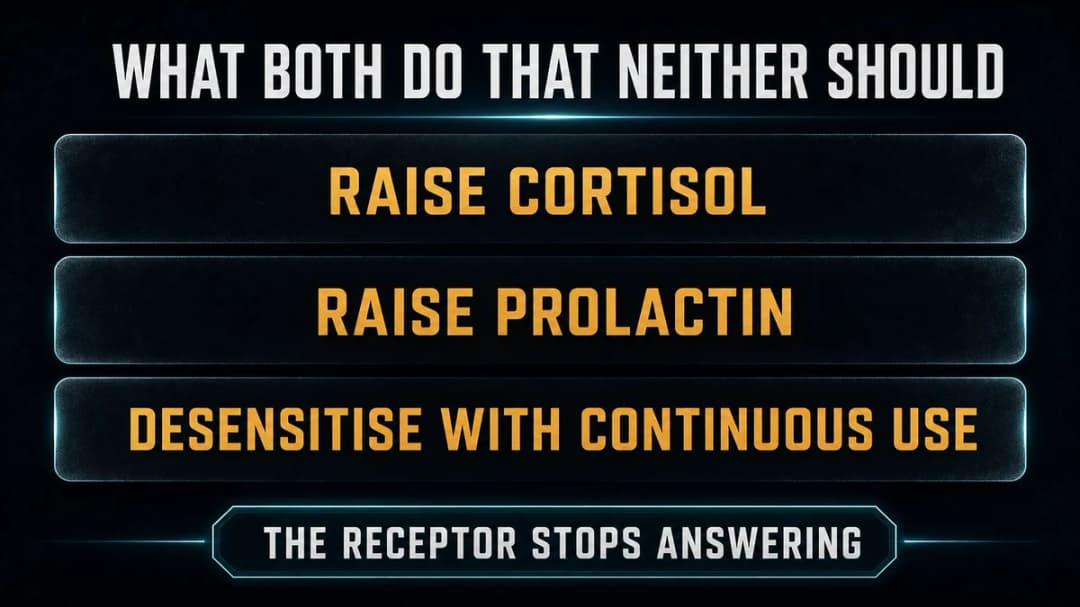
The shared problem is that both raise cortisol and prolactin.
Ghrelin receptor activation by a non-selective compound does not confine itself to the growth hormone pathway. It also drives ACTH and therefore cortisol, and it raises prolactin. Users report the consequences: puffiness, anxiety, disrupted sleep in some cases, and for prolactin at the higher end, effects on libido and, rarely, breast tenderness.
Cortisol is also directly counterproductive to what people are usually taking these compounds for. It opposes the anabolic signalling the growth hormone pulse is meant to produce.
This is the entire reason ipamorelin was developed and the entire reason it displaced both of these in modern protocols. Ipamorelin binds the same receptor with structural modifications that eliminate the cortisol and prolactin response and largely eliminate the appetite effect. It releases somewhat less growth hormone in exchange. See our pages on ipamorelin benefits and ipamorelin side effects.
Reported Dosing
Neither compound is approved for any use. These are figures from research protocols and user practice.
| Parameter | Both compounds |
|---|---|
| Dose per injection | 100 to 300 mcg subcutaneously |
| Frequency | One to three times daily |
| Timing | Empty stomach, 30 to 60 minutes before eating |
| Common windows | Fasted morning, post-exercise, before sleep |
| Cycle | 8 to 12 weeks, then a break |
Two points that matter more than the numbers.
Timing is not optional. Food, particularly fat and carbohydrate, blunts the growth hormone response substantially. Injecting after a meal wastes most of the dose. The pre-sleep window is the one with the strongest rationale, because it sits alongside the largest natural growth hormone pulse of the day.
Above 300 mcg does very little. The dose response for growth hormone release flattens out well before the side effects do. Higher doses mainly buy more hunger, more cortisol and more prolactin.
Reconstitution. A 5 mg vial with 2.5 ml of bacteriostatic water gives 2 mg per ml, so 100 mcg is 5 units on a standard insulin syringe. See our guide to bacteriostatic water and reconstitution.
Stacking
Both are commonly paired with a GHRH analogue such as CJC-1295 or sermorelin. That combination is genuinely synergistic, because the two compounds act on separate receptors and the pituitary responds more to both signals together than to either alone. It is the same logic behind the ipamorelin pairing. See our CJC-1295 vs ipamorelin comparison.
Stacking GHRP-6 with GHRP-2 makes no sense. Same receptor, same pathway, no synergy, twice the cortisol and prolactin.
Are Either Still the Right Choice in 2026?
For most purposes, no.
The category moved on for a clear reason. Ipamorelin does the same job on the same receptor without the cortisol, prolactin and appetite baggage. MK-677 offers oral dosing and a much longer duration, at the cost of considerably more water retention and appetite. Both are better documented as compounds people actually run today.
Where GHRP-6 still has a distinct case is exactly where the appetite is wanted, which is a narrow use. GHRP-2's case is weaker, since it does what ipamorelin does but with cortisol and prolactin attached, and its slightly higher potency does not obviously compensate.
None of this touches the bigger point. The evidence in this whole category demonstrates that these compounds raise growth hormone. It does not demonstrate that raising growth hormone this way produces the body composition outcomes the marketing implies, because those trials have not been run at any useful scale. See our overview of HGH peptides.
Safety Notes
Neither is approved anywhere, neither has meaningful long-term human safety data, and both are on the World Anti-Doping Agency prohibited list.
Both are contraindicated with an active cancer diagnosis, in pregnancy and breastfeeding, and under 18. Anyone on insulin needs medical input, because growth hormone opposes insulin and raises blood glucose. Anyone with existing pituitary disease should avoid compounds that stimulate the pituitary.
FAQ
Which is stronger, GHRP-6 or GHRP-2?
GHRP-2 produces a slightly larger growth hormone pulse at equivalent doses. The difference is small enough that it rarely determines the choice, and appetite usually does instead.
Does GHRP-2 cause hunger?
Some, but far less than GHRP-6. It binds the same receptor as ghrelin so an appetite effect is mechanistically unavoidable, but the magnitude is much lower, which is why it is preferred where fat loss is the goal.
Do both raise cortisol?
Yes, both moderately. That is the main drawback of this generation of compounds and the reason ipamorelin, which does not, largely replaced them.
Can GHRP-6 and GHRP-2 be stacked together?
There is no reason to. They compete for the same receptor and produce no synergy, so the combination adds side effects without adding effect. Pairing either with a GHRH analogue is the combination that does work.
What dose should be used?
Reported protocols use 100 to 300 mcg per injection, one to three times daily, on an empty stomach. The growth hormone response flattens out above roughly 300 mcg while the side effects keep rising.
Is ipamorelin better than both?
For most purposes, yes. It hits the same receptor without raising cortisol or prolactin and with minimal appetite effect, in exchange for somewhat less growth hormone release. The exception is anyone specifically wanting the appetite stimulation, where GHRP-6 has a real use.