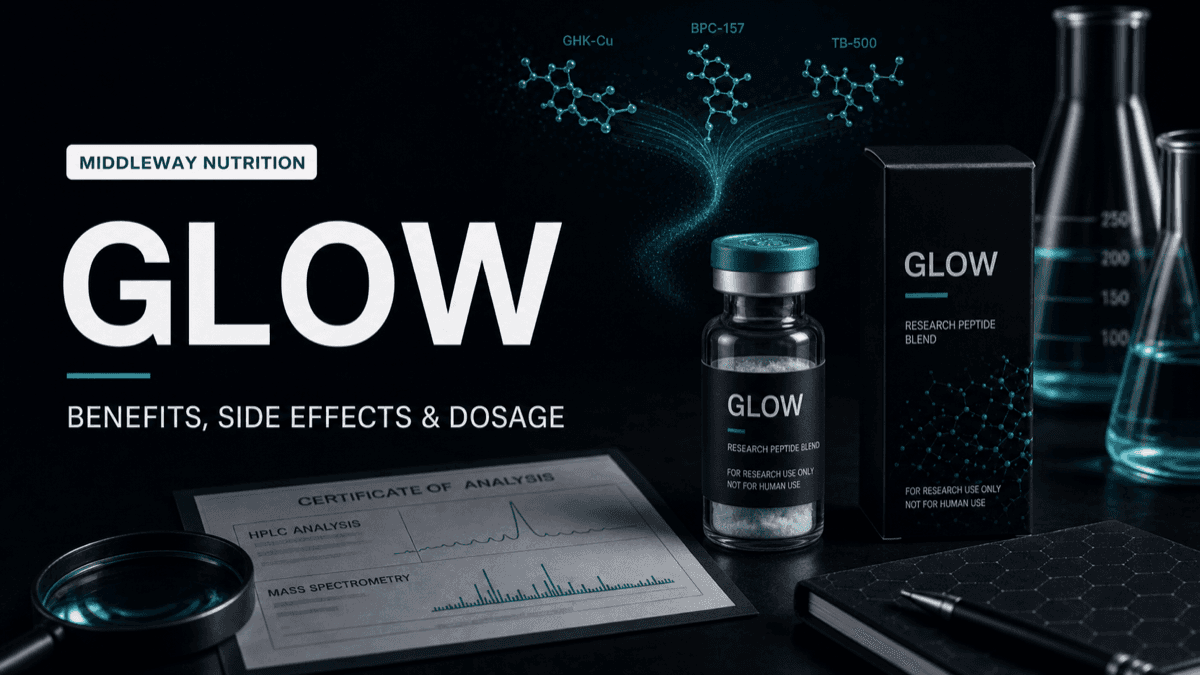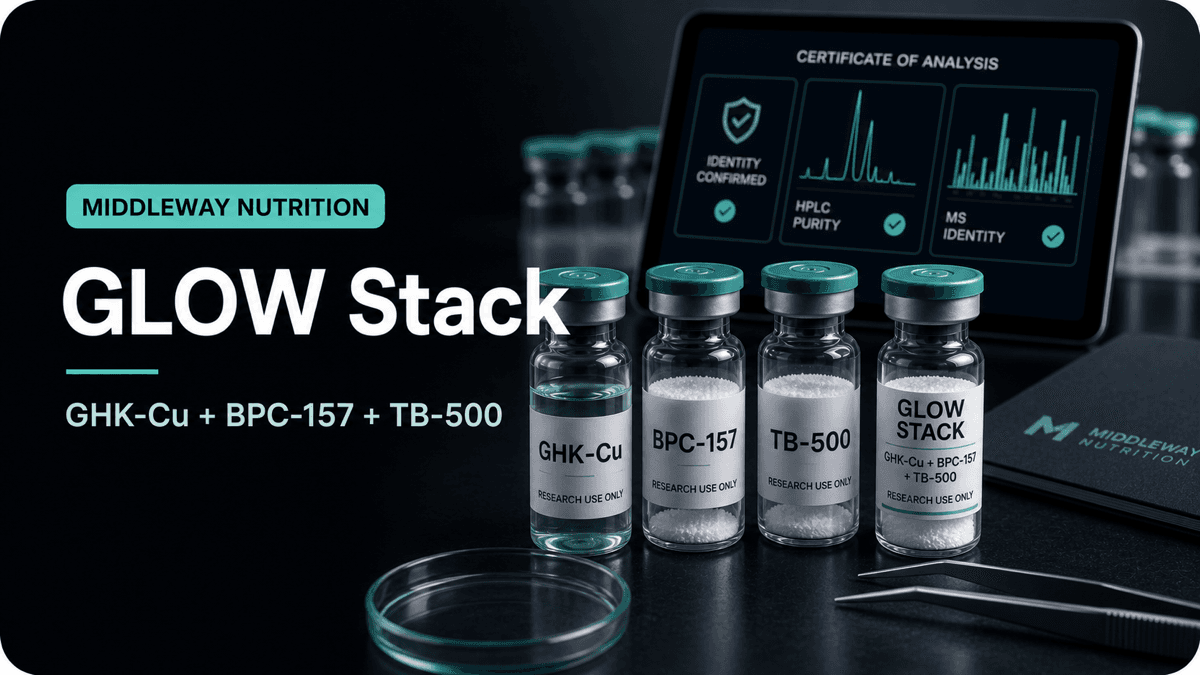
This GLOW dosage chart splits the blend into its three parts, because one number on a syringe is really three doses delivered at once. The usual 70 mg vial holds 50 mg GHK-Cu and 10 mg each of BPC-157 and TB-500. Below you get the per-peptide amounts, what published studies actually used, the units math for other vial sizes, and what little Reddit has to say. None of it is a prescription, since no regulator has approved a dose for any of the three.
Key Takeaways
- A 70 mg GLOW vial is 50/10/10 mg of GHK-Cu, BPC-157 and TB-500. Because the ratio is fixed, one volume sets all three doses together
- With 2 mL of water, 10 units on a U-100 syringe is 3.5 mg of blend: 2.5 mg GHK-Cu and 500 mcg of each of the other two. With 3 mL it is 1.67 mg and 333 mcg
- Vial size matters: a 60 mg listing (50/5/5) gives half as much BPC-157 and TB-500 per injection as the 70 mg vial at the same volume
- Reddit has almost nothing on GLOW itself. Of 400 posts and comments, only 2 were first-hand GLOW reports (plus 1 question) and none named a dose, so the dose figures here lean on arithmetic and on label-style conventions
- No study has tested this blend in people. None of the three is an approved drug, and this page is arithmetic and anecdote, not advice
For what GLOW is and how its claimed benefits are graded, see our GLOW peptide stack guide. This page is the dose-focused companion.
GLOW dosage chart: what is in the vial and what each peptide gets
Start with the table, because it answers the question most people arrive with: what does one injection of this blend actually contain? The answer depends on the vial ratio and how much water you added.
GLOW 70 mg vial: what each peptide gets per injection
| In the vial | 10 units, 2 mL | 20 units, 2 mL | 10 units, 3 mL | Published human data | |
|---|---|---|---|---|---|
| GHK-Cu | 50 mg (71%) | 2.5 mg | 5.0 mg | 1.67 mg | Small topical cosmetic trials; no injection dose-finding found |
| BPC-157 | 10 mg (14%) | 500 mcg | 1.0 mg | 333 mcg | Three pilots; clinic doses of 10 to 20 mg |
| TB-500 | 10 mg (14%) | 500 mcg | 1.0 mg | 333 mcg | None for the fragment; full-length thymosin beta-4 given IV |
| Blend total | 70 mg | 3.5 mg | 7.0 mg | 2.33 mg | No trial of the blend |
Read the shares first. Seventy one percent of the powder is GHK-Cu, and the other two split the rest evenly. That is why the GHK-Cu number looks large next to the others, and why a GLOW injection is a skin-weighted dose rather than a balanced repair dose. Our GLOW peptide blend review covers cost per dose and who the blend suits.
What a GLOW vial really contains
GLOW is a name, not a formulation. Nobody controls it, so the contents are whatever a seller puts under the label. The 70 mg, 50/10/10 split matches the current Ascension Peptides listing (GHK-Cu 50 mg, BPC-157 10 mg, TB-500 10 mg) and the vial described in our existing guide. Most vendor pages I found list the same thing.
It is not universal, though. I found a 60 mg listing from a South African retailer at 50 mg GHK-Cu with 5 mg each of BPC-157 and TB-500. A competitor dosing page describes a 42 mg vial of roughly 27 mg GHK-Cu, 10 mg TB-500 and 5 mg BPC-157, which does not even match the 5:1:1 ratio it claims. I could not verify that one. One r/Peptidesource poster (Feb 2026) described two separate vials: 50 mg of GHK-Cu and a 10 mg BPC-157/TB-500 blend.
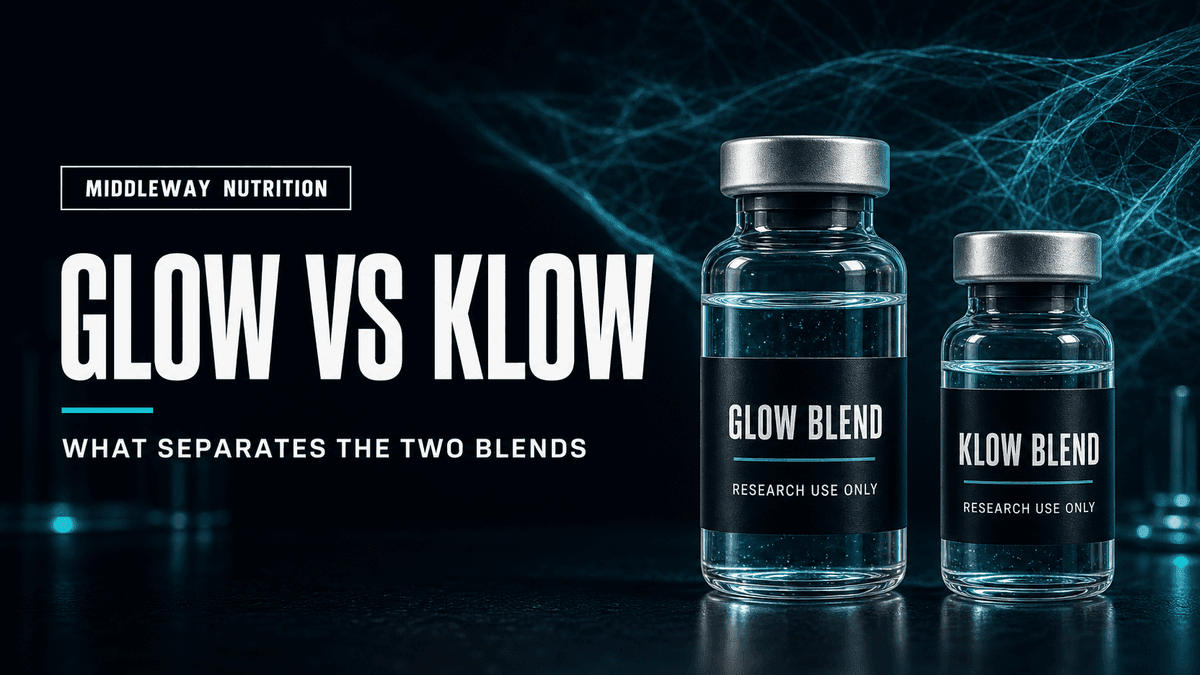
So the first job is to read your own label. If the per-peptide milligrams are not printed, you cannot calculate a dose, and a "70 mg blend" with no breakdown is unverifiable. Our where to buy GLOW guide explains what a proper batch certificate shows. And if you are wondering how this differs from the four-peptide version, see GLOW vs KLOW.
What published studies used for each peptide
The honest way to read a GLOW dosage chart is one ingredient at a time. Here is what the literature supports, which is less than most charts imply.
BPC-157. There is no approved dose. The human record is a handful of pilots: an intravenous safety study in two people given 10 mg and then 20 mg (PMID 40131143), a 12-woman interstitial cystitis pilot using 10 mg injected around the bladder (PMID 39325560), and a knee report. A 2025 systematic review of orthopaedic use found that the evidence base is preclinical and notes the compound lacks US FDA approval (PMID 40756949). Those clinic doses are twenty to forty times the 500 mcg a 10 unit GLOW injection delivers, and they were single procedures, not repeated self-injection. Per-kilogram animal dosing is covered in our BPC-157 dosage chart.
TB-500. TB-500 is not the full thymosin beta-4 protein. Mass spectrometry work identified the product as the acetylated 17-23 fragment, Ac-LKKTETQ, and described it as a suspected doping agent (PMID 22962027). The best human safety data is for the full-length synthetic protein: a placebo-controlled study in healthy volunteers gave it intravenously in ascending doses from 42 to 1,260 mg, then daily for 14 days, and reported infrequent mild or moderate adverse events (PMID 20536472). That says something about the parent protein by infusion, and nothing certain about a fragment injected under the skin. TB-500 is also on the WADA prohibited list for tested athletes, according to secondary sources I did not re-verify against the current list.
GHK-Cu. A 2026 systematic review noted that human randomized trials of GHK-Cu are small and mostly on facial cosmetic creams (PMID 42787770). I found no dose-finding study of subcutaneous GHK-Cu. The 2.5 to 5 mg range in our existing guide is community and vendor convention. A dedicated GHK-Cu dosage chart goes deeper by route.
What Reddit users report
I read 400 posts and comments from nine subreddits across 21 threads, dated February to October 2026. Most were noise: 84 comments under a before-and-after photo on r/GlowUps and 15 near-identical vendor posts on r/NovaPeptides. Only two comments were first-hand accounts of using GLOW itself, plus one question, and none named a dose. With so few reports, this section can only tell you what is missing.
What they said: one r/ScienceBioTechnology commenter (Sep 2026) who ran GLOW with retatrutide said weight loss did not drop on it, and that "my hair, cuticles and skin were much worse off when not on GLOW" (source). One r/Biohackers commenter (May 2026) credited an ankle recovery to BPC-157 after "introducing glow", which cannot separate the blend from anything else. And one r/Peptidesource poster (Feb 2026) asked for help with reconstitution and received no reply in the data.
For numbers, the nearest evidence is from KLOW, which is GLOW plus KPV, so the first three peptides are the same. Five comments named a syringe volume. They land between 5 and 25 units.
Units per injection named in 5 Reddit comments about GLOW-type blends
Two commenters started low: 5 units for a week with a plan to go to 10, and 10 units three times a week as advised by a provider. One reported 15 units, five days on and two off, and one 20 units on 3 mL for four weeks. The 25-unit commenter said they had been on that dose for a week and felt nothing, adding "been on a low 25 unit dose for a week and feel nothing" (r/BiohackingU commenter, Aug 2026). That is an outlier, and saying you felt nothing is not a safety result either way. Their vial concentration was not stated, so the milligrams are unknown.
Separately, people dosing the components as separate vials gave two figures: one r/Biohackers commenter posted a plan of BPC-157 500 mcg with GHK-Cu 1 mg in the morning, and one r/BiohackingU commenter ran GHK-Cu 3 mg daily. These are separate-vial schedules and say little about a fixed-ratio blend.
One side-effect note from the nearest data: an r/ScienceBioTechnology commenter (Sep 2026) described dry mouth in a partner seconds after a KLOW injection, and swelling in their own legs, ankles and hands about eight hours after a first 5-unit dose, after which they stopped. It is a single unverified account, but it is a reminder that "start low" is not a guarantee. Treat all of this as anecdotes from an unverified, self-selected sample.
Reconstitution math: mg, mL and syringe units
The vial holds a fixed mass. Water changes concentration, not total mass. The formula for any component is: dose = (component mg in the vial ÷ water in mL) × (units ÷ 100).
A worked example with the 70 mg vial and 2 mL: GHK-Cu is 50 ÷ 2 = 25 mg/mL, and 10 units is 0.10 mL, so 25 × 0.10 = 2.5 mg. BPC-157 is 10 ÷ 2 = 5 mg/mL, and 0.10 mL gives 0.5 mg, which is 500 mcg. TB-500 works the same way. Total blend is 70 ÷ 2 = 35 mg/mL, so each unit carries 0.35 mg of blend. With 3 mL the concentrations drop to 16.7, 3.33 and 3.33 mg/mL, and 10 units gives 1.67 mg and 333 mcg.
A 2 mL reconstitution gives 200 units, or 20 doses at 10 units. A 3 mL reconstitution gives 300 units, or 30 doses. A 5 mL reconstitution, which one of our own reviews assumes, gives 14 mg/mL total, and 20 units delivers 2.0 mg GHK-Cu and 400 mcg of each of the others.
Vial size changes the repair-peptide dose but not the GHK-Cu dose, which is why the same syringe mark means different things on different products.
Same syringe volume, different vial: 10 units on 3 mL of water
| 70 mg (50/10/10) | 60 mg (50/5/5) | 50 mg GHK-Cu + 10 mg BPC/TB (5/5) | |
|---|---|---|---|
| GHK-Cu per dose | 1.67 mg | 1.67 mg | 1.67 mg |
| BPC-157 per dose | 333 mcg | 167 mcg | 167 mcg |
| TB-500 per dose | 333 mcg | 167 mcg | 167 mcg |
| Doses per vial (10 units) | 30 | 30 | 30 |
Now the weekly totals, which are the part nobody checks. Ten units daily on 3 mL is 11.7 mg of GHK-Cu and 2.33 mg each of BPC-157 and TB-500 a week. Ten units on 2 mL three times a week is 7.5 mg and 1.5 mg. Twenty units on 2 mL three times a week is 15 mg and 3 mg. So a smaller daily dose can add up to more than a mid-sized dose three times a week (11.7 mg against 7.5 mg of GHK-Cu), while a larger dose three times a week (15 mg) can exceed the daily schedule.
Our existing guide says a 2 mL vial at 0.2 mL three times weekly lasts "closer to five" weeks. By my math 2 mL is 10 doses of 0.2 mL, which is about 3.3 weeks. The 0.1 mL figure of roughly seven weeks is right.
If you want a single supplier to check against, Ascension Peptides lists the GLOW 70 mg vial at $110.00 as of 2026-10-11 (the page shows a list price of $174.99). Kovera Labs tests every batch (HPLC, LC-MS identity, net content, endotoxin, sterility and heavy metals), more than 98 percent of tested batches pass, and batch certificates are public. Prices are in US dollars, shipping is US only and all sales are final. New customers can use code PEPTIDEDECK for 50 percent off. It is a research chemical, labeled not for human use.
Timing, frequency and cycle length
No study defines a GLOW schedule, so this section reports conventions. Our existing guide reports 0.1 to 0.2 mL three times a week, 8 to 12 weeks, with 4 to 6 weeks off. Competing pages disagree with each other (one has 10 units five days a week, another a flat daily 2.33 mg), both contradict their own tables on frequency, and none cites a source for cycle lengths of 4 to 12 weeks.
The Reddit data adds little. The one separate-vial schedule that included GHK-Cu ran it 12 weeks on and 4 weeks off, with BPC-157 and TB-500 4 weeks on and 4 off until a shoulder healed, which is a personal plan rather than evidence.

There is a reason to be cautious about the long cycles. GHK-Cu is a copper complex. If the 50 mg is counted as the complex, copper is roughly 16 percent of it by mass, which would be about 8 mg of copper in the vial and about 0.4 mg per 2.5 mg dose. That is my estimate, not a label figure. Nobody has characterised what months of injected GHK-Cu does to copper status, which is the main reason cycling is conventional.
What changes the dose
Reconstitution volume. The same 10 units is 2.5 mg of GHK-Cu on 2 mL and 1.67 mg on 3 mL. This is the single biggest source of confusion, and it is why two people who both say "10 units" may take different amounts.
Vial ratio and fill. Everything above assumes 50/10/10 and a full fill. If the vial is a 60 mg 50/5/5 or is underfilled, the repair-peptide dose halves or shrinks. A batch certificate with net peptide content is the only way to know.
Which peptide you anchor to. Dosing off GHK-Cu gives BPC-157 and TB-500 at one fifth of the GHK-Cu figure. Dosing off a BPC-157 amount of 500 mcg gives 2.5 mg of GHK-Cu. You cannot tune one without moving the others, which is the price of a blend. If you want a higher TB-500 or BPC-157 dose, a separate-vial setup gives control, with the mcg versus mg trap to manage.
Body weight and goal. Studies of BPC-157 in animals dose per kilogram, and the clinic pilots used flat doses. Neither maps to a fixed-ratio vial. For which claims have any evidence behind them, see our GLOW peptide benefits page.
Frequently Asked Questions
What is the GLOW peptide dosage?
There is no established dosage for GLOW or for any of its three components. Published human data are small pilots and creams, and nothing tests the blend. Community and vendor conventions center on 10 to 20 units from a 2 mL reconstitution of the 70 mg vial, which is 2.5 to 5 mg GHK-Cu with 500 mcg to 1 mg each of BPC-157 and TB-500.
How many units of GLOW is 2.5 mg?
It depends on the water. For a 70 mg vial in 2 mL, 10 units is 2.5 mg of GHK-Cu (and 500 mcg of each other peptide). In 3 mL, 15 units gives the same 2.5 mg of GHK-Cu. If you mean 2.5 mg of total blend, that is about 7 units on 2 mL.
How long does a GLOW 70 mg vial last?
With 2 mL of water the vial holds 200 units. At 10 units that is 20 doses, about 6.7 weeks at three a week, or 20 days daily. With 3 mL it holds 300 units, or 30 doses at 10 units.
How do you reconstitute GLOW?
Add bacteriostatic water slowly down the inside wall of the vial and swirl gently without shaking. The solution usually looks light blue from the copper. The volume changes the units, not the total mass, so recompute each time and follow the vendor's and a clinician's guidance on storage.
Is GLOW FDA-approved?
No. GLOW is a research blend of three unapproved peptides. A 2025 review states BPC-157 lacks US FDA approval (PMID 40756949). I did not check FDA databases for injectable GHK-Cu or TB-500, so I cannot say more, and a Reddit claim about compounding rules changing is unverified.
Checking a vial before you do any math
The calculations above assume the label is true. Ascension Peptides lists the GLOW 70 mg vial at $110.00 as of 2026-10-11, with per-batch Kovera Labs testing and public batch certificates; US shipping only and all sales are final. Write units out in full, check your arithmetic twice, and treat every Reddit number here as an anecdote.
Medical Disclaimer: GLOW is a blend of investigational research peptides. None of its components is approved by the FDA or a comparable regulator for any condition, and it is sold for laboratory research use only. This article reports published and user-reported figures for education. It is not medical advice, a dosing protocol or a recommendation for personal use. Consult a qualified healthcare professional about any health concern.