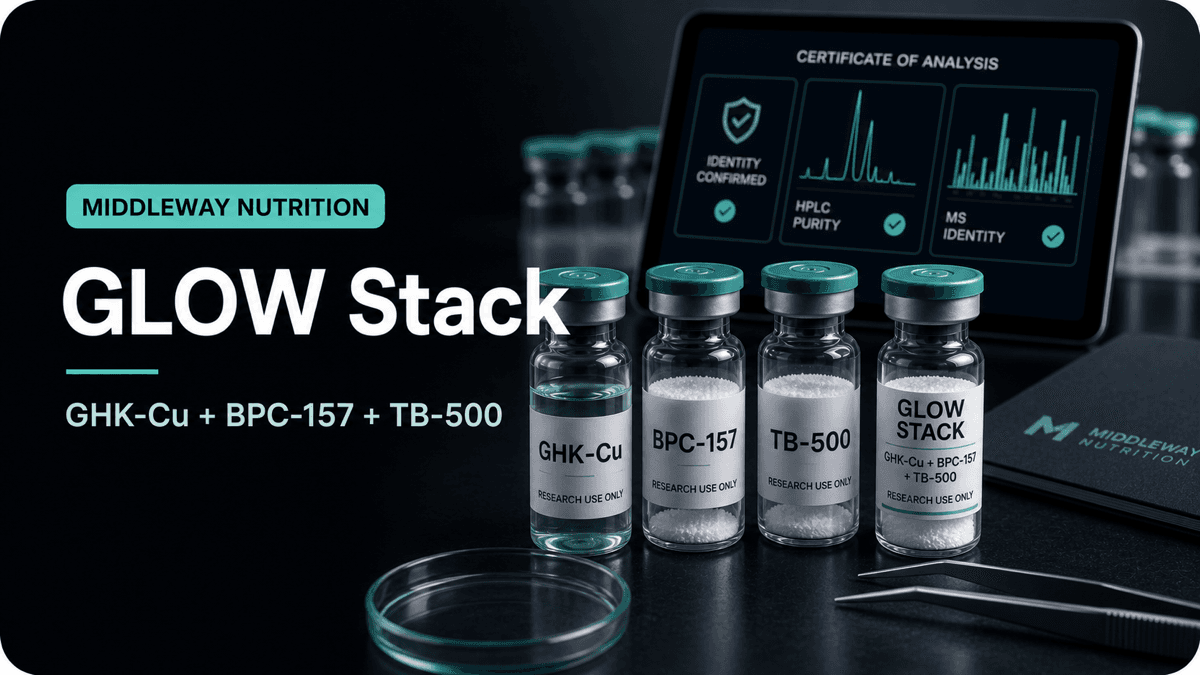
The GLOW vs KLOW peptide question has a simple answer on composition: three of the four ingredients are identical, being GHK-Cu, TB-500 and BPC-157, and only KLOW carries KPV as a fourth. Where GLOW vs KLOW gets more complicated is in deciding whether that fourth ingredient justifies the price difference, because the evidence base underneath both blends is preclinical rather than clinical.
Neither blend is an approved product. Both are pre-mixed research vials, and the compounds inside them have been studied in cell culture and animal models rather than in human trials.
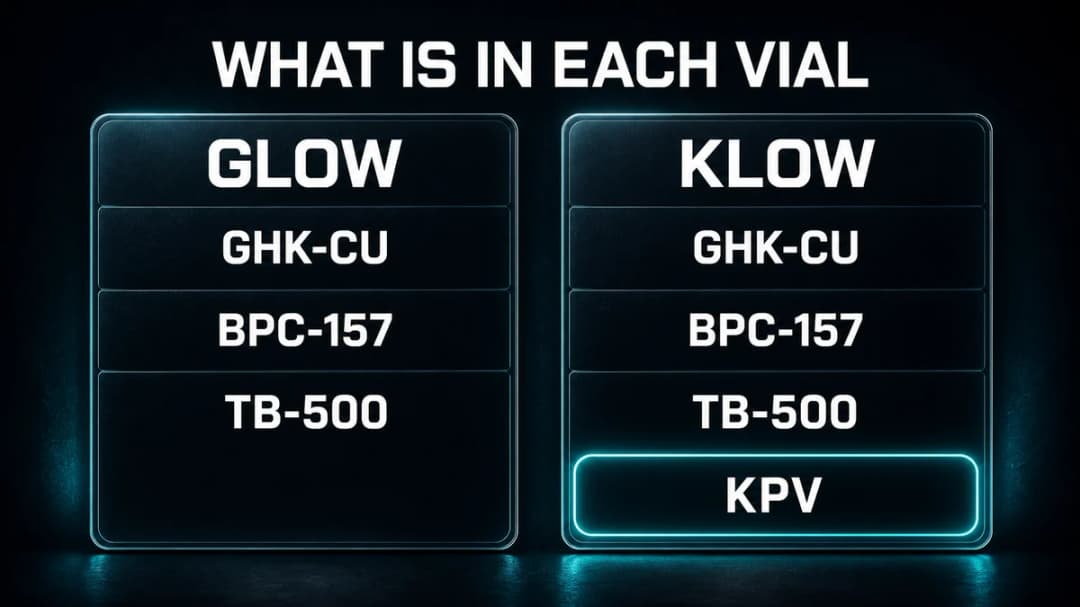
GLOW vs KLOW Peptide: What Is In Each Vial
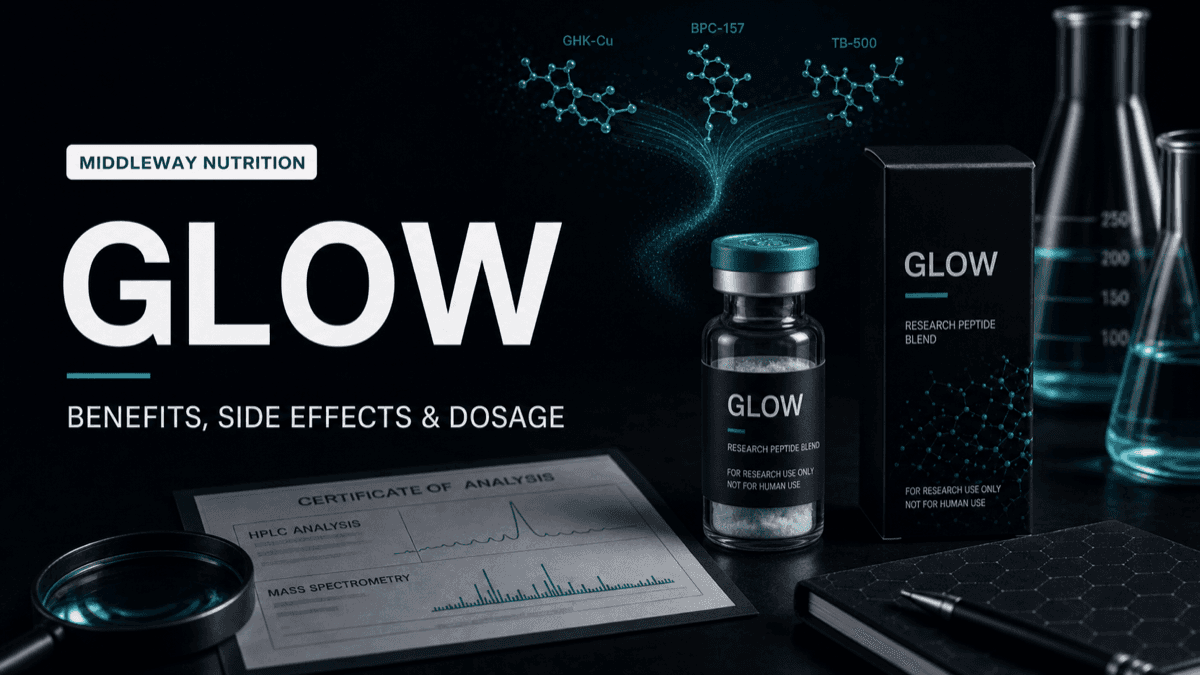
| Component | GLOW | KLOW | What it is |
|---|---|---|---|
| GHK-Cu | Yes | Yes | Copper binding tripeptide, the main skin and hair component |
| BPC-157 | Yes | Yes | Synthetic fragment derived from a gastric protein, studied in rodent healing models |
| TB-500 | Yes | Yes | Synthetic fragment of thymosin beta-4, studied in tissue repair models |
| KPV | No | Yes | Tripeptide fragment of alpha-MSH with anti-inflammatory activity in preclinical work |
GHK-Cu is the component with the deepest literature, and almost all of that literature concerns topical application in a cosmetic context. Its effects on collagen synthesis, skin texture and wound healing have been examined in cell and animal studies and in some topical human work. Injected systemic use is a different proposition with no comparable evidence.
BPC-157 and TB-500 both have substantial rodent literature on tendon, muscle and gut healing, and essentially no human trial data. That absence is not a technicality. It is the whole state of the evidence.
KPV is a fragment of alpha-melanocyte stimulating hormone. Preclinical work, particularly in models of colitis, shows anti-inflammatory activity involving NF-kB signalling. Again, no human trials.
What the Difference Is Meant to Achieve
The positioning is straightforward. GLOW is sold as the skin and appearance blend, with GHK-Cu doing most of the work. KLOW is sold as the repair and inflammation blend, with KPV added to broaden the anti-inflammatory coverage.
| GLOW | KLOW | |
|---|---|---|
| Positioned for | Skin texture, tone, hair, appearance | Recovery, gut, joint and injury inflammation |
| Number of actives | Three | Four |
| Typical price | Lower | Higher |
| Overlap | Substantial. Three of four components are identical |
The honest reading of that table is that the two products are more similar than different. Three quarters of KLOW is GLOW. The choice is really whether KPV is worth the increment, and the evidence to answer that question in humans does not exist.
Which One Fits Which Goal
If your interest is skin quality and hair, GHK-Cu is the relevant component, and it is in both. GLOW simply removes an ingredient you would not be paying for anyway.
If your interest is gut inflammation or systemic inflammatory issues, KPV is the addition with the most relevant preclinical rationale, which is the argument for KLOW. If you would rather run it on its own, our guide to where to buy KPV covers sourcing the single peptide.
If your interest is tendon or soft tissue recovery, both are identical on the components that matter, since BPC-157 and TB-500 appear in each.
For skin specifically, there is a further point worth making. GHK-Cu's best supported use is topical, not injected. A cosmetic formulation applied to the skin has a considerably better evidence base than a subcutaneous injection of a blend, and it carries none of the sterility and product identity risks. See our GHK-Cu for skin and hair guide for that comparison.
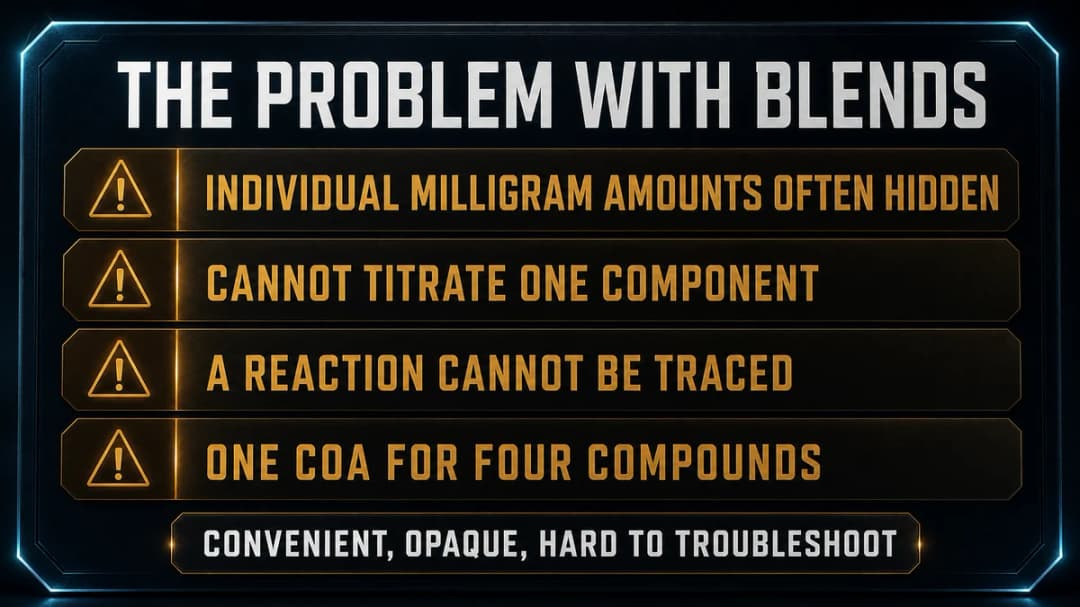
The Problems With Blends Generally
You cannot attribute anything. If a four peptide blend produces an effect, you have no idea which component caused it, or whether three of them are doing nothing. That is fine commercially and useless for anyone trying to understand what works for them.
You cannot adjust the ratio. The relative amounts are fixed by the manufacturer. If you tolerate one component poorly, your only option is to stop everything.
Quality verification is harder. A certificate of analysis for a blend has to establish the identity and quantity of every component. Many do not, and a single HPLC trace of a four peptide mixture is considerably harder to interpret than one for a single compound.
The convenience is real. In fairness, this is the actual selling point: one vial, one reconstitution, one injection instead of four. For someone who has already decided to use all four compounds, that is a genuine advantage.
Cost comparison becomes opaque. A blend priced against four separate vials usually looks favourable, but the comparison only holds if the quantities match. Working out the cost per milligram of each component in a blend, and comparing that against buying the components separately, frequently produces a less flattering picture than the headline price suggests. Our KLOW for sale page tracks the vial pricing and specs behind that comparison.
A Note on the Sport and Regulatory Position
Both blends contain BPC-157 and TB-500, and both of those are on the World Anti-Doping Agency prohibited list. Anyone subject to testing should treat either blend as disqualifying regardless of what else is in it, and the fact that a product is sold as a research compound offers no protection.
Neither blend is an approved medicine anywhere. What is being purchased is a research chemical mixture, and the standards applied to sterility, concentration accuracy and component identity are the supplier's own.
Our KLOW guide and GLOW peptide benefits pages cover each blend in more depth, and peptides for recovery sets out how thin the evidence gets across this category.
FAQ
How do the GLOW and KLOW blends differ?
Only in the fourth ingredient. KLOW carries KPV on top of the GHK-Cu, TB-500 and BPC-157 that both share. KPV is an anti-inflammatory tripeptide, which is why KLOW is positioned for recovery and inflammation rather than skin appearance.
Is KLOW better than GLOW?
Not inherently. It contains one more compound, and whether that compound adds anything in humans has not been tested. If your goal is skin and hair, the extra ingredient is not targeting what you care about.
Can you use GLOW and KLOW together?
There would be no point, since three of the four components are duplicated and you would be doubling those doses without knowing what a safe range is. Running one at a time in separate blocks is the more sensible pattern, and it also lets you tell them apart.
Do these blends have human trial evidence?
No. GHK-Cu has topical cosmetic literature, and BPC-157, TB-500 and KPV have preclinical data in animals and cell culture. None of these compounds has been tested as an injectable blend in a human clinical trial.
Are GLOW and KLOW legal?
They are sold as research compounds and are not approved medicines in any market. BPC-157 and TB-500 are both prohibited in competitive sport under anti-doping rules, which applies regardless of what else is in the vial.