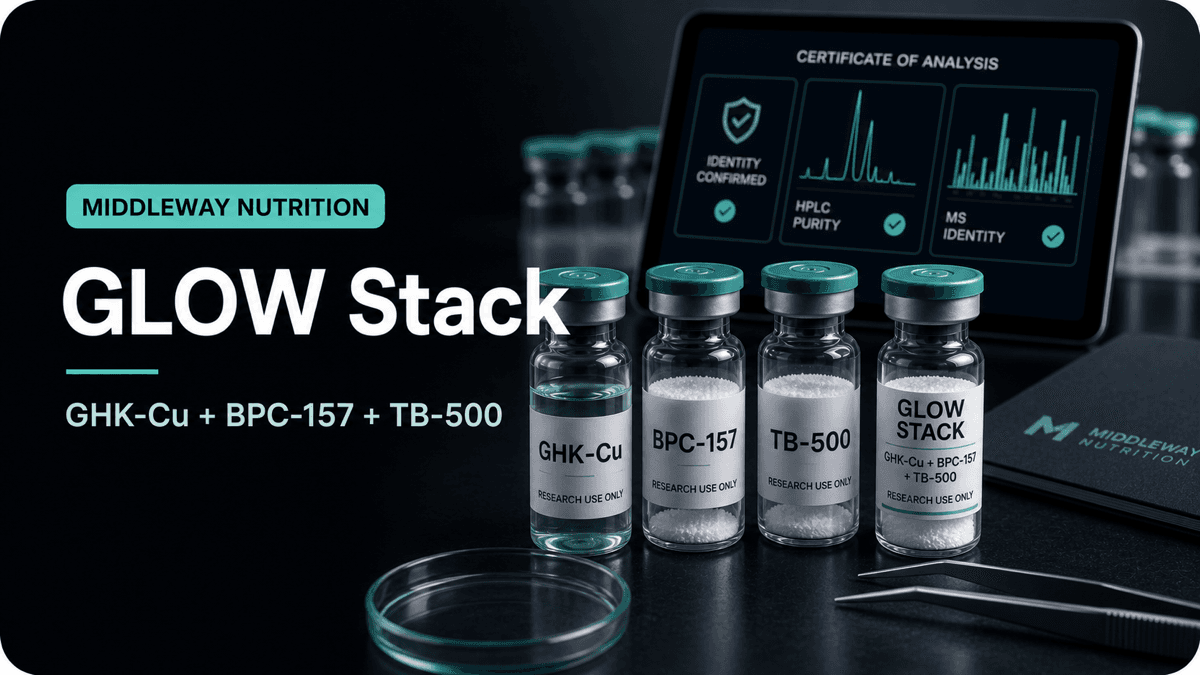
GLOW peptide before and after reports point to a slow, modest change concentrated in skin texture and tone, typically first noticed somewhere between weeks four and eight. Nothing about the biology of collagen remodelling supports a visible change in the first two weeks, and any before and after image showing one is telling you about lighting rather than about peptides.
This page collects what GLOW peptide before and after accounts consistently describe, sets it against what the ingredients could plausibly do on that timescale, and covers how to track your own results in a way that survives scrutiny.
Why Before and After Photos Are Weak Evidence Here
Skin photographs are unusually easy to influence without intending to. Lighting angle, time of day, hydration, how recently you exercised, camera processing and whether you are smiling all change apparent skin quality more than eight weeks of a peptide plausibly does.
Add the direction of motivation. Someone who has spent $145 and injected three times a week for two months is looking for a difference, and the "before" photo was usually taken on the day they decided their skin was a problem.
None of that means the reports are worthless. It means treating them as directional rather than as measurement.
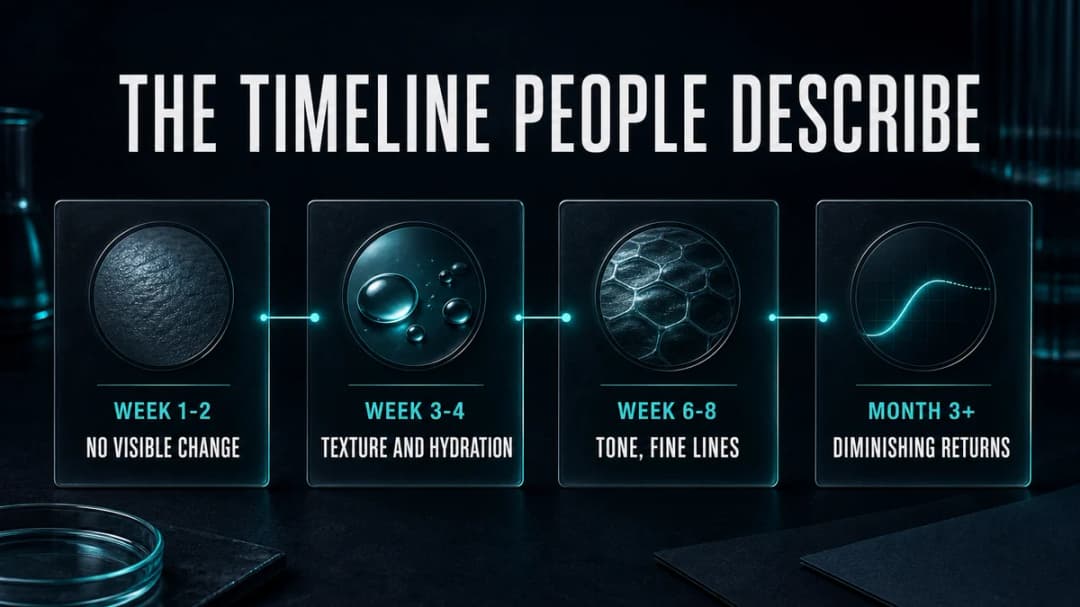
GLOW Peptide Before and After: The Timeline People Describe
| Period | What is commonly reported | What is plausible |
|---|---|---|
| Week 1 to 2 | Little or nothing, some injection site stinging | Correct. No mechanism operates this fast |
| Week 3 to 4 | First mentions of skin feeling smoother, better hydration | Possible. Early surface changes precede structural ones |
| Week 5 to 8 | The main cluster of positive reports, texture and tone | Consistent with collagen turnover timescales |
| Week 9 to 12 | Continued gradual change, some report a plateau | Reasonable |
| After stopping | Gradual return over one to three months | Expected. Nothing here is permanent |
The consistency of that shape is the most interesting thing about the reports. Different people, dosing differently, tend to describe the same rough arc, which is at least what you would expect if something real were happening rather than pure expectation.
What Changes and What Does Not
Commonly reported to change: overall skin texture, described as smoother or softer. Tone and the general "brightness" of skin. Minor healing, small cuts and blemishes clearing faster. Recovery from training, attributed to the BPC-157 and TB-500 content.
Rarely reported to change: deep static lines and folds. Skin laxity in any structural sense. Anything on the timescale of days.
That split makes sense mechanistically. GHK-Cu operates on collagen synthesis and matrix remodelling, which affects surface quality over weeks. Deep folds are a structural and volumetric problem that no injectable peptide addresses.
Our GLOW peptide blend review covers the evidence behind each ingredient, and what is the GLOW peptide blend covers the composition.
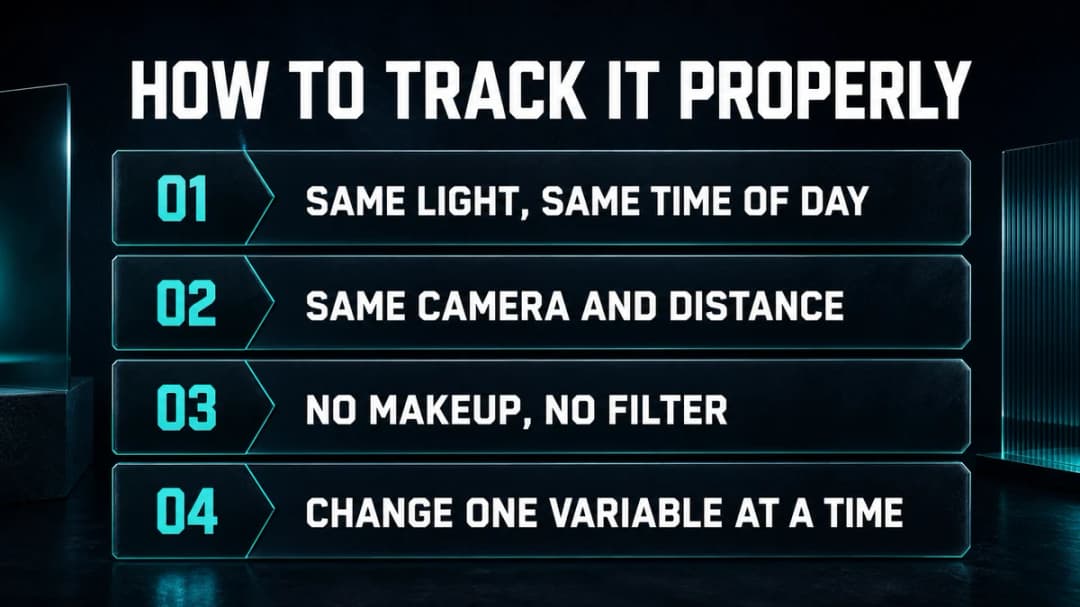
How to Track Your Own Before and After Properly
If you are going to run this, the difference between a useful result and an anecdote is entirely in the setup.
Fix the photo conditions. Same room, same time of day, same distance, no makeup, no smile, flash off, and a note of the light source. Repeat weekly rather than daily.
Record something that is not a photo. Skin feel on a one to ten scale at the same time each day. How long a small blemish takes to clear. Whether makeup sits differently. These are subjective but they are at least consistently subjective.
Take a baseline for two weeks before starting. This is the step everyone skips and the one that matters most. Two weeks of "before" data tells you what your normal week-to-week variation looks like, which is the only way to know whether a later change exceeds it.
Change one thing. Starting GLOW in the same month you begin a retinoid, change your diet, or come off a stressful period makes the result uninterpretable.
Factors That Confound the Result
Skin quality moves for reasons that have nothing to do with peptides. Seasonal humidity, sleep in the preceding week, alcohol, sun exposure, hydration and the menstrual cycle all produce visible weekly variation.
The largest confounder in this specific context is that people who buy a skin peptide usually also improve everything else at the same time: more water, better sleep, a proper sunscreen habit, sometimes a new topical. Those interventions have their own effects, and sunscreen in particular has better evidence for skin appearance over months than anything in the vial.
Dosing in the Reports
Most before and after accounts describe three injections per week rather than daily dosing, with the vial reconstituted in the region of 3 to 5 mL and draws of roughly 15 to 25 units.
There is no established protocol, because this is a research blend rather than a formulated medicine. What that means for interpreting reports is that people are not all doing the same thing, so comparing outcomes across accounts compares different exposures.
What Happens When You Stop
Reports describe a gradual fade over one to three months rather than an abrupt loss. That is consistent with collagen turnover: whatever was built continues to exist for a while and is not replaced at the same rate once the signal stops.
This is worth factoring into the decision before starting. If the appeal is a maintained appearance, the realistic commitment is ongoing rather than a single course, at roughly $145 every eight weeks on a three times weekly schedule.
FAQ
How long before GLOW shows visible results?
Most reports place the first noticeable change between weeks four and eight, concentrated in skin texture rather than lines. Anything visible in the first two weeks is more likely to be hydration, lighting or expectation than collagen remodelling, which does not work that quickly.
Are GLOW before and after photos reliable?
Not on their own. Lighting, camera processing, time of day and hydration all shift apparent skin quality more than a peptide plausibly does over eight weeks. Photos taken under fixed conditions with a two week baseline first are worth something. Marketing comparisons generally are not.
Do the results last after stopping?
They fade gradually, typically over one to three months. Nothing in the blend produces a permanent structural change, so maintaining a result means continuing to dose.
What dose do most before and after reports use?
Three times per week is the most commonly described schedule, with draws of roughly 15 to 25 units depending on how the vial was reconstituted. Since protocols vary widely, outcomes reported by different people reflect different total exposures.
Does GLOW work better than topical GHK-Cu for skin?
There is no comparison study, and the honest answer favours caution. GHK-Cu's stronger evidence base is topical, so the injectable route is the less supported one for a skin goal despite being the more involved.