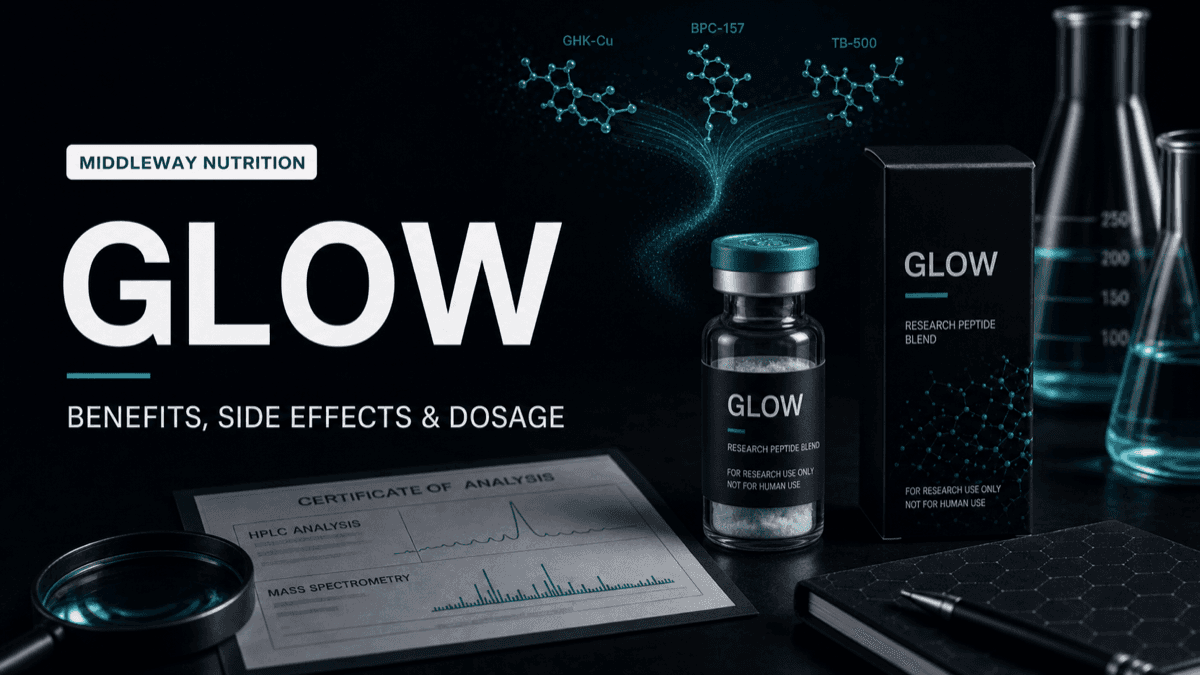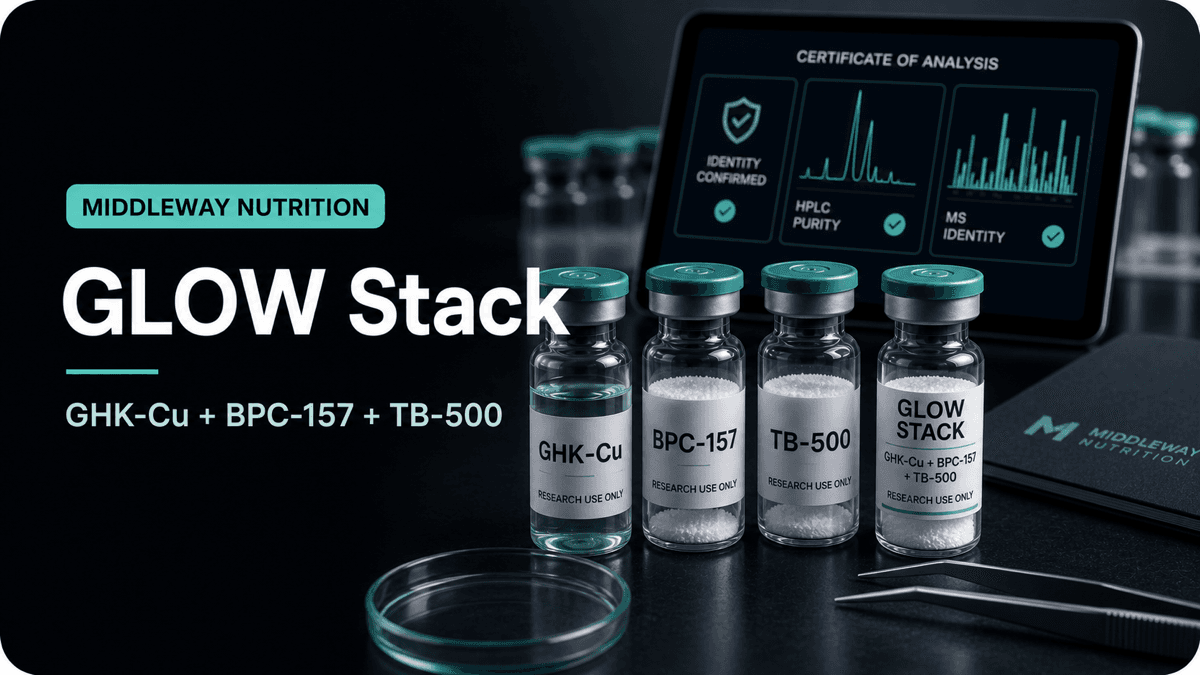
This GLOW peptide blend review reaches a mixed verdict. The convenience case is real, the GHK-Cu content is substantial, and the reported skin results are consistent enough to be worth taking seriously. The evidence case is much weaker: no controlled trial has evaluated this combination, and the fixed ratio removes your ability to adjust any single component.
Most coverage of the GLOW peptide blend is written by someone selling it. This review works through the same product from the other direction: what each ingredient can be expected to do, what users actually report, what a dose costs, and the situations where a different purchase would serve you better.
What This GLOW Peptide Blend Review Covers
| Component | Per vial | Role |
|---|---|---|
| GHK-Cu | 50 mg | The primary active, collagen and skin remodelling |
| BPC-157 | 10 mg | Repair signalling, angiogenesis |
| TB-500 | 10 mg | Cell migration, systemic distribution |
Seventy milligrams of peptide in one vial, dominated by the copper peptide. Our what is the GLOW peptide blend page covers the components in detail.
The Evidence, Ingredient by Ingredient
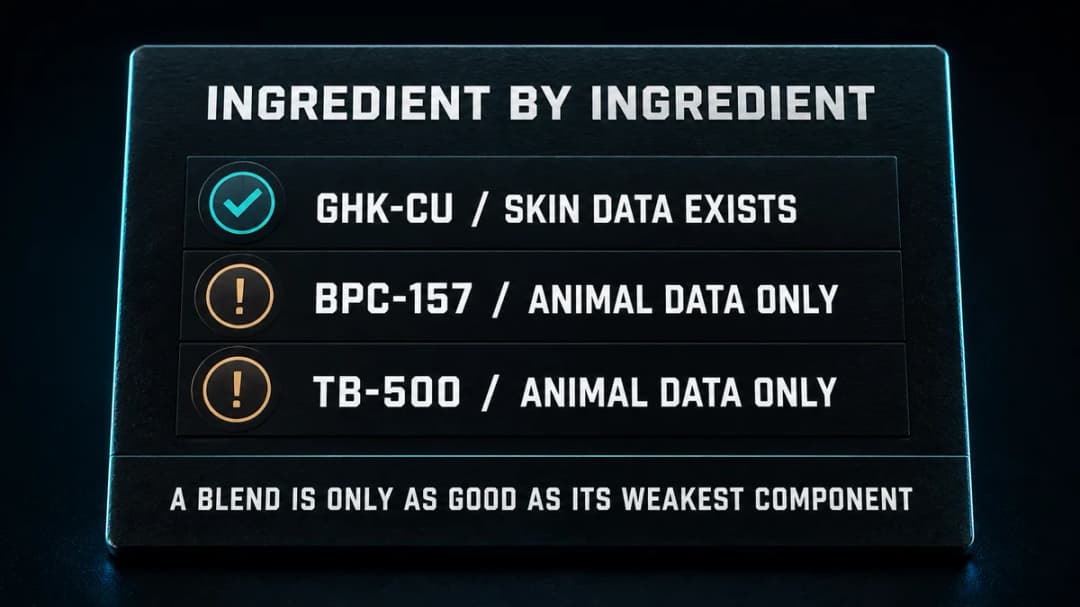
GHK-Cu is the strongest of the three, with a caveat. It has a genuine dermatological literature behind it, including work on collagen synthesis and skin remodelling. Nearly all of that is topical. Injecting it is a different proposition from applying it, and the systemic evidence is considerably thinner than the marketing implies. This is the compound most likely to be doing something and the compound whose delivery route is least supported.
BPC-157 has volume without depth. A large animal literature, essentially no controlled human data. Consistent user reports over a decade. Reasonable to include, impossible to claim confidently.
TB-500 is the weakest. Preclinical and equine data, thin human evidence, and the ingredient least connected to a skin goal. It is here for repair breadth rather than for anything specific to the blend's stated purpose.
The combination itself is unstudied. No trial has compared the blend to GHK-Cu alone, which is the comparison that would tell you whether the other two ingredients earn their place. Anyone stating that the three work synergistically is reasoning from mechanism, not reporting a finding.
What Users Report
The pattern in user accounts is reasonably consistent, which is worth something even though it is not evidence.
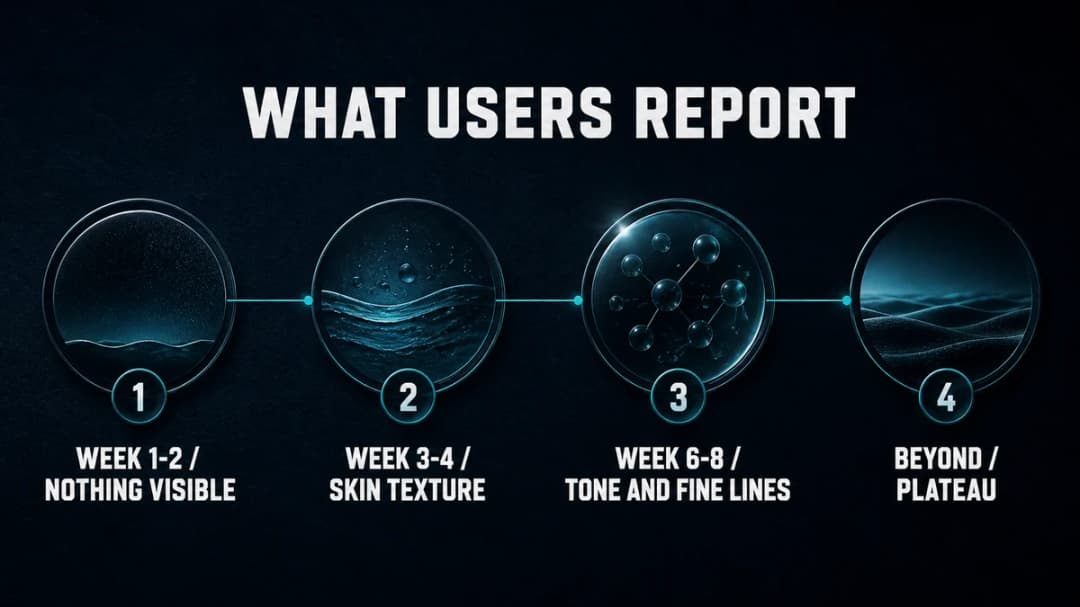
Skin texture and tone are the most commonly cited changes, described in terms of smoothness and a general "brighter" quality rather than anything dramatic. These reports cluster around the four to eight week mark.
Improvements in minor aches and recovery come up as a secondary theme, presumably from the BPC-157 and TB-500 content, though at 400 to 500 mcg per dose of each on a three times weekly schedule the exposure is modest compared with dosing them individually.
Fine lines and wrinkles are the claim with the widest gap between marketing and reports. Users describing structural change in deep lines are rare. Users describing better surface quality are common.
The honest counterweight: people who spend over $100 on a vial and inject it for two months are strongly motivated to notice improvement, and none of this is measured against a control.
Cost per Dose
At Ascension's current $110.00 per vial (checked 2026-10-11; list price $174.99), the arithmetic depends on your schedule.
| Schedule | Doses per vial at 20 units, 5 mL reconstitution | Vial duration | Cost per dose |
|---|---|---|---|
| 3 times per week | 25 | About 8 weeks | Around $4.40 |
| Daily | 25 | About 3.5 weeks | Around $4.40 |
That compares favourably with buying the three components separately if you genuinely want all three. It compares badly if you want only one of them. A standalone BPC-157 vial costs a fraction of this and gives you ten times the flexibility on dosing.
Where the Blend Format Costs You
Fixed ratio. If the copper peptide irritates your injection sites, the only adjustment available is to reduce everything, including the components that were not causing the problem.
No attribution. Three compounds started simultaneously means any effect, positive or negative, has three possible causes. For a first peptide, this is a genuine drawback.
Frequency compromise. BPC-157 is conventionally dosed daily or twice daily. TB-500 is dosed twice weekly. A blend forces a single schedule that is wrong for at least one component.
Shorter usable life. The reconstituted vial is limited by its least stable ingredient, so treat it as a two to three week window rather than the four you might get from a single peptide.
Practical Notes
The reconstituted solution is blue. Copper-bound peptide is expected to look that way, and it is not a fault. Cloudiness, particles or a colour shift away from that original blue are faults, and mean the vial should be discarded.
Site rotation matters more than usual, because GHK-Cu is the ingredient most associated with local stinging and redness and it is present in the largest quantity.
Store it refrigerated, at the back of a shelf rather than in the door.
Who Should Buy It and Who Should Not
Reasonable purchase for someone whose main interest is skin quality, who wants the repair peptides as a bonus rather than as the point, and who values a single injection over managing three vials.
Poor purchase for anyone treating a specific injury, who should buy BPC-157 and TB-500 at proper doses without paying for 50 mg of copper peptide. Also a poor first peptide, for the attribution reason above. And a poor purchase for anyone whose real interest is GHK-Cu for skin, since a topical formulation has better evidence behind it and costs less.
Verdict
As a convenience product, GLOW does what it says: three compounds, one reconstitution, one injection, at a fair price relative to buying the components separately. As a skin treatment, it rests on one ingredient with good topical evidence delivered by a route that evidence does not cover, supported by two compounds with no human trial data at all.
If that is a trade you understand and still want to make, it is a reasonable product. If you were expecting something with clinical backing behind the blend, it does not exist. Our GLOW peptide before and after page covers what a realistic timeline looks like, and GLOW peptide side effects covers what to watch for.
FAQ
How long does GLOW take to work?
Reported changes in skin texture cluster around weeks four to eight. Nothing meaningful should be expected in the first fortnight, since collagen remodelling operates on a timescale of months rather than days.
Is GLOW worth the money?
It is fairly priced against buying GHK-Cu, BPC-157 and TB-500 separately, at around $4.40 per dose at the current $110.00 price (about $7.00 at the $174.99 list price). Whether that is worth spending depends on whether you want all three compounds, because if you want one of them the blend is an expensive way to get it.
Can GLOW be used on the face?
It is a subcutaneous injectable, and injecting research peptides into facial tissue is not something to do casually. If the goal is facial skin, topical GHK-Cu formulations have better evidence and none of the injection risks.
Does GLOW help with hair?
GHK-Cu has been studied in relation to hair follicles, mostly in topical contexts, and hair is a commonly claimed benefit. There is no trial evidence that this blend affects hair growth, and reports on it are mixed.
How long does a reconstituted GLOW vial last?
Treat it as two to three weeks refrigerated. A blend is limited by its least stable component, so the four week figure sometimes quoted for single peptides is optimistic here.