GLOW peptide stack benefits, side effects, and dosage all belong to three separate compounds rather than one, because GLOW is a premixed blend and not a molecule in its own right. That single fact changes how the rest of this page has to be written. A vial sold under the GLOW name contains GHK-Cu, BPC-157, and TB-500 in fixed proportion, and each of those three has its own research base, its own tolerability record, and its own reported dosing convention. Merging them into one tidy profile is the most common mistake in write-ups on this blend, and it hides exactly the details that matter when you are deciding whether the ratio in the vial suits what you are studying.
- GLOW is a convenience format, not a new compound. Nothing inside the vial is unique to GLOW; what you are buying is a fixed ratio and one reconstitution instead of three.
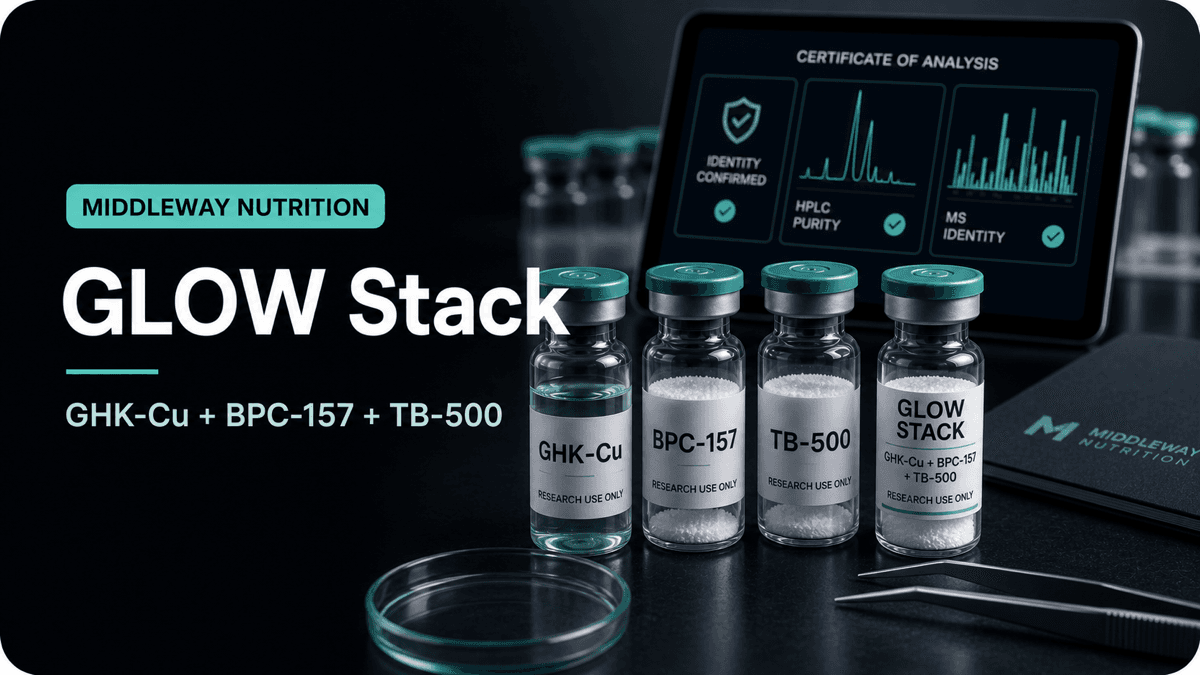
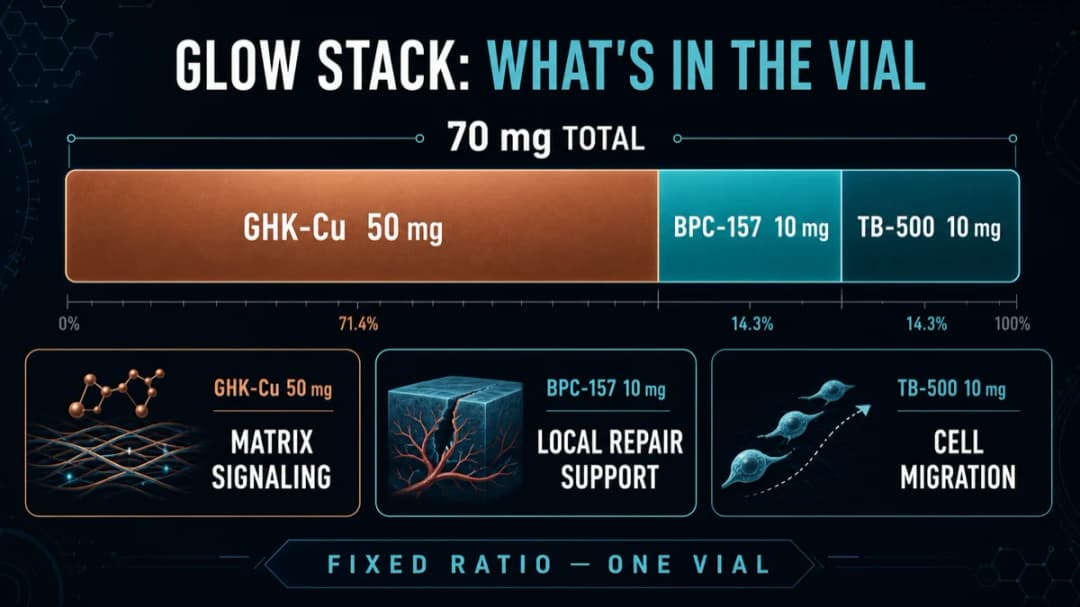
- The commonly sold configuration is 70 mg total: 50 mg GHK-Cu, 10 mg BPC-157, and 10 mg TB-500. GHK-Cu is roughly 71 percent of the blend by mass, which makes GLOW a skin-first formula rather than a balanced repair formula.
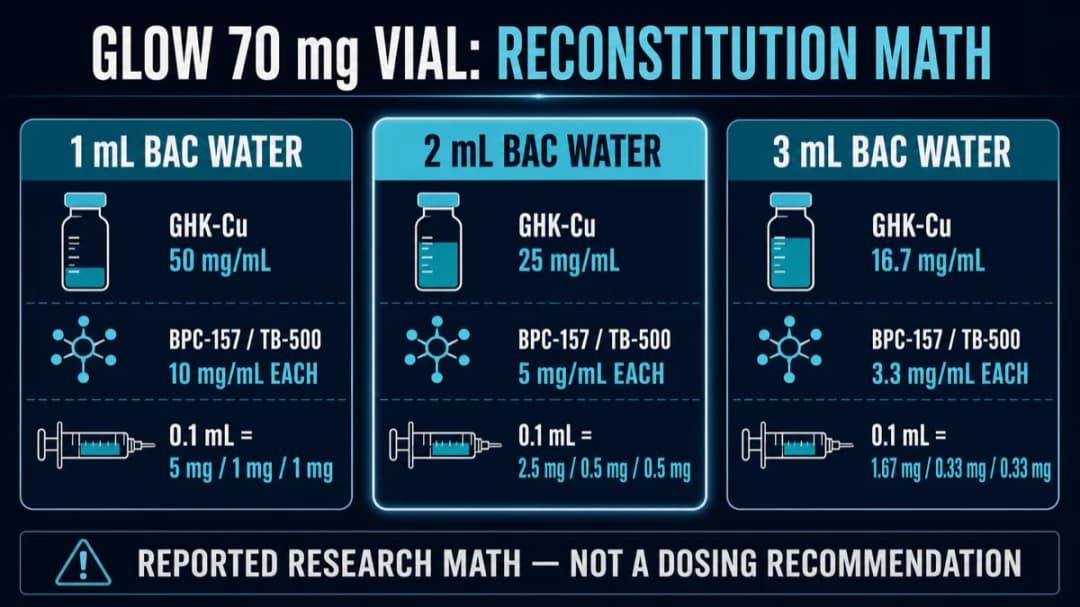
- Reported research handling is 2 mL of bacteriostatic water per vial, yielding 25 mg/mL GHK-Cu, with 0.1 mL to 0.2 mL used three times weekly. That works out to 2.5 mg to 5 mg GHK-Cu and 0.5 mg to 1 mg each of BPC-157 and TB-500 per administration.
- Tolerability reports are dominated by local injection site effects and, for the copper component, transient flushing or a metallic taste. Blend-specific safety data does not exist; everything known comes from the individual peptides.
- None of the three is an approved drug, and a blend makes verification harder because one certificate of analysis has to account for three actives and their ratio.
What Is Actually in a GLOW Vial
GLOW ships as a lyophilized powder, meaning the three peptides are freeze dried together into a single cake that dissolves as one solution. The standard configuration on the research market is 70 mg total peptide content split 50 / 10 / 10.
GHK-Cu is a copper-bound tripeptide, glycyl-L-histidyl-L-lysine complexed to a copper ion. It occurs naturally in human plasma and declines substantially with age, which is the observation that drove interest in supplementing it in the first place. Its research literature is by far the deepest of the three components and concentrates on extracellular matrix remodeling: collagen types I and III, elastin, glycosaminoglycan production, and fibroblast activity. Separate work has looked at what it does to the hair follicle, specifically follicular dimensions and how long the growth phase runs. Our standalone GHK-Cu guide goes further into the dermatological work.
BPC-157 is a 15 amino acid sequence derived from a protein identified in gastric juice. Studied mechanisms include nitric oxide pathway modulation, VEGF-driven angiogenesis, and fibroblast recruitment, largely in soft tissue and gut mucosal repair models. It is the component most people already recognize, and the BPC-157 guide covers what those animal models do and do not establish.
TB-500 is a synthetic fragment of thymosin beta-4. Its central documented action is upregulation of actin, the structural protein that allows cells to migrate. That gives it a broader, more systemic character than BPC-157, which tends to be studied close to the site of an injury.
The logic of the combination is sequential rather than additive. GHK-Cu supplies the structural signal, telling fibroblasts to build matrix. BPC-157 supports the local vascular and inflammatory environment repair depends on. TB-500 moves repair-competent cells into position. Whether the three genuinely potentiate one another has not been tested directly; nobody has compared GLOW against its components administered separately, so any claim of synergy is an inference from mechanism rather than a finding. All three are sold for laboratory research use, and none has an approved human indication or established dosing standard.
GLOW Benefits
Grading the evidence here means splitting it by component and by species, because the quality drops sharply as you move down the list.
Skin matrix and appearance (best supported). GHK-Cu has the strongest case of anything in the vial. Human dermatological work, mostly with topical formulations, has associated it with improved skin density, firmness, and the appearance of fine lines over multi-week use. In cell and tissue models it increases collagen and glycosaminoglycan production and shifts gene expression across a wide set of repair and antioxidant pathways. The honest caveat is that most of the controlled human evidence used creams applied to skin, not injections. Injectable use is an extrapolation, and the assumption that systemic delivery reaches dermal tissue at a useful concentration is reasonable but not demonstrated.
Wound and post-procedure recovery (moderate, mostly preclinical). Both GHK-Cu and BPC-157 have wound healing data, and TB-500's actin mechanism is a plausible contributor. Reports of faster resolution of redness after microneedling or laser resurfacing are consistent with what the mechanisms predict, but they come from user accounts rather than trials. Treat the direction as plausible and the magnitude as unquantified.
Soft tissue and tendon repair (animal data only). BPC-157's tendon and ligament results are extensive in rodents and effectively absent in humans, and TB-500 sits in a similar position. If tissue repair rather than skin is the main interest, note that GLOW carries only 10 mg of each next to a 50 mg copper peptide load.
Hair follicle support (limited but real). Research settings have documented GHK-Cu enlarging the follicle and extending the period it spends actively growing. Reports of reduced shedding on GLOW are common but uncontrolled, and shedding fluctuates seasonally on its own, which makes self-assessment unreliable.
Gut related effects (indirect). BPC-157's mucosal repair data is one of its better studied areas, though at 10 mg per vial spread across many administrations, the per-dose amount is low relative to what gut-focused protocols typically use. If inflammation is the actual target, the four-peptide KLOW peptide stack adds KPV specifically for NF-kB signaling and is the more logical formula.
What the evidence does not support: any claim that GLOW reverses aging, resolves scarring, or works on a fixed timeline. Reported onset spans two to three weeks for subjective changes and eight to twelve for anything structural, and plenty of people report nothing.
GLOW Side Effects
There is no side effect profile for GLOW as a product. No one has run tolerability studies on the blend, so everything below is inherited from the individual peptides plus user reporting, and it should be read as incomplete.
Injection site reactions. The most consistently reported issue across all three components: redness, itching, mild swelling, or a stinging sensation during administration. GHK-Cu solutions are noted for stinging more than most peptides, which is generally attributed to the copper. Site rotation reduces the incidence of persistent lumps or induration.
Copper-related effects. GHK-Cu carries copper into the body, and this is the one respect in which GLOW differs meaningfully from a plain peptide. Reported effects include a metallic taste, transient flushing, and occasional headache or lightheadedness shortly after administration. The theoretical concern with sustained use is copper accumulation and the copper to zinc balance. Nobody has characterized what long-term injectable GHK-Cu does to copper status, which is a real gap rather than a formality, and it is the main reason cycling is conventionally recommended for this blend rather than continuous use.
Nausea and digestive upset. Reported mostly in connection with BPC-157, usually mild and usually early in a protocol.
Fatigue or feeling washed out. Associated with TB-500 in the first week or two of use in user reports. The mechanism is unclear and the reports are inconsistent.
Where the data is genuinely thin. No long-term human safety data exists for any of the three by injection. Effects on people with liver or kidney impairment, hormone-sensitive conditions, or Wilson's disease and other copper metabolism disorders are unstudied, and the copper load makes that last category a specific concern. Interactions with prescription medication are uncharacterized. A blend also removes your ability to isolate a reaction: if something goes wrong, you cannot tell which of the three caused it without stopping everything.
GLOW Dosage Chart
The figures below are the ranges reported in research and community protocols for the standard 70 mg vial. They describe what has been used, not what anyone should use. There is no validated human dose for any component of this blend.
Everything depends on reconstitution volume, since the vial contains a fixed mass and the concentration is whatever you make it.
| Reconstitution | GHK-Cu | BPC-157 / TB-500 | 0.1 mL delivers |
|---|---|---|---|
| 1 mL BAC water | 50 mg/mL | 10 mg/mL each | 5 mg / 1 mg / 1 mg |
| 2 mL BAC water | 25 mg/mL | 5 mg/mL each | 2.5 mg / 0.5 mg / 0.5 mg |
| 3 mL BAC water | 16.7 mg/mL | 3.3 mg/mL each | 1.67 mg / 0.33 mg / 0.33 mg |
Two milliliters is the most commonly reported choice, because it keeps the working dose at a measurable volume on a U-100 insulin syringe without making it uncomfortably large.
| Goal or context | Reported range per administration | Frequency | Typical cycle |
|---|---|---|---|
| Skin, collagen, general anti-aging | 0.1 mL at 2 mL recon (2.5 mg GHK-Cu, 0.5 mg BPC-157, 0.5 mg TB-500) | 3x weekly | 8 to 12 weeks, then 4 to 6 weeks off |
| Post-procedure or injury alongside skin goals | 0.2 mL at 2 mL recon (5 mg GHK-Cu, 1 mg BPC-157, 1 mg TB-500) | 3x weekly | 6 to 8 weeks |
| Lower dose spread daily | 0.1 mL at 3 mL recon (1.67 mg GHK-Cu, 0.33 mg each) | Daily | 4 to 5 weeks per vial |
| Maintenance after a completed cycle | 0.1 mL at 2 mL recon | 2x weekly | Open ended |
Two consequences of that math are worth noting. At 0.1 mL three times weekly a 2 mL vial yields roughly 20 administrations, about seven weeks; at 0.2 mL it is closer to three and a half (10 administrations, about 3.3 weeks). And a daily schedule is not automatically gentler: the daily row above (1.67 mg GHK-Cu, seven times a week) delivers about 11.7 mg GHK-Cu per week, more than the 7.5 mg per week of 0.1 mL three times weekly at 2 mL, though less than the 15 mg per week of 0.2 mL three times weekly.
Cycling is conventional rather than mandatory. The stated reasoning is preservation of response to GHK-Cu; the more defensible reason is the copper load discussed above. Administration is subcutaneous in every reported protocol.
Reconstitution and Storage
Bring the vial to room temperature first and swab the stopper with alcohol. Introduce the bacteriostatic water slowly down the inside wall rather than jetting it onto the powder cake, which is a straightforward way to damage peptide structure. Swirl gently until dissolved; never shake.
GLOW solutions typically look clear to faintly blue-tinged, which comes from the copper in GHK-Cu and is expected. Cloudiness or particles that will not dissolve after a few minutes are a reason to discard rather than troubleshoot. Keep the reconstituted vial refrigerated, label it with the date, and treat roughly 28 days as the outer limit of usable life. Unreconstituted powder is far more stable and keeps for months kept cold and out of light.
Stacking
Documented stacking evidence for GLOW is essentially nonexistent, so this section is about what makes mechanistic sense and what is redundant.
Running GLOW alongside KLOW is the clearest mistake to avoid: KLOW contains the same three peptides plus KPV, so you would be doubling three actives to gain one. Pick the formula whose ratio matches your target and run that alone. If KLOW is the one that matches, our KLOW buyer's guide covers the vial specs worth checking.
Adding standalone BPC-157 is sometimes done when tissue repair is the real objective, on the reasoning that 10 mg spread across a full cycle is a small allocation. That is a defensible argument, but it means you are paying blend prices for a formula weighted toward something you are not primarily after.
Topical GHK-Cu alongside injectable GLOW is reported for scalp and facial applications, and it is the one combination with a coherent rationale, since topical delivery reaches tissue that systemic administration may not concentrate in. It also stacks copper exposure from two routes, which is worth weighing rather than ignoring. For the standalone compound, our GHK-Cu buyer's guide covers vial specs and how to verify what arrives.
GH secretagogues and GLP-1 compounds operate on unrelated pathways, and no interaction with the GLOW components has been described. Absence of documented interaction is not the same as demonstrated safety.
How to Verify What You Buy
A blend is harder to verify than a single peptide, because a certificate of analysis has to establish three identities and the ratio between them, and plenty of documents only confirm total peptide mass. Ask for a batch-specific certificate showing mass spectrometry and HPLC data for each component, check that the batch number on the document matches the vial in your hand, and be skeptical of any certificate without a legible identifier. Our guide to where to buy the GLOW peptide stack covers which suppliers publish per-batch testing and what an inadequate certificate looks like in practice.
Looking for the numbers behind this guide? Our GLOW dosage chart sets label and trial doses beside what Reddit users report taking.
Frequently Asked Questions
What does the GLOW peptide stack do?
It supplies three peptides that act on tissue repair from different angles. GHK-Cu, which makes up most of the blend by mass, signals fibroblasts to produce collagen and other matrix components. BPC-157 supports the local vascular and inflammatory conditions repair depends on. TB-500 promotes the cell migration that moves repair-competent cells into damaged tissue. Skin quality is the application with the most supporting evidence, and most of that evidence is for GHK-Cu specifically rather than the blend.
Is the GLOW peptide stack safe?
There is no basis for calling it safe or unsafe, because no safety studies have been conducted on the blend and long-term human injectable data does not exist for any of its three components. Reported issues are mostly local injection site reactions plus copper-associated effects like metallic taste and flushing. The unstudied questions that matter most are copper accumulation with sustained use and interactions with medication, neither of which has been characterized.
How much GLOW is typically used?
Reported protocols center on reconstituting the 70 mg vial with 2 mL of bacteriostatic water and using 0.1 mL to 0.2 mL three times weekly, delivering 2.5 mg to 5 mg of GHK-Cu with 0.5 mg to 1 mg each of BPC-157 and TB-500. Cycles run eight to twelve weeks with a four to six week break. These are observed ranges from research and community use, not a dosing recommendation, and no validated human dose exists.
Is the GLOW peptide stack legal?
In the United States, the individual peptides are legal to sell and possess for laboratory research purposes. None is an approved drug, none may be lawfully marketed for human use, and blends like GLOW are not FDA reviewed as products. GHK-Cu appears in cosmetic topicals under a separate regulatory pathway, which does not extend to injectable preparations. Rules differ substantially outside the US, and some jurisdictions treat import of research peptides as a customs matter.