This KLOW Peptide Blend Review concludes that the four-compound mix is mechanistically coherent, unusually convenient, and considerably less evidenced than its marketing suggests. The honest verdict of any KLOW Peptide Blend Review has to separate two questions that get merged: whether combining GHK-Cu, BPC-157, TB-500 and KPV makes biological sense, and whether anyone has demonstrated that the combination does anything measurable in humans. The answer to the first is broadly yes. The answer to the second is no, because no controlled trial of this blend exists.
All four are sold as research compounds. None is an approved medicine, and none of the reported results below come from a clinical study of the blend itself.
What is in KLOW
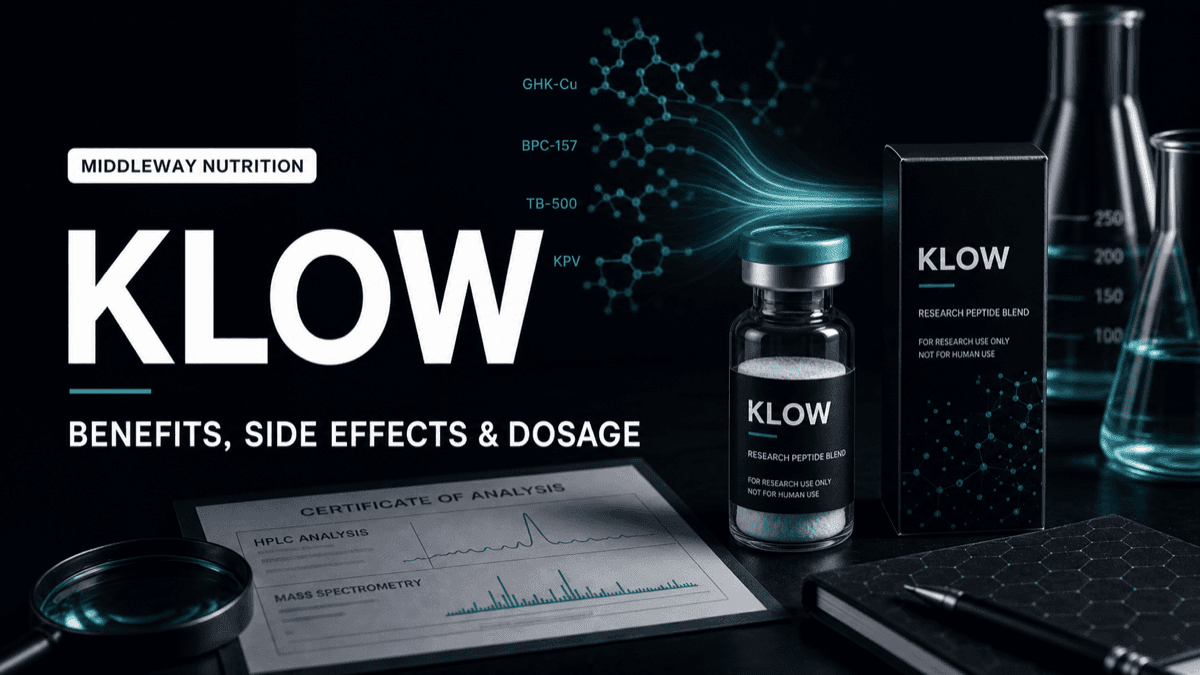
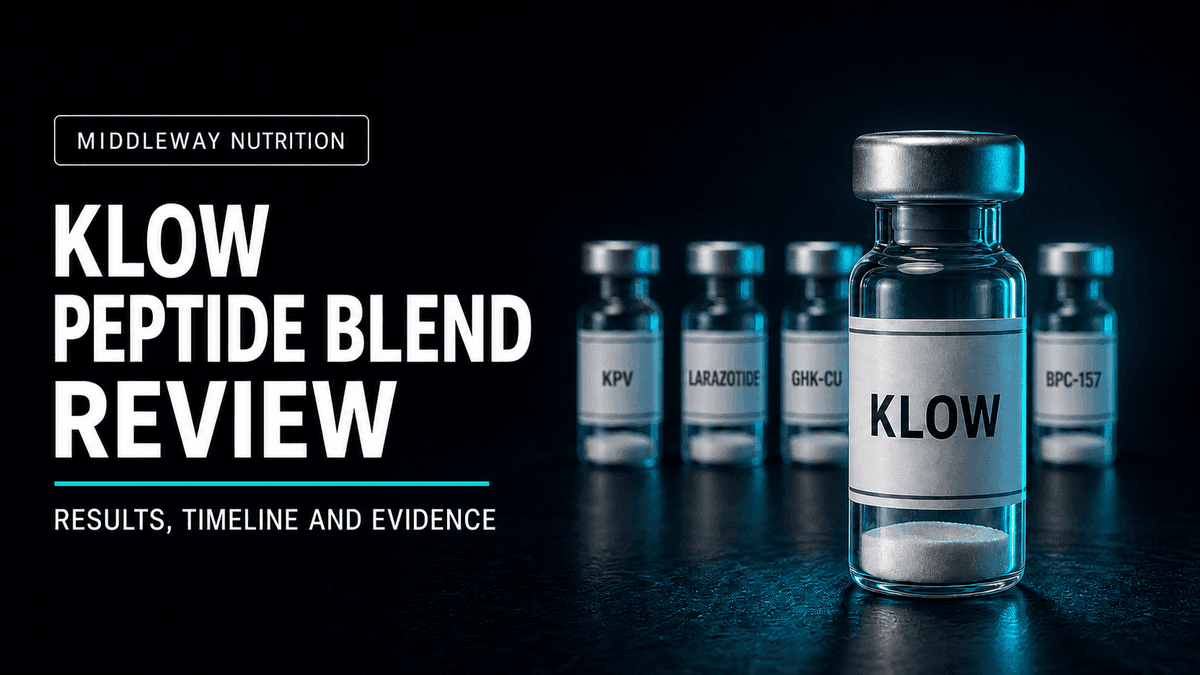
KLOW is a single lyophilised vial containing four peptides, most often in equal amounts. An 80 mg presentation typically means 20 mg of each.
| Component | What it is | Main research focus |
|---|---|---|
| GHK-Cu | Copper-binding tripeptide found in human plasma | Skin remodelling, collagen synthesis, wound repair |
| BPC-157 | 15-amino-acid sequence from gastric juice | Tendon, ligament and gut repair, angiogenesis |
| TB-500 | Synthetic fragment related to thymosin beta-4 | Cell migration, actin dynamics, systemic repair |
| KPV | Tripeptide from the tail end of alpha-MSH | Inflammatory signalling, gut mucosa, skin |
The name is an initialism of the four components rather than a compound in its own right, which is worth knowing before searching for research on "KLOW". There is none. There is research on each ingredient, at varying quality.
KLOW Peptide Blend Review: what results people actually report
There is no trial data, so what follows is a description of what users commonly say, ordered by when they say it happens. Read it as a map of expectations, not as evidence of effect.
| Reported change | Commonly reported window | Which component is credited |
|---|---|---|
| Reduced bloating, calmer digestion | Weeks 1 to 3 | KPV, BPC-157 |
| Less soreness between training sessions | Weeks 2 to 4 | BPC-157, TB-500 |
| Skin texture and tone | Weeks 3 to 6 | GHK-Cu |
| Joint and tendon comfort | Weeks 3 to 8 | BPC-157, TB-500 |
| Scalp and hair density | Weeks 6 to 12 | GHK-Cu |
Two structural problems with these reports deserve stating. First, a blend makes attribution impossible: four compounds change at once, so nothing observed can be traced to any one of them. Second, most people who start a recovery protocol simultaneously change training load, sleep or diet, and those confounders are large relative to any plausible peptide effect.
Evidence quality, component by component
GHK-Cu
The best-evidenced of the four for one narrow purpose: skin. GHK-Cu occurs naturally in human plasma and declines with age. Gene expression work has reported that it shifts the activity of a very large number of human genes, many of them involved in tissue remodelling and collagen production, and cosmetic studies have reported improvements in dermal density, fine lines and elasticity. Those cosmetic studies are typically small and frequently industry-funded, and most tested topical application rather than injection, so applying their percentages to a subcutaneous protocol is not justified. Our GHK-Cu guide covers this in more depth.
BPC-157
Broad, consistent animal data across gut, tendon and muscle injury models, essentially no human outcome data. The gut work is the strongest strand, which is unsurprising given the peptide was isolated from gastric juice. See the BPC-157 guide for where the evidence sits.
TB-500
Here the marketing is often loose. TB-500 is usually described as the active fragment of thymosin beta-4, and the sequence most vendors supply corresponds to the actin-binding region of that protein. Some product descriptions instead name a different, shorter thymosin-derived peptide, and the two are not interchangeable. If you care what you are injecting, check the sequence on the COA rather than the product name. The underlying research on thymosin beta-4 in wound healing is real but does not automatically transfer to a fragment.
KPV
The smallest molecule and, in some ways, the tidiest story: a three-amino-acid tail of alpha-MSH that retains anti-inflammatory activity, studied mainly in models of intestinal inflammation where it appears to dampen NF-kB signalling and inflammatory cytokine output. The work is preclinical. See the KPV guide.
Does the combination logic hold up?
Better than most stacks, yes. The four occupy genuinely different roles: KPV suppresses inflammatory signalling, BPC-157 supports local blood supply, TB-500 supports cell migration, GHK-Cu supports matrix rebuilding. Nothing in that list is redundant.
But mechanistic tidiness is a weak form of evidence. It predicts that a combination should work, it does not show that it does, and combinations frequently underperform the sum of their parts because doses that suit one compound do not suit another. Nobody has tested whether four peptides at a 1:1:1:1 ratio is a sensible ratio. It is a convenient one to manufacture.
The fixed-ratio problem
This is the strongest practical criticism of KLOW and applies regardless of what you think about the individual compounds.
The typical research ranges cited for these four are not equal. BPC-157 is usually discussed in the hundreds of micrograms per day. TB-500 is usually discussed in milligrams, given twice weekly rather than daily. GHK-Cu is used at one to two milligrams daily or topically. KPV sits in the hundreds of micrograms daily.
A single vial at equal ratios and one daily injection cannot reproduce that. Dosing the blend to hit a sensible BPC-157 amount underdoses TB-500 relative to its usual schedule; dosing to hit TB-500 overshoots everything else. Whatever you choose, you are accepting a compromise on at least two of the four. You also cannot stop one component if it disagrees with you, and you cannot cycle anything independently.
For anyone running a structured protocol rather than a convenience protocol, four vials is the technically correct answer, and the Wolverine Stack guide covers the simpler two-compound version of the same idea.
Who the blend actually suits
Being fair to the format: convenience is a real benefit and adherence is a real variable. Someone who would otherwise abandon a four-vial protocol after ten days is better served by one vial they will actually use. A short, fixed, eight-week block where nobody intends to adjust anything is a reasonable fit. So is a first experiment by someone who does not yet want to manage four reconstitutions.
Anyone running longer than twelve weeks, tracking a specific outcome, or wanting to identify which compound is doing what should buy the components separately.
Safety notes worth taking seriously
Reported side effects across these four are mostly mild and local: injection site irritation, occasional nausea, and with GHK-Cu a possible metallic taste or flush shortly after dosing. The more substantive points are structural. No long-term human safety data exists for any of the four. GHK-Cu delivers copper, and copper is not something to accumulate carelessly, particularly for anyone with a copper metabolism disorder. BPC-157 and TB-500 both promote new blood vessel growth, which is a genuine reason for caution in anyone with a current or recent cancer.
FAQ
How long does KLOW take to work?
There is no trial that measures this. Users most often report digestive changes within the first three weeks and skin changes between weeks three and six, with connective tissue changes later. Because a blend changes four variables at once and most people also change their training or diet, these timelines cannot be attributed to the peptides with any confidence.
Is KLOW better than the Wolverine Stack?
It is broader, not necessarily better. The Wolverine Stack is BPC-157 plus TB-500 and is aimed at musculoskeletal repair. KLOW adds skin remodelling and inflammatory control. If your interest is a tendon, the two extra compounds add cost and complexity without addressing the target.
Can I just mix the four peptides myself?
Yes. All four are water soluble and researchers commonly reconstitute them separately and draw more than one into a single syringe. Doing it yourself preserves a certificate of analysis for each compound and lets you set your own ratio, which is the main technical advantage over a pre-mixed vial.
Why can I not find studies on KLOW?
Because KLOW is a product name, not a compound. Research exists on GHK-Cu, BPC-157, TB-500 and KPV individually, mostly in animals or cell culture. No published study has tested the four together in this ratio in humans.
Is KLOW legal?
The four peptides are sold in most jurisdictions as research chemicals rather than as medicines, and none is approved for human use. Rules vary by country and have been tightening, so check your own jurisdiction before ordering anything.