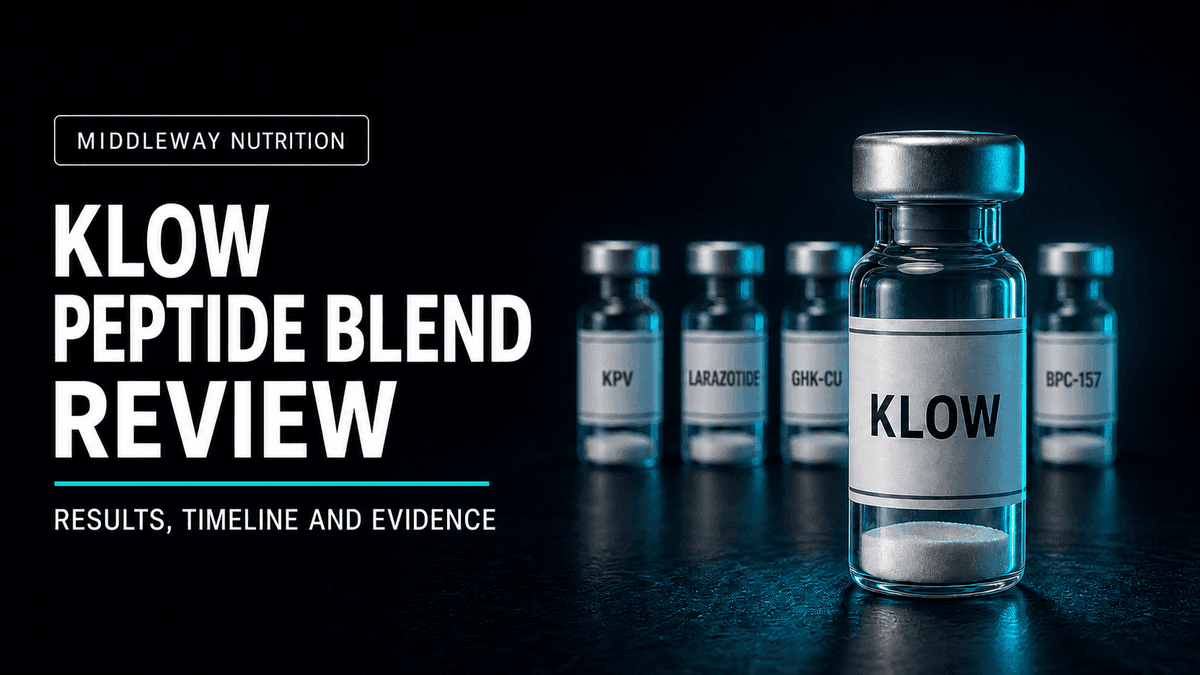
KLOW for sale means one thing in practice: an 80mg blend vial, typically $99 to $200, sold research-use-only. Below is the pricing, the exact mg split, and the certificate checks that separate a real blend from relabeled GHK-Cu.
Key Takeaways
- The standard vial is 80mg total: GHK-Cu 50mg, BPC-157 10mg, TB-500 10mg, KPV 10mg. If a listing will not state the split, walk.
- Realistic 2026 pricing runs roughly $99 to $200 per 80mg vial. Well under that usually means testing was skipped or the blend was cut with the cheap component.
- KLOW is a blend, so one purity number on a certificate proves almost nothing. You need four identities and four quantities from a single lot.
- GHK-Cu gives you a rare physical tell: it is a copper complex and the powder should carry a blue or blue-green tint. Pure white KLOW deserves questions.
- Batch-specific third-party COAs from a named lab, not recycled product PDFs, are the only documentation worth anything.
KLOW price and specs
| Size | 80mg blend vial (GHK-Cu 50mg + BPC-157 10mg + TB-500 10mg + KPV 10mg) |
| Price | Roughly $99 to $200 per 80mg vial across sellers |
| Form | Lyophilized powder, sealed vial |
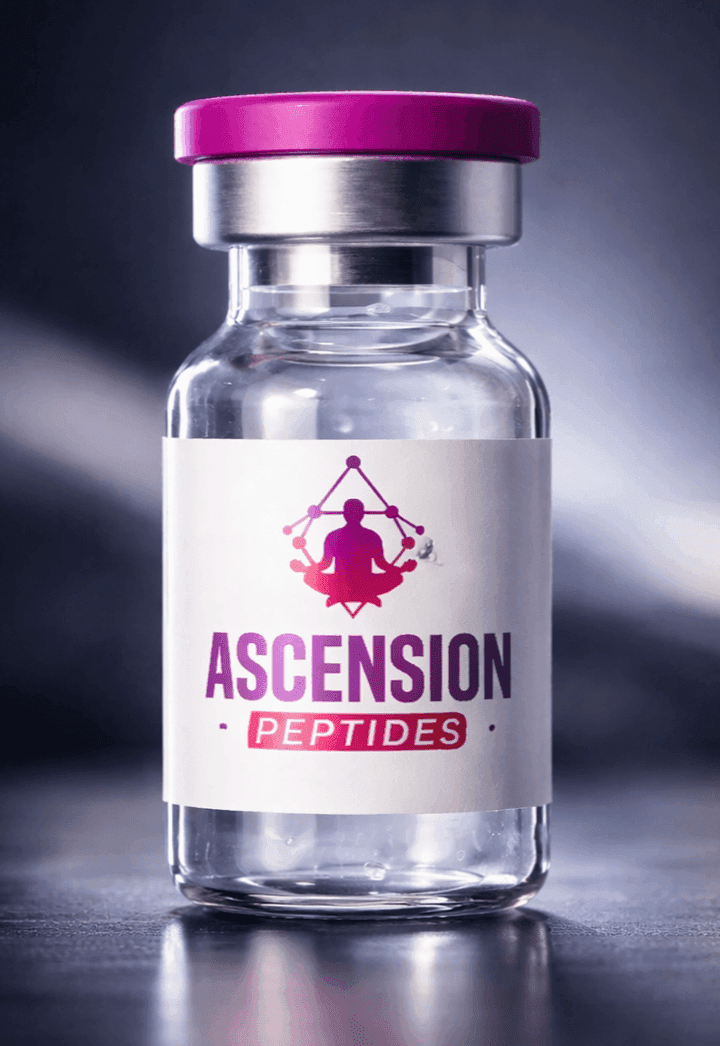
| Our pick | Ascension Peptides KLOW 80mg, $120.00 USD |
What is worth verifying on any listing is the paperwork: lot-specific certificates issued by named outside laboratories, with batch numbers you can match against the vial. On a four-component blend, that documentation discipline is the entire product.
If you want the broader vendor comparison rather than the buying checklist, our companion guide on where to buy KLOW covers sourcing options and pricing across sellers.
Our pick for KLOW: Ascension Peptides
Ascension Peptides is where we would buy KLOW. Its KLOW 80mg is a true four-component KLOW: GHK-Cu 50mg, BPC-157 10mg, TB-500 10mg and KPV 10mg, the full split this page tells you to demand. Ascension lists it at $120.00 USD, as checked on 27 September 2026, and new customers get 50% off with code PEPTIDEDECK. That list price sits toward the lower end of the realistic band below.
The documentation is the reason it gets the pick. Every Ascension batch is independently tested by a third-party lab, currently Kovera Labs, with certificates covering HPLC purity, LC-MS identity, net content (mg per vial), endotoxin, a rapid sterility screen and heavy metals, and a pass mark of >98% purity. Its 85 batch-specific certificates are published in a public certificate library, and we checked one Kovera report (KVR-2026-410047, for DSIP) against the lab's own records: it matched. Run the blend checks below on the certificate for your own lot all the same.
On terms, prices are in US dollars, with 3%, 5% or 10% off when you buy 3, 5 or 10 units and free shipping on orders over $250. Ascension ships within the United States only, and all sales are final, with damaged or incorrect items replaced if reported quickly.
What you are actually buying
KLOW is not a molecule. It is a marketing name for four research peptides freeze-dried together into one vial: GHK-Cu, BPC-157, TB-500 (a thymosin beta-4 fragment), and KPV (a fragment of alpha-MSH). GHK-Cu carries the bulk of the mass; the other three ride along at 10mg each.
Each is studied in preclinical settings around tissue repair, inflammatory signaling, and skin or connective tissue remodeling. None is an FDA-approved drug, and blending them changes nothing about that. What the blend does create is a product that is unusually easy to fake, because a buyer opening a vial of powder cannot count how many peptides are in there.
There is also no chain of custody behind a research chemical listing. A research peptide moves from a contract synthesis lab, often overseas, to a reseller who prints a label. Whether anyone tested it in between is a business decision, not a legal requirement. With a single peptide, a light vial is simply an underdose. With a blend, it can also be a reweighted vial, where the expensive components were quietly reduced and the cheap one made up the mass.
How to read a KLOW certificate of analysis
This is where most buyers get fooled, because a COA looks authoritative whether or not it says anything.
It must be batch-specific. Find a lot number on the certificate and confirm it appears on the vial. A COA with no lot number, or one that does not match what arrives, is a brochure. Vendors hosting a single permanent PDF per product are showing you a batch you will never receive.
It must resolve all four peptides. This is the KLOW-specific trap. A certificate reading "KLOW, 99.2% purity" is close to meaningless. 99% of what? A real HPLC chromatogram for a blend shows four distinct peaks, each attributed to a named component with a quantity. One number for the whole vial means it tested one component, or nothing.
Purity is only half the picture. A working standard of 98% or better per component is achievable, but purity says nothing about fill weight. A vial can be 99% pure by HPLC and still be underfilled, which is why per-component quantities matter as much as percentages. GHK-Cu is a copper-coordinated complex rather than a plain peptide, so it is often reported alongside a copper content figure, which is normal rather than a red flag.
Identity needs mass spec. HPLC tells you how pure a peak is, not that the peak is the peptide you paid for. Mass spectrometry confirms molecular weight and therefore identity, which on a blend means four expected masses.
Third-party testing: independent or it does not count
A manufacturer grading its own homework is not third-party testing. The certificate should name an outside analytical laboratory you can look up and contact. Janoshik Analytical is the name that turns up most often in this market. Some vendors use ISO 17025-accredited labs, a meaningful mark of testing competence.
Three checks take two minutes. Does the lab exist as a contactable entity? Does the report carry its own letterhead, a report number, and a test date? Does that date make sense against the batch date? A certificate dated before the lot was synthesized is fabricated, and a vendor logo pasted over the lab's means the document was edited. Genuine labs confirm report numbers by email.
Pricing sanity check
In 2026, an 80mg KLOW vial from a vendor that actually tests lands roughly in the $99 to $200 band, with most legitimate listings clustering around $130 to $170. Bacteriostatic water adds about $8 to $15. Buying the four peptides individually usually runs $200 to $320 for equivalent quantities, which is the honest reason the blend exists.
A $45 KLOW vial is not a bargain, it is information. Synthesis, purification, lyophilization, and independent testing have floor costs, and a blend multiplies the analytical work by four. When price falls far below the band, something was removed. The usual shortcut is not an empty vial but a vial that is mostly GHK-Cu, the cheapest and heaviest component, with token amounts of BPC-157, TB-500, and KPV. It looks right, weighs right, even carries the blue tint. Only a per-component assay catches it.
What actually arrives
Expect a small sealed glass vial with a crimped aluminum cap holding a lyophilized cake or loose powder, not a liquid. Because GHK-Cu dominates the mass and copper complexes are colored, KLOW powder typically shows a blue to blue-green tint and produces a distinctly blue solution on reconstitution. A stark white vial sold as KLOW is worth questioning.
Store it cold, dark, and dry. Anything pre-mixed is a problem: peptides in water are far less stable, and a mixed vial cannot be checked against a powder COA.
Red flags that mean walk away
- No COA at all, or a COA supplied only after purchase.
- A single purity figure for the whole blend with no per-component breakdown.
- Lot number missing from the certificate, the vial, or both.
- Human dosing protocols or injection instructions on a page that also says "research use only."
- Claims of FDA approval, pharmaceutical grade, or medical grade. None mean anything here.
- Crypto-only or wire-only payment, no refund policy, no physical address, support only on Telegram.
- Pre-reconstituted vials, or a listing that will not disclose the mg split of the four peptides.
Quick pre-purchase checklist
- The listing states the exact mg split of all four peptides.
- A batch-specific COA is viewable before you pay, and its lot number matches the vial.
- Four identified peaks, four quantities, per-component purity reported.
- Mass spec identity data, not purity alone.
- A named, verifiable independent lab with a sane test date.
- Price sits inside the realistic band for an 80mg vial.
- Ships as sealed lyophilized powder, never pre-mixed.
- Real address, card payment, refund policy, and no dosing advice on the page.
Legal and safety reality
In the United States, KLOW's component peptides are not approved drugs and are not legal dietary supplements. They are sold lawfully as research chemicals, and that legality rests entirely on the research-use framing. Marketing them for human use is where sellers get into trouble, which is why the honest ones stay in their lane. Other countries are stricter: several treat unapproved peptides as prescription-only or controlled imports, and customs seizure is a routine outcome. There is no established human safety profile for this combination, no approved dosing, and no clinical oversight, and several of these compounds appear on anti-doping prohibited lists.
FAQ
How much does KLOW cost?
Our pick, Ascension Peptides, lists its four-component KLOW 80mg at $120.00 USD (checked September 2026). The other vendors we found selling a four-component KLOW blend listed it at $135 and $149.99 in July 2026, the latter reduced from $189.99. Bacteriostatic water adds $8 to $15. Buying the four peptides separately typically runs $200 to $320, which is the blend's actual selling point.
Is KLOW legal to buy?
In the US, KLOW's components are not FDA-approved drugs and are not legal supplements, but they can be sold for laboratory research use. Buying research material for that purpose is generally lawful; marketing it for human consumption is not. Rules are tighter elsewhere, and international orders are frequently seized at customs.
How do I know KLOW is real?
Match the vial's lot number to a batch-specific third-party COA, confirm the report shows four separate peaks with individual quantities and mass spec identity for each, then verify the lab exists. The blue-green tint from GHK-Cu is a supporting clue only, since it confirms one of four components.
Do I need a prescription for KLOW?
No, because no prescription exists. KLOW is not an approved medicine anywhere, so no physician can write for it and no pharmacy stocks it. That absence signals the regulatory status rather than a loophole.
Why is some KLOW so cheap?
Usually because the expensive components were cut. GHK-Cu is the cheapest and heaviest ingredient at 50mg of the 80mg total, so a vial can hit the correct fill weight and correct color while carrying almost no BPC-157, TB-500, or KPV. Only a per-component assay from a real lab detects this.
Medical disclaimer: This article is for informational purposes only and describes compounds sold for laboratory research use. It is not medical advice, and nothing here endorses buying or self-administering unapproved substances. KLOW and its components are not FDA-approved drugs. Consult a qualified healthcare professional about any health decision.