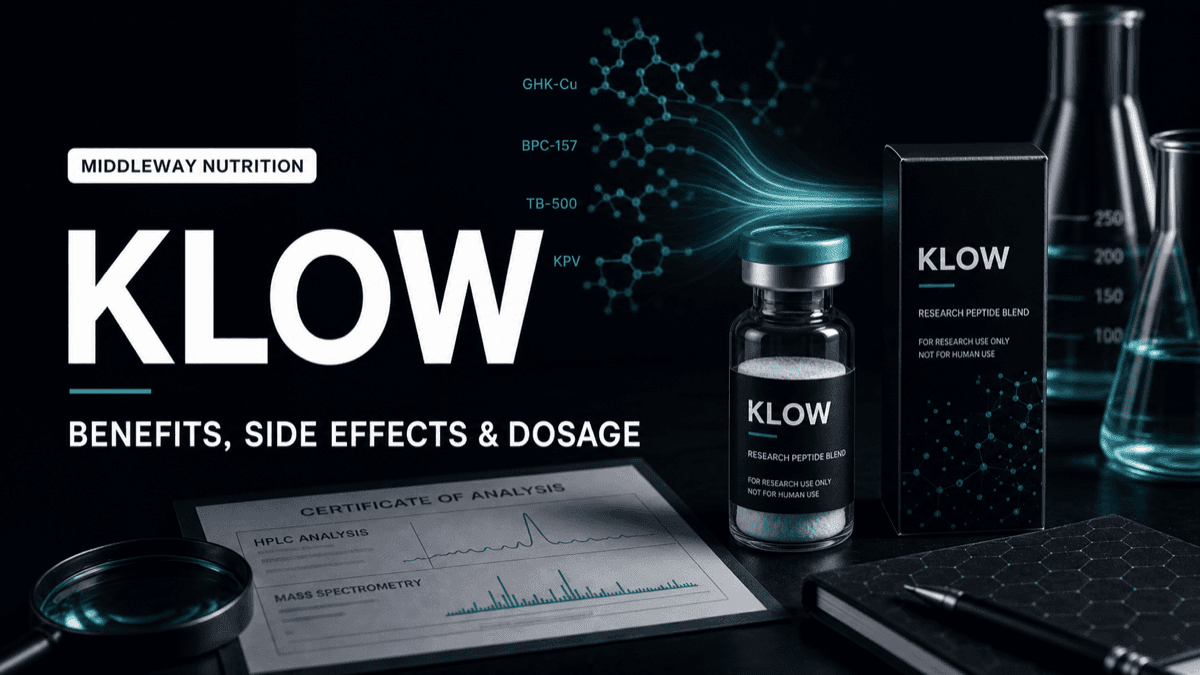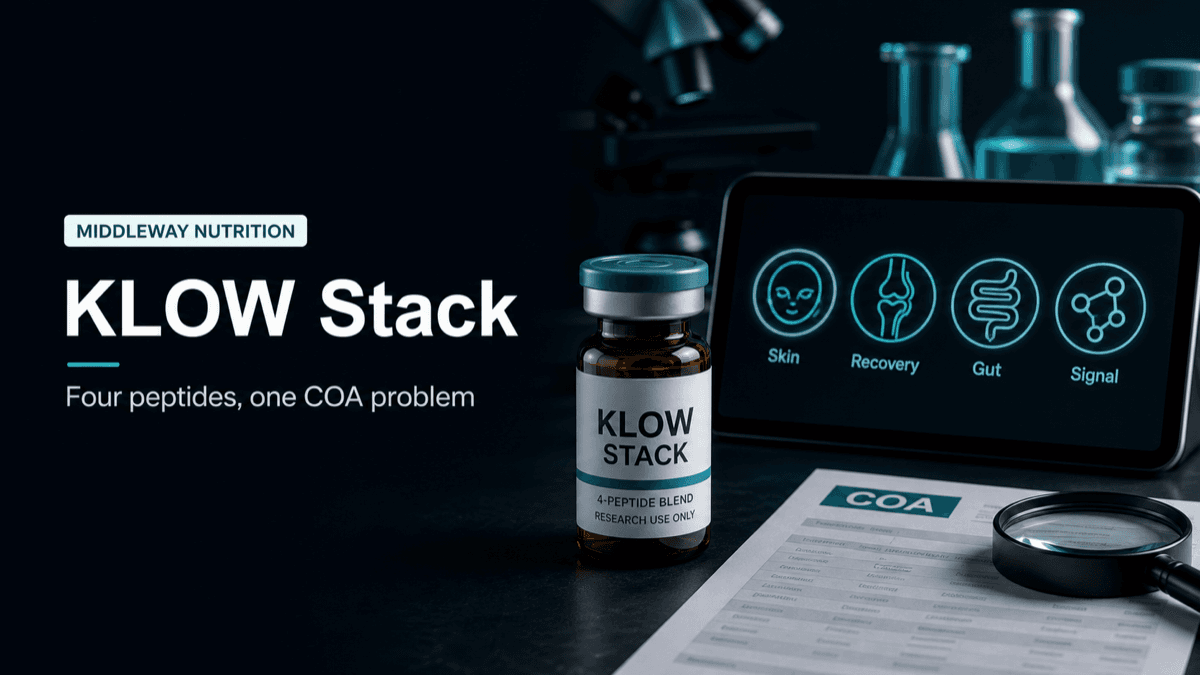
This KLOW dosage chart splits the blend into its four parts, because one number on a syringe is really four doses delivered at once. The usual 80 mg vial holds 50 mg GHK-Cu and 10 mg each of BPC-157, TB-500 and KPV. Below you get the per-peptide amounts, what published studies actually used, and what Reddit users say they inject. None of it is a prescription, since no regulator has approved a dose for any of the four.
Key Takeaways
- An 80 mg KLOW vial is 50/10/10/10 mg of GHK-Cu, BPC-157, TB-500 and KPV. Because the ratio is fixed, one volume sets all four doses together
- With 3 mL of water, 12 units on a U-100 syringe is 3.2 mg of blend: 2.0 mg GHK-Cu and 400 mcg of each of the other three. 15 units is 2.5 mg and 500 mcg
- In 14 Reddit comments that stated a dose, 8 reported about 2.5 mg of GHK-Cu per injection and 5 reported about 2.0 mg. That is a small, self-selected sample, not a recommendation
- No study has tested this blend or this ratio in people or animals. Each ingredient has its own evidence, mostly by a different route than injection
- None of the four is an approved drug. Treat every chart, including this one, as arithmetic and anecdote, and read the label on your own vial
For what KLOW is and how its claimed benefits are graded, see our KLOW peptide guide. This page is the dose-focused companion.
KLOW dosage chart: what is in the vial and what each peptide gets
Start with the table, because it answers the question most people arrive with: what does one injection of this blend actually contain? The answer depends on the vial ratio and how much water you added.
KLOW 80 mg vial: what each peptide gets per injection
| In the vial | 12 units (3 mL) | 15 units (3 mL) | Published human data | |
|---|---|---|---|---|
| GHK-Cu | 50 mg (62.5%) | 2.0 mg | 2.5 mg | Small topical cosmetic trials; no injection dose-finding found |
| BPC-157 | 10 mg (12.5%) | 400 mcg | 500 mcg | Three pilots; clinic doses of 10 to 20 mg |
| TB-500 | 10 mg (12.5%) | 400 mcg | 500 mcg | None for the fragment; full-length thymosin beta-4 given IV |
| KPV | 10 mg (12.5%) | 400 mcg | 500 mcg | None found; mouse colitis work only |
| Blend total | 80 mg | 3.2 mg | 4.0 mg | No trial of the blend |
Read the shares first. Nearly two thirds of the powder is GHK-Cu, and the other three split the rest evenly. That is why the GHK-Cu figure looks large next to the others and why people argue about which peptide to dose "off". Our KLOW peptide blend review covers how vendors compare on this vial.
What a KLOW vial really contains
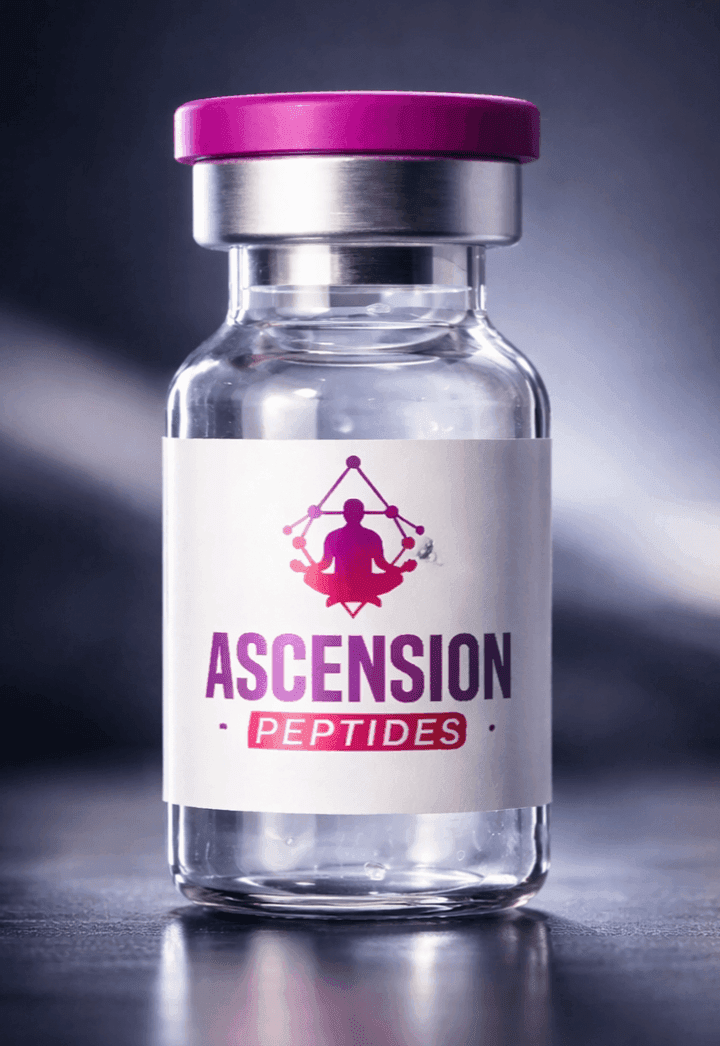
KLOW is a name, not a formulation. Nobody controls the name, so the contents are whatever a seller puts under that label. The 80 mg, 50/10/10/10 split above matches the current Ascension Peptides listing (GHK-Cu 50 mg, BPC-157 10 mg, TB-500 10 mg, KPV 10 mg) and the vial described in our existing guide. Most Reddit commenters described the same vial.
But the ratio is not universal. A r/peptidefaqs poster (Oct 2026) said ratios differ between sellers and that some listings add a fifth peptide, larazotide, under the same name. One r/BodyHackGuide poster (Jul 2026) said their bottle had a ratio they had not seen at other retailers. Another commenter on r/Peptidesource (Jul 2025) calculated from a vial that totalled 86.54 mg on its label. These are unverified claims, but they point at a real rule: use the amounts printed on your certificate, not the typical split. If your vial is not 50/10/10/10, every number on this page needs recomputing with the formula further down.
Some people build KLOW themselves by adding a separate 10 mg KPV vial to a 70 mg GLOW vial, which adds a transfer step and a chance of error. Our GLOW vs KLOW comparison explains what the extra KPV changes.
What published studies used for each peptide
The honest way to read a KLOW dosage chart is one ingredient at a time. Here is what the literature supports, which is less than most charts imply.
BPC-157. There is no approved dose. The human record is three pilots: an intravenous safety study in two people given 10 mg and then 20 mg in saline (PMID 40131143), a 12-woman bladder study using 10 mg injected around inflamed tissue in one cystoscopy (PMID 39325560), and a knee report. A 2025 systematic review found 36 studies, 35 of them preclinical (PMID 40756949). Those clinic doses are an order of magnitude above the 400 to 500 mcg that a KLOW injection delivers, and they were single procedures, not daily self-injection. Per-kilogram animal dosing is covered in our BPC-157 dosage chart.
TB-500. TB-500 is not the full thymosin beta-4 protein. Mass spectrometry work identified the product as the acetylated 17-23 fragment, Ac-LKKTETQ (PMID 22962027). The best human safety data is for the full-length synthetic protein: a placebo-controlled study in healthy volunteers gave it intravenously in ascending doses from 42 to 1,260 mg, then daily for 14 days, and reported infrequent mild or moderate adverse events and no serious ones (PMID 20536472). That says something about the parent protein by infusion, and nothing certain about a fragment injected under the skin. The "2 mg twice weekly" schedule that circulates for TB-500 has no source in what I found.
GHK-Cu. A 2026 systematic review noted that human randomized trials of GHK-Cu are small and mostly on facial cosmetic creams (PMID 42787770). I found no dose-finding study of subcutaneous GHK-Cu. The 1 to 2 mg daily range in our existing guide is community and vendor convention. A dedicated GHK-Cu dosage chart goes deeper.
KPV. The animal work I could verify is mouse colitis research in which KPV was packaged into a nanoparticle designed to ride the PepT1 transporter (PMID 39211778), and PepT1 is known to be switched on in inflamed colon (PMID 22194420). A r/peptidefaqs poster argued that this means KPV results belong partly to the delivery system, and that injecting it skips that mechanism. The poster's knock-out mouse claim is not something I could confirm, but the nanoparticle design is real. I found no human dosing data.
Why published KLOW numbers are hollow
A r/peptidefaqs post from October 2026 put the problem bluntly: every chart divides the vial mass by the water volume, then across syringe marks. The arithmetic is correct, but the dose it is multiplied by could not be traced to any study. I agree with that reading. The competing charts I read step up from 250 to 750 mcg of each peptide over 12 weeks, and at least one contradicts itself on cycle length (4 to 6 weeks in one section, 12 in another). None cites a source for the progression.
The fixed ratio creates a second problem that no chart can fix. The four peptides are usually discussed on different schedules: BPC-157 daily, TB-500 once or twice a week. A daily injection of 12 units delivers 2.8 mg of TB-500 a week, and 15 units delivers 3.5 mg. Dosing 12 units five days a week lands at 2.0 mg of TB-500 a week, which happens to match the circulating convention. The blend trades a precise schedule for convenience.
What Reddit users report taking
I read 189 posts and comments from nine subreddits, mostly r/BodyHackGuide, r/NTNPerformance and r/Peptidesource, covering 23 threads from June 2025 to October 2026. After removing bot welcome messages, deleted comments, vendor-style review posts, questions, and replies about other compounds, 14 comments in 6 threads stated the amount they use themselves. That is a small, self-selected, unverified sample from people who chose to post.
Here is how those 14 distribute by GHK-Cu per injection. Most described a 3 mL reconstitution and a volume in units.
GHK-Cu per injection reported in 14 Reddit comments (KLOW 80 mg vials)
Eight commenters landed on about 2.5 mg of GHK-Cu: 15 units on 3 mL, or 10 units on 2 mL. Five landed on about 2.0 mg, which is 12 units on 3 mL. Six said they inject every day, usually at night, and three said they run five days on and two off. One described a two-week loading phase at 8 mg of blend, then 4 mg for ten weeks. Durations were rough: 4 to 6 weeks, about 50 days then a three-week break, 12 weeks, 12 to 16 weeks on then 4 to 8 off, and one person who ran 16 weeks.
The quality of advice varied. An upvoted reply to a poster who had asked a chatbot for a dose said "Please don't do dosing from ChatGPT." (a r/Peptidesource commenter, Jun 2025). The chatbot figure under discussion was 10 to 20 mg a day, which is five to ten times what the people who answered actually inject. The same replier described 2 mg GHK-Cu with 400 mcg of the others and claimed this ratio reduced injection-site reactions. I found nothing to back that.
On results, the data is thin and mixed. One r/Biohacking commenter (Sep 2026) wrote "I didn’t really notice a difference on Klow until like the 12th week so I ran it 16 weeks" (link). A r/BodyHackGuide commenter who tried 25 units said "No side effects or anything noticeable just throwing money out the window. KLOW is expensive." (a r/BodyHackGuide commenter, Mar 2026). That 25-unit report works out to about 4 mg of GHK-Cu and is the outlier on the chart. Silence about harm from one person is not a safety result. An elderly commenter claimed an elbow healed in five days on a daily "80 mg" of KLOW, which confuses the vial size with a dose; I excluded it.
Others reported no change in a stubborn tennis elbow after months of KLOW or BPC-157 plus TB-500, so read fast-result stories alongside those.
Reconstitution math: mg, mL and syringe units
Most KLOW threads are really reconstitution threads, and the commonest slip is dividing by the wrong number. The vial holds a fixed mass. Water changes concentration, not total mass.
The formula for any component is: dose = (component mg in the vial ÷ water in mL) × (units ÷ 100). A worked example with 3 mL: GHK-Cu is 50 mg ÷ 3 mL = 16.67 mg/mL, and 12 units is 0.12 mL, so 16.67 × 0.12 = 2.0 mg. BPC-157 is 10 ÷ 3 = 3.33 mg/mL, and 0.12 mL gives 0.4 mg, or 400 mcg. KPV and TB-500 work out the same way. Total blend is 80 ÷ 3 = 26.67 mg/mL, so each unit carries 0.267 mg of blend.
Syringe units to dose, by water volume (80 mg vial, 50/10/10/10)
| 8 units | 10 units | 12 units | 15 units | |
|---|---|---|---|---|
| 3 mL: GHK-Cu per dose | 1.3 mg | 1.7 mg | 2.0 mg | 2.5 mg |
| 3 mL: each other peptide | 267 mcg | 333 mcg | 400 mcg | 500 mcg |
| 3 mL: doses per vial | 37 | 30 | 25 | 20 |
| 2 mL: GHK-Cu per dose | 2.0 mg | 2.5 mg | 3.0 mg | 3.75 mg |
| 2 mL: each other peptide | 400 mcg | 500 mcg | 600 mcg | 750 mcg |
| 2 mL: doses per vial | 25 | 20 | 16 | 13 |
Two Reddit mistakes are worth naming. One commenter wrote that they drew 1.5 units a day on 3 mL; a reply pointed out that would give 200 doses and they meant 15. And a r/BodyHackGuide thread disagreed on whether to calculate from the 80 mg total or from GHK-Cu. Anchoring to GHK-Cu is right, because it sets the other three automatically, while treating 80 mg as one peptide gives wrong answers.
A 3 mL reconstitution of the 80 mg vial gives 300 units, so 12 units a day lasts 25 days and 15 units lasts 20. Five days a week at 12 units stretches one vial to about five weeks. If you want a single supplier to check against, Ascension Peptides lists the KLOW 80 mg vial at $120.00 as of 2026-10-11 (the page shows a list price of $199.99), or $1.50 per mg. Kovera Labs tests every batch (HPLC, LC-MS identity, net content, endotoxin, sterility and heavy metals), more than 98 percent of tested batches pass, and batch certificates are public. Prices are in US dollars, shipping is US only and all sales are final. New customers can use code PEPTIDEDECK for 50 percent off. It is a research chemical, labeled not for human use.
Timing, frequency and cycle length
No study defines a KLOW schedule, so this section reports habits. Timing in Reddit comments was mostly evening, before sleep on an empty stomach, though one user injects first thing in the morning fasted. Nobody gave a reason beyond preference. Frequency was daily for most and five days a week for a minority, and the 5-on, 2-off pattern is described by one commenter as mainly a way to stretch an expensive vial. Another commenter noted that tesamorelin was dosed daily in trials, so weekends off look like convention.

Cycle length is the weakest area. The numbers above range from 4 to 16 weeks, and the rest period from three weeks to eight. There is no data on repeated cycles, so treat the 12-week, 4-week-off pattern that many charts print as a custom, not a finding.
What changes the dose
Reconstitution volume. The same 12 units is 2.0 mg of GHK-Cu on 3 mL and 3.0 mg on 2 mL. This is the single biggest source of confusion, and it is why two people who both say "12 units" may take different amounts.
Vial ratio and purity. Everything above assumes 50/10/10/10 and a full fill. If the vial is underfilled or the ratio differs, so does the dose. A batch certificate with net peptide content is the only way to know. Our guide on where to buy KLOW and the KLOW for sale page explain what to look for.
Which peptide you anchor to. Dosing off GHK-Cu gives BPC-157, TB-500 and KPV at one fifth of the GHK-Cu figure. Dosing off BPC-157 at 500 mcg gives 2.5 mg of GHK-Cu. You cannot tune one without moving the others, which is the price of a blend.
Sensitivity to copper. For the documented and reported adverse effects, see our KLOW side effects page.
Other peptides. Several users stack KLOW with tesamorelin, retatrutide or CJC/ipamorelin. One mixed up KLOW amounts, which are quoted as blend totals, with CJC/ipamorelin amounts, which are quoted per peptide.
Frequently Asked Questions
What is the KLOW dosage?
There is no established dosage for KLOW or for any of its four components. Published human data are small pilots and creams, and nothing tests the blend. On Reddit, the commonest amounts were about 2.0 to 2.5 mg of GHK-Cu with 400 to 500 mcg of each of the other three per injection, which is 12 to 15 units on a 3 mL reconstitution.
How many units of KLOW is 2 mg?
It depends on the water. For an 80 mg vial in 3 mL, 12 units is 2.0 mg of GHK-Cu (and 400 mcg of each other peptide). In 2 mL, 8 units gives the same 2.0 mg. If you mean 2 mg of total blend, that is 7.5 units on 3 mL.
How long does an 80 mg KLOW vial last?
With 3 mL of water the vial holds 300 units. At 12 units a day that is 25 days, and at 15 units it is 20 days. Dosing five days a week at 12 units makes it last about 35 days.
How do you reconstitute KLOW?
Reddit users most often added 3 mL of bacteriostatic water, with 2 mL second. The volume changes the units, not the total mass, so recompute each time and follow the vendor's and a clinician's guidance on storage.
Is KLOW FDA-approved?
No. KLOW is a research blend of four unapproved peptides. BPC-157 is described in recent papers as not approved, and TB-500 appears on the WADA prohibited list under S2 for tested athletes. I did not check FDA databases for KPV or GHK-Cu injectables, so I cannot say more about them.
Checking a vial before you do any math
The calculations above assume the label is true. Ascension Peptides lists the KLOW 80 mg vial at $120.00 as of 2026-10-11, with per-batch Kovera Labs testing and public batch certificates; US shipping only and all sales are final. Write units out in full, check your arithmetic twice, and treat every Reddit number here as an anecdote.
Medical Disclaimer: KLOW is a blend of investigational research peptides. None of its components is approved by the FDA or a comparable regulator for any condition, and it is sold for laboratory research use only. This article reports published and user-reported figures for education. It is not medical advice, a dosing protocol or a recommendation for personal use. Consult a qualified healthcare professional about any health concern.