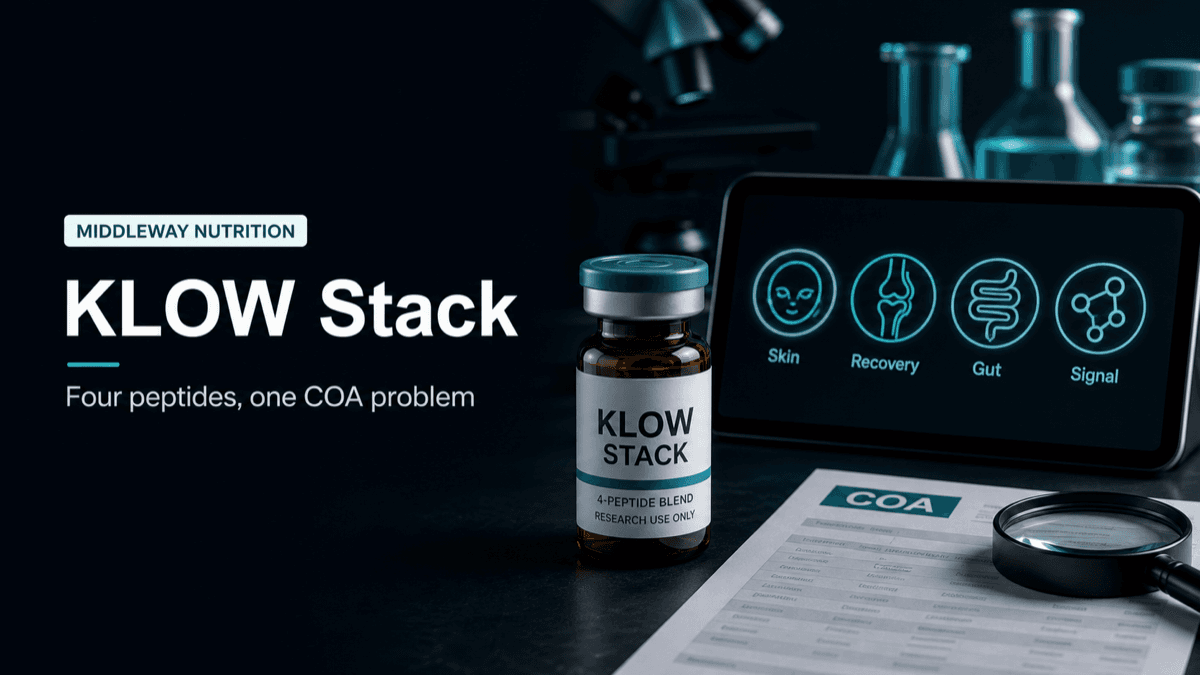
KLOW packs four of the most-researched recovery peptides into a single 80mg vial — GHK-Cu, BPC-157, TB-500, and KPV. That convenience is exactly why the market around it is so messy. A "four-in-one" label is easy to print and hard to verify, and plenty of sellers are counting on you not to check.
If you've been searching where to buy KLOW, this guide skips the hype and gives you what actually matters: where the blend is realistically sold in 2026, how to read a certificate of analysis so you know what's in the vial, what fair pricing looks like, and the red flags that separate a legitimate vendor from a relabeled scam. KLOW is sold as a research peptide blend, not an FDA-approved drug, so vetting the source is the entire game.
Key Takeaways
- KLOW is a research-use peptide blend, not an FDA-approved medicine. There is no prescription pathway and no pharmacy shelf for it — every legitimate source is a research-chemical vendor.
- No single vendor owns this blend, so judge every seller against the same bar: a batch-specific third-party COA covering all four peptides, ≥98% HPLC purity per component, real stock, and US domestic shipping.
- A blend complicates testing. A real COA verifies identity and purity for each of the four peptides, not a single combined number. Demand a lot-specific certificate.
- Expect to pay roughly $99–$200 for a quality 80mg vial. Buying the four peptides separately usually runs $200–$320, which is why the blend exists.
- Price is a weak signal for quality. The cheapest vials are usually where testing got skipped.
Our Pick: Ascension Peptides
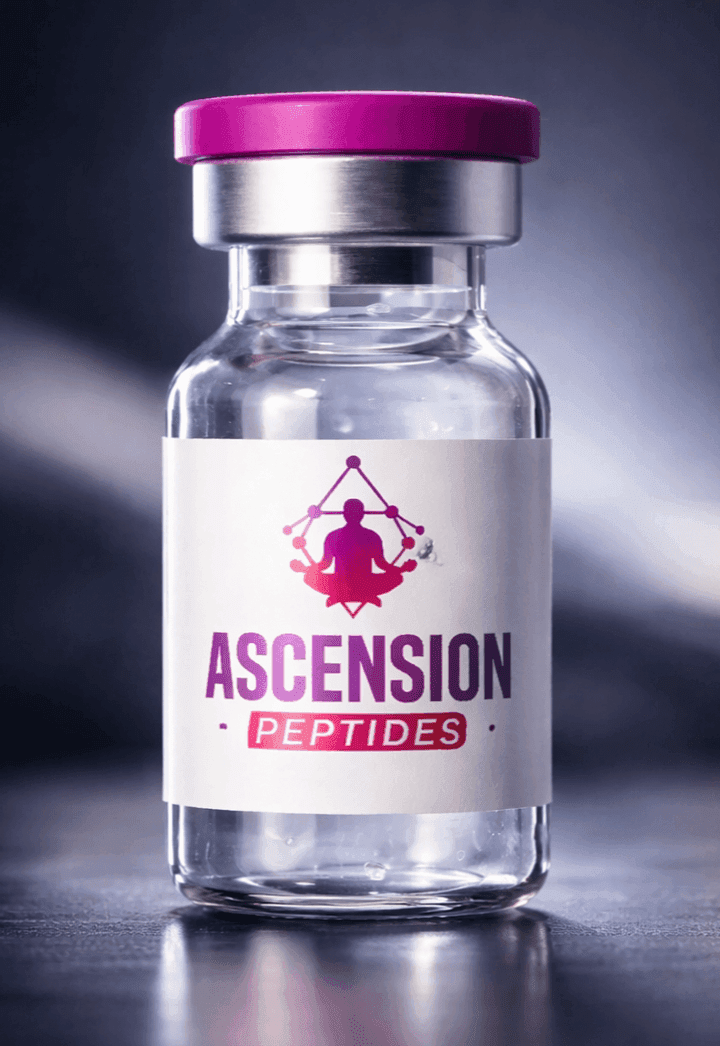
Ascension Peptides is our #1 pick for KLOW. It lists the blend as GHK-Cu 50mg + BPC-157 10mg + TB-500 10mg + KPV 10mg (KLOW 80mg) at $120.00 USD.
- Independent testing on every batch. Current batches are tested by Kovera Labs (older batches by MZ Biolabs), with certificates covering HPLC purity, LC-MS identity, net content per vial, endotoxin, a rapid sterility screen and heavy metals (lead, arsenic, cadmium, mercury).
- A purity bar you can check. The certificate pass mark is >98% purity, and recent batches tested between 98.9% and 99.9%.
- Public certificates. 85 batch-specific certificates sit in a public COA library. We checked one Kovera report against the lab's own records, and it matched.
- Pricing, shipping and returns. Prices are in USD, with 3% / 5% / 10% off when you buy 3 / 5 / 10 units. Ascension ships within the United States only, with free shipping on orders over $250. All sales are final; damaged or incorrect items are replaced if reported quickly.
- Discount. Code PEPTIDEDECK gives new customers 50% off.
A blend still needs checking at the lot level, so confirm that the certificate for your lot reports each of the four components before you pay. The vendor checklist further down applies to Ascension too.
What KLOW Actually Is
KLOW isn't a single molecule — it's a stack of four peptides combined into one lyophilized (freeze-dried) vial, marketed around skin, tissue repair, and recovery research. The standard formulation is GHK-Cu 50mg, BPC-157 10mg, TB-500 10mg, and KPV 10mg, for 80mg total. Here's what each component is, framed honestly:
- GHK-Cu (50mg) — a naturally occurring copper-binding tripeptide. It's the bulk of the blend and the most-studied of the four for skin remodeling, collagen signaling, and hair-follicle research. If you want the deeper background, our guides on GHK-Cu for skin and hair and GHK-Cu capsules cover the research context.
- BPC-157 (10mg) — a synthetic "body protection compound" peptide derived from a sequence found in gastric juice. It's studied primarily in animal models for tendon, gut, and soft-tissue repair signaling.
- TB-500 (10mg) — a synthetic fragment related to thymosin beta-4, researched for cell migration, angiogenesis, and tissue-repair pathways. BPC-157 and TB-500 are the classic recovery pairing — the same two peptides in the Wolverine Stack.
- KPV (10mg) — a tripeptide fragment of alpha-MSH, studied mainly for anti-inflammatory and gut-signaling research.
None of these are approved drugs in the United States. They are sold for laboratory and research use only, and that framing matters for everything below.
What the FDA Says About KLOW's Four Peptides
Before any vendor comparison, it's worth knowing that all four of KLOW's components have already been through FDA review as candidate compounding ingredients, and none of them came out of it approved for that use.
Under the agency's interim policies for bulk drug substances nominated for pharmacy compounding, FDA sorts nominations into categories. Category 2 is the bucket for substances that "may present significant safety risks." GHK-Cu (injectable routes), BPC-157, TB-500, and KPV were all placed in category 2, and all four nominations were later withdrawn by the nominators. Withdrawn means the review ended without the substance being added to the compounding lists — not that the concerns were answered.
Here is what FDA actually recorded for each, in its own terms:
| Component | FDA's stated concern |
|---|---|
| GHK-Cu (injectable routes) | Immunogenicity risk from potential aggregation and peptide-related impurities; "limited data in humans to inform safety-related considerations" |
| BPC-157 | Immunogenicity risk for certain routes; complexities around peptide-related impurities and API characterization; no or only limited safety information, so the agency "lacks sufficient information to know whether the drug would cause harm when administered to humans" |
| TB-500 (thymosin beta-4 fragment, LKKTETQ) | Immunogenicity risk from potential aggregation and peptide-related impurities; no human exposure data identified |
| KPV | No human exposure data identified by any route; FDA "lacks important information regarding any safety issues raised by KPV" |
Two things follow from this, and both matter while you're choosing a vendor.
First, the phrase that keeps repeating is no human exposure data. This isn't a compound with a known risk profile you can weigh against a known benefit. For KPV and TB-500 especially, the regulator's recorded position is that it does not have the information to say what happens when a person is exposed at all. KLOW stacks four of those unknowns into one vial, and FDA's review looked at these as four separate substances, never as the blend a KLOW vendor sells them in.
Second, the specific technical problems FDA names — aggregation and peptide-related impurities — are not what a purity percentage measures. Hold on to that when you reach the COA section below, because a clean certificate and a safe product are two different claims.
Where to Buy KLOW in 2026
There is no pharmacy counter for KLOW, no insurance pathway, and no telehealth prescription for the blend as a unit. Whether you search where to buy KLOW or KLOW for sale, the results resolve to the same single channel. Realistically, you have one channel: research-peptide vendors that sell it as a "research use only" product. Within that channel, quality ranges from genuinely excellent to outright fraudulent, so the decision isn't where the category is — it's which vendor you trust.
The vendors worth your money share a short list of habits. They publish batch-specific COAs that verify all four peptides, not a vague single figure. They source from real synthesis labs and send each lot to an independent testing facility. They keep stock instead of running on perpetual backorder, ship domestically so your vial doesn't sit in customs, and they don't dress up research chemicals with human dosing protocols.
That last point is the cleanest tell. A vendor that lists KLOW "for research use only" on one line and tells you how to inject it "for healing" on the next is talking out of both sides of its mouth. The good ones stay in their lane.
What to Demand From Any KLOW Vendor
Ascension Peptides is our pick, but the blend market rotates stock and suppliers faster than any recommendation stays true, and the one document that actually settles the question — per-component testing on your lot — is the thing sellers are quietest about. So alongside a name, here is the bar. Hold every vendor in the table below to all four points before you pay, our pick included.
Batch-specific testing. Insist on lot-specific COAs from an independent lab rather than a generic, recycled product certificate. With a blend, this is non-negotiable: you want each component identified and quantified, not a single "80mg, ≥99%" line that tells you nothing about the ratio inside.
Purity standards. Look for ≥98% by HPLC on each of the four peptides. Cheaper blends often hover lower, and in a stack that gap can mean a component is underdosed or partly degraded before it ever reaches you.
In-stock, US domestic shipping. Supply gaps are chronic in this market. A vendor holding real inventory with clear stock status and domestic dispatch gets your vial to you in days, not weeks; perpetual backorder is its own answer.
Transparent sourcing. A good vendor is upfront about where material comes from and how it's handled, with no vague "pharmaceutical grade" claims that have no documentation behind them.
Ask for the current lot's certificate before you order. A vendor that can't produce one in a day has told you what you needed to know. For context on where we spend our own money: Ascension Peptides is the source we use for the individual peptides it stocks, and it does list KLOW (GHK-Cu 50mg + BPC-157 10mg + TB-500 10mg + KPV 10mg, 80mg) at $120.00 USD. Every batch is tested by an independent lab and the certificates are published in a public COA library, but hold its KLOW lot to the same per-component bar as anyone else's.
How to Verify KLOW Quality: The COA Deep-Dive
Most guides tell you to "look for third-party testing" and stop there. With a blend, that advice is incomplete, because a single combined number can hide a lot.
Batch-specific vs. product-level COAs
A product-level COA covers a product line and may have been tested months ago on a different run. Some vendors reuse the same PDF indefinitely. A batch-specific COA references the exact lot number printed on your vial, with a testing date and results that correspond to what you actually received. Match the lot number on the vial to the lot number on the certificate. If they don't match, or the vendor can't provide a lot-specific document, walk away.
The blend problem: verify all four
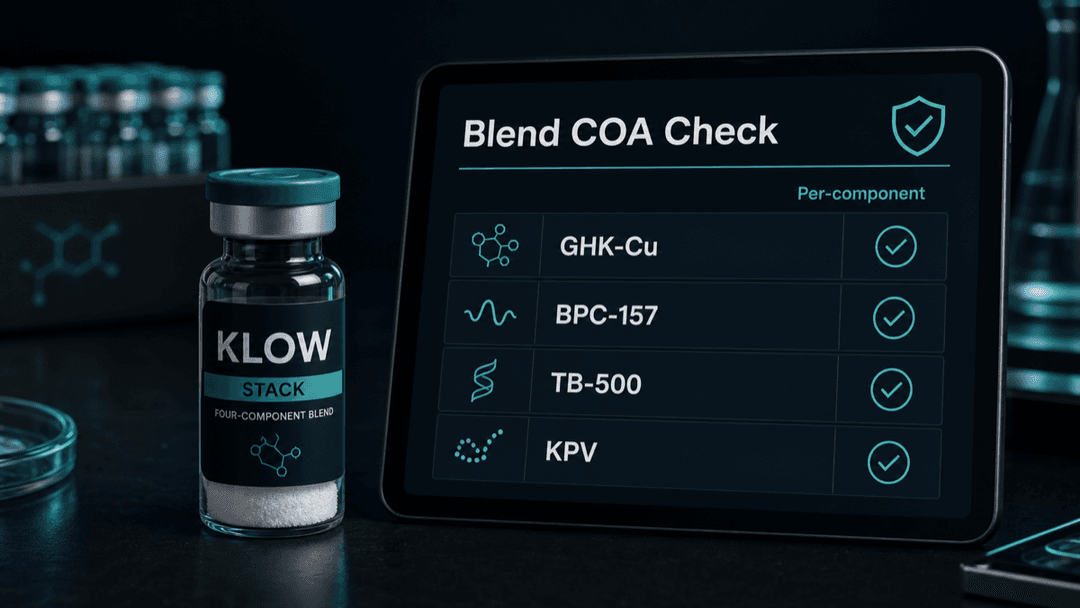
This is what's unique to KLOW. A proper COA should confirm the identity and purity of each peptide — GHK-Cu, BPC-157, TB-500, and KPV — ideally with HPLC for purity (look for ≥98% per component) and mass spectrometry to confirm each molecule's identity. A certificate that lists one combined "80mg" figure with a single purity percentage isn't verifying the blend; it's papering over it. The whole risk of a stack is that one of the four is underdosed or missing, and only per-component testing catches that.
Verifiable labs
Names like Janoshik and Colmaric Analyticals run public-facing portals where you can confirm a certificate's authenticity by its ID. If the COA names a lab you can't find online, or the PDF looks edited and lacks official letterhead, treat it as unverified.
What KLOW Costs in 2026
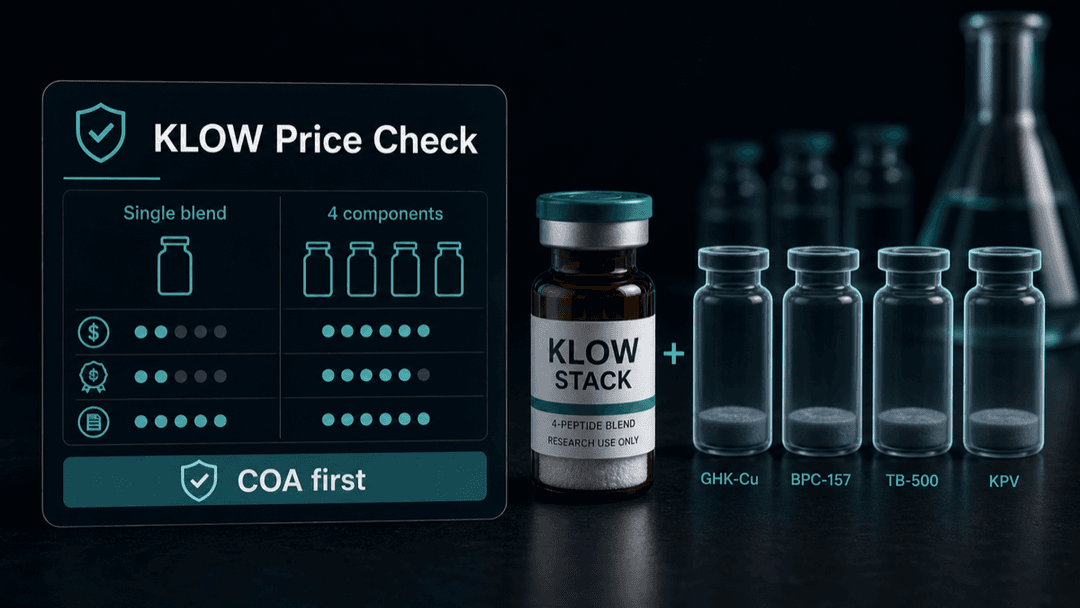
Pricing for an 80mg KLOW vial in 2026 generally runs $99 to $200, depending on the vendor's quality tier, current promotions, and whether you buy single vials or in bulk. Discounted listings dip toward $99–$140; full-documentation vendors tend to sit in the $130–$200 band.
The economic argument for the blend is real: buying GHK-Cu, BPC-157, TB-500, and KPV as four separate vials typically totals $200–$320, so a single well-tested KLOW vial is genuinely cheaper than assembling the stack yourself. That's the legitimate appeal.
What the price can't tell you is quality. A vial priced far below the market didn't find a magic discount — it cut a cost somewhere, and testing is the usual casualty because it adds real expense. Spend the extra $20–$40 and get the per-component COA. In a blend, that documentation is the only thing standing between you and a vial that's three peptides plus filler. Blend pricing drifts more than single peptides, so a second where to buy KLOW roundup is worth a look before you settle on a vendor.
Red Flags to Avoid When Buying KLOW
- No COA, or a generic one only. No batch-specific, per-component certificate means no sale.
- A single combined purity number. "80mg total, ≥99%" with no breakdown hides which of the four peptides is actually in there and at what dose.
- Prices that seem too good. GHK-Cu, BPC-157, TB-500, and KPV all cost money to synthesize and test. A suspiciously cheap blend is cutting a corner you can't see.
- Medical or dosing claims. A "research use only" product that comes with human injection protocols is signaling that compliance is not a priority there.
- Pre-mixed liquid with no batch date. KLOW should ship lyophilized. A pre-reconstituted solution with no date is a stability and freshness gamble.
- No verifiable presence. Check community boards (r/Peptides and similar). Vendors with zero reputation, good or bad, deserve extra caution — the community vets sources actively.
- False FDA claims. Any vendor implying KLOW is FDA-approved is lying. It isn't.
How to Get KLOW
Because KLOW is sold as a research peptide and not a regulated medicine, there's no prescription to obtain and no doctor's visit gating access. The realistic path is straightforward: choose a vetted vendor, confirm the current batch's per-component COA, and order online for domestic shipping.
The vial arrives as a lyophilized powder. In a research setting it's reconstituted with bacteriostatic water — added gently down the side of the vial, never blasted directly onto the powder — then swirled, not shaken. Reconstituted peptide is stored at 2–8°C and protected from light; lyophilized vials store best frozen, and you avoid repeated freeze-thaw cycles either way. These are handling notes for the research context, not a usage recommendation.
KLOW Vendor Comparison
Top Vendors
Ranked by purity, third-party testing, COA availability, and price.
>98% HPLC (certificate pass mark) · Kovera Labs, every batch · US only, free over $250
≥99% claimed · Janoshik/Finnrick · US shipping
≥99% HPLC · ISO lab claimed · US shipping
Listed · Batch COA · US shipping
"Lab tested" · Varies / unclear · Varies
Prices are approximate and change often. Always verify current pricing and that a batch-specific, per-component COA is available before you buy.
Related Buying Guides
Use these next if you are comparing adjacent research-peptide sourcing decisions:
Frequently Asked Questions
Where can I buy KLOW?
KLOW is sold by research-peptide vendors as a research-use-only blend — there's no pharmacy or prescription channel for it. Our pick is Ascension Peptides, which lists KLOW 80mg at $120.00 USD (code PEPTIDEDECK takes 50% off for new customers). Whichever seller you use, hold it to the same standard: batch-specific third-party COAs covering all four peptides, ≥98% HPLC purity per component, real stock, and US domestic shipping. Whichever vendor you choose, confirm the current lot's COA before ordering.
Is KLOW legal to buy?
KLOW's component peptides are not scheduled controlled substances, and they're sold legally as research chemicals for laboratory use. They are not FDA-approved for human use, so buying KLOW means operating outside the standard pharmaceutical system. Purchasing from a domestic vendor for research purposes carries low practical legal risk, but you should understand the research-use framing and check your local jurisdiction's rules.
How much does KLOW cost?
An 80mg KLOW vial typically runs $99–$200 in 2026 depending on the vendor and any promotions, with well-documented sources usually in the $130–$200 range. Buying the four peptides separately tends to cost $200–$320, which is the main reason the blend exists. Be wary of vials priced well under market, as testing is the most common cost a cheap seller cuts.
How do I know my KLOW is real and high purity?
Insist on a batch-specific COA whose lot number matches your vial, and make sure it verifies each of the four peptides individually — identity by mass spectrometry and purity by HPLC at ≥98% per component. A single combined "80mg" figure isn't enough for a blend. Confirm the testing lab is real and verifiable (Janoshik and Colmaric run public portals). No lot number or an unverifiable lab means treat it as unproven.
Do I need a prescription for KLOW?
No. KLOW is sold as a research peptide, not a prescription medication, so there's no Rx pathway. That also means there's no clinician overseeing quality or safety for you — the verification responsibility falls entirely on you and the vendor's documentation.
What's the difference between KLOW and GLOW?
GLOW is a three-peptide blend (GHK-Cu, BPC-157, and TB-500) without KPV. KLOW adds KPV, the alpha-MSH fragment studied for anti-inflammatory signaling, making it a four-peptide stack. The COA verification rules are the same: demand per-component testing for whichever blend you buy.
Is KLOW for sale anywhere except research peptide vendors?
No. There is no pharmacy, telehealth, or prescription channel for KLOW, so every listing offering KLOW for sale is a research-chemical vendor operating under research-use-only terms. Middleway Nutrition doesn't sell it either — this is a sourcing and verification guide, not a store. Treat any seller presenting KLOW as FDA-approved, pharmacy-grade, or clinically validated as misrepresenting what it is: all four of its components were nominated for use in pharmacy compounding, flagged by FDA as potentially presenting significant safety risks, and withdrawn without ever being approved for it.
Does a good COA mean KLOW is safe?
No, and this is the distinction worth being strict about. HPLC purity and mass-spec identity are chemistry results: they tell you the vial contains the peptides the label claims, at the ratio claimed, without excess synthesis by-products. They are not sterility results, not endotoxin results, and not evidence of what the compound does in a person. FDA's own concerns about these four peptides center on immunogenicity, aggregation and missing human exposure data — none of which a purity percentage addresses. Verification protects you from buying something that isn't what the label says. It cannot establish that the thing on the label is safe to use.
The Bottom Line on Where to Buy KLOW
KLOW's appeal is genuine — four well-researched peptides in one vial, cheaper than buying them separately. But a blend multiplies the ways a vendor can cut corners, and a single combined purity number is the easiest place to hide them. Your framework stays simple: per-component COA first, vendor reputation second, price last.
No vendor gets a free pass on that framework, including the ones listed in the table above. Ask for the current lot's per-component certificate before you pay, check the lot number against the vial when it lands, and treat a vendor that can't produce either as an answer rather than an inconvenience.
Sources
- U.S. Food and Drug Administration — Certain Bulk Drug Substances for Use in Compounding that May Present Significant Safety Risks. Category 2 of the bulk substances nominated under sections 503A or 503B, including the "nominated but withdrawn" table listing GHK-Cu (injectable routes), BPC-157, thymosin beta-4 fragment (TB-500), and KPV. Content current as of April 22, 2026.
Medical Disclaimer: This article is for informational purposes only and does not constitute medical advice. KLOW and its component peptides (GHK-Cu, BPC-157, TB-500, KPV) are not FDA-approved and are sold for research use only — they are not intended to diagnose, treat, cure, or prevent any disease. Always consult a qualified healthcare provider before considering any new compound or protocol. The purchase and use of research peptides carries legal and health risks that vary by jurisdiction and individual circumstances.