KLOW peptide before and after reports follow a fairly consistent order: wound and blemish healing changes first at around two to four weeks, skin texture and tone at three to six weeks, and hair changes last if they happen at all, at eight to sixteen weeks. Anyone reading KLOW peptide before and after content should also know that none of the four compounds in the blend has been tested in a human clinical trial, so the timeline above is a summary of user reports rather than trial data.
We do not publish transformation photographs. In a category where the outcome is skin appearance, photographs are the easiest thing in the world to manipulate with lighting, angle and camera, and they are worth close to nothing as evidence.
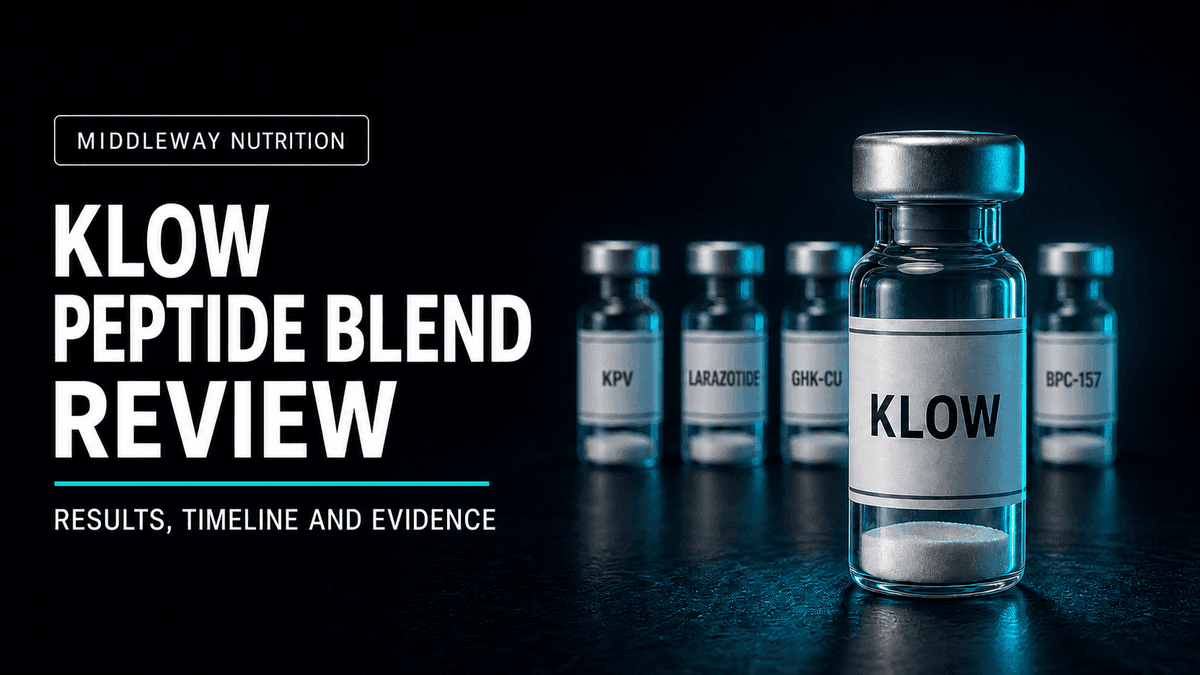
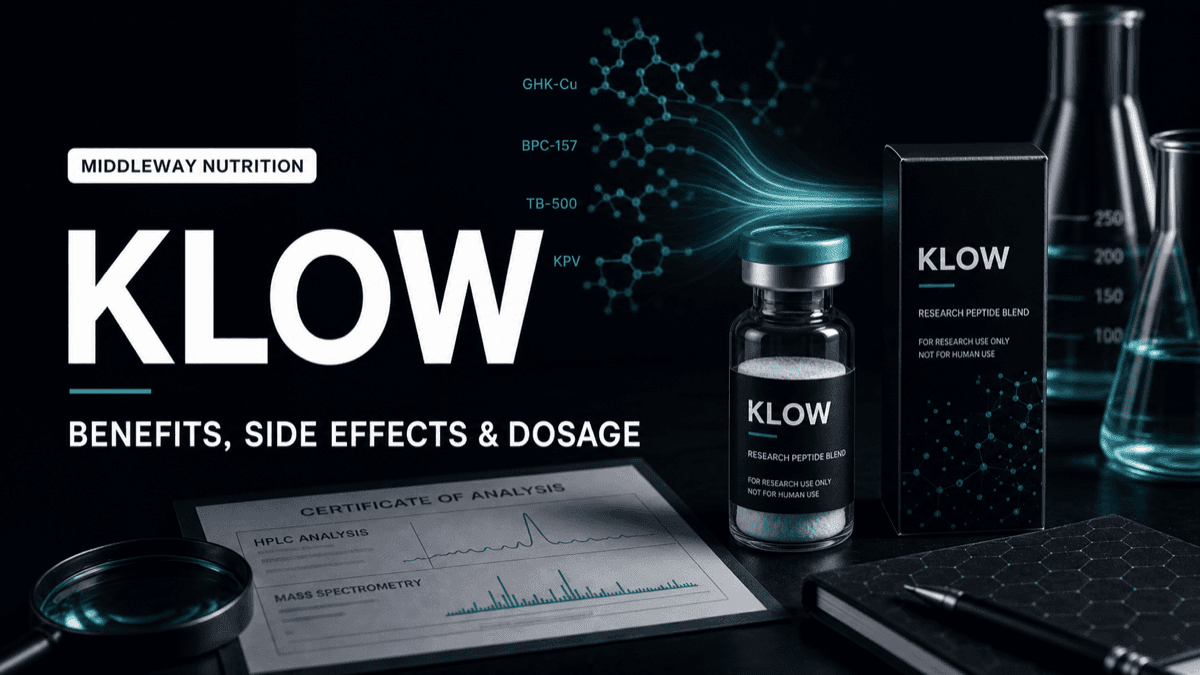
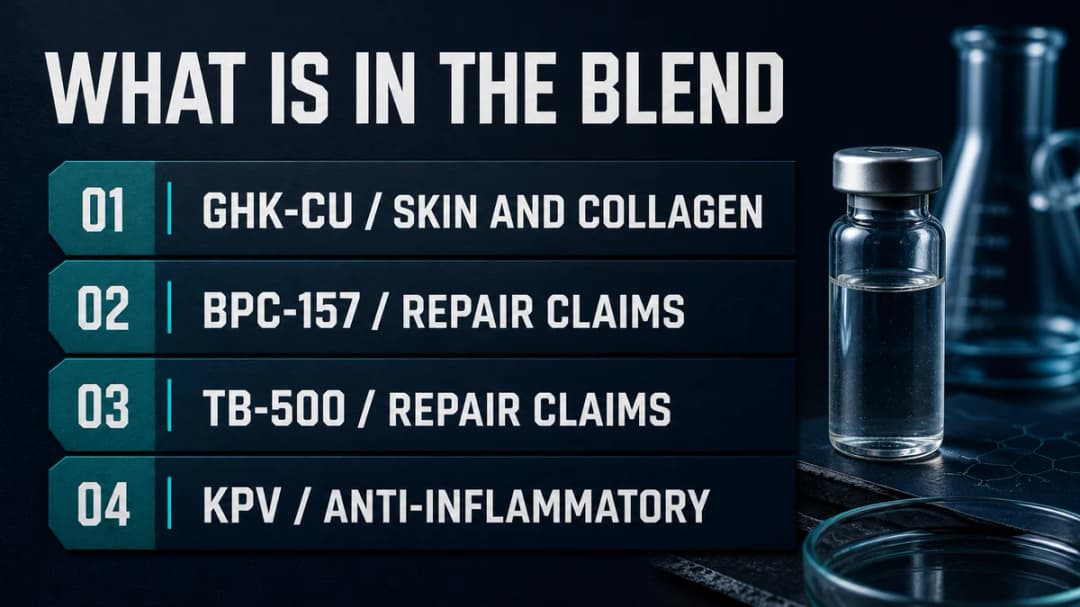
What Is in the Blend and What Each Part Claims
| Component | Claimed contribution | Evidence base |
|---|---|---|
| GHK-Cu | Collagen synthesis, skin texture, hair follicle effects | The deepest of the four, mostly topical and preclinical |
| BPC-157 | Tissue and gut healing | Rodent studies. No human trials |
| TB-500 | Soft tissue repair, cell migration | Preclinical. No human trials |
| KPV | Anti-inflammatory signalling | Preclinical, particularly colitis models. No human trials |
GHK-Cu is doing most of the work in any skin related report, and it is worth knowing that its best supported application is topical. Cosmetic formulations containing copper peptides have human data behind them. Subcutaneous injection of GHK-Cu as part of a blend does not.
KLOW Peptide Before and After: The Reported Timeline
| Period | What people commonly describe |
|---|---|
| Weeks 1 to 2 | Nothing visible. Some report better sleep or reduced joint ache, which is difficult to attribute |
| Weeks 2 to 4 | Cuts, blemishes and small wounds reported as healing faster. This is the earliest consistent claim |
| Weeks 3 to 6 | Skin texture and tone described as smoother and more even. The most frequently reported outcome |
| Weeks 6 to 10 | Fine lines and scarring reported as softened. Reports become more variable here |
| Weeks 8 to 16 | Hair thickness or regrowth, reported by a minority and inconsistently |
Two things about that pattern are worth noting. It is plausible, in that faster superficial healing preceding textural change is what you would expect if the compounds did what the preclinical work suggests. And it is also exactly the pattern you would expect from someone who has started paying close attention to their skin, improved their sleep and hydration, and is waiting to see a result they have paid for.
Neither explanation can be ruled out from user reports alone. That is the fundamental limitation.
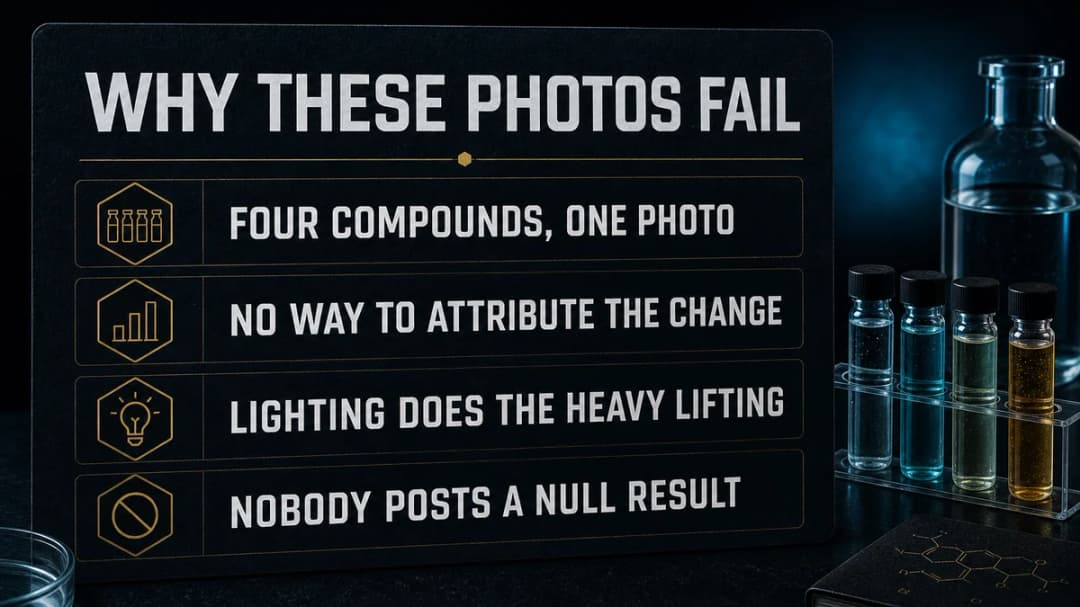
Why Before and After Photos Fail Here
Skin appearance is unusually sensitive to variables that have nothing to do with what was injected:
- Lighting direction and colour temperature, which can add or remove the appearance of texture entirely
- Camera and lens, since phone cameras apply skin smoothing by default in many modes
- Time of day, hydration status and recent sleep
- Whether the person was flushed, warm or cold
- Angle, distance and expression
A before photo taken tired under overhead lighting and an after photo taken in soft daylight will show a transformation with no compound involved at all. This is not a hypothetical, it is the standard practice of the category.
If you want to track your own results, use fixed lighting, a fixed distance, the same time of day, no camera filters, and take the photographs for yourself rather than for anyone else.
What Would Actually Improve Attribution
- Change one thing at a time. Starting a blend, a new skincare routine and a new sleep schedule in the same week guarantees an uninterpretable result
- Track something measurable alongside appearance, such as time for a specific blemish or cut to close
- Give it eight weeks before concluding anything, since the reported skin timeline is slower than the healing one
- Photograph under controlled conditions, or not at all
- Be willing to conclude that nothing happened, which is a normal outcome that almost never appears in published reports
Reported Protocols
Reported use of the blend clusters around small subcutaneous doses several times weekly, with a vial lasting several weeks. Those figures come from vendor material and user reports rather than any study, and there is no established dose for any component of this blend in humans. Our KLOW for sale page covers vial specs and how to check what you are actually being sold.
Injection site reactions are the most commonly reported problem, which is unsurprising for a blend containing GHK-Cu. Anyone using it should treat sterility seriously: new needles, alcohol swabs, correct storage of the reconstituted vial, and no reuse.
One further consideration applies specifically to copper peptides. GHK-Cu delivers copper, and while the quantities involved are small, copper is a mineral where more is not better. Anyone already taking a copper containing supplement, or with a condition affecting copper handling, has a reason to ask a clinician rather than assume the amounts are trivial.
Both BPC-157 and TB-500 are on the World Anti-Doping Agency prohibited list, which makes the blend disqualifying for anyone competing in a tested sport. That applies regardless of the product being sold as a research compound.
For the compound level detail see our KLOW guide, and for the case that topical GHK-Cu is the better supported route for skin, see GHK-Cu for skin and hair.
FAQ
How long does KLOW take to show results?
User reports describe wound and blemish healing changes at two to four weeks, skin texture at three to six weeks, and hair changes at eight to sixteen weeks if at all. No clinical trial has measured any of this.
Are KLOW before and after photos real?
Some undoubtedly are, in the sense that they were taken by real people. That does not make them evidence. Skin photographs are extraordinarily sensitive to lighting, camera and hydration, so any pair of images can show a dramatic change without anything having happened.
Which part of KLOW affects skin?
GHK-Cu, primarily. It is the component with the strongest rationale for collagen and skin texture effects. Its best evidence is topical rather than injected, which is worth knowing before choosing a route.
Does KLOW help hair growth?
Reports exist and are inconsistent, and hair is the slowest reported outcome. GHK-Cu has been examined in relation to hair follicles in preclinical work, but there is no human trial evidence for injected use, and established hair loss treatments have vastly better data.
Is KLOW safe?
Nothing serious has emerged from user reports beyond injection site reactions, but none of its components has been through a human safety trial. Absence of reported harm from self selected users is not a safety profile.