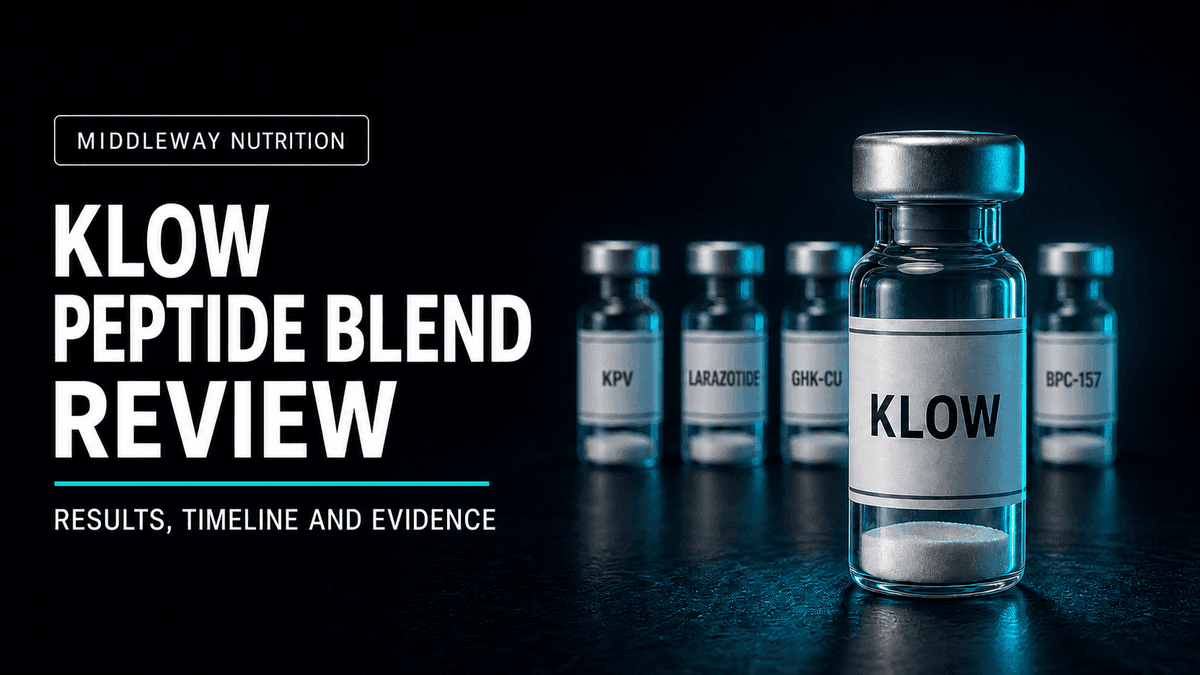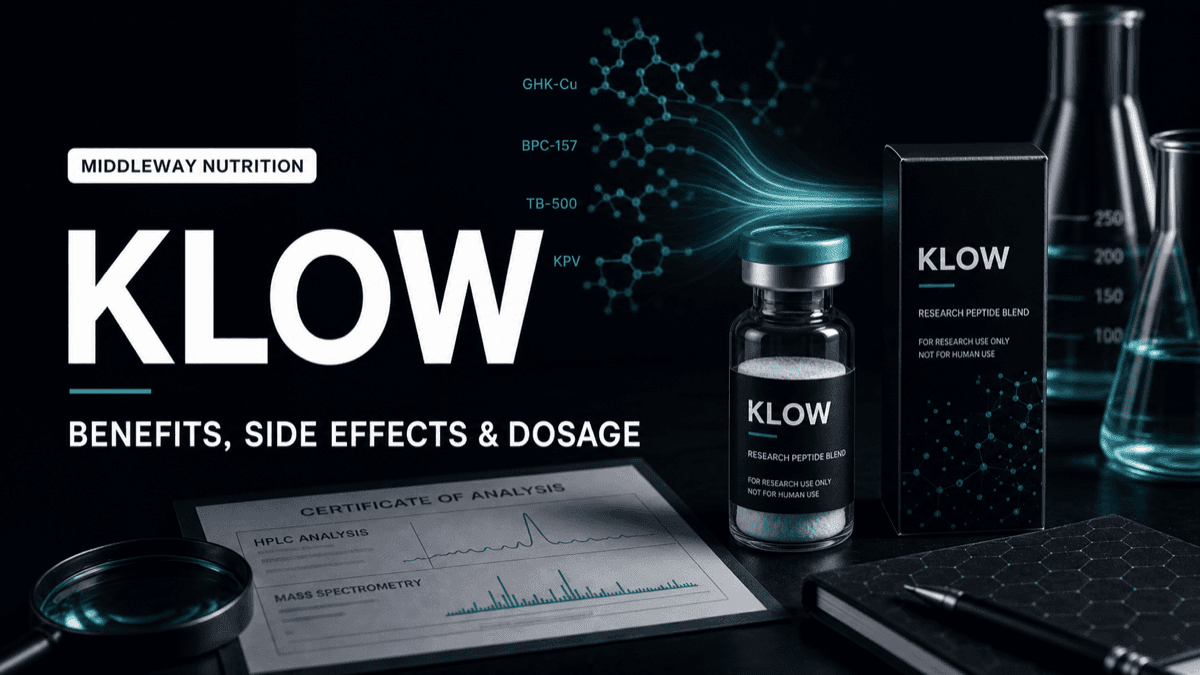
KLOW side effects are hard to pin down because the blend has never been studied. It combines GHK-Cu, BPC-157, TB-500 and KPV in one vial, and every safety statement you read is either borrowed from one ingredient or reported by users. This page keeps those apart: what the literature documents, what 17 Reddit accounts describe, and what is only theory.
Key Takeaways
- No trial has tested KLOW or any ratio of its four peptides, so there are no labeled side effects, no frequencies and no approved use
- The human record is thin: three small BPC-157 pilots, one early safety study of the full thymosin beta-4 protein (not the TB-500 fragment), and small cosmetic trials of GHK-Cu
- Among 17 Reddit comments describing tolerability, 7 mentioned injection-site stinging or burning, 3 reported feeling wired, palpitations or insomnia, 2 reported dryness, and 4 said they had no side effects
- The stinging is usually blamed on the GHK-Cu, and users say KPV or a larger water volume helps. These are anecdotes, not findings
- Stop and seek care for allergy signs, chest pain, a racing heart that does not settle, or spreading redness with fever. This page is information, not medical advice
For what the blend is and what it is claimed to do, see our KLOW peptide guide. Dose arithmetic lives on a separate page, our KLOW dosage chart.
KLOW side effects: what is actually documented
The most useful way to frame this is that there is no KLOW safety record, only four ingredient records of very different quality. The table sets out what each has on file, next to what users tend to blame on it.
KLOW side effects: what each ingredient has on record
| Human data | What those reports found | What users blame on it | |
|---|---|---|---|
| GHK-Cu | Small trials, mostly facial creams | Injection safety not established | Injection-site sting, redness, dryness |
| BPC-157 | Three pilots, 2 to 12 people | No adverse events reported in the pilots | Nausea on vendor lists; not seen in the Reddit sample |
| TB-500 | None for the fragment; full-length protein given IV to 40 volunteers | Infrequent, mild or moderate events for the full protein | Fatigue on vendor lists; one Reddit fatigue report on the blend |
| KPV | None found | Nothing to report | Rarely named; some credit it with fewer injection-site reactions |
| The blend | None | No safety data at any ratio | Wired feeling, palpitations, insomnia in 3 comments |
The gap matters. When a vendor page lists "mild nausea, transient fatigue and injection site redness" for KLOW, those items are the summed folklore of four compounds. They are not frequencies from a study. One competing KLOW page I read labels its list community-reported and another gives none at all, which is more honest than inventing a percentage.
What the literature says about each ingredient
BPC-157. The human evidence is three pilots. In an intravenous study of two people, infusions of 10 mg and then 20 mg caused no change in heart, liver, kidney, thyroid or glucose markers and no reported side effects (PMID 40131143). In a 12-woman bladder study, 10 mg injected around inflamed tissue produced no adverse events, but there was no control group (PMID 39325560). A 2025 systematic review found 36 studies, 35 of them preclinical, and a second review counted three human pilots in total (PMID 40756949, PMID 40789979). Absence of reports in the 14 people across the first two pilots is not a safety profile.
TB-500. TB-500 is the acetylated 17-23 fragment of thymosin beta-4 (PMID 22962027). The human safety study I could verify used the full-length synthetic protein, given intravenously to healthy volunteers in four dose cohorts of 10 people, and found infrequent mild or moderate adverse events with no serious ones (PMID 20536472). That is a different molecule by a different route. TB-500 also appears on the WADA prohibited list under S2, so tested athletes should treat it as banned.
GHK-Cu. A 2026 systematic review concluded that human randomized trials are small, mostly on facial cosmetic creams (PMID 42787770). That is evidence about skin application. I found no study of daily subcutaneous GHK-Cu, and the copper content is a separate question I return to below.
KPV. The animal work I could verify is mouse colitis research using a nanoparticle built to target the PepT1 transporter (PMID 39211778). I found no human safety data.
A 2026 review of injectable peptides sold outside medicine warned that unapproved compounds including BPC-157 and TB-500 lack established human safety profiles, and listed product contamination, impurities, inaccurate dosing and theoretical risks such as pathological blood vessel growth (PMID 42757290). Those theoretical risks are mechanism-based concerns, not documented harms, and I treat them that way here.
Can the four peptides be mixed safely?
This came up repeatedly. A r/BodyHackGuide thread from January 2026 split into two camps: one claimed copper destroys the other peptides in the vial, another said lab purity tests on KLOW pass even after weeks of liquid storage. Neither side showed data I could check, and one commenter noted the testing lab requires samples not to be reconstituted. I found no published stability study of the blend, so the honest position is that it is untested. The practical consequence is that a degraded vial and a reaction to the peptides would look the same from the outside.
What Reddit users report
I read 446 posts and comments from eight subreddits across 24 threads, mostly r/NTNPerformance, r/BodyHackGuide and r/Biohackers. After removing bot messages, vendor-style review posts, praise, questions, and the large share that discussed other compounds, 17 comments gave a first-person account of tolerating KLOW or its GLOW sibling. They came from 7 threads and 4 subreddits (r/BodyHackGuide 10, r/BiohackingU 4, r/Biohacking 2, r/Biohackers 1). Only 17 usable reports is a small, self-selected, unverified sample. People who have problems post asking for help, and people who feel fine mostly do not, so do not read the proportions as rates.
What 17 Reddit comments reported about tolerating KLOW or GLOW
The mix is lopsided toward local complaints. Seven of the 17 described stinging, burning or similar reactions at the injection site, six of them in r/BodyHackGuide. The next section covers those. Four said they had no side effects: one after two weeks, one after 3.5 weeks, one after a month at 2 to 5 mg, and one while using 25 units a day.
Injection-site reactions and how users manage them
Users generally blame the copper in GHK-Cu. One r/Biohackers account described rotating injection sites in a grid around the stomach and icing the skin before and after. A r/BodyHackGuide commenter drew an extra 20 units of bacteriostatic water into the syringe to dilute the dose, another suggested bacteriostatic saline instead of water, and a third added that the thighs and upper glutes sting less than the stomach. One person who stopped on GLOW because of bad reactions wrote: "Switched to Klow and the KPV helped a lot. I barely get any ISR now." (a r/BodyHackGuide commenter, Feb 2026). That is one person, and I found no trial showing KPV reduces injection-site reactions.
Not everyone adapted. A r/Biohacking commenter at week two of a 12-unit, five-days-a-week schedule described intense burning at the injection site and skin they called a mess, and asked whether to quit. Another said the sting stopped after a while and wondered whether the peptide had degraded or they had just adjusted. That second thought is worth keeping: a vanishing sting is not proof of anything either way. One user who tested GHK-Cu alone in a separate thread ran it on one side of the body and a different peptide on the other, and only the copper side reacted. That is a useful home test, but still a sample of one.
The cardiovascular and nervous system reports
Three comments stood out because they were not about the skin. A r/BiohackingU poster (Jul 2026) wrote "by day 5 I was having heart palps, blood pressure felt high, couldn’t sleep, just overall felt wired." (link). When they dropped to just GHK-Cu and KPV the same symptoms returned after three days. They later reported no symptoms after buying GHK-Cu from a different supplier and restarting at half the dose, and suspected the first source was contaminated or mislabeled. That is a theory, not a finding.
A second r/BiohackingU commenter reported fatigue, feeling wired and not sleeping. They wrote "I tried to push through and took it 2 weeks, but couldn’t handle it anymore." (a r/BiohackingU commenter, Jul 2026). A week off cleared it, and a single small dose later brought back fatigue and irritability.
The third was a r/BiohackingU poster (Apr 2026) who described a pattern of racing heart, with a rate in the 150s to 170s within minutes of a first injection of a 50/10/10 blend, a similar episode at a much lower second dose, and recurring episodes afterwards. They went to an emergency department, where the EKG, troponin, chest X-ray, blood counts and telemetry were reported as normal, and planned heart monitoring. Note that the vial they described was 50/10/10, the GLOW formula without KPV, though they called it KLOW. They also reported becoming sensitive to stimulants and supplements afterwards, which is their own account.
None of this shows that KLOW causes arrhythmia. Three comments in a sample of 17 cannot establish a rate, a mechanism or a cause, and sellers, doses and co-medications were unknown. What they do show is that a few users report a stimulating or cardiovascular reaction, and that two of them took the possibility seriously enough to stop. One reply to the first poster suggested starting at 250 mcg of each of the three peptides and 1.25 mg of GHK-Cu, and another advised a test dose of a tenth of the minimum. Both are user opinions.
Dryness, swelling and other complaints
Two commenters reported dryness. One said their skin was drier with no visible change in acne after a few weeks at 10 units a day; another had a week of dryness and added zinc, which other users had suggested for what one called the copper uglies. The zinc idea is community lore and I found no evidence for it.
One r/Biohackers poster asked about ankle and foot swelling and joint tightness after two weeks on a stack of five compounds including IGF-1 LR3, tesamorelin with ipamorelin, retatrutide and KLOW. With that many variables, the swelling cannot be assigned to the blend. That is the general problem, and six commenters across three threads said so directly: stacking makes it impossible to tell what caused a reaction, and the advice was to introduce one compound at a time.
Risks that are theoretical or unmeasured
Blood vessel growth. BPC-157 and TB-500 are studied for promoting repair and new vessel formation. In a person with an existing or hidden tumor, that is theoretically undesirable. It has not been shown to happen with these peptides at these doses, and it is why the cancer-history caution appears on every responsible page.
Copper load. GHK-Cu is about 16 percent copper by mass, so a 2.5 mg dose carries roughly 0.4 mg of elemental copper. That sits below the adult reference intake of 0.9 mg per day and well below the 10 mg upper limit, figures I took from NIH and could not re-check today. But those limits assume copper absorbed through the gut, which regulates how much gets in. Injection bypasses that control. This is a reasonable concern for anyone with a copper disorder such as Wilson's disease, not a documented problem.
Product quality. Contamination, wrong fill and wrong ratio can produce reactions that look like the peptide. The same r/BiohackingU thread shows a user blaming a supplier. A batch certificate that matches your lot, with identity and net content, is the minimum. Our guides on where to buy KLOW and KLOW for sale cover what to check.
When to stop and call a clinician or emergency services
- 1Signs of allergy
Hives, a spreading rash, swelling of the face or throat, trouble breathing. Treat as an emergency. - 2Chest pain or a racing heart
Fainting, chest pain, or a fast heartbeat that does not settle. Do not wait it out. - 3Infection at an injection site
Spreading redness, heat, pus or fever after an injection. - 4A lump or growth that changes
Any new or changing lump, mole or unexplained bleeding, especially with a cancer history. - 5Symptoms that start with the blend
A new problem that appears after day one and does not fade is a reason to stop and ask.
Who should avoid KLOW, and interactions
Nobody can say who it is safe for, but some groups have reasons to stay away or talk to a clinician first. These come from mechanism and caution, not from trials.
- Anyone with a current or past cancer, or an undiagnosed lump, given the blood vessel growth concern
- Pregnant or breastfeeding people, because no data exist
- People with copper metabolism disorders, including Wilson's disease
- People on anticoagulants, immunosuppressants or immunomodulators, because interactions are unstudied
- Tested athletes, since TB-500 is prohibited under S2
- Anyone with a history of arrhythmia or palpitations, in light of the reports above
- People who react to injections or have a known peptide or preservative allergy
Interactions have not been studied for the blend. The one Reddit thread that touched them involved supplements and stimulants after a reaction, which is anecdote. Several users run KLOW alongside tesamorelin, retatrutide or CJC/ipamorelin; none of those pairings has been tested together.
How long do KLOW side effects last?
There is no data. Injection-site stinging was described as fading in the first weeks by some and persisting for others. The fatigue and wired feeling reports lasted for as long as the person kept injecting and eased within a week of stopping in the one case with a detailed timeline. A reaction that starts on day one and does not fade is a reason to stop and ask, not to push through. Our KLOW dosage chart explains why the same "12 units" can mean different amounts, which matters if you are trying to work out whether a reaction tracked with a dose.

If you decide to buy, a verified vial removes one variable. Ascension Peptides lists the KLOW 80 mg vial at $120.00 as of 2026-10-11 (list price shown $199.99). Kovera Labs tests every batch (HPLC, LC-MS identity, net content, endotoxin, sterility and heavy metals), more than 98 percent of tested batches pass, and batch certificates are public. Prices are in US dollars, shipping is US only and all sales are final. New customers can use code PEPTIDEDECK for 50 percent off. It is a research chemical, labeled not for human use.
Frequently Asked Questions
What are the side effects of KLOW?
There are no documented side effects for the blend because it has never been trialed. Users most often describe stinging or burning at the injection site, blamed on the GHK-Cu. A few report feeling wired, palpitations, insomnia, fatigue or dryness. These are anecdotes from an unverified sample.
Is KLOW safe?
Nobody can say. No regulator has evaluated it, no study has tested the combination, and long-term effects are unknown. The ingredients have short, small human studies at best. Safety also depends on what is really in a vial, which is a quality question separate from the peptides.
Why does KLOW sting?
Users usually blame the copper in GHK-Cu, and one user's side-by-side test pointed the same way. Reported workarounds include more water, rotating sites, icing the skin and different body areas. None of these has been tested.
Can KLOW cause heart palpitations?
Three Reddit comments described a wired feeling, palpitations or a racing heart. That cannot show cause, but it is a reason people report starting low and stopping if it happens. Anyone with heart symptoms should see a clinician instead of experimenting.
Who should not take KLOW?
People with a cancer history, pregnant or breastfeeding people, people with copper disorders, people on anticoagulants or immune-modifying drugs, and tested athletes all have reasons for caution. A clinician who knows your history should make that call.
Checking the vial first
Many reported reactions could come from the vial rather than the peptides. Ascension Peptides lists the KLOW 80 mg vial at $120.00 as of 2026-10-11, with per-batch Kovera Labs testing and public batch certificates; US shipping only and all sales are final. Match the lot on the certificate to your vial, and treat every Reddit report here as anecdote.
Medical Disclaimer: KLOW is a blend of investigational research peptides. None of its components is approved by the FDA or a comparable regulator for any condition, and it is sold for laboratory research use only. This article reports published and user-reported information for education. It is not medical advice, a dosing protocol or a recommendation for personal use. Consult a qualified healthcare professional about any health concern.