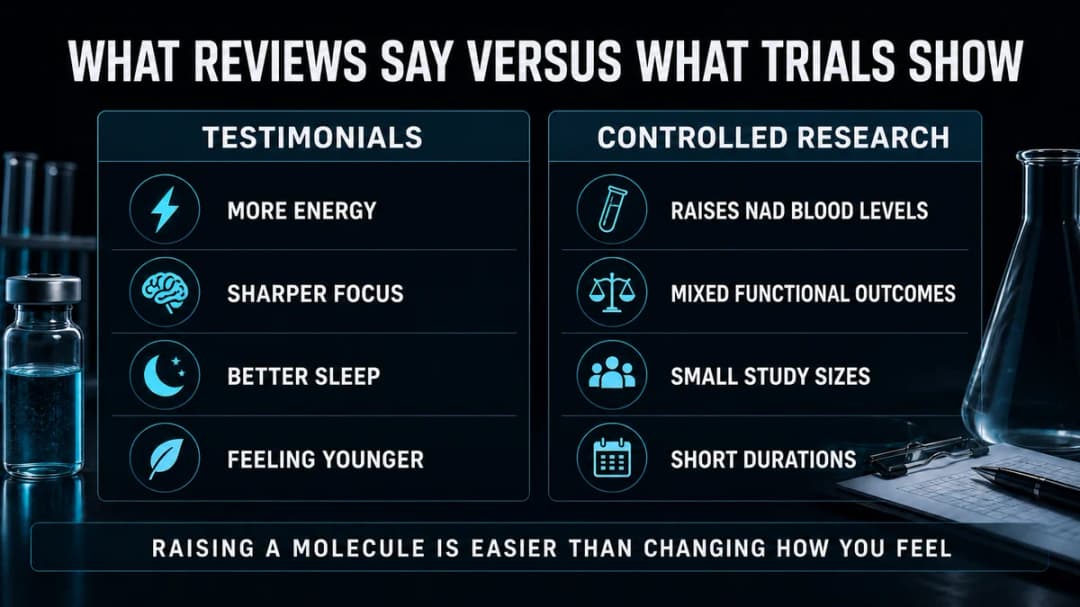
NAD Reviews 2026 fall into two incompatible camps: enthusiastic personal accounts of restored energy and focus, and a controlled trial literature that reliably shows only one thing, which is that NAD+ levels in blood go up. The gap between them is the most useful thing about NAD Reviews 2026, because it tells you exactly which claims are load bearing and which are not.
Neither side is lying. The reviews describe real experiences. The trials measure something narrower under conditions designed to remove expectation. Both are worth reading, in that order.
What NAD Reviews 2026 Are Actually Describing
Reviews bundle three different products under one name, and the format changes both the experience and the evidence base.
| Format | Typical delivery | Where the reviews come from | Where the trials come from |
|---|---|---|---|
| IV infusion | 250 to 1,000 mg, dripped slowly over a clinic appointment lasting an hour or more | Most dramatic testimonials | Almost no controlled data |
| Subcutaneous injection | 50 to 100 mg, a few times weekly at home | Steady, moderate reports | Almost no controlled data |
| Oral precursors (NR, NMN) | 250 to 1,000 mg daily capsules | More muted reports | Nearly all the randomised evidence |
That mismatch is the central problem with the review literature. The formats generating the strongest testimonials are the ones with the least controlled evidence, and the format with the trial data behind it is the one people describe as underwhelming.
What the Controlled Research Actually Established
NAD+ levels rise. This is solid. A randomised placebo controlled crossover trial in a small group of healthy older adults gave a gram of nicotinamide riboside per day across a six week period and measured blood NAD+ roughly 60 percent above baseline, with good tolerability throughout. Systematic review work across the precursor trials has confirmed a dose dependent rise.
Blood pressure showed the clearest functional signal. In that same trial, participants who began with elevated systolic blood pressure showed a reduction of around 10 mmHg. This was an exploratory finding in a subgroup of a small study, not a primary endpoint in a trial designed to answer that question. It is the most interesting result in the field and also the one most in need of replication.
Functional and cognitive outcomes have been inconsistent. Randomised work in specific populations, including post viral fatigue, has generally failed to show significant benefit on primary cognitive endpoints, with some secondary signals on fatigue and sleep among those who continued longest. Secondary signals in trials that missed their primary endpoint are hypothesis generating, not conclusions.
Anti-ageing outcomes have not been tested. No trial has followed people long enough to say anything about lifespan, healthspan or age related disease incidence. The animal data that started this field has not been reproduced as a human outcome.
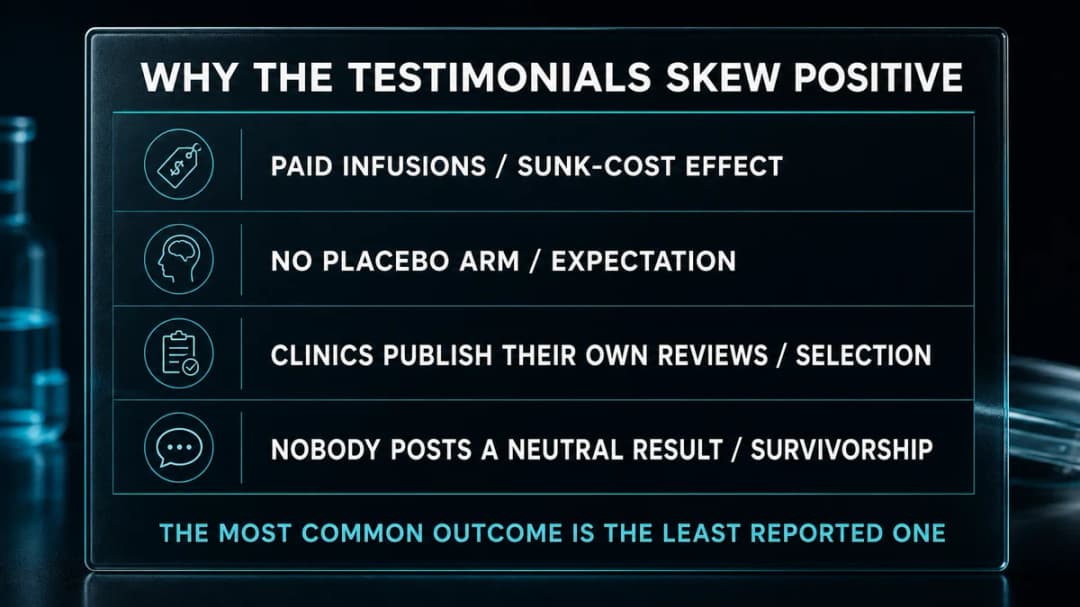
Why the Testimonials Skew Positive
Four reasons, none of which require anyone to be dishonest.
The conditions NAD is used for, fatigue and mental fog above all, have among the largest placebo responses in clinical research. An IV infusion in a clinic, with a nurse, a private room and an hour of stillness, is close to a maximally effective placebo delivery system.
People who pay several hundred pounds for a session are motivated to notice improvement. People who felt nothing rarely write a review.
Many NAD IV protocols include B vitamins, magnesium and saline. Rehydration alone produces a noticeable lift in someone who arrived tired and underhydrated.
And regression to the mean does the rest. People seek treatment when they feel worst, and they usually feel better afterwards regardless of what was infused.
The Before and After Timeline People Describe
| Timepoint | Commonly reported with IV or injection | Commonly reported with oral precursors |
|---|---|---|
| During or day 1 | Flushing, nausea during infusion, then a lift | Nothing |
| Days 2 to 7 | Better sleep, more stable energy | Nothing distinctive |
| Weeks 2 to 4 | Effects described as fading between sessions | Occasional reports of steadier energy |
| Months 2 to 3 | Diminishing novelty, ongoing cost questions | Most people report no clear change |
| Beyond | Discontinuation is common | Continued as a low cost maintenance habit |
The pattern worth noticing is that reported effects fade. That is consistent with either tolerance or with the initial response being partly expectation. Neither can be distinguished from the outside.
Cost, and Whether It Is Worth It
IV sessions typically run into the hundreds of pounds each, and protocols usually involve several. Subcutaneous injection at home costs a small fraction of that. Oral precursors are cheaper again. Vial pricing and certificate checks for the injectable form sit on our NAD+ for sale page.
A defensible way to think about it: the cheapest option has the best evidence, and the most expensive option has the least. If the primary reason for choosing IV is speed of effect, the honest counterpoint is that no controlled trial has established what that effect is.
Our NAD+ injections guide covers the home protocol side, and NAD+ vs NMN covers the precursor decision.
Side Effects Reviews Frequently Understate
Infusion reactions are common and underreported in testimonials. Flushing, chest pressure, nausea and abdominal cramping during a fast drip are the norm rather than the exception, and small real world reports have found most patients experiencing moderate or worse symptoms during infusion. Slowing the rate resolves it. See NAD+ side effects for the full picture.
Who Might Reasonably Try It
- Someone with a specific, modifiable target such as elevated blood pressure, under clinician supervision, using an oral precursor
- Someone who has already excluded the common medical causes of fatigue rather than skipping that step
- Someone comfortable spending money on an intervention whose functional benefit is unproven, with clear eyes about that
Who should not: anyone with active cancer or on chemotherapy without oncology input, anyone pregnant or breastfeeding, and anyone treating persistent fatigue as a supplement problem rather than something that warrants a proper medical workup.
FAQ
Do NAD+ IV drips actually work?
They raise NAD+ in the blood. Whether they improve energy, focus or sleep beyond what a comparable placebo would produce has not been tested in a controlled trial. The positive reviews are real experiences, but they cannot separate the compound from the setting.
How long do NAD reviews say the effects last?
Most describe an effect that fades over one to three weeks, which is why clinics recommend recurring sessions. That fading pattern is consistent with several explanations, including expectation effects, and the reviews cannot distinguish between them.
Is oral NMN or NR as good as IV NAD+?
They have the better evidence base, which is not the same question. Oral precursors reliably raise NAD+ and have small randomised trials behind them. IV delivers a faster rise with almost no controlled outcome data.
Are the before and after photos genuine?
There is nothing meaningful to photograph. NAD is marketed for subjective states rather than visible change, so any before and after imagery in this category should be read as marketing.
Is NAD therapy worth the money in 2026?
For most healthy adults, the evidence does not support the cost of IV therapy. An oral precursor is inexpensive, well tolerated and has the trial data behind it, which makes it the more rational place to start if you want to try the category at all.