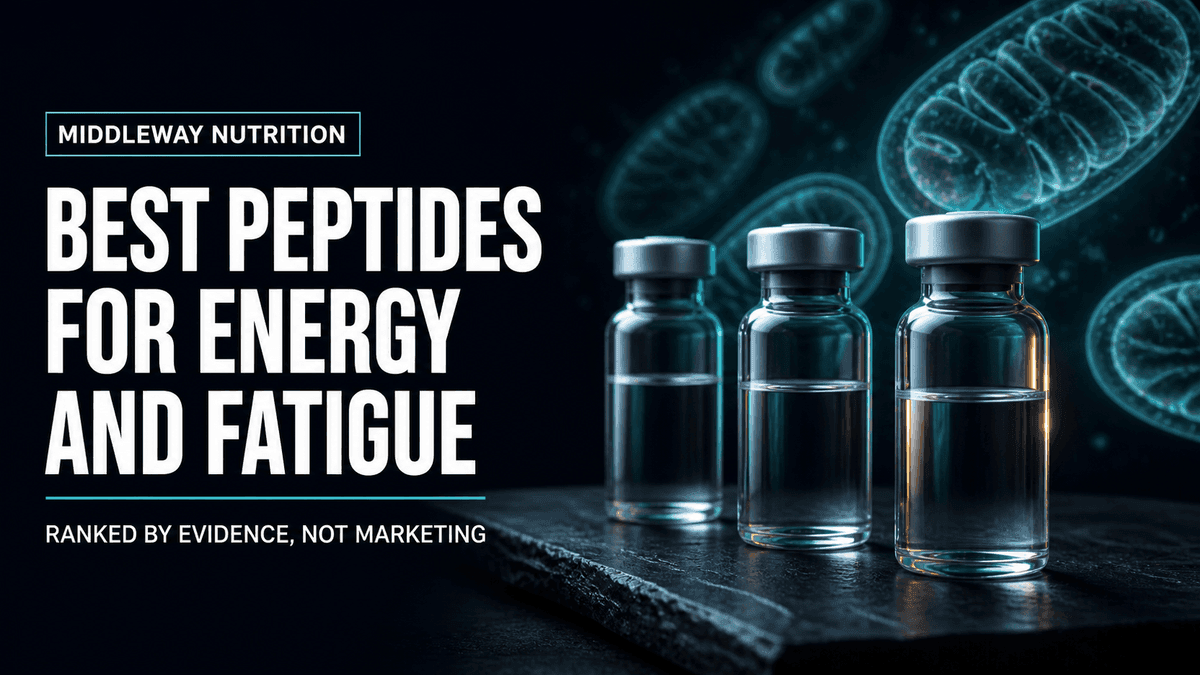
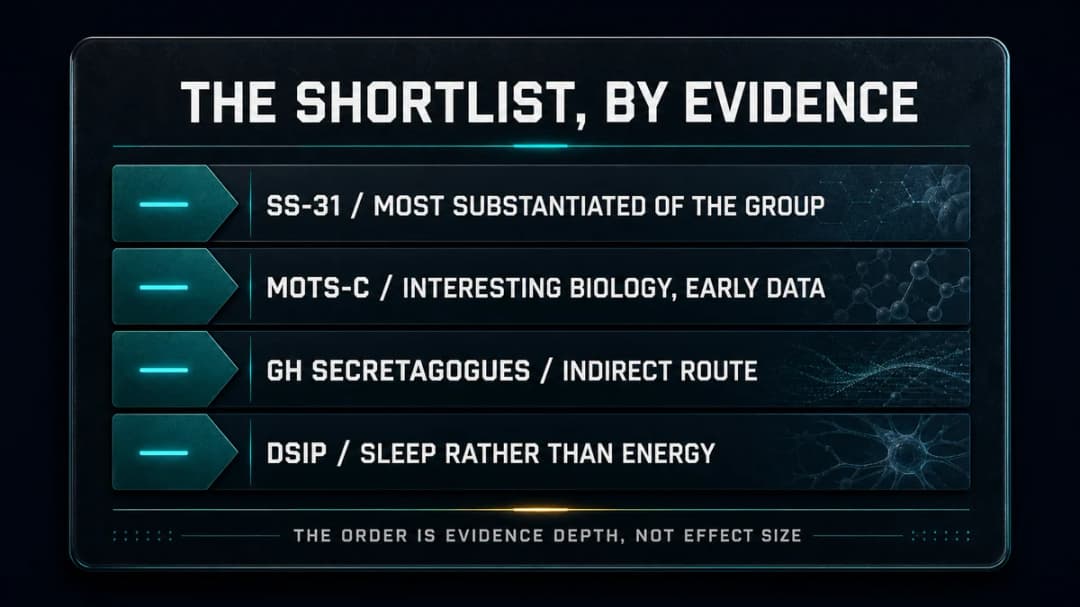
The best peptides for energy and fatigue, judged on evidence rather than marketing, are the mitochondrial compounds SS-31 and MOTS-c, and the growth hormone secretagogues that work indirectly by improving sleep. None of them is approved for treating fatigue, and the human trial data is thin for all of them.
Anyone searching for the best peptides for energy and fatigue should start somewhere less interesting than a peptide vial. Fatigue has a long list of common, treatable causes, and mitochondrial dysfunction is far down that list. Iron deficiency, low B12, hypothyroidism, sleep apnoea, depression and simple sleep debt account for the overwhelming majority of cases. A blood panel and a sleep assessment cost less than a month of any compound below and are considerably more likely to find the answer.
With that said, here is an honest read of the compounds people actually use.
Best Peptides for Energy and Fatigue: The Shortlist by Evidence
| Peptide | Proposed mechanism | Human evidence | Reported research doses |
|---|---|---|---|
| SS-31 (elamipretide) | Stabilises cardiolipin in the inner mitochondrial membrane | The strongest of this group. Studied in clinical trials for mitochondrial myopathy and heart conditions | Commonly cited around 5 to 20 mg daily in research contexts |
| MOTS-c | Mitochondria-derived peptide affecting metabolic signalling | Mostly animal work, human trials early | Often cited at 5 to 10 mg weekly, usually split |
| CJC-1295 with ipamorelin | Raises endogenous growth hormone, mainly benefiting sleep | Indirect. GH physiology is well characterised, fatigue outcomes are not | Ipamorelin 100 to 300 mcg, CJC-1295 100 to 200 mcg, evening |
| DSIP | Influences sleep architecture | Older, largely observational | Around 100 to 300 mcg before bed |
| Thymosin alpha-1 | Immune modulation | Real clinical use in some countries for immune indications, not for fatigue | Typically 1.6 mg, dosing varies |
| 5-Amino-1MQ | NNMT inhibition, raising NAD+ | Animal data, not a peptide strictly | Commonly 50 to 150 mg orally |
Every dose in that table is a figure reported in research or common practice, not a recommendation, and none of these compounds is approved for human use as a fatigue treatment.
SS-31: The Most Substantiated of the Group
SS-31, also called elamipretide, is a four amino acid peptide that concentrates in mitochondria and binds cardiolipin, a phospholipid in the inner membrane that the electron transport chain depends on. When cardiolipin is damaged, energy production becomes inefficient and oxidative stress rises. Stabilising it is a coherent mechanism, not a marketing story.
It has been through genuine clinical trials, principally in primary mitochondrial myopathy and cardiac conditions. That is a meaningful distinction from most of this category. What it does not have is trial evidence that it improves fatigue in people whose mitochondria are working normally, which describes most people who will read this page.
If your fatigue has a diagnosed mitochondrial or cardiac component, this is the compound with the most behind it. If it does not, the extrapolation is larger than the marketing suggests. Our SS-31 guide covers the research in more depth.
MOTS-c: Interesting Biology, Early Data
MOTS-c is encoded in mitochondrial DNA rather than nuclear DNA, which is genuinely unusual and part of why it attracted attention. It appears to act on metabolic signalling in ways that overlap with the effects of exercise, and rodent work has shown improvements in metabolic markers and endurance.
The "exercise in a vial" framing that follows from this is where it gets oversold. Mouse endurance results do not transfer cleanly to human subjective energy, and the human trial base is still early. Users commonly report improved workout tolerance and steadier energy across a day; users also commonly report nothing.
Our MOTS-c guide and MOTS-c side effects pages cover what is documented.
Growth Hormone Secretagogues: An Indirect Route
CJC-1295 paired with ipamorelin is the most used stack in this space, and the mechanism for fatigue is entirely indirect. Growth hormone is released predominantly during deep sleep. These compounds prompt more of that release, and the reported benefit is usually described as better sleep quality first and daytime energy second.
That is a plausible chain, and it is also the point at which to be careful. If sleep is the mechanism, then anything else that improves sleep competes directly, and several of those things are free. It is also worth noting that fluid retention and morning grogginess are common early effects of this class, which for the first fortnight can make fatigue worse rather than better.
The consideration that matters most: growth hormone opposes insulin. Anyone with prediabetes or insulin resistance should not use this class without glucose monitoring.
DSIP and Sleep
DSIP is dosed before bed and is described as improving sleep depth without the hangover of a sedative. The evidence base is old, mostly observational, and mostly from Russian clinical literature. Reports from users are mixed enough that it is fair to call the response highly variable.
The reason it appears on a fatigue list at all is sound: poor sleep is the most common driver of low energy, and it is routinely underestimated by the person experiencing it. But a compound with weak evidence is a poor first response to a sleep problem that has not been properly investigated. Untreated sleep apnoea produces exactly the fatigue picture people bring to peptides, and no peptide addresses it.
Side Effects Worth Knowing Before You Start
| Compound | Commonly reported | Requires more caution |
|---|---|---|
| SS-31 | Injection site reactions | Limited long-term human data outside trial settings |
| MOTS-c | Injection site reactions, occasional flushing | Effects on glucose handling not well characterised |
| CJC-1295 and ipamorelin | Water retention, tingling in hands, early grogginess | Raised fasting glucose, reduced insulin sensitivity |
| DSIP | Grogginess, vivid dreams | Response is inconsistent between people |
| Thymosin alpha-1 | Injection site reactions | Autoimmune conditions warrant clinical input |
| 5-Amino-1MQ | Digestive upset | Oral compound, animal data only |
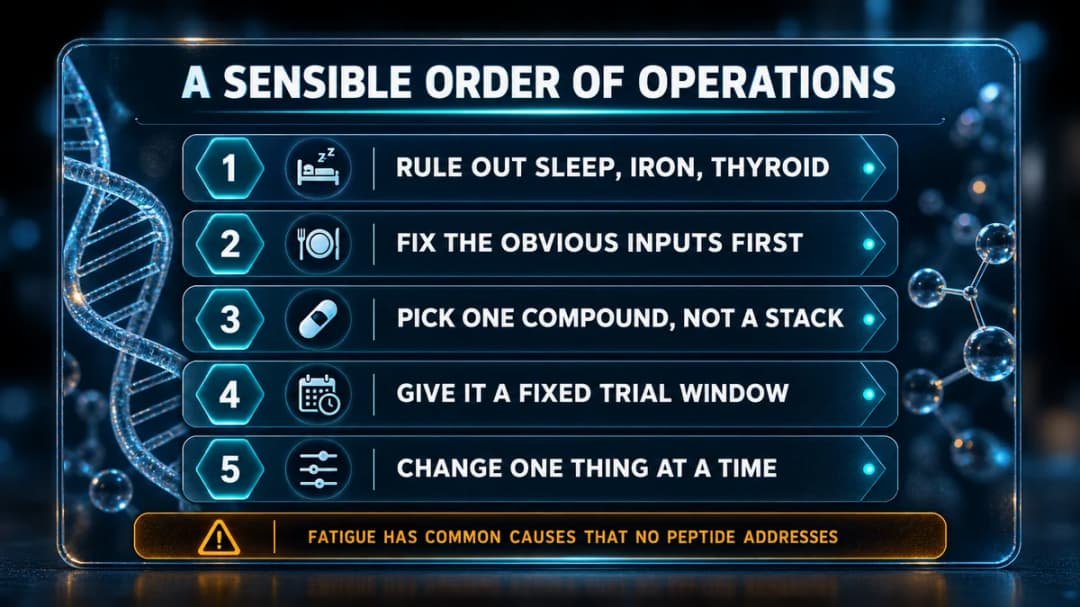
A Sensible Order of Operations
First, rule out the common causes. Full blood count, ferritin, B12, folate, thyroid function, vitamin D, HbA1c. Ask directly about snoring and daytime sleepiness, and get a sleep study if either is present.
Second, fix the obvious. Consistent sleep timing, adequate protein, actual recovery days if you train hard. These sound like filler advice because they are usually true and usually ignored.
Third, if you still want to try a compound, run one. Rate energy on a fixed scale at the same times each day for two weeks before starting, so you have a baseline that is not memory. Then run one compound for six to eight weeks and compare.
Stacking three compounds at the start is the most common mistake in this category, and it guarantees you learn nothing about which of them, if any, did anything.
What a Realistic Timeline Looks Like
Sleep-mediated effects appear first, typically within one to two weeks if they appear at all. Changes in exercise tolerance take longer, generally four to eight weeks. Anything described as producing a dramatic energy shift within days is describing a stimulant effect, which is not what these compounds do.
If eight weeks of consistent use has produced no measurable change on the scale you were tracking, the compound is not working for you and more time will not fix that.
FAQ
What is the best peptide for chronic fatigue?
There is no peptide approved or proven for chronic fatigue. SS-31 has the most clinical trial history of the compounds discussed, though in mitochondrial and cardiac conditions rather than in fatigue generally. Chronic fatigue syndrome specifically needs medical evaluation, because it has diagnostic criteria and a differential that a peptide protocol does not address.
Do peptides work faster than stimulants for energy?
No, and they work differently. Caffeine acts within an hour by blocking adenosine. The compounds here act on sleep, metabolic signalling or mitochondrial function, and any effect builds over weeks. Anyone expecting a stimulant experience will conclude they do not work.
Can peptides fix fatigue caused by poor sleep?
Only indirectly, and only if the sleep problem is one they influence. If the cause is sleep apnoea, restless legs, shift work or insufficient sleep opportunity, no peptide corrects it. Improving sleep architecture in someone already sleeping enough is a much smaller lever than most marketing implies.
Should energy peptides be cycled?
Growth hormone secretagogues are usually cycled, commonly three to six months on with a break, on the argument that receptor sensitivity declines with continuous use. Mitochondrial peptides are more often run continuously in research contexts. There is little controlled evidence establishing an optimal pattern for any of them.
Are these peptides legal to buy?
SS-31, MOTS-c, DSIP and the GH secretagogues are sold as research compounds rather than approved medicines, which is legal for the vendor and leaves human use unaddressed by regulators. None is available as a prescription treatment for fatigue. Our are peptides legal page covers the framework.