The PE-22-28 peptide is a seven amino acid fragment derived from spadin, and it works by blocking TREK-1, a potassium channel involved in setting the excitability of mood-related circuits. That mechanism is genuinely different from anything in current psychiatric practice, and the reason people ask about PE-22-28 peptide dosage at all is that in mice it produces antidepressant-like effects within days rather than the four to six weeks an SSRI needs.
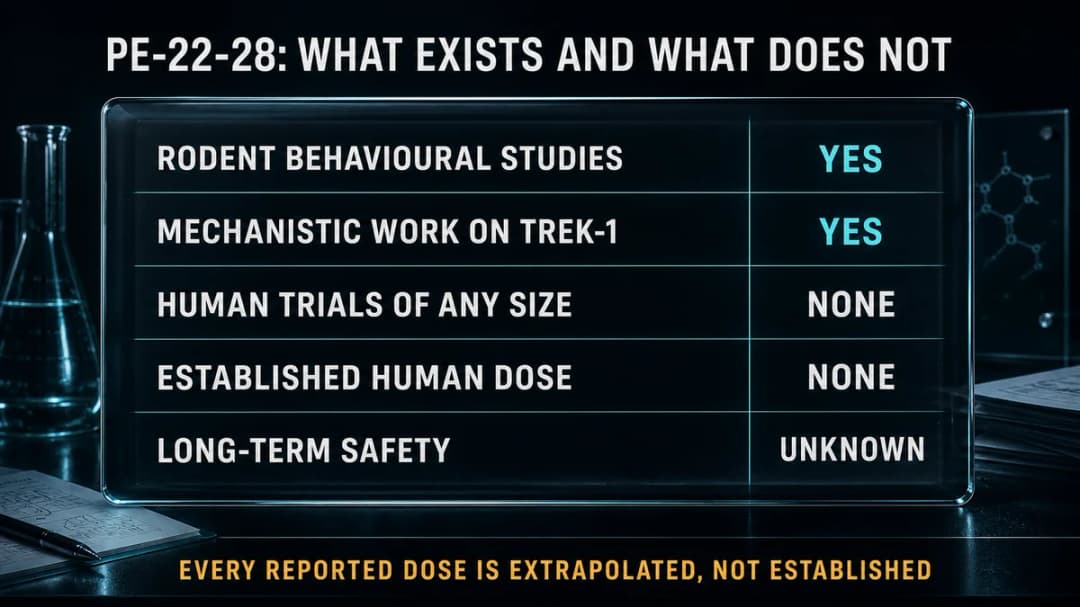
The sentence that has to sit alongside that one: no human clinical trial of this compound has been completed. There is no validated dose, no human safety data, and no approval anywhere.
What It Is
PE-22-28 is a truncated version of spadin, a seventeen amino acid peptide that is itself a fragment of the propeptide of sortilin. The shortening was deliberate, aimed at improving stability and potency over the parent molecule.
Its target is TREK-1, a two-pore domain potassium channel expressed in brain regions involved in mood regulation, including the dorsal raphe and prefrontal cortex.
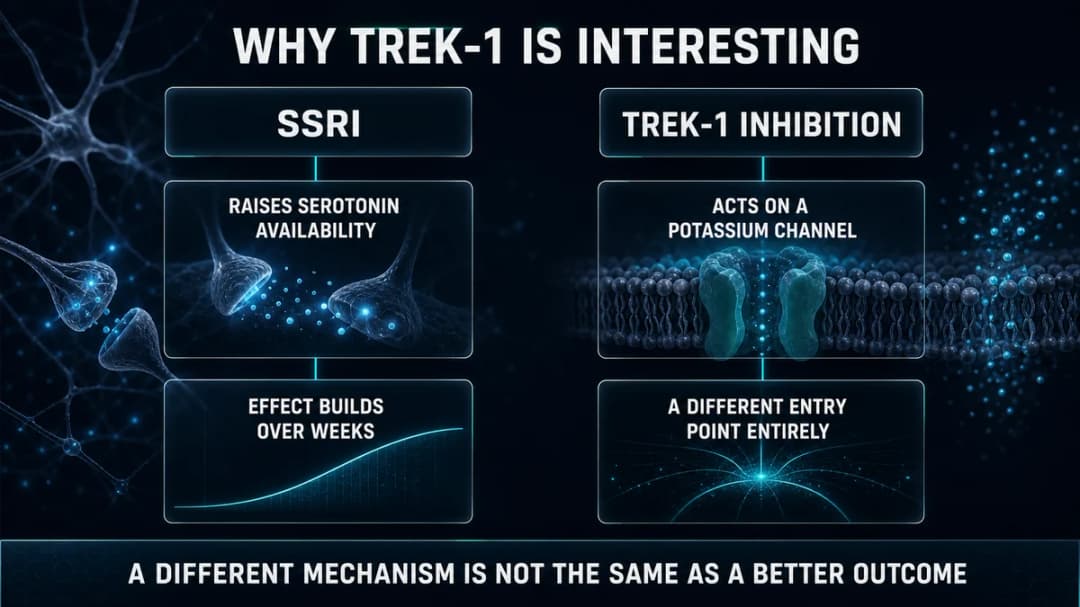
Why TREK-1 Is Interesting
The rationale here is stronger than for most compounds in this market, and it comes from genetics rather than from marketing.
Mice engineered without the TREK-1 channel display a phenotype that looks like the effect of successful antidepressant treatment, and they show it without any drug. That observation identified TREK-1 as a target worth pursuing: if removing the channel produces the effect, blocking it pharmacologically might too.
The mechanistic story runs through serotonin. TREK-1 activity reduces the excitability of serotonergic neurons. Blocking it increases the efficiency of serotonin signalling in the circuits SSRIs eventually influence, but directly rather than through the slow adaptive changes that make SSRIs take weeks to work.
That difference in timescale is the entire appeal. If an antidepressant mechanism can act in days rather than a month, it changes what is possible for people in acute crisis.
What the Animal Data Shows
- Antidepressant-like behaviour within about four days in mouse models, against four to six weeks for conventional antidepressants
- Increased hippocampal BDNF expression, which supports synaptic plasticity and is the mechanism shared with clinically effective antidepressants
- Promotion of hippocampal neurogenesis, again a shared feature with drugs that work
- Neuroprotection in ischaemia models, which has generated interest in stroke recovery
Each of those is a real finding. Each is in animals. The behavioural tests used in rodent depression research measure things like how long an animal struggles in an inescapable situation, which is a proxy for a human illness rather than a model of it, and the history of compounds that passed those tests and failed in people is long.
PE-22-28 Peptide Dosage: What Is Reported
There is no validated human dose, because there is no human trial.
Protocols circulating in the research market typically describe 1 to 5 mg subcutaneously once daily, usually in the morning. Those numbers are extrapolated from animal work rather than derived from anything tested in people, and the extrapolation involves exactly the kind of body-weight scaling that goes wrong.
Practical points that follow from the compound rather than from a protocol:
- It arrives as lyophilised powder and needs reconstitution with bacteriostatic water. See our bacteriostatic water guide
- Refrigerate after reconstitution and use within roughly four weeks
- It is difficult to source. Few vendors stock it, which is why it most often appears bundled with other compounds rather than sold alone. See our Calm + Clarity review
How It Compares With What People Actually Use
| Compound | Mechanism | Onset | Human evidence |
|---|---|---|---|
| PE-22-28 | TREK-1 potassium channel blockade | Days, in mice | None |
| SSRIs | Serotonin reuptake inhibition | Four to six weeks | Extensive, decades |
| Selank | GABA signalling, BDNF | Under an hour for anxiolysis | Small Russian clinical trials |
| Semax | BDNF, monoamine modulation | Same day | Russian clinical use |
| Ketamine | NMDA antagonism | Hours | Approved derivative, substantial trials |
The comparison worth drawing is with ketamine rather than with SSRIs. Ketamine established that rapid-acting antidepressant mechanisms exist, which made targets like TREK-1 credible rather than fanciful. What ketamine also demonstrates is how much work sits between a promising mechanism and an approved treatment.
For compounds in the same space with actual human data behind them, see our pages on Selank and Semax.
What Is Not Known
Almost everything that matters for a person considering it.
- Whether it works in humans at all
- What dose would be appropriate
- What it does over weeks or months
- How it interacts with antidepressants, anxiolytics or anything else. TREK-1 is expressed outside the brain as well, including in the cardiovascular system, and chronic blockade has not been characterised
- Whether the rapid onset in rodents reflects anything that would happen in a person
Anyone taking prescribed psychiatric medication should treat this as a hard stop rather than a caution. Adding an unstudied compound acting on serotonergic signalling to an existing regimen is not a manageable experiment, and depression is not a condition where experimenting with an unvalidated compound instead of treatment that works is a reasonable trade.
The Honest Position
PE-22-28 is one of the more scientifically interesting compounds sold in this market, and that is precisely why it should be described accurately rather than oversold. A novel target validated by knockout genetics, a plausible mechanism for rapid onset, and preclinical results that justify further study is a strong position for a research compound.
It is also, at present, a compound that has never been given to a person in a controlled setting. Both of those things are true, and the second one is the one that determines what anyone should do about it today.
FAQ
What is PE-22-28 used for?
In research, for antidepressant mechanism studies and, more recently, stroke recovery models. It is not approved or validated for any use in humans, and no clinical trial has been completed.
How does PE-22-28 differ from an SSRI?
Completely different mechanism. SSRIs block serotonin reuptake and work through slow adaptive changes over weeks. PE-22-28 blocks a potassium channel that constrains the excitability of serotonergic neurons, which in animals produces an effect within days.
What is the PE-22-28 dose?
There is no established dose. Protocols in the research market describe 1 to 5 mg daily by subcutaneous injection, extrapolated from animal studies rather than derived from human data.
Is PE-22-28 safe?
Unknown. There is no human safety data of any kind. That is not the same as evidence of harm, and it is not a basis for confidence either.
Can it be combined with an antidepressant?
Nobody has studied that, and it acts on the same broad signalling system that prescribed antidepressants target. Anyone on psychiatric medication should discuss any addition with their prescriber rather than experimenting.
Why is PE-22-28 so hard to find?
It is a niche compound with no clinical use, so few suppliers stock it. Where it does appear, it is often bundled with other nootropic peptides rather than sold on its own.