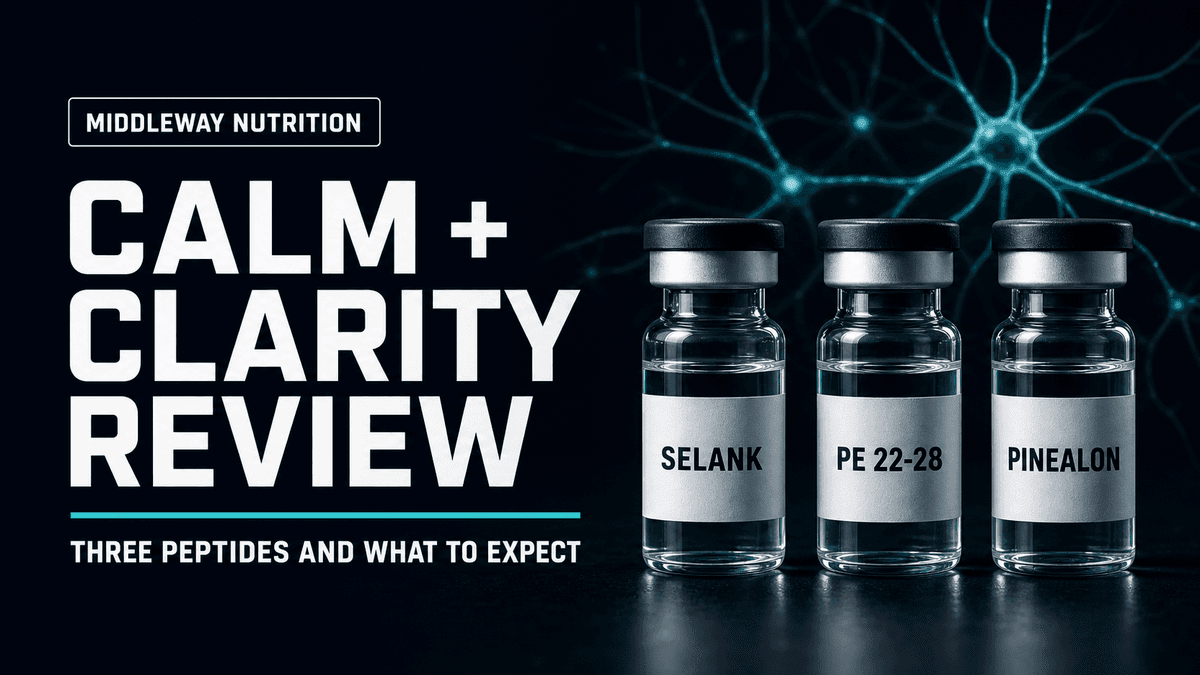
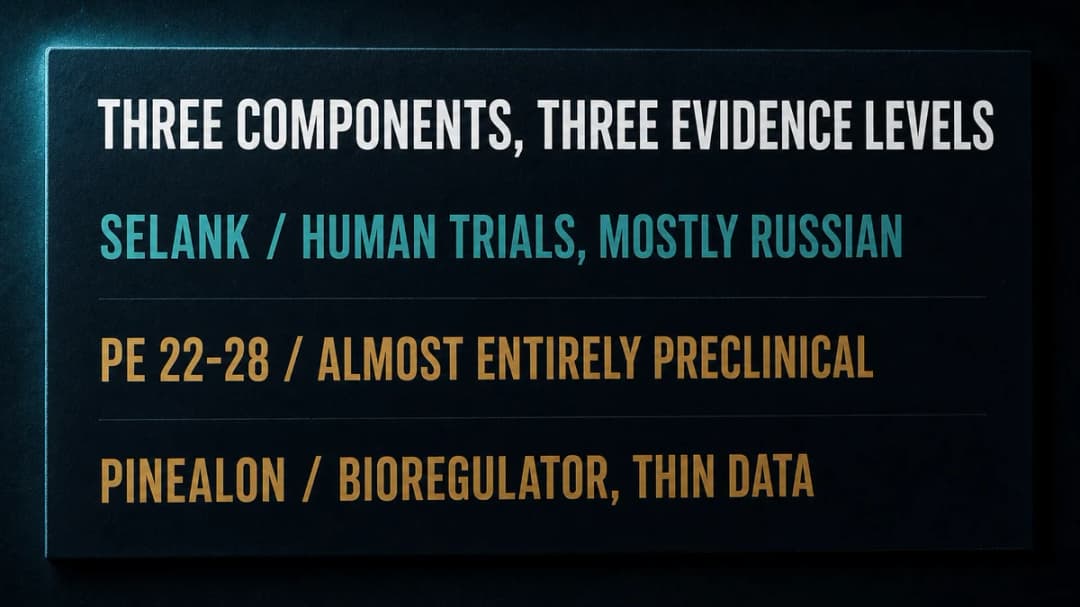
This Calm + Clarity review covers a three-peptide blend that pairs Selank, an anxiolytic with a real clinical history in Russia, with PE 22-28 and Pinealon, two compounds whose human evidence is close to nonexistent. Anyone reading a Calm + Clarity review should understand that split up front, because the three components are not on remotely equal footing.
The logic of the combination is coherent: daytime anxiety, mood, and sleep are three separate levers on the same problem. Whether pulling all three at once produces more than pulling the one that is well evidenced is an open question nobody has tested.
What Is in It
| Compound | Amount | Class | Human evidence |
|---|---|---|---|
| Selank | 10 mg | Tuftsin analogue, anxiolytic | Small Russian clinical trials, approved there |
| PE 22-28 | 10 mg | Spadin derivative, TREK-1 channel blocker | Animal models only |
| Pinealon | 10 mg | Tripeptide bioregulator | Russian bioregulator literature, largely unreplicated |
Three vials of lyophilised powder. Bacteriostatic water is bought separately.
Selank: The Component With Evidence
The anchor of the blend and the only part of it with human clinical work behind it. Selank is a synthetic analogue of tuftsin, extended with a stabilising tail so it survives long enough to reach the brain. It enhances GABA signalling without acting at the benzodiazepine site, which is the mechanistic explanation for calm without sedation, tolerance or dependence.
Russian trials in generalised anxiety compared it against a benzodiazepine over a two week course and reported comparable improvement on anxiety rating scales without the sedation. Those trials are small and open-label and have not been replicated independently, but they exist, which is more than can be said for the other two compounds here.
Onset is twenty to forty minutes intranasally, duration a few hours. See our Selank peptide guide.
PE 22-28: Interesting, and Almost Entirely Preclinical
PE 22-28 is derived from spadin, a natural peptide that blocks TREK-1, a potassium channel expressed in brain regions involved in mood regulation. TREK-1 inhibition is a genuinely interesting antidepressant target: animals lacking the channel show resistance to stress-induced depressive behaviour.
In animal models PE 22-28 has shown antidepressant-like effects at low doses, promotion of hippocampal neurogenesis, and a faster onset than conventional antidepressants, which take weeks. It also appears to enhance BDNF signalling.
Here is the part that usually gets left out. Every one of those findings is in animals. There is no human trial of PE 22-28 for depression, mood, or anything else. The mechanism is legitimately novel and worth watching. What it does in a person is unknown.
It is also difficult to source separately, which is part of the appeal of a blend that includes it. See our PE 22-28 peptide guide.
Pinealon: The Bioregulator
Pinealon is a three amino acid peptide from the Russian bioregulator tradition, the same line of work that produced Epithalon. The proposal is that short peptides derived from a given tissue influence gene expression in that tissue, and Pinealon's target is the pineal gland and melatonin production.
Reported findings include restored melatonin output in ageing animals, improved sleep architecture, and neuroprotection in low-oxygen models.
The caveat applies to the whole bioregulator category rather than to Pinealon specifically. Most of this literature comes from a single research group, the studies are old, sample sizes are small, and the work has not been replicated by independent laboratories anywhere. That does not mean the results are wrong. It means treating them as established is not justified. See our page on Pinealon.
Calm + Clarity Review: What Results Are Realistic
Given the above, here is an honest split.
| Result | Likely source | Confidence |
|---|---|---|
| Lower anxiety and stress reactivity within days | Selank | Reasonable |
| Easier focus under pressure | Selank, indirectly | Reasonable |
| Better sleep onset if anxiety was preventing it | Selank | Reasonable |
| Change in sleep architecture and depth | Pinealon, in theory | Unknown |
| Mood lift beyond the anxiety effect | PE 22-28, in theory | Unknown |
| Neurogenesis or long-term neuroprotection | PE 22-28 and Pinealon, in theory | Not demonstrated in humans |
Anyone running this blend and reporting that it worked is most likely describing the Selank. That is not a criticism of the product, it is a description of where the evidence sits. The other two compounds may be contributing something, and there is currently no way for a user to tell.
Reported Protocol
| Compound | Reported dose | Route | Timing |
|---|---|---|---|
| Selank | 250 to 500 mcg | Intranasal or subcutaneous | Morning and early afternoon |
| PE 22-28 | 1 to 5 mg | Subcutaneous | Once daily, usually morning |
| Pinealon | 100 to 300 mcg | Intranasal or subcutaneous | 30 to 60 minutes before sleep |
Course lengths of ten to twenty days, repeated a few times a year, follow the bioregulator convention rather than anything derived from trial data.
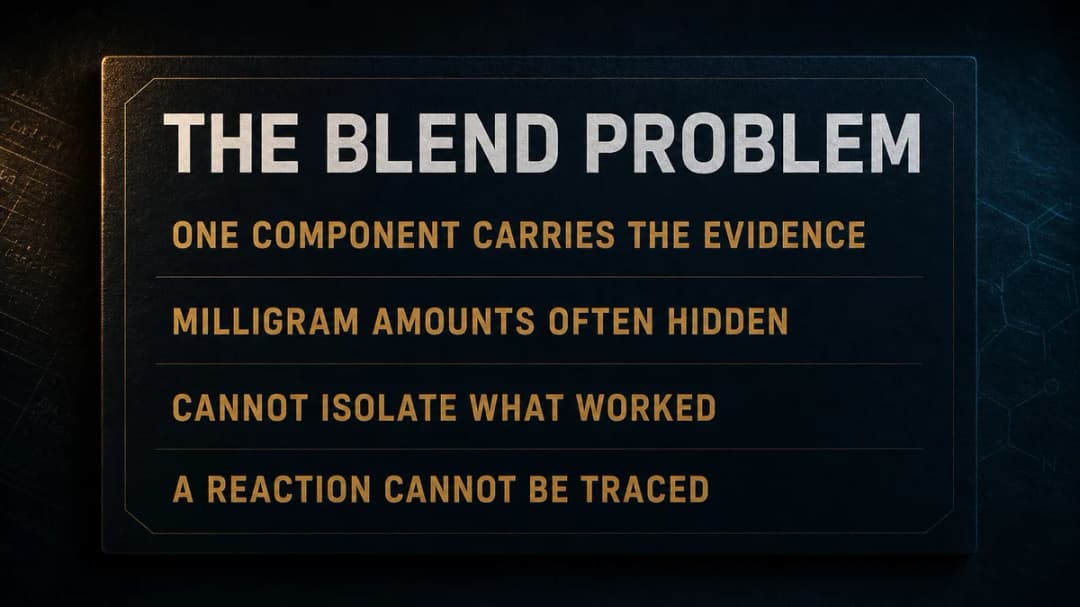
Running three compounds at once creates an obvious practical problem: if something works, or if something goes wrong, there is no way to attribute it. Anyone who has not used Selank before would learn more by running it alone first.
Value
The blend sits around the $130 mark at the time of writing, which is broadly what Pinealon and Selank cost bought separately, with PE 22-28 effectively included. That is a real value argument for anyone who specifically wants PE 22-28, since few vendors stock it. Prices move, so check current figures rather than trusting a number in an article.
The counter-argument is that paying for two compounds with no human evidence is only good value if you want them. For someone whose actual goal is less anxiety, buying Selank alone is cheaper and better supported.
Who It Suits
Reasonable fit: someone already familiar with Selank, interested in the TREK-1 mechanism specifically, and comfortable that most of what they are buying is preclinical.
Poor fit: anyone treating a diagnosed mood or anxiety disorder, anyone who wants to know which compound is doing what, and anyone taking psychiatric medication, since none of these three has been studied for interactions with anything.
FAQ
Can Selank be taken intranasally rather than injected?
Yes, and intranasal is the route used in the Russian clinical work. Selank's plasma half-life is only a few minutes, so nasal delivery to the central nervous system is what makes it practical at all.
How does this differ from a Selank and Semax stack?
The familiar pairing is anxiety plus cognitive activation. This blend swaps the activating compound for a novel antidepressant mechanism and adds a sleep-directed bioregulator. It is aimed at mood and sleep rather than at focus, and it is far less well evidenced.
Is PE 22-28 safe?
Nobody knows. There is no human safety data of any kind, only animal work. That is not the same as evidence of harm, and it is not a basis for confidence either.
How long does it take to notice anything?
The Selank component acts within about half an hour per dose, with a deeper effect over one to two weeks. Whatever the other two compounds do, if anything, would be slower and there is no timeline data to quote.
Should the three be started together?
It is the least informative way to do it. Starting with Selank alone establishes a baseline response, which makes any additional effect from the other two at least noticeable rather than invisible.