
PEG-MGF peptide is a pegylated version of mechano growth factor, a splice variant of IGF-1 that muscle produces locally in response to mechanical load, and the reported research dosage sits around 200 to 400 mcg two or three times a week. Everything interesting about the PEG-MGF peptide follows from one engineering decision: native MGF disappears from circulation in well under an hour, and attaching polyethylene glycol chains stretches that to days. Without the modification the compound would be unusable. With it, the compound is usable and still almost entirely untested in humans.
PEG-MGF is a research chemical. It is not approved for human use and is prohibited in tested sport.
What MGF is
When a muscle is loaded hard enough to cause damage, the IGF-1 gene in that tissue is spliced differently, producing a variant with a distinct C-terminal sequence. That variant is mechano growth factor. It appears early in the response to mechanical stress and is one of the signals that wakes satellite cells, the resident stem cells of skeletal muscle, out of dormancy.
Satellite cells matter because muscle fibres cannot make new nuclei on their own. When a fibre needs to repair or grow beyond a certain point, satellite cells fuse with it and donate nuclei. Anything that reliably increases satellite cell activation is, in theory, raising the ceiling on what a muscle can do rather than just accelerating a process.
That is the mechanistic argument. It is genuinely elegant and it has never been demonstrated to work in a person.
Why pegylation
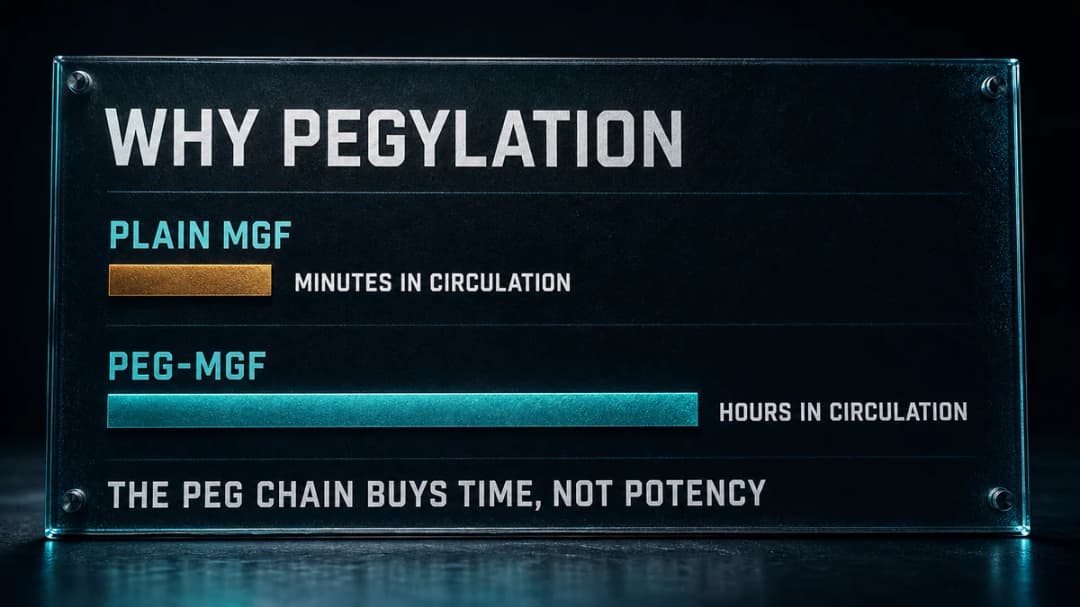
Native MGF has a circulating half-life measured in tens of minutes. Injected, most of it would be degraded before reaching anything useful. Pegylation attaches polyethylene glycol chains that physically shield the molecule from enzymes and slow renal clearance, extending its persistence to days.
The technique is well established and is used in several approved medicines, so this is not an exotic modification. What is unclear is whether a pegylated version of a locally acting signal behaves like the local signal it imitates. MGF evolved to appear in one damaged muscle for a short time. PEG-MGF circulates everywhere for days. Those are not obviously the same intervention.
PEG-MGF versus IGF-1 and IGF-1 LR3
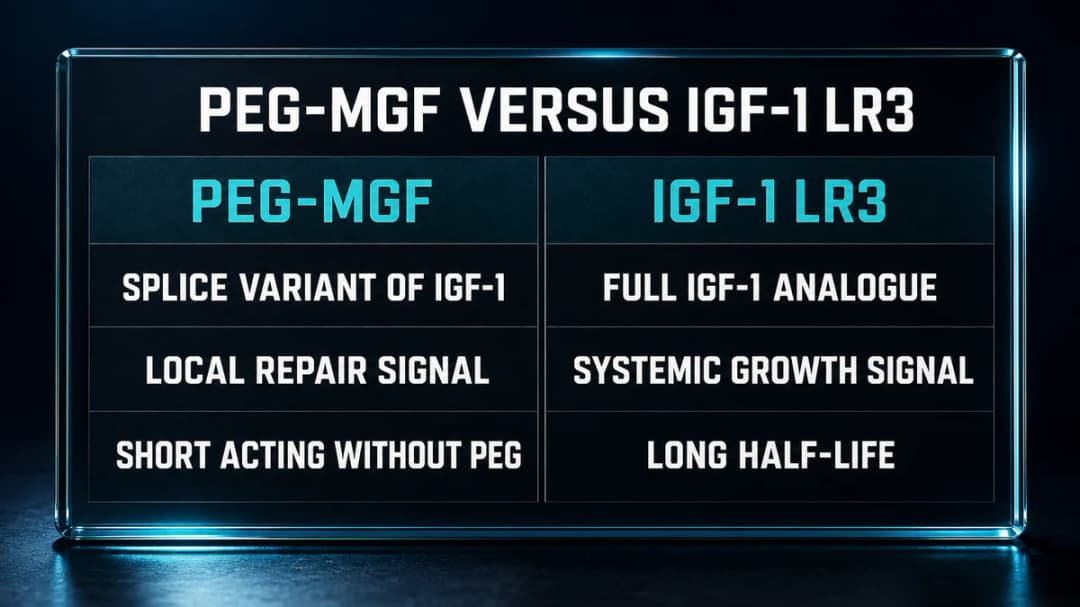
| Compound | Reported half-life | Main mechanism | Character of effect | Where it is used |
|---|---|---|---|---|
| Native IGF-1 | Minutes when unbound | IGF-1 receptor signalling | Strong, systemic | Rarely, the half-life makes it impractical |
| IGF-1 LR3 | Roughly 20 to 30 hours | IGF-1 receptor, resistant to binding proteins | Strong, systemic | General anabolism |
| PEG-MGF | Several days | Satellite cell activation via the MGF C-terminal sequence | Moderate, more local | Repair and recovery |
The practical distinction people draw is between growth and repair. IGF-1 LR3 produces a broad anabolic signal across the body, with the hypoglycaemia and mitogenic concerns that come with it. PEG-MGF is framed as a targeted repair signal with a milder systemic footprint.
That framing is partly marketing. A pegylated compound with a multi-day half-life is by definition circulating systemically, so "local" describes where the mechanism is thought to matter rather than where the drug goes.
PEG-MGF peptide dosage ranges reported in research
Given as a description of protocols in circulation, not as instructions.
| Approach | Amount | Frequency | Timing | Route |
|---|---|---|---|---|
| Conservative | 200 mcg | Twice weekly | Post-training or morning | Subcutaneous |
| Common | 200 to 400 mcg | Two to three times weekly | Post-training | Subcutaneous or intramuscular |
| Upper end | 400 to 500 mcg | Three times weekly | Post-training | Intramuscular |
| Injury-focused | 200 mcg | Three times weekly | Morning | Near the site or subcutaneous |
Cycles are typically four to six weeks, often four weeks on and four off. The reasoning for not dosing more frequently is the extended half-life: with a compound that persists for days, daily dosing accumulates, and concern about receptor desensitisation is the stated limit.
None of these numbers comes from a human dose-finding study. There is no published human pharmacokinetic profile for PEG-MGF, which means the doses in circulation were reasoned from animal work and adjusted by trial and error in the community.
What the research actually shows
The honest summary is that the evidence is preclinical and mostly indirect.
Cell studies of muscle-derived cells reported that the MGF C-terminal sequence drove proliferation of myoblasts while mature IGF-1 drove their differentiation, which is the origin of the claim that MGF is the more satellite-cell-specific of the two. Rodent injury models have reported faster functional recovery and less fibrosis with MGF administration, and local injection in rodent limb models has produced localised growth without the systemic effects seen with comparable IGF-1 doses. Work in aged animals has suggested that MGF can partly restore satellite cell responsiveness that declines with age.
What does not exist is a controlled human trial. Not for muscle growth, not for recovery, not for injury. The mechanisms are real biology, the animal results are interesting, and the leap to a person taking 300 mcg twice a week is an assumption rather than a finding.
Side effects and risks
Community-reported effects are mild: injection site redness and swelling for a day or two, some fatigue in the first week, mild transient water retention.
Two risks deserve more weight than the list suggests.
Hypoglycaemia. As an IGF-1 family compound, PEG-MGF can lower blood glucose. Reports suggest a milder effect than IGF-1 LR3, but "milder than a compound that can put people on the floor" is not reassurance. Dosing around a meal rather than fasted is the standard precaution.
Mitogenic signalling. Anything that promotes cell proliferation carries a theoretical concern about unwanted growth. The argument that PEG-MGF is safer here rests on its supposedly local action, which a multi-day circulating half-life undercuts. Nobody has studied this, so the risk is unquantified rather than absent.
There is also a purity problem specific to this compound. PEG-MGF is harder to synthesise and characterise than simpler peptides, and the pegylation step introduces variability that a basic purity figure does not capture. Identity confirmation on a certificate of analysis matters more here than for most peptides.
Who actually uses it
A narrow group. Strength athletes layering it onto training for recovery, usually alongside other compounds. People working through a muscle-tendon junction injury, where PEG-MGF is sometimes added during the later remodelling phase of a BPC-157 and TB-500 protocol. And older athletes, on the reasoning that satellite cell responsiveness declines with age and this is the pathway that addresses it.
It is not a first compound. Anyone who has not worked through the better-documented options has no reason to start with a peptide that has thinner evidence, higher synthesis complexity and a blood glucose effect. For what does and does not have support in this category, see peptides for muscle growth.
FAQ
What does the PEG in PEG-MGF stand for?
Polyethylene glycol. Attaching PEG chains to the peptide shields it from enzymatic breakdown and slows clearance, extending the half-life from under an hour for native MGF to several days. Without that modification, injected MGF would degrade before reaching target tissue in useful amounts.
Is PEG-MGF better than IGF-1 LR3?
They do different things. IGF-1 LR3 produces a stronger systemic anabolic signal along with a stronger hypoglycaemia risk. PEG-MGF is aimed at satellite cell activation and repair. Neither has human trial evidence, so any ranking between them is mechanistic argument rather than data.
How is PEG-MGF injected?
Reported protocols use subcutaneous injection for general use and sometimes intramuscular injection near a targeted muscle. The rationale for injecting near the target follows from MGF's local biology, but there is no good evidence that it outperforms subcutaneous injection given the pegylated compound's systemic distribution.
Can PEG-MGF be stacked with BPC-157?
They are commonly combined for injury work, with BPC-157 aimed at the early inflammatory and vascular phase and PEG-MGF added later during remodelling. No adverse interaction has been reported, though as with most peptide combinations, no study has tested it.
Does PEG-MGF cause low blood sugar?
It can, as a shared property of IGF-1 family compounds, and reports suggest the effect is milder than with IGF-1 LR3. Dosing with food rather than fasted is the usual precaution, and anyone with unstable blood glucose should treat this as a reason to avoid it.
How long does PEG-MGF take to work?
Users typically describe recovery changes around weeks two to three, with anything attributed to satellite cell activity taking four to six weeks. Since no trial has measured this and the compound is normally used alongside training changes, these timelines describe expectation rather than measured effect.