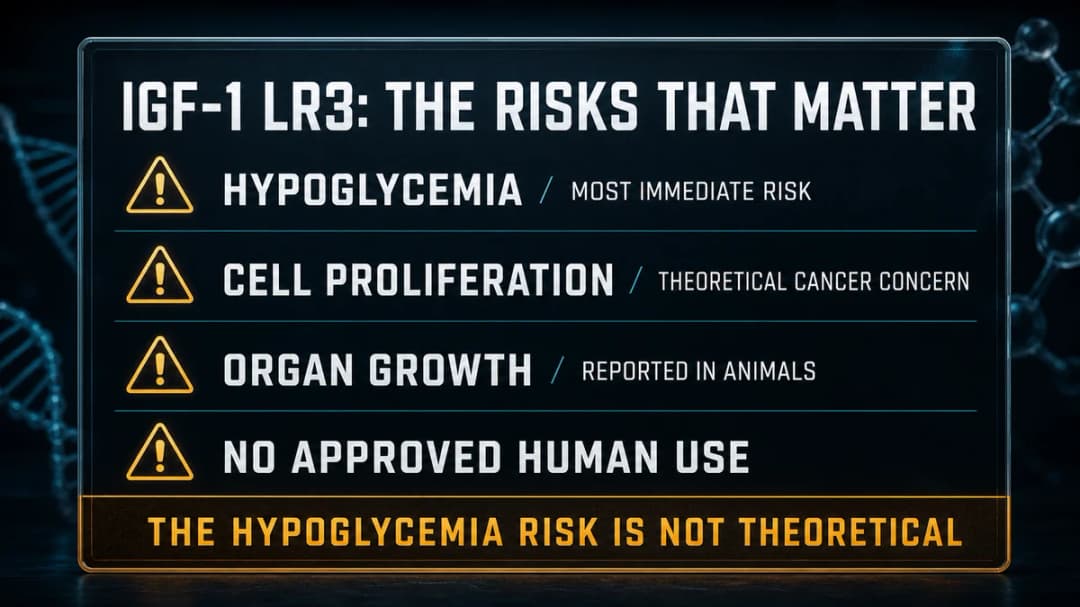
IGF-1 LR3 has no approved human use in any country. Its one sanctioned commercial role is as a cell culture reagent, dosed into bioreactors to keep mammalian cell lines dividing during biologics manufacturing. Everything else comes from animal work, from mechanism, or from people reporting on themselves.
- IGF-1 LR3 is an 83 amino acid analog of insulin-like growth factor 1: the native 70 amino acid protein with arginine swapped in at position three and a 13 residue N-terminal extension.
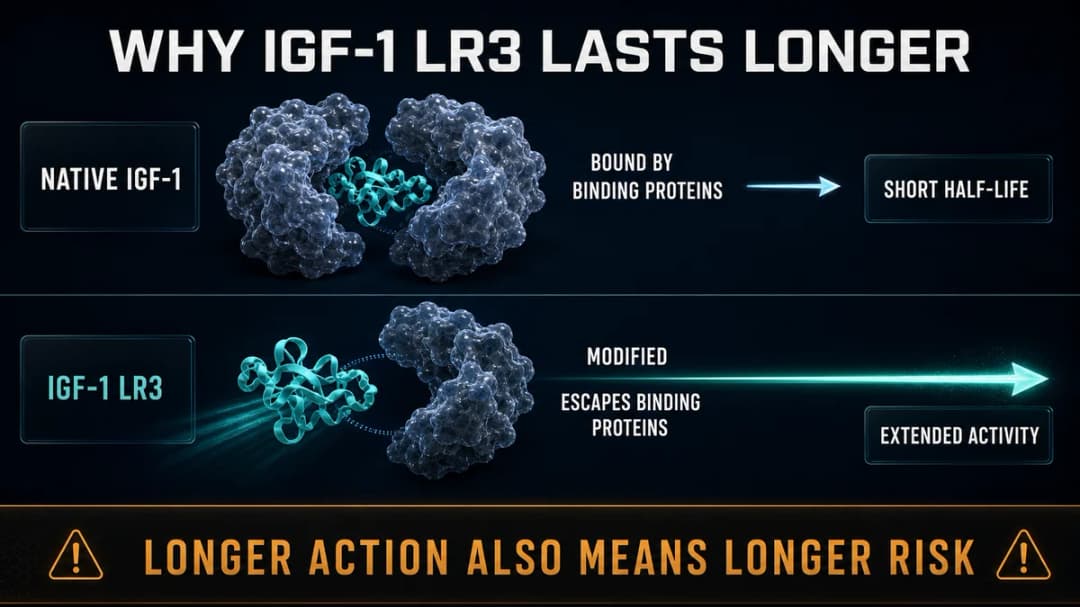
- Both modifications cut its affinity for the IGF binding proteins that sequester almost all circulating IGF-1, so far more stays free and receptor-active.
- Hypoglycemia is the acute risk that deserves top billing. Free IGF-1 at supraphysiologic levels drives glucose uptake and suppresses hepatic glucose output, and a long half-life prolongs that window.
- IGF-1 receptor signaling is mitogenic and anti-apoptotic by design, which is why sustained unbuffered signaling raises a real theoretical concern about promoting cells you would rather not promote.
- No human pharmacokinetic or safety study of IGF-1 LR3 exists. Every half-life figure and dosing number in circulation is extrapolated, vendor-supplied or anecdotal.
What IGF-1 LR3 Is, Structurally
Insulin-like growth factor 1 is a 70 amino acid protein, structurally related to proinsulin, produced mainly by the liver in response to growth hormone. It is the messenger carrying out most of what growth hormone gets credited with: protein synthesis, cell survival, tissue growth. That upstream relationship, growth hormone pulse to hepatic IGF-1 output, is unpacked further in the CJC-1295 and IGF-1 explainer.
IGF-1 LR3 keeps that 70 residue core and changes two things. Glutamic acid at position three is replaced with arginine, the R3 in the name. A 13 amino acid extension derived from a growth hormone sequence is fused to the N-terminus, the Long part. Together that gives 83 residues and roughly 9.1 kDa, far larger than the short synthetic peptides most research suppliers handle, and it is produced recombinantly in bacterial systems rather than by solid-phase synthesis.
Neither modification was made to increase potency. At the receptor itself, LR3 is broadly comparable to native IGF-1. The modifications exist to get it past a control system.
Why Escaping the Binding Proteins Changes Everything
Native IGF-1 does not float freely in blood. The overwhelming majority of it, commonly put at well above 95 percent, travels bound to IGF binding proteins, principally IGFBP-3, which assembles with an acid-labile subunit into a ternary complex too large to leave the vasculature easily. The system is both reservoir and brake, releasing free IGF-1 into tissue in a regulated way.
That is what IGF-1 LR3 was engineered to defeat. Both modifications sharply reduce binding protein affinity, so the molecule stays free, crosses into tissue, and keeps signaling. It is why LR3 works as a cell culture additive, where an uninterrupted proliferative signal is the entire point, and why the safety questions are sharper than for a molecule the body can still buffer. The rheostat has been removed, and the rheostat was doing real work.
Persistence figures reflect it. Free native IGF-1 clears within minutes, while IGF-1 LR3 is widely reported to last far longer, with cited figures ranging roughly from 20 to 30 hours. Treat that as an estimate rather than a measurement. It comes from animal and in vitro work plus supplier literature, not human pharmacokinetics, and the spread is itself informative.
IGF-1 LR3 Compared With Related Molecules
| Molecule | Structure | Binding protein affinity | Reported persistence | Status |
|---|---|---|---|---|
| Native IGF-1 | 70 amino acids | High, mostly bound in a ternary complex | Free fraction gone in minutes | Endogenous hormone |
| Mecasermin | Identical to native IGF-1 | Normal | Short, dosed with meals | FDA approved for severe primary IGF-1 deficiency |
| IGF-1 LR3 | 83 amino acids: R3 substitution plus 13 residue extension | Sharply reduced | Roughly 20 to 30 hours, unverified in humans | No human approval; research and cell culture reagent |
| DES(1-3) IGF-1 | 70 amino acid core minus three N-terminal residues | Reduced | Short | No human approval; research reagent |
The mecasermin row is the useful anchor. A recombinant IGF-1 drug does exist, prescribed for children with severe primary IGF-1 deficiency, and its labeling carries a prominent hypoglycemia warning plus instructions to dose around food. That is a molecule with normal binding affinity and rapid clearance. IGF-1 LR3 is the version built to avoid both moderating features, and it has been through none of the evaluation mecasermin went through.
Hypoglycemia: The Risk That Deserves Top Billing
IGF-1 and insulin are structurally related and their receptors are close cousins. IGF-1 binds the insulin receptor weakly, the two receptors form hybrids that respond to both, and the IGF-1 receptor itself drives glucose uptake into skeletal muscle through PI3K and Akt, the same pathway insulin uses.
Under normal physiology this barely registers, because binding proteins keep free IGF-1 low. Remove that constraint and add an exogenous dose, and the insulin-like effect stops being negligible. Muscle pulls glucose out of circulation, the liver reduces its output, and blood sugar falls.
Two features make this worse than a comparable insulin effect rather than better.
The first is duration. Rapid-acting insulin has a defined, relatively short action window people learn to manage with food. A molecule reported to persist for the better part of a day does not offer that. One meal does not close the window, and hypoglycemia can recur hours after someone decides the risk has passed.
The second is variability. With no human dosing data, no pharmacopeial standard for gray market material, and no way to confirm concentration or purity, the delivered dose is uncertain in both directions, and reconstitution errors compound it.
Symptoms follow the standard pattern: shakiness, sweating, hunger, palpitations, blurred vision, confusion, and at lower glucose levels seizure and loss of consciousness. The overnight case is what turns a manageable event into an emergency, because the warning symptoms arrive while someone is asleep. Risk compounds with anything else that lowers glucose, including insulin, sulfonylureas, prolonged fasting, alcohol and hard training.
The Cancer and Proliferation Question
This one gets dismissed too quickly in both directions, so it is worth stating precisely.
The IGF-1 receptor is a receptor tyrosine kinase with two major downstream arms. The PI3K/Akt/mTOR arm drives protein synthesis and suppresses apoptosis. The MAPK/ERK arm drives cell cycle progression. Those are the intended effects. In a different context they are also exactly what a tumor needs: more division, less programmed cell death.
Three observations make the concern more than hand-waving. Higher circulating IGF-1 within the normal range has been associated in observational epidemiology with modestly increased incidence of several common cancers, notably prostate, breast and colorectal. Acromegaly, a state of chronic growth hormone and IGF-1 excess, carries increased colorectal neoplasia risk, which is why surveillance is part of managing it. At the opposite end, people with Laron syndrome, who cannot generate IGF-1 in response to growth hormone, show strikingly low cancer incidence.
None of that establishes that IGF-1 LR3 causes cancer. Association is not causation, the epidemiology concerns endogenous variation rather than injected analogs, and no human study of this compound exists. IGF-1 is not a mutagen and does not create the initiating damage.
The honest framing is promotion rather than initiation. This is a growth and survival signal delivered indiscriminately to every tissue expressing the receptor, which is nearly all of them. If cells with existing damage are present, and in most adults some are, sustained unbuffered signaling is not the environment you would choose for them. The concern is amplified for LR3 because the binding protein layer that modulates tissue-level signal has been engineered out, and several of those proteins have independent growth-inhibitory roles of their own.
Other Reported Effects and Open Questions
Beyond glucose and proliferation, the reported effects match what excess IGF-1 signaling would predict, though the data behind them is thin.
- Fluid retention, puffiness in the hands and face, and joint aching, familiar from the growth hormone axis generally
- Headache. Raised intracranial pressure is documented in the mecasermin literature, worth taking seriously in any IGF-1 context
- Tissue growth that is not selective for skeletal muscle. Visceral organ enlargement has been reported in animal work with IGF-1 analogs
- Injection site reactions, which for a bacterially expressed protein also raise an endotoxin question if purification fell short of pharmaceutical standards
- Immunogenicity, genuinely unstudied. LR3 is not a human sequence, and repeated exposure to a non-native protein can provoke antibodies. Whether those would neutralize only the analog or cross-react with endogenous IGF-1 is unknown
One feedback effect gets missed often. IGF-1 exerts negative feedback on growth hormone secretion at the hypothalamus and pituitary, so raising it exogenously suppresses the body's own output, making a stack with a secretagogue partly self-cancelling. Upstream approaches work with that loop rather than against it, which is the design logic behind the tesamorelin peptide guide, the CJC-1295 peptide guide and the ipamorelin peptide guide.
Reported Dosing Ranges, and Why Site Injection Logic Fails
Dosing has never been established in humans, and nothing below is guidance. What circulates in bodybuilding contexts is roughly 20 to 50 mcg daily, occasionally higher, run in short blocks of a few weeks and timed around training. Those figures have no clinical basis. They emerged from forums rather than dose-finding studies, and the wide spread reflects that.
The most common technique claim fails on the compound's own mechanism. Injecting into a specific trained muscle to produce localized growth assumes the molecule stays where it is put. It largely does not, for the same reason it was attractive in the first place. Extracellular matrix binding proteins are part of what retains a growth factor near an injection site, and LR3 was purpose-built for low affinity to that system. The change extending systemic exposure is the change undermining local retention.
People weighing this compound are usually really asking about raising IGF-1 at all, and the pathways that do it indirectly leave the feedback loop and the binding protein buffer intact. The oral secretagogue route is covered in the MK-677 guide, and the broader picture of what the growth hormone axis realistically delivers sits in the peptide therapy guide.
Sourcing, Purity and Anti-Doping Status
Practical realities separate this compound from smaller research peptides. A 9.1 kDa recombinant protein implies bacterial expression, purification and endotoxin control, none of which a buyer can verify from a label. Certificates of analysis here are inconsistently sourced and sometimes recycled between batches, and misidentification between LR3 and DES(1-3) IGF-1 happens. As a protein rather than a short peptide it is also sensitive to heat, agitation and freeze-thaw cycles, so cold chain failures degrade material invisibly. Our guide to where to buy IGF-1 LR3 sets out what to verify before paying.
IGF-1 and its analogs are prohibited at all times under the World Anti-Doping Agency's peptide hormones and growth factors category. In the United States it is not an approved drug and not a lawful dietary supplement ingredient. It is sold as a research reagent, which is an accurate description rather than a loophole.
Frequently Asked Questions
Is IGF-1 LR3 the same as the approved drug mecasermin?
No. Mecasermin is recombinant human IGF-1, identical to the native 70 amino acid protein, approved for severe primary IGF-1 deficiency and dosed with attention to food because of hypoglycemia risk. IGF-1 LR3 is an 83 amino acid analog engineered to evade binding proteins, has never been approved for human use, and has no equivalent safety evaluation behind it.
How long does IGF-1 LR3 stay active in the body?
Nobody has measured it properly in humans. The widely repeated range of roughly 20 to 30 hours comes from animal and in vitro work plus supplier literature. What is mechanistically clear is that it persists far longer than free native IGF-1, which clears within minutes, because it resists the binding protein pathway governing the native hormone.
Does IGF-1 LR3 cause cancer?
No human study answers that, and claiming it does would go beyond the evidence. The concern is mechanistic and indirect: IGF-1 receptor signaling promotes cell division and suppresses apoptosis, higher endogenous IGF-1 has been associated observationally with modestly higher incidence of some cancers, and chronic IGF-1 excess carries elevated neoplasia risk. The worry is promoting existing abnormal cells, not initiating damage.
Why is hypoglycemia the main acute risk?
Because IGF-1 acts on the insulin receptor and on insulin-receptor hybrids, and IGF-1 receptor activation drives glucose uptake through the same Akt pathway insulin uses. Binding proteins normally keep free IGF-1 too low for that to matter. LR3 removes the constraint, so the low-glucose window can run for many hours, including overnight when warning symptoms go unnoticed.
Can IGF-1 LR3 be used for site-specific muscle growth?
The mechanism argues against it. Local retention depends partly on binding to extracellular matrix binding proteins, and LR3 was engineered for low affinity to that system, so the modification extending systemic exposure is the same one reducing local retention. No human evidence supports localized hypertrophy from injection technique.