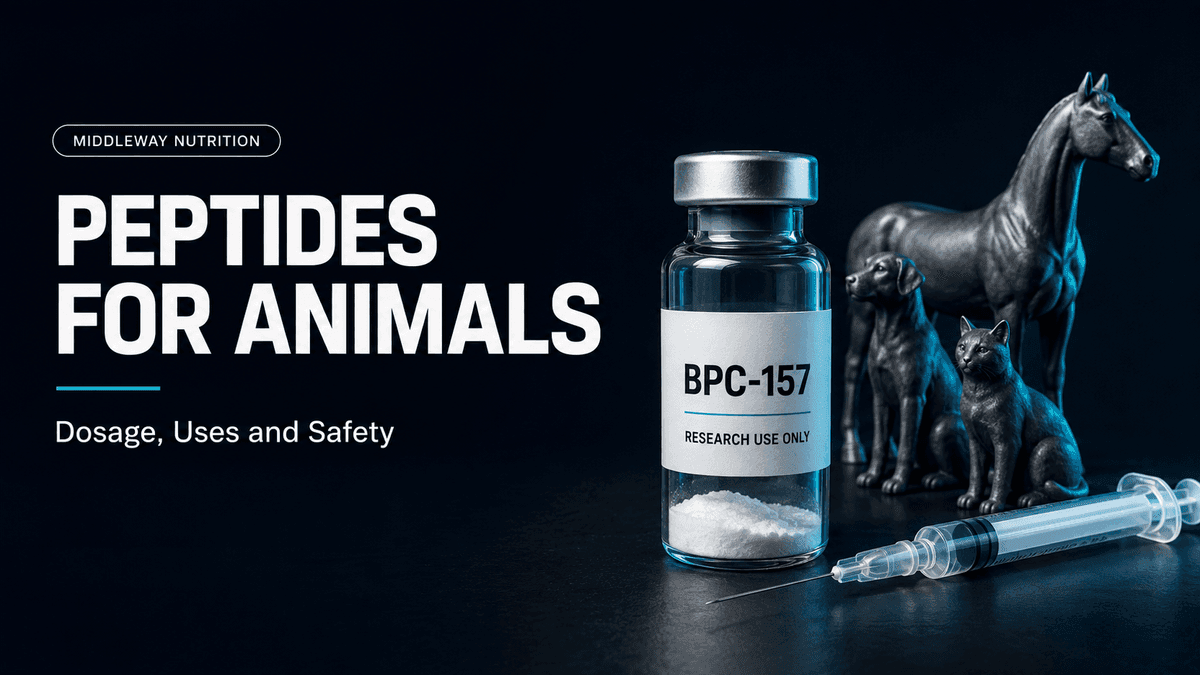
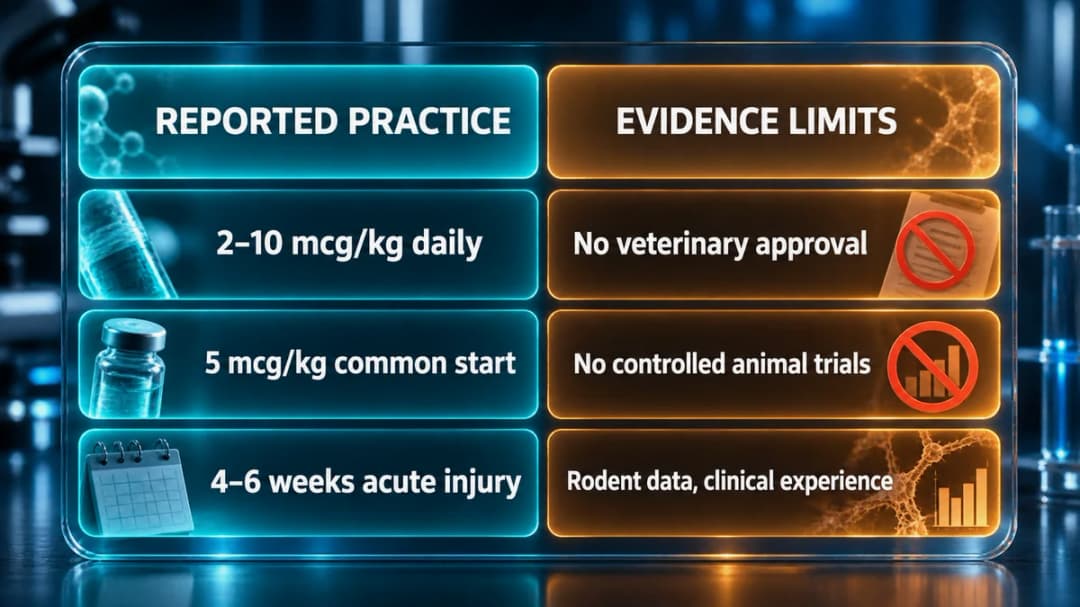
Peptides for animals are dosed off bodyweight, and the working band runs from 2 to 10 micrograms per kilogram a day. Where joints and soft tissue are the target, 5 mcg/kg is where almost every protocol opens. Not one of these compounds holds veterinary approval, and what sits behind them is rodent data and accumulated clinical experience, not controlled trials in dogs, cats or horses.
Almost everyone reading about peptides for animals has arrived by the same route. A dog is getting old, the anti-inflammatories and the joint powders have been tried, and the vet has run out of suggestions that sound new. Arriving there is understandable. What matters is knowing what the dosage figures below are and are not: they describe what off-label veterinary practice does, and nothing in them has been through an approval process.
The Six Compounds That Account for Most Use
Catalogues run to dozens of products. Real protocols keep returning to the same handful.
| Peptide | Mechanism in brief | Most used for | Species |
|---|---|---|---|
| BPC-157 | A 15 amino acid sequence of gastric origin; drives new vessel growth and repairs mucosal lining | Joints and tendons, inflamed gut, recovery after an operation | All three species |
| TB-500 | Fragment of thymosin beta-4; moves cells to where they are needed and wakes up tenocytes | Damaged tendons and ligaments, torn muscle | Established in horses before dogs |
| GHK-Cu | A tripeptide carrying copper; signals for collagen and elastin | Open wounds, skin and coat condition, scarring after surgery | Fine in dogs and horses, treat cats carefully |
| KPV | The tail end of alpha-MSH, and anti-inflammatory in its own right | Colitis, IBD, itchy allergic skin | Both dogs and cats |
| Thymosin alpha-1 | Comes from the thymus; adjusts how T cells behave | Propping up immunity, recovery after illness | Cats and dogs alike |
| Epithalon | Pineal tetrapeptide | Ageing and healthspan attempts in older animals | Dogs, and the weakest evidence base here |
Most owners begin with BPC-157, partly on price and partly because one vial covers two unrelated problem areas, the musculoskeletal and the gastrointestinal. TB-500 tends to be reached for when the diagnosis is specifically a tendon or a ligament. Yards and equine vets were using it for exactly that long before anyone was writing about peptides for people.
Pairing the two is common. Since they push on separate cellular mechanisms, running both is a defensible position rather than simple maximalism, which is more than can be said for most stacks.
Peptides for Animals: Dosage by Bodyweight
Dosage scales with the animal, in micrograms per kilogram rather than as a flat amount.
| Tier | Daily dose | Typical use | Notes |
|---|---|---|---|
| Low | 2 mcg/kg | Holding pattern, low-grade inflammation, digestive support | Where protocols tend to settle after the acute phase passes |
| Standard | 5 mcg/kg | Everyday joint pain, soft tissue repair, recovery after surgery | Where nearly everyone begins, whatever the species |
| High | 10 mcg/kg | Sudden or severe injury | Kept brief, and the tier least suited to doing without a vet |
What that means in practice:
| Animal | Bodyweight | Dose at 5 mcg/kg |
|---|---|---|
| Cat | 4 kg | 20 mcg |
| Small dog | 10 kg | 50 mcg |
| Medium dog | 25 kg | 125 mcg |
| Large dog | 45 kg | 225 mcg |
| Horse | 500 kg | 2,500 mcg (2.5 mg) |
On length, an acute injury is usually worked for four to six weeks and a gut problem for six to eight, at which point the animal comes off and gets looked at again. Running any of this indefinitely is not how these compounds are normally used.
Why the Dilution Maths Bites Harder in Animals
Here is the step that ambushes owners. Follow a human reconstitution recipe on a 10 mg vial and a cat or a terrier ends up needing a volume too small to see. At 5,000 mcg per mL, a 20 mcg dose sits at four tenths of one unit on an insulin syringe. That is not a measurement, it is a guess.
Squinting harder does not solve it. More bacteriostatic water in the vial means a weaker solution, and a weaker solution pushes that same tiny dose up the barrel to where the printed lines are. So decide the dose first, then pick the volume of water that lands it somewhere between the 5 and 30 marks. Our peptide reconstitution calculator handles the sums, and how to use peptides sets out the method behind them.
What you give up is shelf life. Diluting further does not extend the two to four week post-mixing window, so with a genuinely small animal it is normal to discard a vial with solution still in it.
Needle or by Mouth
The needle is the default and the dependable option. Loose skin over the neck and shoulders gives dogs and horses an easy target, and the animals themselves generally object less than the person holding the syringe expects.
Oral dosing earns its place in exactly one situation, which is when the digestive tract is the thing being treated. Getting the compound into the bloodstream stops being the objective if the mucosa it needs to reach is right there, and BPC-157 is reputed to survive gastric conditions reasonably well. KPV has its own way in, through the peptide transporters lining the intestine. So oral has a real argument behind it for colitis and IBD. For anything involving a joint or a tendon, that argument disappears.
What Is Actually Known About Safety
Over a decade of clinical use, vets working with these compounds have not reported serious adverse events, and unlike the NSAIDs that older animals often end up on long term, peptides do not come with a known organ toxicity burden. Both of those are worth something. Neither substitutes for a controlled safety study, and in companion animals no such study has been run.
Three questions are worth putting to a vet directly.
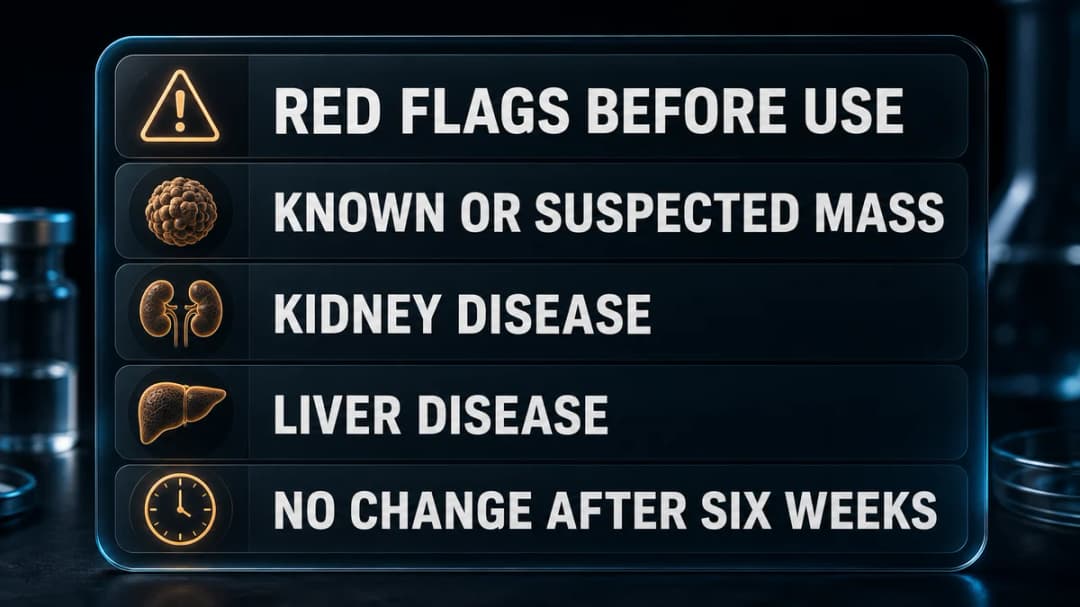
The blood vessel problem. Angiogenesis is how BPC-157 and TB-500 do their work, and it is the reason a damaged tendon rebuilds. The uncomfortable corollary is that a tumour already present also needs a blood supply. Nothing in the literature shows either compound causing cancer, but declining to use them in an animal carrying a known or suspected mass is a defensible line to draw. Raise this before anything else if the animal is elderly, since that is where undetected masses are most likely.
What is actually in the vial. Nothing obliges a research supplier to put in the vial what the label claims, and contamination was the FDA's original reason for placing several of these compounds under Category 2 review. Insist on a certificate of analysis from an independent lab that names the batch you are buying. That is the floor, not a mark of quality.
Organs that are already struggling. BPC-157's protective results in rodent kidney and liver work came from animals whose organs were healthy to begin with. Nobody knows what it does in an animal already living with chronic kidney disease, and in cats that is not a theoretical scenario. GHK-Cu raises a different flag, since the liver is what clears the copper it carries.
The Regulatory Position
Nothing described in this article holds FDA approval for animals. Once a drug is compounded from a bulk substance for veterinary use, it is legally an unapproved drug. The agency has published guidance setting out when it does not plan to take enforcement action over certain veterinary compounding, which is a promise not to prosecute rather than permission to proceed. Your vet has to care about that difference. As an owner, you mostly do not.
The human-side compounding picture for several of these peptides has shifted more than once while under review, and it may shift again. Treat any dated statement about what a pharmacy is currently allowed to prepare, this page included, as something to check with the pharmacy itself. Our are peptides legal overview explains the framework underneath it.
Where that leaves an owner is somewhere ambiguous. These compounds have not been approved and have not been banned, they are sold openly for laboratory use, and vets who have read enough to be comfortable use them off-label.
Two Sourcing Routes
Your vet writes it and a compounding pharmacy fills it. What arrives is made for animals, at a concentration someone has verified, and a licensed professional has put their name to the prescription. The price reflects that, and the harder part is finding a vet prepared to write it in the first place, because plenty will not.
You buy research grade and do the rest yourself. Realistically this is where most owners land. What turns up is freeze dried powder in a vial labelled for laboratory use, and mixing it and working out the dose falls to you. Suppliers differ enormously in what they actually ship, so restrict yourself to ones that publish independent test results tied to the specific batch. Our best peptide vendors guide sets out what that paperwork should contain.
FAQ
Is it safe to give peptides to a dog or a cat?
Ten years and more of off-label use in practice have not thrown up serious adverse events, but nobody has run a controlled safety trial in companion animals, so the word safe here means only that no harm has shown up in uncontrolled use. Save the real caution for animals carrying a diagnosed or suspected tumour and animals already managing kidney or liver disease.
Can my dog use the vial I bought for myself?
Chemically, yes, because the research market has never made a separate animal version. The difference lies entirely in how much and how dilute. Dogs work out at roughly 2 to 10 mcg per kilogram, which for most of them sits under a human dose, so the answer is usually a differently mixed vial rather than a smaller draw from your existing one.
What should a first-time owner reach for?
For most presentations, BPC-157. Its use spans more situations than the others, it addresses joints and digestion alike, and a vet with any peptide experience has probably used it. Swap that for TB-500 when the injury is a confirmed tendon or ligament problem, which is doubly true in horses.
When should something start to change?
Reports of easier movement often land at the one to two week mark. Long-standing arthritis is slower, and four to six weeks is the more realistic window there. Digestive problems tend to turn around sooner than either. Six weeks with nothing to show for it is a signal to stop rather than to persist.
Are horses a separate exercise?
The per kilogram logic carries over unchanged, though 500 kg makes the arithmetic look very different, and there is a complication no dog or cat owner deals with. Competition bodies almost universally ban these compounds, so where a course sits relative to the calendar can matter more than the protocol on paper.