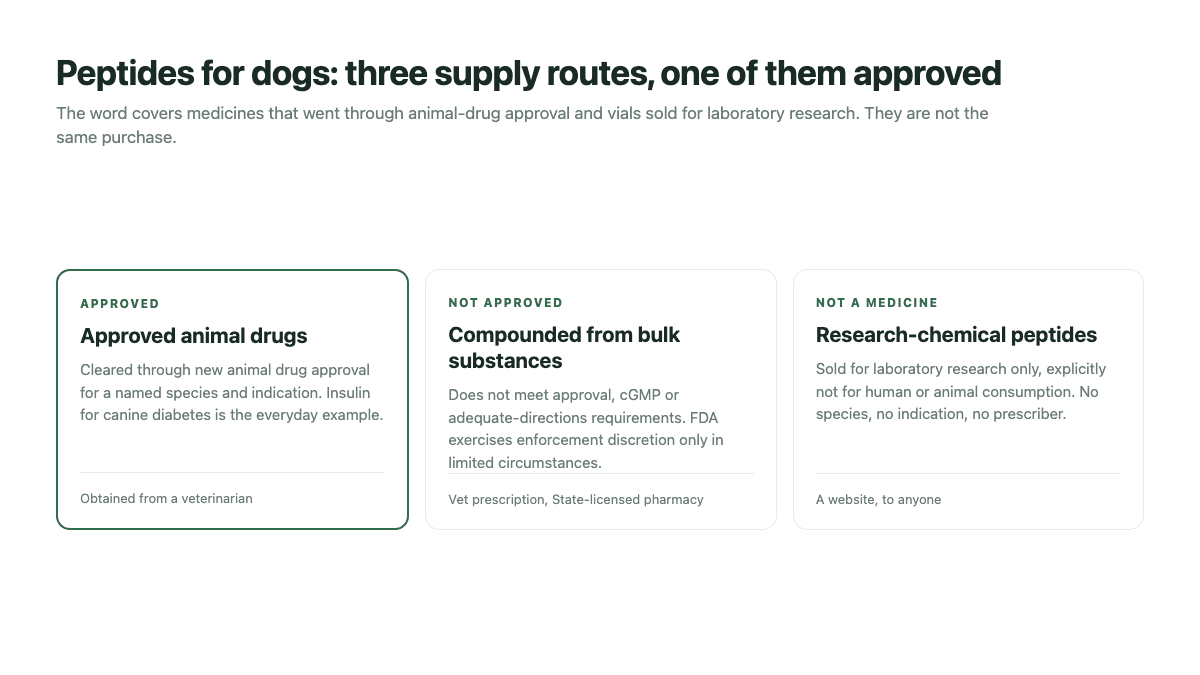
Peptides for dogs are three different things wearing one word. Some are FDA approved animal drugs your veterinarian already prescribes. Some are compounded from bulk drug substances, which is not approval but is tolerated in narrow circumstances through a vet and a State-licensed pharmacy. Nothing on a research-peptide website belongs to either group.
Most owners arrive the same way. An older dog is slower on the stairs, or a younger one is weeks out from a cruciate repair, and somewhere between a forum thread and a product page the word "peptides" turns up. It rarely comes from the practice that has weighed that dog for years.
This is a nutrition desk, so the running order is deliberate. Body condition, diet, a diagnosis and the approved treatments come first, and for most dogs they are the part with evidence behind them.
Key Takeaways
- Some peptide medicines for dogs are FDA approved. Insulin is a peptide, and Merck Animal Health describes Vetsulin (porcine insulin zinc suspension) as "the first FDA-approved insulin for use in dogs and cats with diabetes"
- Nothing on a research-peptide website is approved for a dog. Even the tolerated compounding route runs through a veterinarian and a State-licensed pharmacy, not a checkout page
- There is no "dietary supplement" category for animals in US law. FDA treats such a product as either a food or a new animal drug
- Body weight is the lever with the strongest canine evidence. In a supervised study of obese dogs with osteoarthritis, lameness improved after modest weight loss
- This article publishes no doses, deliberately. A dog cannot tell you the vial was wrong, and nothing here is veterinary advice
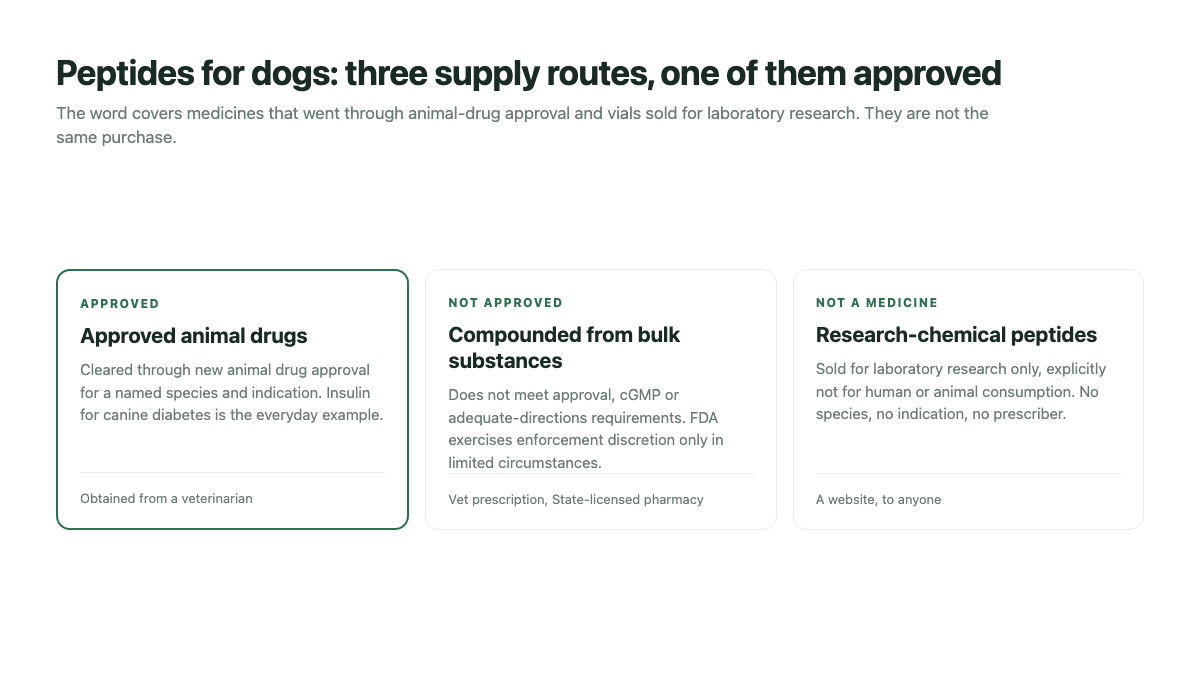
Peptides for Dogs Fall Into Three Lanes, and Only One Is Approved
The line you meet most often is that peptides are not approved for dogs. It is tidy and wrong, and the correction is what lets you tell a medicine from a vial bought on the internet.
Peptides are a class of molecule, not a product. Insulin is a peptide. Merck Animal Health markets Vetsulin, a porcine insulin zinc suspension, and describes it as "the first FDA-approved insulin for use in dogs and cats with diabetes". A diabetic dog on insulin is on peptide therapy: prescribed by a vet, made under manufacturing rules, with a label, a monitoring plan and a company legally obliged to report adverse events.
So the honest version is narrower: some peptide medicines are approved for dogs, and none sold on research-chemical websites are among them.
| Lane | What it is | Where it comes from |
|---|---|---|
| Approved animal drugs | Went through new animal drug approval and carries a label. Insulin for canine diabetes is the everyday example | Your veterinarian, a pharmacy |
| Compounded from bulk drug substances | Not approved. FDA exercises enforcement discretion in limited circumstances | A vet's prescription, filled by a State-licensed pharmacy |
| Research-chemical peptides | Sold labelled for laboratory research use only, not for human or animal consumption | A website, to anyone with a card |
The Lawful Route Runs Through an Exam Room, Not a Checkout
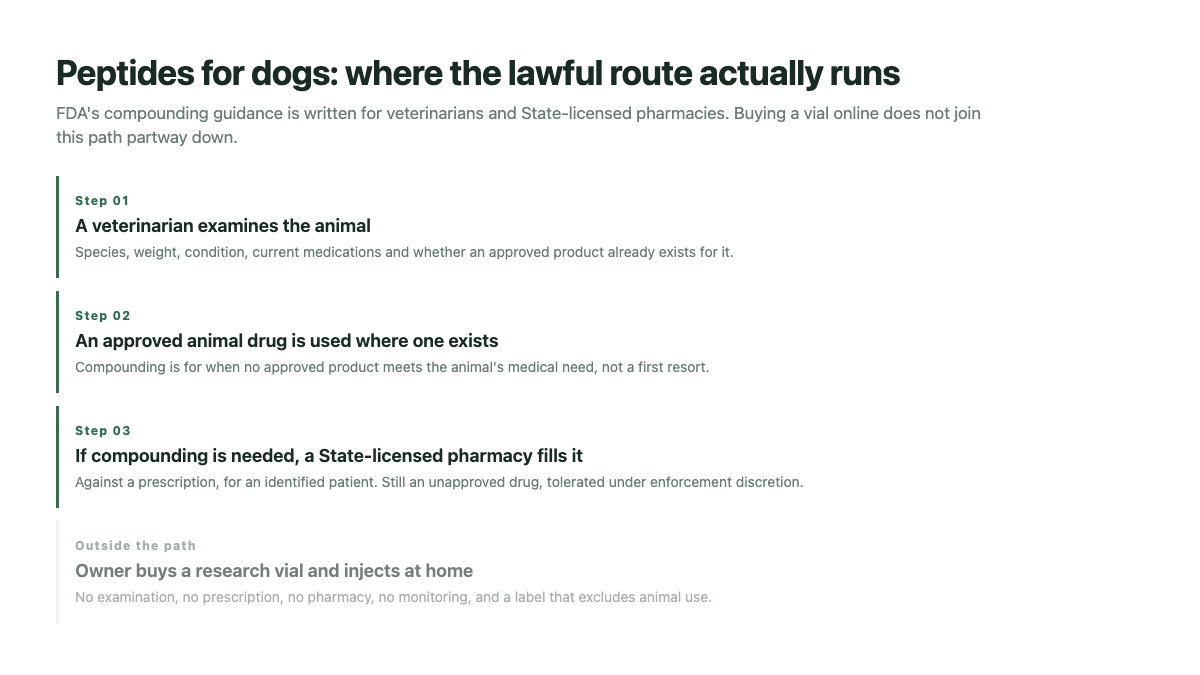
Compounding is the middle lane, and the one most often used to make research peptides sound legitimate. It does not make them so.
FDA's Center for Veterinary Medicine sets out its position in Guidance for Industry #256, Compounding Animal Drugs from Bulk Drug Substances, issued in April 2022 under docket FDA-2018-D-4533:
"Animal drugs that are compounded from bulk drug substances do not meet the FD&C Act's new animal drug approval, cGMP, or adequate directions for use requirements. However, FDA has generally exercised enforcement discretion with regard to animal drug compounding from bulk drug substances under certain circumstances."
Two things follow.
The pathway has people in it. The guidance is explicitly "intended for veterinarians, State-licensed pharmacies, and Federal facilities". An owner buying a vial online is not on that pathway at all.
Enforcement discretion is not approval. FDA describes what it does not intend to pursue "at this time and based on our current understanding of the risks", which is conditional and revocable. It is blunt about what these drugs lack: they "are not FDA-approved and have not been reviewed by FDA for evidence that they are safe, effective, properly manufactured, accurately labeled, and adequately packaged", and compounders "are not required to report adverse events and product defects to FDA".
What a Nutrition Desk Would Change First
Osteoarthritis is the usual reason this question gets asked. The VetCompass study of 455,557 UK dogs in primary veterinary care put the annual period prevalence of appendicular osteoarthritis at 2.5 percent, and named higher bodyweight and age over eight years among the risk factors for diagnosis. Weight is one of the few items on that list you can move.
Moving it does measurable work. In an open prospective trial at the University of Glasgow, fourteen obese client-owned dogs with clinical and radiographic osteoarthritis were fed a restricted-calorie diet across sixteen weeks with six follow-up visits. Lameness decreased significantly from a weight reduction of 6.10 percent onwards, and kinetic gait analysis, which has no opinion about what anyone hoped to see, supported the improvement from 8.85 percent. The authors concluded that weight loss should be presented to owners as an important treatment in its own right.
None of that needs a syringe. It needs a body condition score assigned by someone who handles dogs all day, a target weight, a measured ration rather than a scooped one, and a recheck on the practice scales. The WSAVA global nutrition guidelines exist because "he looks fine to me" is not an assessment.
A Symptom Is a Diagnostic Question Before It Is a Supplement Question
A dog that is stiff, tired, drinking more or reluctant on walks is not presenting you with a shopping problem. Stiffness can be osteoarthritis, but also soft tissue injury, spinal disease, or a compensating gait from the other limb. Lethargy can be hypothyroidism, and increased thirst can be kidney disease, diabetes or hyperadrenocorticism. An exam, bloods and urine separate them, and they lead to different treatments. Anything you give that seems to help a little will delay that appointment, and a delayed diagnosis in a dog is measured against a shorter life.
It is also worth knowing what a "supplement" is when the customer is an animal. In the United States there is no such category. FDA's stated assessment is that the Dietary Supplement Health and Education Act of 1994 "does not apply to animal food, including pet food", so "there is no 'dietary supplement' regulatory classification for animal food substances and products", and products described that way are "either 'food' or 'new animal drugs' depending on their intended use". That reassuring middle ground does not exist in law.
What the Evidence Base on Peptides for Dogs Actually Contains
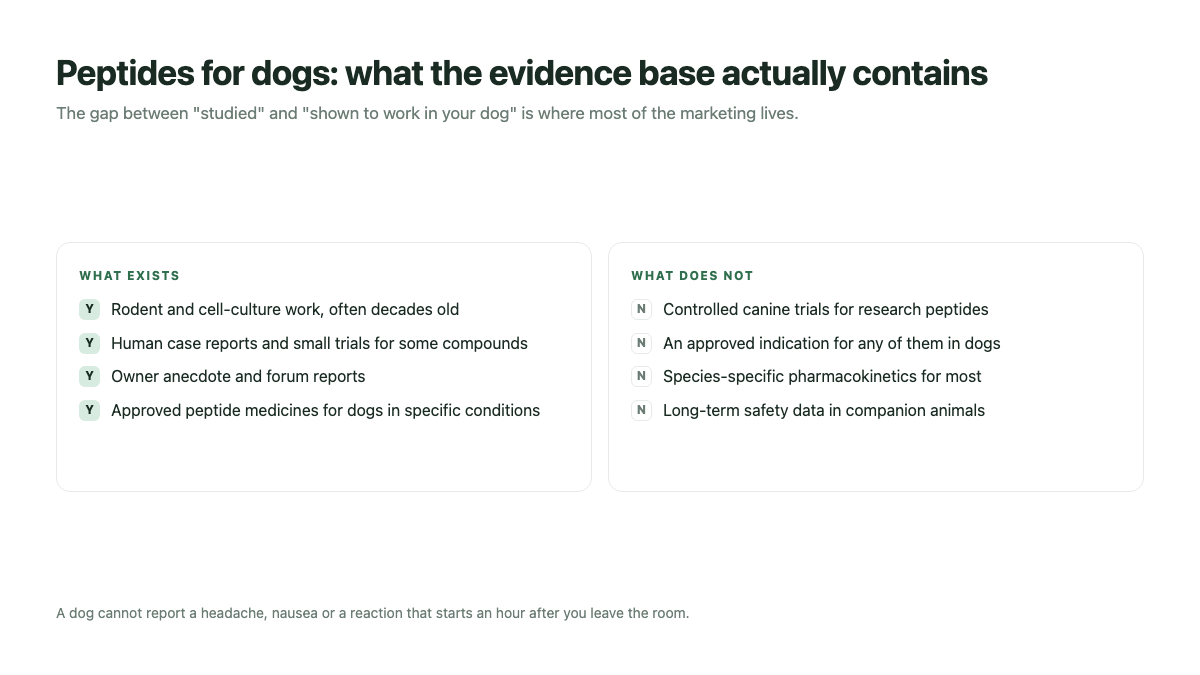
Here the numbers are worth quoting, because they are small. Search PubMed for BPC-157 and you get 227 indexed records. Add dog or canine and you get two, one of which is a rat study that matched only because it describes a behaviour called wet dog shake. The other is real: a 2022 pharmacokinetics paper in Frontiers in Pharmacology that gave BPC-157 to rats and beagle dogs and measured what became of it. The elimination half-life of the intact peptide was under 30 minutes, and absolute bioavailability after intramuscular injection was roughly 45 to 51 percent in beagles.
Read that carefully. It is the strongest canine result available and it says nothing about whether a dog gets better: it describes where a molecule goes, not what it does. There is no controlled canine efficacy trial, no approved indication and no dosing standard, which is why no responsible page hands you a number for an animal.
The rest is rodent work, in vitro work, human anecdote and vendor copy. Extrapolating from humans is not the cautious move either: species differ in absorption, clearance and sensitivity, which is why a common human painkiller can kill a dog. Our human-focused write-up on peptide side effects shows how thin even the human record is.
For a fuller compound-by-compound treatment, PeptideDeck's breakdown of peptides for dogs covers BPC-157, TB-500, GHK-Cu and KPV, and publishes weight-based dosing tables. Read those as a description of what people do rather than an instruction, and take anything that interests you to your vet instead of to a syringe. Our guide to whether peptides are legal explains what "for research use only" does for a seller.
Sterility Matters More in a Smaller Body, Not Less
A smaller animal is not a smaller version of the problem. A dog cannot tell you the injection site stings or that today is worse than yesterday, and there is no monitoring in a kitchen, no baseline bloods, and nobody to catch a reaction early.
Certificates of analysis are the usual reassurance, so know what one covers. A certificate reporting an endotoxin test to USP Chapter 85 or a sterility test to USP Chapter 71 describes one tested lot at one moment. It says nothing about the vial in your hand if the lot numbers do not match, and nothing about what happens once someone reconstitutes it on a worktop. Most research-peptide certificates report purity and identity rather than sterility and endotoxin, so the document owners read as a safety guarantee is answering a different question.
Questions Worth Taking Into the Appointment
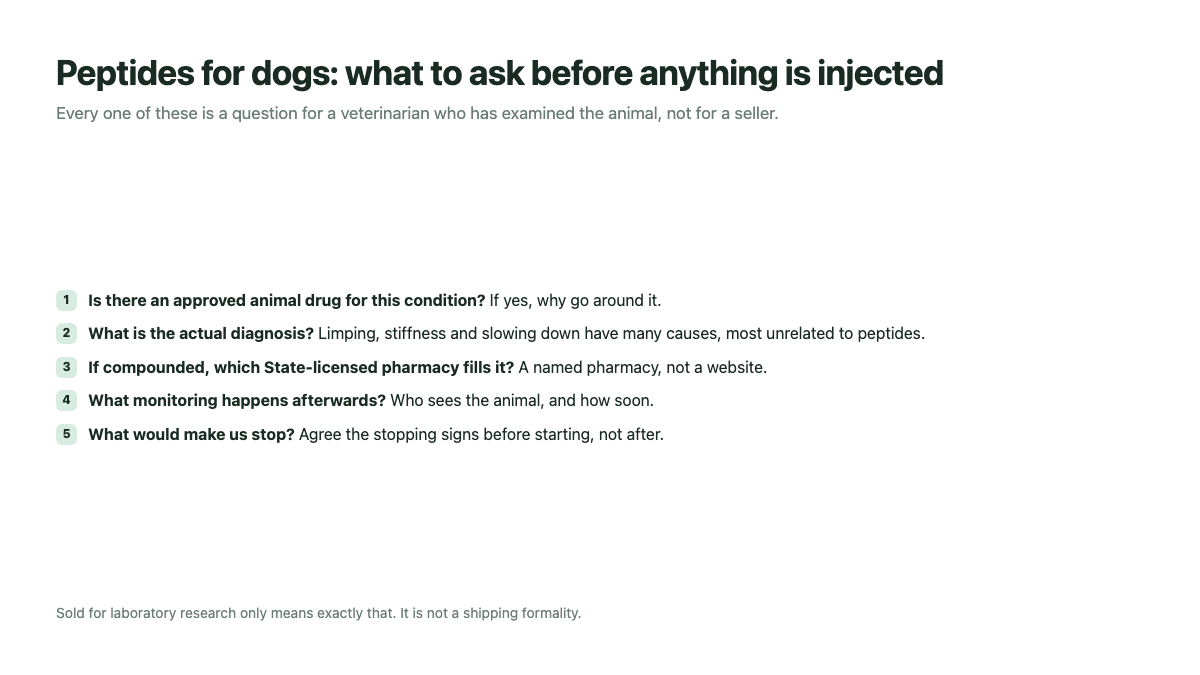
Raising this with a vet is not a confession. It turns a forum idea into a conversation about your actual dog:
- What is my dog's body condition score, what should it be, and what does the gap mean for the joints?
- What is the working diagnosis, what would change it, and what is unexplained?
- Which approved options apply, including diet, pain control, physiotherapy and weight management, in what order?
- If a compounded preparation is appropriate, which pharmacy would fill it, and why not an approved product?
- What would you want to monitor, and what should make me call sooner?
Frequently Asked Questions
Are peptides safe for dogs?
The question splits, because "peptides" names a class of molecule, not a product. Approved peptide medicines for dogs, insulin being the clearest example, have a safety profile, a label and a monitoring plan. Research peptides sold online have none of those, and no regulator has reviewed them.
Is BPC-157 approved for dogs?
No. There is no FDA approval for BPC-157 in dogs or in people. The only substantial canine record is a 2022 pharmacokinetics study in beagles that measured how quickly the molecule is cleared. It was not designed to show that treated dogs recover better, and it does not.
Why will you not publish a dose for a dog?
Because there is no established dose to publish. No controlled trial has set a dosing standard in dogs, and a figure copied from a website or scaled from a human report is a guess wearing the clothes of a number. A dog cannot decline, and cannot tell you the vial was mislabelled.
Can my vet legally prescribe a compounded peptide for my dog?
Compounding from bulk drug substances is a real pathway, described in FDA's Guidance for Industry #256 and intended for veterinarians, State-licensed pharmacies and Federal facilities. It is not approval: FDA states these drugs do not meet the approval, cGMP or adequate directions for use requirements, and that it exercises discretion only in certain circumstances. Whether it suits your dog is a judgement for your vet.
What actually helps an ageing dog with stiff joints?
Start where the canine evidence is. Get a body condition score and a target weight, then act on it: in a supervised trial of obese dogs with osteoarthritis, lameness improved measurably after modest weight loss. Add a diagnosis, approved pain control where indicated, controlled exercise, and a diet chosen with the practice rather than off a shelf. Our best peptides for joint pain guide covers the peptide side of the question in people, where evidence is also thin.
Sources
- CVM GFI #256, Compounding Animal Drugs from Bulk Drug Substances, docket FDA-2018-D-4533, FDA Center for Veterinary Medicine
- Animal Drug Compounding and Animal Foods and Feeds, FDA, the second for its assessment of DSHEA 1994
- Vetsulin, porcine insulin zinc suspension, Merck Animal Health USA
- Weight loss and lameness in obese dogs with osteoarthritis, Marshall et al., Veterinary Research Communications, 2010
- Appendicular osteoarthritis in UK dogs under primary veterinary care, Anderson et al., Scientific Reports, 2018
- Pharmacokinetics of BPC 157 in rats and dogs, He et al., Frontiers in Pharmacology, 2022. Record counts via NCBI E-utilities, August 2026
- Global Nutrition Guidelines, World Small Animal Veterinary Association
Veterinary disclaimer: this is general information, not veterinary advice, and not an endorsement of giving any compound named here to an animal. This page deliberately publishes no dosing information of any kind. Talk to a veterinarian who has examined your dog before starting or stopping anything, and call one straight away if your dog is unwell.