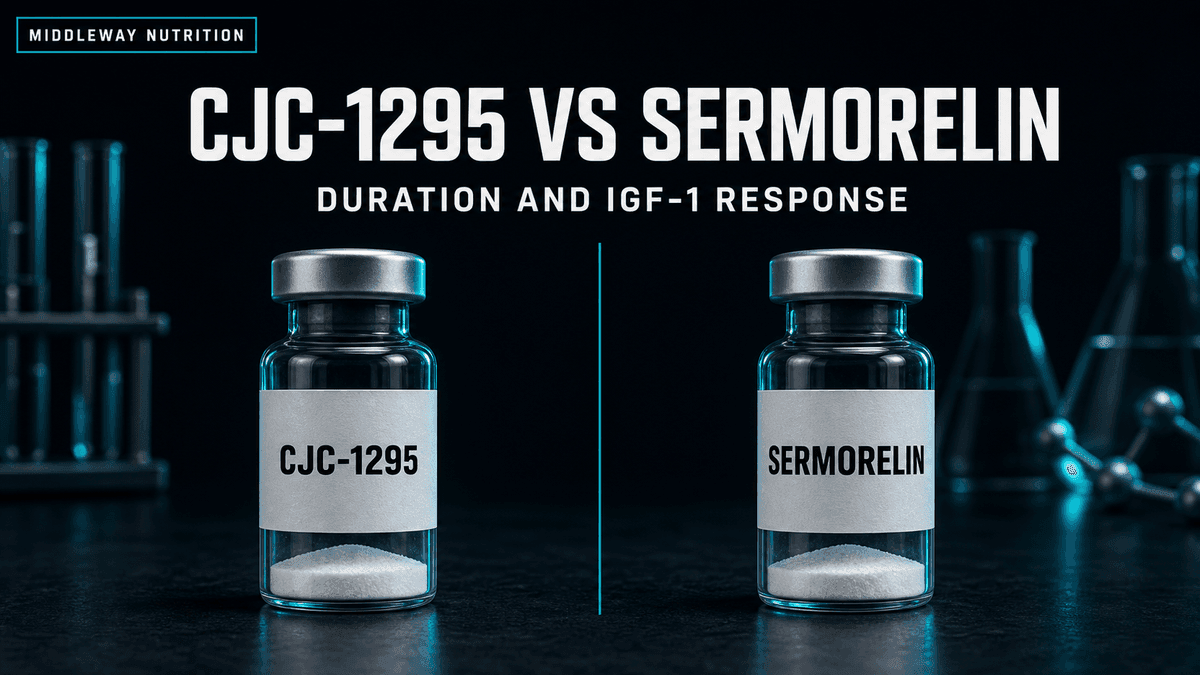
CJC-1295 vs sermorelin is not a contest between different mechanisms: both are GHRH analogs built on the same 29 amino acid fragment, both act on the same pituitary receptor, and both leave the body's feedback control intact. The whole of CJC-1295 vs sermorelin comes down to duration, and the gap is extreme, with sermorelin cleared in minutes and CJC-1295 in its DAC form persisting for days.
Everything else, dosing frequency, IGF-1 response, side effect pattern and what each one is reasonable for, follows from that single variable.
The Shared Starting Point
Endogenous growth hormone releasing hormone is 44 amino acids long, and the first 29 carry the receptor-binding activity. Sermorelin is that fragment, unmodified. CJC-1295 is the same fragment with four amino acid substitutions that resist the enzymes which would otherwise break it down within minutes.
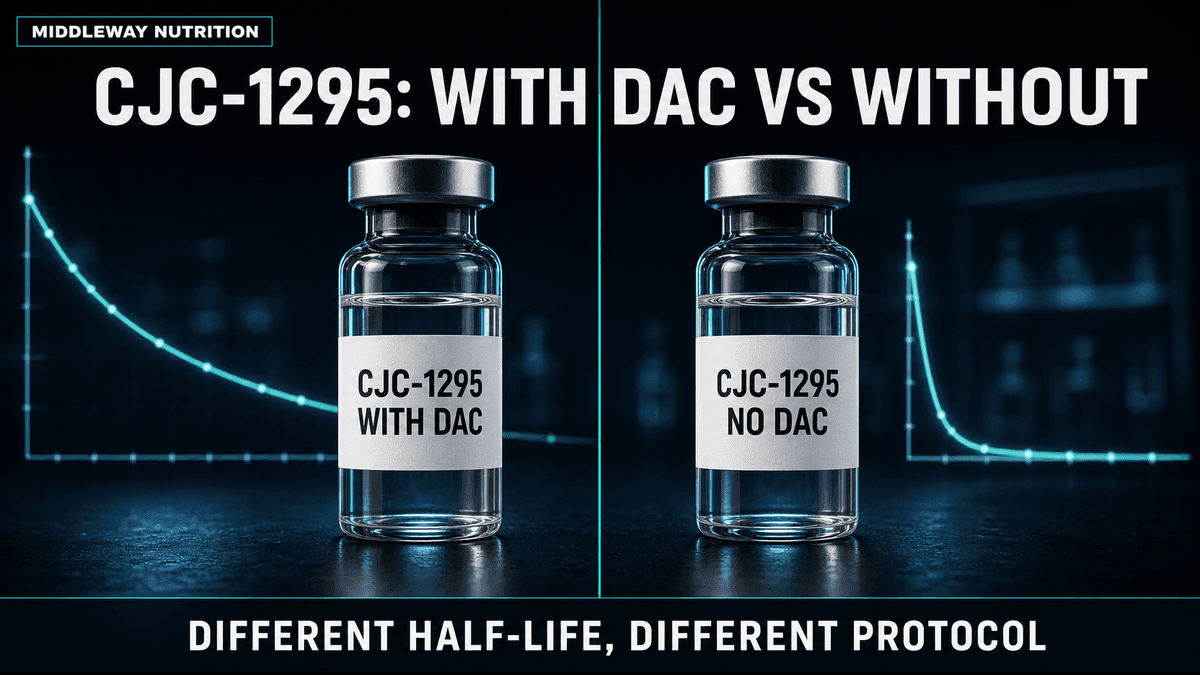
The DAC version adds one more step: a maleimide group that bonds covalently to albumin in the bloodstream, turning circulating plasma protein into a slow-release reservoir.
So there are really three compounds in this comparison, not two, and the version of CJC-1295 being discussed changes the answer completely.
CJC-1295 vs Sermorelin Compared
| Sermorelin | CJC-1295 without DAC | CJC-1295 with DAC | |
|---|---|---|---|
| Backbone | GHRH 1-29 | Modified GHRH 1-29 | Modified GHRH 1-29 |
| Half-life | Minutes | Roughly 30 minutes | Around 6 to 8 days |
| GH pattern | Sharp pulse | Sharp pulse | Sustained elevation |
| Dosing frequency | Daily, usually nightly | One to three times daily | Once or twice weekly |
| IGF-1 effect | Gradual rise with consistent use | Transient rise per dose | Sustained elevation across days |
| Regulatory history | Former FDA-approved diagnostic, discontinued | Never approved | Never approved |
| Human trial data | Diagnostic and paediatric use | Very limited | Early-phase studies only |
| Reversibility if dose is wrong | Within the hour | Within the hour | Roughly a week |
What the Human Data Shows
Sermorelin's clinical history is the older one. It was approved as a diagnostic agent for assessing pituitary function and was withdrawn from the market for commercial reasons rather than safety findings. That history means its short-term safety in humans is reasonably characterised. What it does not include is trial evidence for the outcomes people now use it for, meaning body composition, sleep and recovery in healthy adults.
CJC-1295 has the opposite profile. Published early-phase work in healthy adults established the pharmacokinetics clearly: the DAC version showed a half-life measured in days, with growth hormone raised several fold for close to a week after a single dose and IGF-1 elevated for longer still. That is solid pharmacology. What does not exist is any long-term safety or efficacy data, because development never produced an approved medicine.
So the honest framing is that CJC-1295 has better characterised pharmacokinetics and worse characterised safety, while sermorelin has a longer clinical track record and almost no outcome data for its current use.
Where the Duration Difference Actually Bites
Pulsatility. Natural GH release comes in bursts with near-zero troughs between them. Sermorelin and the non-DAC version of CJC-1295 preserve that shape. The DAC version does not: it raises the baseline instead. Whether that matters clinically is unresolved, but it is a departure from how the system normally operates, and sustained GH elevation is the pattern associated with GH excess states.
Error correction. A dose that is too high on sermorelin is gone within the hour. A dose that is too high on CJC-1295 with DAC is still working a week later. That asymmetry deserves more weight than it usually gets, because fluid retention, joint symptoms and glucose effects all track total exposure.
Stacking logic. Pairing a GHRH analog with a ghrelin-pathway peptide such as ipamorelin works by amplifying a discrete pulse. That combination is coherent with short-acting compounds and much less coherent with a continuously acting one.
Adherence. A weekly injection is genuinely easier to sustain over six months than a nightly one. This is not a trivial advantage, and it is the strongest argument for the DAC version.
Side Effects
The effects overlap because both work through growth hormone: injection site reactions, flushing, headache, altered sleep early on, then fluid retention, joint stiffness and hand tingling at higher exposures.
The difference is in likelihood and reversibility. Sustained elevation makes the GH-mediated effects more probable and slower to resolve. Sermorelin's short action makes it the more forgiving option, particularly for someone new to this class.
Both warrant the same monitoring: IGF-1 to confirm the dose is doing something without overshooting the age-appropriate range, and fasting glucose because growth hormone opposes insulin.
Which One Fits Which Goal
New to GH secretagogues, wanting a cautious trial: sermorelin. Lowest exposure, fastest reversal, longest clinical history. If it is the one you land on, our guide to where to buy sermorelin compares what different vendors charge.
Wanting a pulsatile signal to pair with a GHRP: CJC-1295 without DAC. It provides a stronger and slightly longer pulse than sermorelin while keeping the shape intact.
Prioritising convenience over physiological fidelity: CJC-1295 with DAC, understanding that you are accepting continuous stimulation and a week-long commitment to whatever dose you choose. If that is the version you settle on, our CJC-1295 for sale page covers vial sizes and how to verify what arrives.
Wanting an approved treatment with outcome data: none of the three. That is a real answer, not a dodge. If the goal is a medically supervised, evidence-backed intervention, this class does not currently supply it.
For more detail, see the sermorelin guide, the CJC-1295 guide, and our growth hormone secretagogue comparison for how both sit against the ghrelin-pathway peptides. For a closer look at sourcing, see where to buy CJC-1295, which walks through batch testing and how to compare sellers before you order.
Frequently Asked Questions
Is CJC-1295 stronger than sermorelin?
It produces greater total growth hormone exposure, particularly in the DAC form, because it persists far longer rather than because it binds the receptor more powerfully. The pulse height per dose is broadly comparable. Greater exposure also means a higher chance of fluid retention, joint symptoms and glucose effects.
Can you take CJC-1295 and sermorelin together?
There is no mechanistic reason to. Both compete for the same GHRH receptor, so combining them mostly duplicates one signal. The combination with an actual rationale pairs a GHRH analog with a ghrelin-pathway peptide such as ipamorelin, which acts on a different receptor.
Which has fewer side effects?
Sermorelin, mainly because its exposure is lower and shorter. The side effects themselves are the same family in both cases, since they are growth hormone effects rather than peptide-specific ones. The practical advantage is that a sermorelin dose that proves too high can be corrected the next day.
Is either one FDA approved?
Sermorelin held approval as a diagnostic agent under the Geref brand, which was discontinued in 2008; there is no current approved sermorelin product. CJC-1295 has never been approved in any form and is sold as a research compound. Neither is approved for anti-aging or body composition use.
Which is cheaper?
Sermorelin is generally the less expensive of the two per month, and it is more widely available through compounding pharmacies because of its former approval status. CJC-1295 is sold almost exclusively as a research chemical, which makes purity dependent entirely on the vendor's third-party testing.