
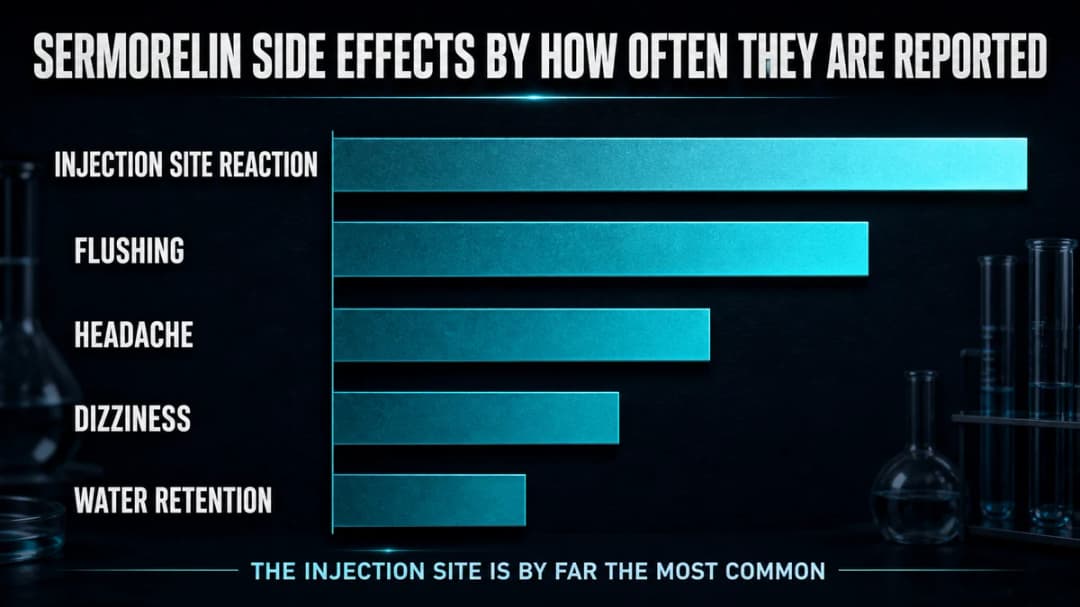
Sermorelin side effects are mostly local, mild and closely tied to dose: injection site redness, flushing, headache and vivid dreams account for the large majority of what people report. The sermorelin side effects that deserve genuine attention are different: fluid retention, joint or wrist symptoms, and a gradual drift upward in fasting glucose, all of which are growth hormone effects rather than peptide effects.
One structural point explains why the profile is comparatively mild. Sermorelin stimulates the pituitary rather than replacing growth hormone, and somatostatin feedback still works, so the gland will not release GH without limit. That puts a ceiling on exposure that injected growth hormone does not have.
Sermorelin Side Effects: A Note on the Frequency Numbers
You will find precise percentages for each sermorelin side effect online. Treat them with caution. There is no large modern safety trial in healthy adults using it for body composition or sleep, so those figures are estimates drawn from clinic experience rather than measured incidence rates.
The table below therefore uses frequency bands rather than false precision.
| Effect | How often reported | Typical timing | Usually means |
|---|---|---|---|
| Injection site redness, itching, small welt | Common | Immediately, settles within hours | Normal subcutaneous response |
| Facial flushing or warmth | Common | Within 30 minutes | Vasodilation, transient |
| Headache | Fairly common | First two weeks | Often settles with adaptation |
| Vivid dreams, altered sleep depth | Fairly common | First two weeks | GH pulse affecting sleep architecture |
| Fluid retention, puffy hands or ankles | Occasional, dose-related | Builds over weeks | Dose likely too high |
| Joint aches or stiffness | Occasional, dose-related | Weeks to months | Dose likely too high |
| Tingling or numbness in the hands | Uncommon | Weeks to months | Fluid-related nerve compression, reduce dose |
| Nausea, dizziness | Uncommon | Around injection time | Often timing or technique related |
| Rising fasting glucose or HbA1c | Uncommon, needs testing to detect | Months | GH opposing insulin, needs review |
| Allergic reaction | Rare | Any time | Stop and seek medical care |
The Common Ones and What to Do
Injection site reactions
This is the most frequent complaint and the least concerning. A red, slightly raised, itchy area appearing right after injection and fading within a few hours is a standard subcutaneous response.
What reduces it: rotating sites rather than using the same spot repeatedly, letting the solution reach room temperature before injecting rather than going straight from the fridge, injecting slowly, and using a fresh needle each time. A reaction that persists for days, spreads, or is accompanied by warmth and pus is a different problem and needs medical attention.
Flushing and headache
Both usually appear early and fade as the body adapts over the first couple of weeks. Adequate hydration helps with the headache. If either persists past a month, the dose is a more likely explanation than adaptation.
Sleep changes
Vivid dreams and heavier sleep in the first weeks are consistent with a stronger GH pulse during slow-wave sleep. Most people regard this as the intended effect rather than a side effect. If it tips into non-restorative sleep or early waking, reducing the dose usually resolves it.
The Ones That Actually Matter
Fluid retention
Growth hormone promotes sodium and water retention. At modest sermorelin doses this is usually mild, showing up as slightly puffy hands in the morning or rings feeling tight. It is the clearest early signal that the dose is higher than it needs to be.
Reducing the dose resolves it. Adding a diuretic to keep a high dose going is the wrong response.
Carpal tunnel type symptoms
Tingling, numbness or weakness in the fingers is a well-known effect of growth hormone excess, caused by fluid-related compression of the median nerve. It is uncommon at sensible sermorelin doses and reversible when the dose comes down. It is also a symptom that should not be worked through: persistent nerve compression can cause lasting problems.
Glucose and insulin sensitivity
This is the effect most likely to be missed, because it produces no symptoms. Growth hormone opposes insulin action, and sustained GH elevation can raise fasting glucose and HbA1c over months.
Anyone with prediabetes, insulin resistance, a family history of type 2 diabetes or significant abdominal adiposity should have fasting glucose and HbA1c checked at baseline and again after a few months. This is inexpensive and it is the single most useful safety test for this class of compound.
IGF-1 running too high
More is not better. IGF-1 above the age-appropriate range is the biochemical definition of over-dosing, and it is where the joint, fluid and glucose effects cluster. Testing at eight to twelve weeks tells you whether the dose is appropriate, which is a better guide than symptoms alone.
Who Should Not Use It
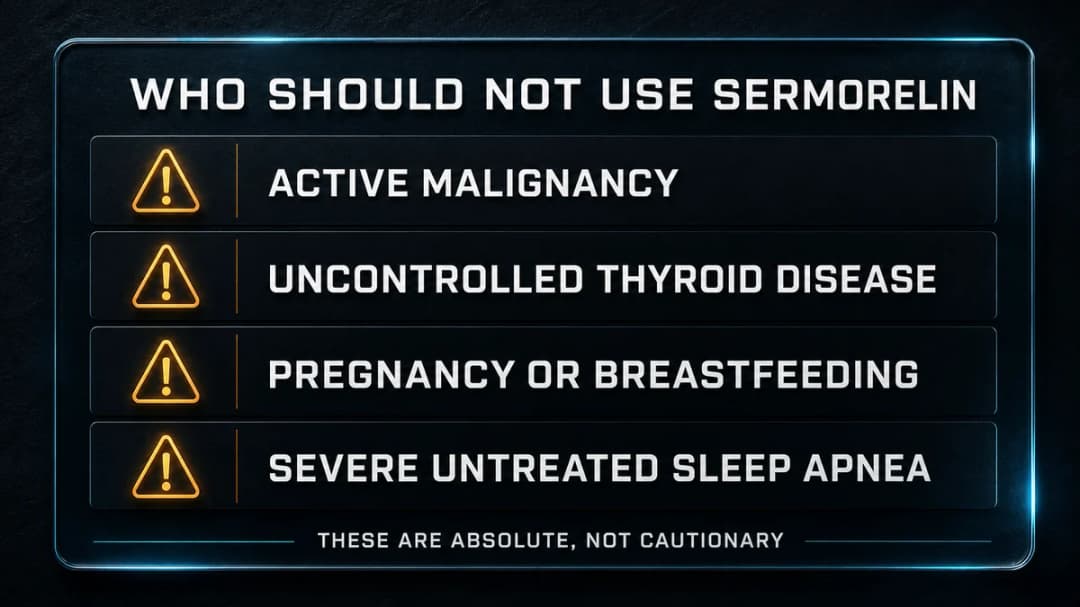
- Anyone with an active malignancy, since IGF-1 is a growth signal
- Anyone with untreated pituitary disease or a pituitary tumour
- People who are pregnant or breastfeeding, where no safety data exists
- Anyone competing in tested sport, since GHRH analogs are prohibited
- Children and adolescents outside of medically supervised treatment
Poorly controlled diabetes is a relative contraindication requiring clinician involvement rather than a hard exclusion.
Reducing Side Effects in Practice
Start low. Most reported effects are dose-dependent, and the difference between 100 mcg and 300 mcg in side effect burden is substantial.
Inject away from food. Insulin suppresses GH release, so injecting after a meal produces a smaller effect at the same dose, which is the worst combination.
Rotate sites and keep technique clean. Most injection site problems are technique problems.
Test rather than guess. IGF-1 plus fasting glucose at baseline and at around three months catches almost everything that matters.
Take symptoms as dose information. Puffiness, aching joints and tingling hands are the body reporting that the signal is too strong. They are not something to push through.
For related context, our sermorelin guide covers mechanism and dosing, and the growth hormone secretagogue comparison sets out how the side effect profiles differ across this class.
Frequently Asked Questions
Are sermorelin side effects dangerous?
The common ones are not. Injection site reactions, flushing, headache and altered dreams are mild and self-limiting. The effects worth monitoring are fluid retention, nerve compression symptoms in the hands and rising blood glucose, all of which are reversible when the dose is reduced but can be missed without testing.
How long do sermorelin side effects last?
Most early effects settle within one to two weeks as the body adapts. Fluid retention and joint discomfort behave differently: they build over weeks and persist until the dose is lowered, because they are driven by ongoing GH exposure rather than by novelty.
Does sermorelin cause weight gain?
It should not cause fat gain. Early scale increases are usually fluid retention rather than tissue, and they resolve when the dose comes down. A steady, sustained weight increase over months is not an expected effect and is worth investigating rather than attributing to the peptide.
Can sermorelin affect blood sugar?
Yes, indirectly. Growth hormone opposes insulin, so sustained elevation can raise fasting glucose and HbA1c. The change is usually small at modest doses and produces no symptoms, which is exactly why it needs to be tested for rather than felt.
Is sermorelin safer than HGH?
On the available evidence it appears milder, mainly because it works within the pituitary's own capacity and preserves somatostatin feedback, which caps total GH exposure. Injected growth hormone bypasses that ceiling entirely. Milder is not the same as risk-free, and the same GH-mediated effects can occur at high enough sermorelin doses.