
This Tesamorelin Review 2026 starts from the fact that separates it from every other peptide in the category: it is an approved medicine with published randomised trial data, approved in 2010 as Egrifta for excess abdominal fat in people with HIV-associated lipodystrophy, at a standard dosage of 2 mg daily. Anyone reading a Tesamorelin review in 2026 is usually interested in something the approval does not cover, which is general visceral fat reduction in people without HIV, and that gap between the evidence and the intended use is the most important thing on this page.
The trial data is genuinely good. What it is good evidence for is narrower than the marketing suggests.
What it is
Tesamorelin is a synthetic 44-amino-acid analogue of growth hormone-releasing hormone. A trans-3-hexenoic acid group added to the N-terminus makes it more resistant to enzymatic breakdown than native GHRH while preserving how the molecule behaves.
It binds GHRH receptors in the anterior pituitary, prompting the gland to release growth hormone in pulses that resemble the body's own pattern. Growth hormone then acts on fat, liver and muscle tissue, and the liver produces IGF-1, which carries most of the downstream metabolic effects.
The important structural point is that the negative feedback loop stays intact. As growth hormone rises, somatostatin rises in response and dampens further release. Injecting growth hormone directly bypasses that regulation entirely; tesamorelin works through it, which is why the resulting levels stay within a physiologically coherent range.
Its plasma half-life is around 26 minutes. That sounds too short to be useful until you remember that GHRH is naturally a pulse signal rather than a sustained one. Peak growth hormone follows roughly 30 to 60 minutes after injection, and IGF-1 accumulates over weeks of consistent use.
What the trials actually showed
This is the section that justifies the compound's reputation.
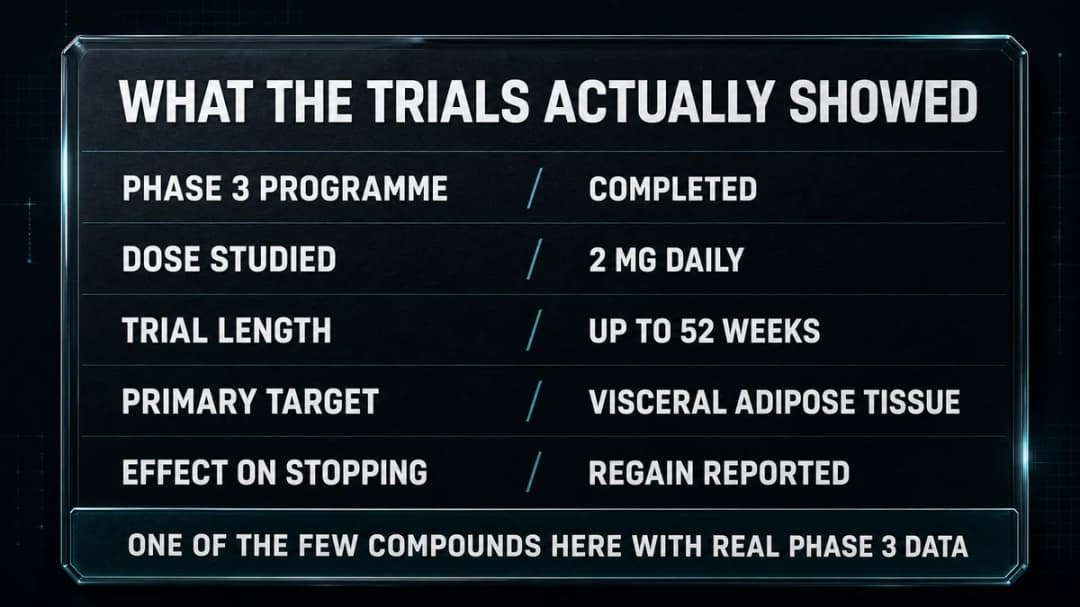
The pivotal phase 3 work enrolled over 400 people with HIV-associated lipodystrophy and ran to 52 weeks. At 26 weeks the 2 mg daily group had reduced visceral adipose tissue by roughly 18% relative to placebo, and the benefit was maintained at 52 weeks with continued treatment.
Three details in that result deserve attention.
Subcutaneous fat did not change meaningfully. This is not a general fat loss drug. It moves the deep abdominal fat wrapped around organs and leaves the fat under the skin largely alone. For the approved population that specificity was the point, since their problem was fat redistributing inward while it was lost from limbs and face.
Lipids improved. Triglycerides and total cholesterol fell significantly in treated patients, consistent with the metabolic role of visceral fat.
Effects reverse on stopping. Continued treatment maintained the benefit. This is a treatment rather than a cure.
Later analyses of the trial data reported increases in skeletal muscle area and density. A separate trial gave 1 mg daily for 20 weeks to older adults, including some with mild cognitive impairment, and reported favourable effects on executive function and memory. That cognitive finding is interesting and it is one study.
The caveat that governs everything: almost all of this data comes from people with HIV-associated lipodystrophy. Studies in healthy populations without HIV are limited. The mechanistic argument for translation is reasonable, since visceral fat is visceral fat, but reasonable arguments are not trial results.
Tesamorelin Review 2026: dosage and administration
| Context | Dose | Frequency | Timing | Duration |
|---|---|---|---|---|
| Approved indication | 2 mg | Daily | Consistent time | Ongoing while treated |
| Off-label fat loss | 1 to 2 mg | Daily, sometimes 5 days on and 2 off | Before bed, a couple of hours after eating | 8 to 12 weeks |
| Longevity or GH-axis use | 1 mg | Daily or 5 on and 2 off | Before bed | 3 to 6 months |
| Combined with a GHRP | 1 to 2 mg tesamorelin plus 200 to 300 mcg ipamorelin | 5 on and 2 off | Pre-sleep, fasted | 8 to 12 weeks |
Only the first row is the approved regimen. The rest describe what is done off-label and in the research community, and they are not recommendations.
The timing logic is sound. Growth hormone is released most strongly in the first hours of deep sleep, so dosing at bedtime works with that rhythm rather than against it. Dosing a couple of hours after the last meal avoids the insulin rise that blunts growth hormone release.
Practical handling: subcutaneous injection into the abdomen below the navel, rotating sites each time to avoid lipohypertrophy, using a fine 29 to 31 gauge insulin syringe. Reconstitute with bacteriostatic water, use promptly or refrigerate, and do not freeze.
Side effects
Because there is trial data, the frequencies here are real numbers rather than forum impressions.
| Effect | Reported frequency |
|---|---|
| Injection site reactions: redness, swelling, itching, bruising | Roughly 25 to 35% |
| Joint pain | Roughly 8 to 13% |
| Muscle aches | Around 7% |
| Peripheral swelling | Roughly 5 to 8% |
| Nausea | Around 5% |
| Fatigue early on | Common, usually settling in the first month |
Less common: headache, tingling or numbness in the extremities, and carpal tunnel-type symptoms with prolonged use. Those last two are classic growth hormone effects and are a signal to reduce the dose rather than push through.
The glucose question deserves its own paragraph because it gets handled badly online. Growth hormone opposes insulin, so any GH-raising compound has a plausible route to worsening glucose control. In the pivotal trials at 2 mg daily over 52 weeks, fasting glucose was not significantly elevated. That is reassuring for the trial population. It is not a reason for someone with prediabetes or insulin resistance to skip monitoring, because trial averages describe trial populations, and the people most drawn to a visceral fat drug are often the people whose glucose control is already marginal.
Our tesamorelin side effects page goes through these in more detail.

Who should not use it
- Anyone with an active malignancy, since growth hormone stimulation is a theoretical route to promoting tumour growth
- Anyone with a pituitary disorder, tumour, or a history of pituitary surgery, because the mechanism requires an intact pituitary to work at all
- Anyone with disruption of the hypothalamic-pituitary axis from head injury, radiation or surgery
- Pregnancy and breastfeeding, where safety is not established
- Known hypersensitivity to tesamorelin or to mannitol, which is used in the formulation
Where it sits against the alternatives
Tesamorelin, sermorelin and CJC-1295 are all GHRH analogues working on the same receptor. What separates them is evidence and duration. Tesamorelin has phase 3 data and an approval; the others do not. Sermorelin is shorter acting; CJC-1295 with DAC is much longer acting, which trades the pulsatile pattern for convenience and arguably loses the main physiological argument for using a GHRH analogue at all.
Combining a GHRH analogue with a growth hormone releasing peptide such as ipamorelin is common practice, on the reasoning that the two receptor pathways are complementary and produce a larger pulse together. That reasoning is plausible and untested in a trial. Our growth hormone secretagogues overview compares the category.
The honest verdict
Tesamorelin is the best-evidenced compound in a category where the bar is very low, and that is a real distinction rather than a backhanded one. For its approved use it works, the effect size is meaningful, and the mechanism is elegant.
For everything else, understand what you are extrapolating. The trials studied a specific population with a specific cause of visceral fat accumulation, on continuous treatment, for a year. Applying that to a healthy adult running eight weeks for physique reasons involves several assumptions, none of which has been tested. And visceral fat responds well to the interventions that have far more evidence behind them: energy deficit, resistance training, sleep and alcohol reduction. A drug that moves visceral fat by 18% is competing with lifestyle changes that can do more, for free.
FAQ
What is tesamorelin approved for?
Reduction of excess abdominal fat in adults with HIV-associated lipodystrophy, approved in the US in 2010 under the brand name Egrifta. Any other use, including general fat loss or growth hormone optimisation, is off-label.
How much visceral fat does tesamorelin remove?
In the pivotal phase 3 trial, the 2 mg daily group reduced visceral adipose tissue by roughly 18% relative to placebo at 26 weeks, with the benefit maintained at a year on continued treatment. Subcutaneous fat did not change meaningfully.
What is the standard tesamorelin dosage?
The approved dose is 2 mg subcutaneously once daily. Off-label protocols commonly use 1 to 2 mg daily, often before bed and sometimes five days on with two off, for eight to twelve weeks. Only the approved regimen has trial support.
Does tesamorelin raise blood sugar?
Growth hormone opposes insulin, so the concern is mechanistically real, but the pivotal trials did not show a significant rise in fasting glucose at 2 mg daily over 52 weeks. Anyone with prediabetes, insulin resistance or diabetes should still monitor glucose.
Does the fat come back after stopping?
The trials showed benefit maintained with continued treatment, and visceral fat reaccumulates once treatment stops unless the underlying drivers have changed. It is a treatment rather than a permanent correction.
Is tesamorelin better than sermorelin or CJC-1295?
It is far better evidenced, which is the only defensible sense of "better" here. All three act on the same receptor, but only tesamorelin has completed phase 3 trials and gained approval. That does not automatically make it the right choice for an off-label purpose neither drug was tested for.