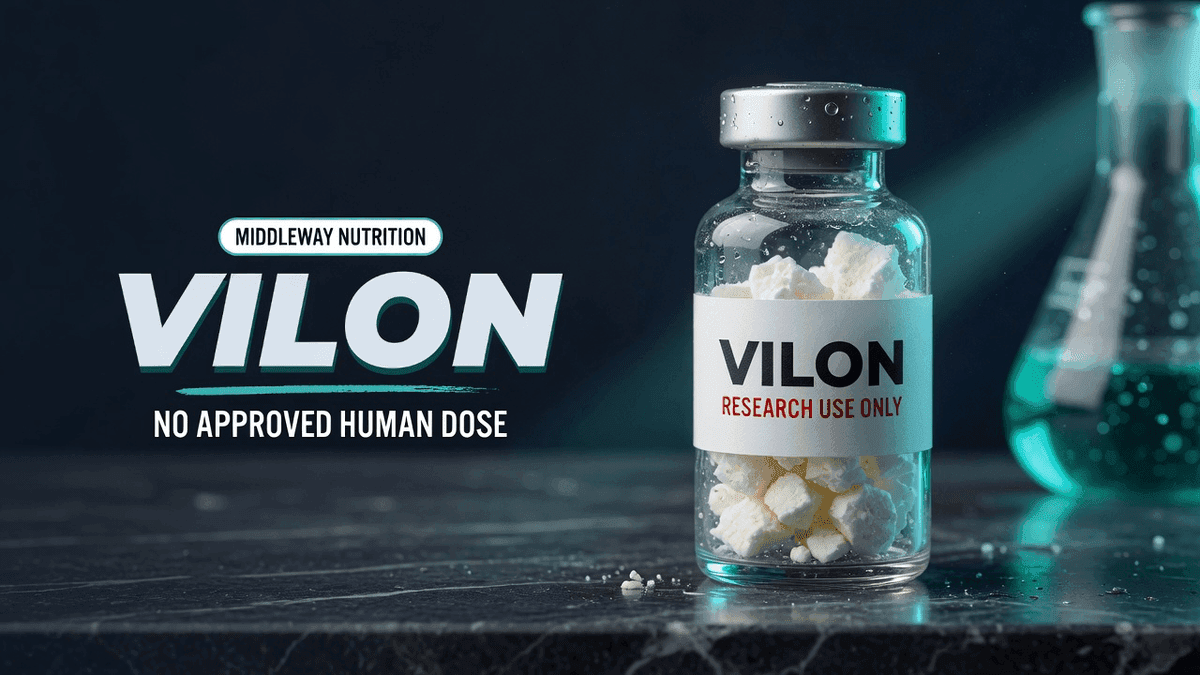
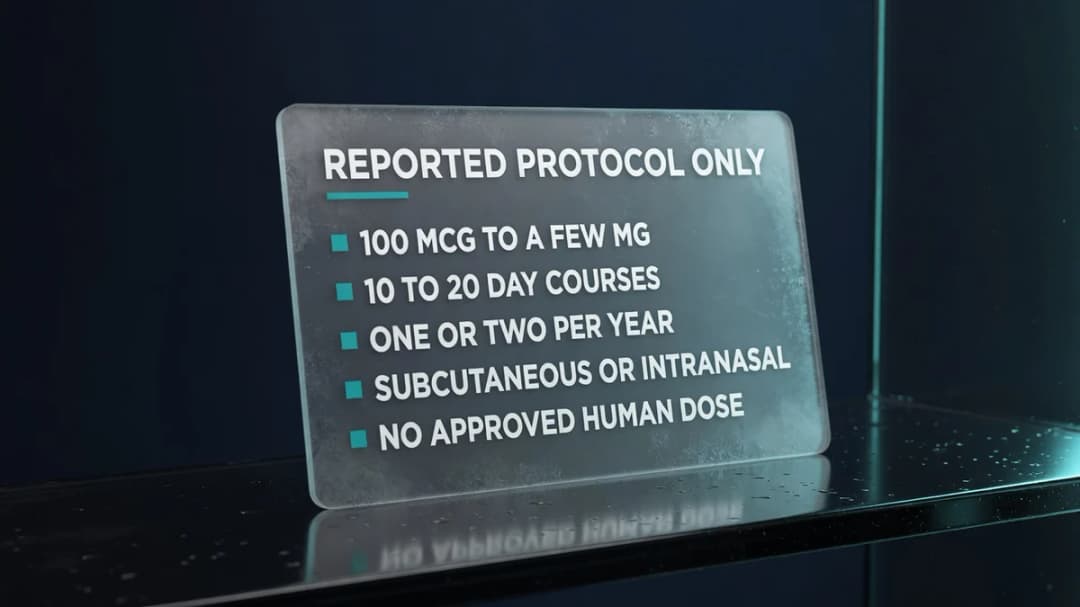
The Vilon peptide is a dipeptide, just lysine and glutamic acid joined together, usually written KE, which makes it about as short as a peptide can be while still doing anything measurable. Reported Vilon peptide dosage follows the Russian bioregulator convention rather than any trial: short courses of roughly 10 to 20 days, repeated once or twice a year, at doses in the region of 100 mcg to a few milligrams.
Those figures vary between sources, which is itself informative. They are conventions from a research programme, not doses established by controlled trials.
What Vilon Is
Vilon was developed by Vladimir Khavinson's group at the St Petersburg Institute of Bioregulation and Gerontology, as part of a long-running Russian programme investigating what they call peptide bioregulators.
The idea behind that programme is specific. Rather than acting as hormones or general stimulants, very short peptides derived from a particular tissue are proposed to influence which genes that tissue expresses, nudging cells towards a younger pattern of activity.
Vilon's lineage is thymic. Thymalin, a calf thymus extract studied in Russia for decades, is a mixture containing several active fragments, and KE is one of them. Vilon can be understood as one purified, chemically defined piece of that older preparation.
It sits in the same family as epitalon, the pineal tetrapeptide, and pinealon. See our pages on epithalon, pinealon and cartalax.
The One Piece of Clean Mechanism
Most of what is claimed for the bioregulator class is theory. Vilon has one relatively clean finding behind it.
In cultured lymphocytes, the Lys-Glu peptide increased expression of the interleukin-2 gene, in a way that depended on both concentration and exposure time. IL-2 is a central signal for T-cell growth and coordination, so a peptide that raises its expression is plausibly influencing immune organisation rather than simply stimulating it.
The authors proposed that Vilon might be the shortest regulatory fragment capable of contributing to IL-2 gene activation. That is a specific, testable claim from a specific experiment, and it is the load-bearing mechanistic result for this compound.
The broader claims that circulate online, that these dipeptides bind DNA directly and reprogramme ageing cells across many genes, come from review articles and the wider bioregulator hypothesis rather than from independent replication. They are best treated as a working model rather than as established biology.

What the Animal Data Shows
A long-term mouse study reported that Vilon inhibited the growth of spontaneous tumours, increased lifespan, reduced spontaneous lung adenomas, and raised physical activity, without changing body weight or food intake.
Across the wider Khavinson bioregulator class, rodent studies have reported lifespan extensions in the region of 20 to 40 percent, with Vilon studied alongside epitalon and thymalin.
Those numbers are substantial and they need the same caveat that applies to the whole category. The work comes overwhelmingly from a single research group, much of it is decades old, sample sizes are modest, and independent replication by laboratories outside that programme is largely absent. That does not make the results wrong. It means the confidence anyone should place in them is lower than the number of citations suggests, because citation count is not the same as replication.
Vilon Peptide Dosage: Reported Protocols
There is no approved dose. What follows is the convention used within the bioregulator literature and repeated in the research market.
| Parameter | Reported approach |
|---|---|
| Route | Subcutaneous injection, or intranasal in some protocols |
| Dose | Roughly 100 mcg to a few milligrams per administration, figures vary widely between sources |
| Course length | 10 to 20 consecutive days |
| Frequency | One or two courses per year |
| Reconstitution | Bacteriostatic water, refrigerate, use within about four weeks |
The course-based structure is characteristic of this whole family and reflects the underlying theory: the proposal is that a short course produces a durable shift in gene expression, rather than that continuous exposure is needed. Whether that is true has not been demonstrated in a way that would satisfy a regulator.
Oral capsule forms are also sold. Absorption of an intact dipeptide taken orally is a genuine open question, since the gut is efficient at breaking peptides down, and the case for oral bioregulators rests on the argument that dipeptides survive better than longer chains. Treat that as unresolved.
See our bacteriostatic water and reconstitution guide.
Where the Evidence Actually Stands
| Claim | Basis | Confidence |
|---|---|---|
| It is a defined dipeptide with measurable activity | Chemistry and cell studies | Established |
| It increases IL-2 gene expression in lymphocytes | A specific published experiment | Reasonable |
| It extends lifespan in mice | Rodent studies from one research programme | Reported, not independently replicated |
| It reduces spontaneous tumours in mice | Same source | Same caveat |
| It supports immune function in ageing humans | Older Russian clinical observation | Weak by modern standards |
| It reprogrammes gene expression across tissues | Bioregulator theory | Hypothesis |
| It does anything measurable in a healthy adult | Nothing | Unknown |
Safety and Status
Vilon is not approved in the United States or in Europe. It is sold for laboratory research only.
No serious adverse effects have been reported in the available literature, and the compound is chemically simple, which is an argument for it being unlikely to do much harm. That is not the same as a safety profile, because nothing has been studied at the scale that would produce one.
Two specific cautions. Anything proposed to modulate immune signalling is a question for anyone with an autoimmune condition or on immunosuppressive treatment, and that is a conversation with a doctor rather than something to reason through from an article. And anyone using it alongside other bioregulators, which is how these are usually sold, is stacking multiple unstudied compounds.
For a compound in the immune space with considerably more clinical development behind it, see our page on thymosin alpha-1.
FAQ
What is Vilon used for?
In the bioregulator literature, for immune modulation and as a general geroprotective agent, on the basis of its thymic lineage. In practice it is sold as a research compound with no approved use.
What is a typical Vilon dose?
Reported protocols use short courses of 10 to 20 days, one or two times a year, at doses ranging from around 100 mcg to a few milligrams. The variation between sources is wide, which reflects the absence of trial-derived dosing.
Is Vilon the same as thymalin?
No. Thymalin is a calf thymus extract containing a mixture of active fragments. Vilon is one of those fragments, isolated and made synthetically, so it is a defined single compound rather than a mixture.
Does Vilon extend lifespan?
In mice, studies from the group that developed it report that it does. Those results have not been independently replicated by laboratories outside that programme, and nothing comparable exists in humans.
Can Vilon be taken orally?
Oral capsules are sold. Whether an intact dipeptide survives digestion in useful quantities is an open question, and the argument for it rests on dipeptides being more robust than longer peptides rather than on absorption data.
Is Vilon safe?
No serious adverse effects appear in the available literature, which is reassuring as far as it goes and is not the same as an established safety profile. Anyone with an autoimmune condition or taking immunosuppressive medication should treat an immune-modulating compound as a medical question.