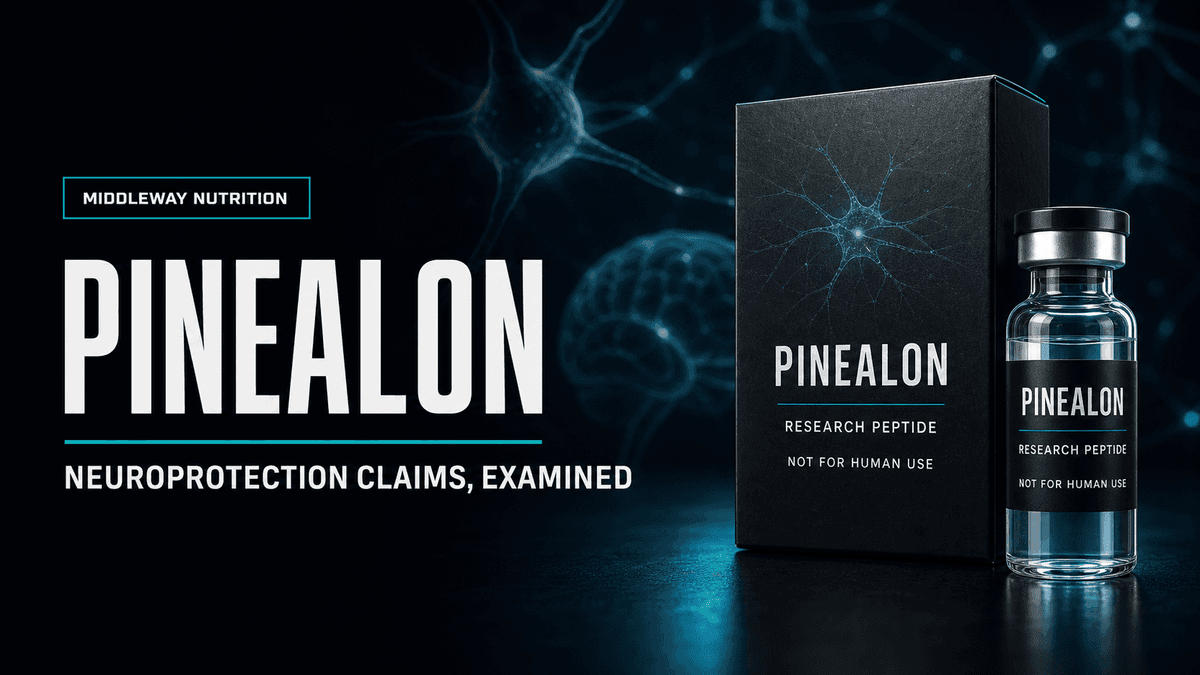
Pinealon is the trade name for EDR, a synthetic tripeptide of glutamic acid, aspartic acid, and arginine that was derived from a cerebral cortex preparation, not from the pineal gland its name implies. That one fact clears up most of the confusion around this compound, because nearly every article about it gets the tissue assignment backwards.
Key Takeaways
- Pinealon is Glu-Asp-Arg (EDR), formula C15H26N6O8, molecular weight about 418.4 daltons. Three residues, no modifications.
- The sequence was identified within Cortexin, a preparation made from cattle cerebral cortex, by Vladimir Khavinson's group at the St Petersburg Institute of Bioregulation and Gerontology.
- Reported preclinical work centers on oxidative stress and neuronal survival: less reactive oxygen species in cultured neurons, altered antioxidant and apoptotic gene expression, and outcomes in rodent hypoxia models.
- The proposed mechanism is not receptor binding. The peptide is described as small enough to reach the nucleus and modulate transcription directly, a claim independent work has not closed.
- There are no completed human efficacy trials, no Western approval, and essentially no replication outside the originating research network. Pinealon is sold for laboratory research use only.
What Pinealon Is, and Why the Name Is Misleading
Pinealon is three residues: glutamic acid, aspartic acid, arginine. Formula C15H26N6O8, molecular weight roughly 418.4 daltons, smaller than most small-molecule pharmaceuticals. It ships as a white lyophilized powder in research vials and as an encapsulated powder in the consumer bioregulator lines sold in Russia.
The name is the problem. "Pinealon" reads as a pineal gland product, and vendors lean into that, pairing it with melatonin and sleep language. The published description points elsewhere. EDR was identified as an active fragment within Cortexin, a polypeptide complex prepared from bovine cerebral cortex and used in Russian neurology practice. Cortex, not pineal.
The context is the Khavinson bioregulator program. Starting in the Soviet era, researchers extracted peptide fractions from animal organs, reported that each fraction preferentially influenced the organ it came from, then tried to synthesize the shortest active sequence inside each extract. Those sequences are what is now sold as bioregulators. Pinealon is the one assigned to brain and neural tissue.
Pinealon vs Epithalon: Two Peptides People Constantly Confuse
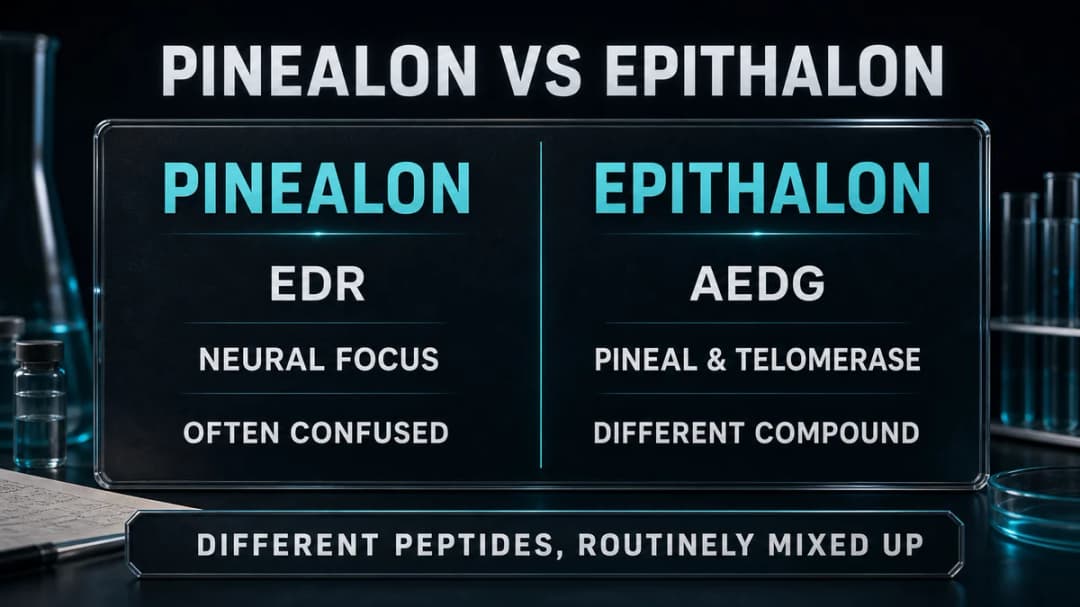
This is the most common mix-up, and the two have different sequences, different assigned tissues, and completely different claim sets attached.
Epithalon is the tetrapeptide Ala-Glu-Asp-Gly (AEDG), the pineal gland bioregulator, and it carries the telomerase and melatonin claims that circulate in longevity forums. Pinealon is the tripeptide Glu-Asp-Arg (EDR), it came out of a cortex preparation, and its reported work is about neuronal oxidative stress and survival rather than telomere biology.
| Pinealon | Epithalon | |
|---|---|---|
| Sequence | Glu-Asp-Arg (EDR) | Ala-Glu-Asp-Gly (AEDG) |
| Length | 3 residues | 4 residues |
| Molecular weight | About 418.4 Da | About 390.4 Da |
| Source preparation | Cortexin (cortex complex) | Epithalamin (pineal complex) |
| Assigned tissue | Brain, neural tissue | Pineal gland |
| Headline claims | Neuroprotection, oxidative stress | Telomerase, melatonin rhythm |
| English-language attention | Low | Moderate |
They share design logic and a research group, and they are not substitutes. A vendor calling Pinealon "the pineal peptide" has not read the source material. If Epithalon is the one you were actually after, our Epithalon for sale page covers vial sizes, pricing and batch checks.
How Pinealon Is Proposed to Work
Most research peptides act at the cell surface: something binds a receptor, a cascade fires, an effect follows. The bioregulator model is different, and that difference is the entire reason these compounds attract interest.
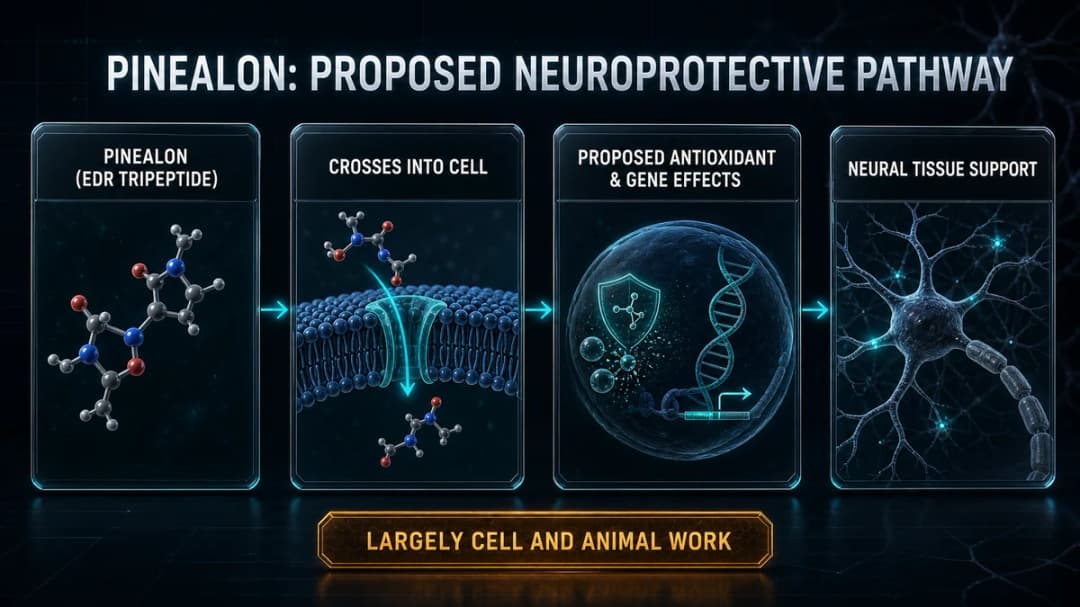
The argument goes like this. A peptide of three or four residues is small enough to cross the plasma membrane and then the nuclear envelope without a transporter. Once inside, it is proposed to interact with DNA, histone proteins, or RNA in a sequence-preferential way, changing how accessible certain promoter regions are to transcription machinery. The peptide becomes a transcription modifier rather than a classical drug, and tissue specificity comes from which genes are already poised for expression in that cell type.
Applied to Pinealon, the originating group's published discussion points at the cell's stress-handling machinery rather than at one target: expression of antioxidant enzymes, regulators of programmed cell death, and the kinase signaling that decides whether a stressed neuron repairs itself or dies. Later writing from the same network extends that framework toward neurodegenerative disease in general, which is where the neuroprotection language on vendor pages originates. Note what that is: a proposed mechanism carried forward into a disease context, not a demonstrated effect on the disease.
That story has several untested joints. An oral tripeptide has to survive gastric acid and intestinal peptidases intact. An injected one has to survive serum peptidases long enough to distribute. Either route then has to deliver enough intact peptide into the right nuclei to compete with the DNA-binding protein already there. Published human pharmacokinetic data for Pinealon in English is not something you can pull up and read. That absence does not falsify the model, but it leaves it open.
What Pinealon Research Has Actually Reported
Reported findings cluster in four areas: oxidative stress in cultured neurons, neuronal survival, gene and protein expression, and rodent behavior. Here is how they grade.
| Reported finding | Evidence type | Replicated? | How to read it |
|---|---|---|---|
| Reduced reactive oxygen species in neuron cultures | In vitro, originating group | Not confirmably | The most direct and testable claim in the set |
| Less cell death, altered stress-response signaling | In vitro, originating group | Not confirmably | Consistent, but culture conditions are permissive |
| Higher expression of antioxidant enzymes | In vitro, originating group | Not confirmably | Marker-level; many compounds move these |
| Better neuronal survival in rodent hypoxia models | Animal, originating group | Not confirmably | Induced-stress models overstate real-world effects |
| Preserved dendritic spines in neurodegeneration model neurons | In vitro, originating group | Not confirmably | Interesting if real; far from human outcomes |
| Improved memory or cognition in people | Vendor material | No trial you can read | Marketing until a registered trial exists |
Two things are true at once. The mechanistic tier is genuinely interesting and not obviously wrong. The human tier is unsupported by anything a skeptical reader can verify.
The Verification Problem, Stated Plainly
Almost every claim above traces to one research network. That is not disqualifying on its own, since every new compound starts with a single group, but replication by an unaffiliated laboratory is how a real effect gets separated from an artifact, and for EDR that step has largely not happened in the decades it has existed.
Much of the primary work appears in Russian-language journals that are thinly indexed, and a claim you cannot retrieve is a claim you cannot evaluate. Vendor citation lists tend to loop, with reviews from the same group citing earlier reviews from the same group. The Western regulatory record is empty: no approval, no registered pivotal trial, no review document.
The accurate summary is not that Pinealon is fake. It is that Pinealon is unverified, which is narrower and more useful. Nobody buying it today is acting on established evidence, and anyone presenting it as settled is overselling.
Pinealon Dosage: What Ranges Are Reported
Two formats circulate, and treating them as interchangeable causes most of the confusion.
Oral capsules. The consumer format sold in Russia as a supplement-style bioregulator. Product literature describes short courses of roughly 10 to 30 days, repeated a few times per year rather than taken continuously. Peptide content per capsule is low and blended with excipients, so the label milligram figure is not comparable to a research vial.
Lyophilized powder vials. The research-chemical format sold by Western suppliers, commonly labeled in the 10 to 20 mg range per vial for reconstitution. Community-reported use falls in the low milligram per day range on short cycles, mirroring the other short bioregulators.
Both are reported ranges taken from vendor material and user discussion. Neither is an established dose. No regulator has set a human dose for Pinealon, no published English-language dose-finding study establishes one, and the numbers do not translate between formats. Nothing here is an instruction.
Where Pinealon Sits Among Other Neuro-Adjacent Peptides
For cognition, mood, or sleep, Pinealon is among the least studied options people encounter.
Semax and Selank are the closest comparisons. Both also come out of Russian research, but both have registered clinical use inside Russia and a larger published record, putting them a tier above EDR on verifiability even though neither is approved in the US or EU. DSIP is what people usually mean when chasing sleep architecture effects, worth naming because Pinealon often gets marketed into that slot on the strength of its misleading name.
Within the bioregulator family, the pattern is uniform.
| Peptide | Sequence | Assigned tissue | Independent evidence |
|---|---|---|---|
| Pinealon | Glu-Asp-Arg (EDR) | Brain, neural tissue | Minimal |
| Epithalon | Ala-Glu-Asp-Gly (AEDG) | Pineal gland | Some in vitro follow-up, still thin |
| Cartalax | Ala-Glu-Asp (AED) | Cartilage, connective tissue | Minimal |
| Vesugen | Lys-Glu-Asp (KED) | Vascular endothelium | Minimal |
Epithalon draws the most English-language discussion of the four, and even there the independent base is thin.
Safety, Side Effects, and Legal Status
The documented side effect record for Pinealon is sparse, and sparse is not the same as clean. Short peptide bioregulators are generally described as well tolerated at the exposures studied, with injection site reactions the most commonly mentioned issue. That rests on short courses, small numbers, and unsystematic reporting.
What does not exist is a controlled human safety study of any size, long-term exposure data, or interaction profiling. Anyone with a seizure disorder, an active neurological or psychiatric condition, or ongoing CNS medication falls outside what has been examined, as do pregnancy and breastfeeding.
In the United States, Pinealon is not an approved drug and is not a controlled substance. It is sold for laboratory research use and cannot lawfully be marketed for human consumption or as a dietary supplement. The oral capsules sit in a different national category in Russia, which is not equivalent to approval elsewhere.
How to Evaluate a Pinealon Source
A three residue peptide is cheap and trivial to synthesize, which inverts the usual risk profile. The worry is not failed chemistry. It is whether the vial holds the stated compound at the stated quantity.
Ask for a batch-specific certificate of analysis rather than a generic PDF, carrying both HPLC purity and a mass spectrometry result. For EDR the mass figure should land near 418.4 Da; a number well away from that is an identity failure, not rounding. Confirm the certificate came from an independent lab rather than the seller, and be wary of unusually low pricing on something already cheap to make, since underfilling is the standard way to cut cost. Treat any page presenting Pinealon as a proven treatment for cognitive decline as unreliable across the board.
Frequently Asked Questions
What is Pinealon used for?
In the literature it comes from, Pinealon is described as a bioregulator for brain and neural tissue, with reported effects on oxidative stress, neuronal survival, and expression of antioxidant and apoptosis-related genes. It has no approved medical use in the West. People buying it are acting on that neural framing, not on established clinical evidence.
Is Pinealon the same as Epithalon?
No. Pinealon is the tripeptide Glu-Asp-Arg and traces to a cerebral cortex preparation. Epithalon is the tetrapeptide Ala-Glu-Asp-Gly and is the pineal gland member of the family, carrying the telomerase and melatonin claims. Despite the name, Pinealon is not the pineal peptide. They share a research program and design logic, and that is where the similarity ends.
Does Pinealon actually improve memory?
No controlled human trial establishes that it does. The claim circulates because reported cell and rodent work points toward reduced oxidative damage and better neuronal survival under stress. That makes it an open question, not an established effect. Rodent results under induced hypoxia do not transfer to healthy human memory.
Is Pinealon approved by the FDA?
No. Pinealon has not been approved by the FDA or any comparable Western regulator, and it is not a permitted dietary supplement ingredient in the US. Cortexin, the preparation EDR was identified within, is used clinically in Russia, but that is a different product under a different national approval.
Can Pinealon be taken orally, or does it have to be injected?
Both formats exist. The Russian consumer product is an oral capsule, and the originating group described oral administration in its own work, so oral use is not a vendor invention. Whether a tripeptide survives digestion intact in useful quantity is unresolved, and it is the weakest link in the model.