Epithalon peptide benefits center on sleep and telomere biology, its side effects are unusually sparse for an injectable, and reported research dosage sits in a narrow band of a few milligrams daily. What makes the compound worth careful treatment is the mismatch between a genuinely interesting cellular mechanism and an evidence base that comes almost entirely from one laboratory.
Key Takeaways
- Epithalon is a synthetic tetrapeptide, sequence Ala-Glu-Asp-Gly (AEDG), molecular weight roughly 390 Da, derived from the pineal extract epithalamin.
- Its described mechanism is telomerase induction plus direct stimulation of pineal melatonin output, which is why sleep effects show up long before anything else could.
- Cell-culture and rodent data are the strongest part of the file. Human data is thin, short-term, and largely produced by the group that developed the compound.
- The 5 to 10 mg per day subcutaneous courses of 10 to 20 days, repeated once or twice a year, are community convention, not a documented research protocol. The only dose we could verify in the literature is 1 microgram per mouse ([PMID 12428286](https://pubmed.ncbi.nlm.nih.gov/12428286/)), and the human trials used epithalamin (the extract), not the synthetic peptide.
- Because the peptide is only four residues long, synthesis is easy and cheap, which means the real sourcing risk is underfilled or mislabeled vials rather than difficult chemistry.
What Epithalon Actually Is
Epithalon, also written Epitalon or Epithalone, is about as small as a functional peptide gets. Four amino acids, alanine to glutamate to aspartate to glycine, abbreviated AEDG, molecular weight roughly 390.35 daltons. It ships as a white lyophilized powder and its circulating half-life is usually described online as short, two to three hours, though we could not trace that figure to a primary source.
The origin story shapes the evidence base. The pineal gland produces a mixture of peptides collectively called epithalamin. Professor Vladimir Khavinson and colleagues at the St. Petersburg Institute of Bioregulation and Gerontology spent decades on what they termed peptide bioregulators, short sequences proposed to influence gene expression rather than bind a classical receptor. Epithalon is the isolated synthetic sequence their group identified as the active fragment of epithalamin. That distinction matters for the evidence: the long-term human trials, such as a randomized trial of 39 versus 40 older adults over six courses across three years (PMID 22451889), tested epithalamin, not the synthetic four-residue peptide.
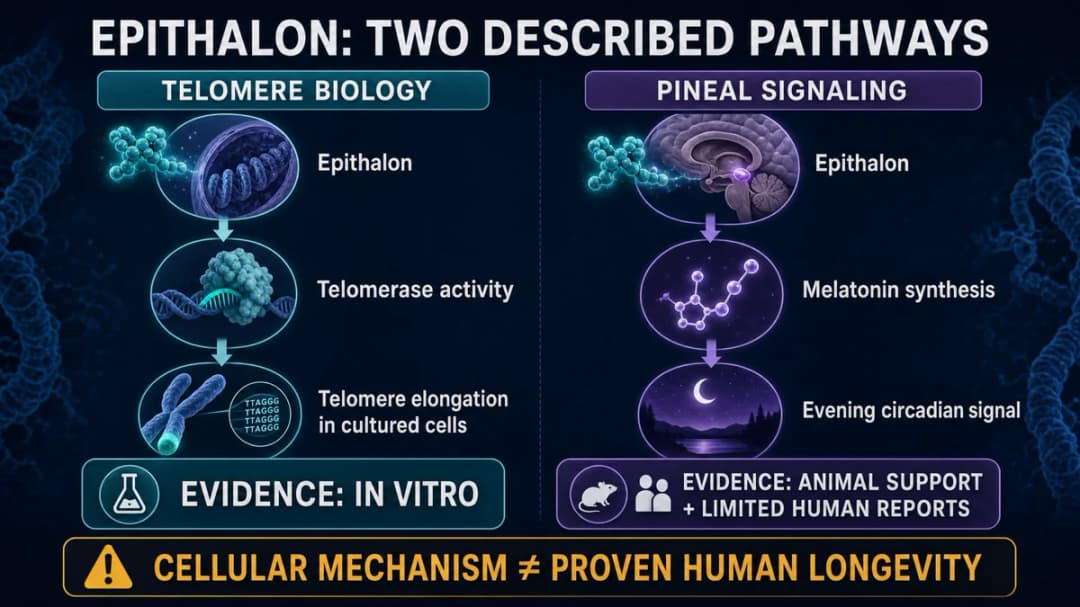
Two mechanisms are described. The first, and the reason anyone cares, is telomerase induction. Telomeres are repeat sequences capping each chromosome, and they shorten with every round of cell division. Once they get short enough, the cell stops dividing and enters senescence. Telomerase can rebuild them, but in most adult somatic tissue the enzyme is effectively switched off. Published work from Khavinson's group reported that Epithalon exposure induced telomerase activity and telomere elongation in human somatic cells, with treated fibroblast cultures continuing to divide past the point where controls had stopped. The proposed route is not receptor binding but chromatin accessibility: the peptide is described as decondensing chromatin early in the cell cycle, making the relevant genes available for transcription.
The second mechanism is pineal. Epithalon appears to raise melatonin synthesis and restore a more youthful evening melatonin curve, an effect reported in aged animals including primates. Since pineal output declines substantially with age, this is the one action a person would plausibly notice within days rather than years.
Epithalon is not an approved drug in the US, EU, or UK. It is sold as a research chemical, and nothing here is a protocol for personal use.
Epithalon Benefits
The useful way to read Epithalon benefits is to keep three tiers separate: what has been shown in cells, what has been shown in animals, and what has been shown in people. Marketing copy tends to collapse all three into one sentence.
Sleep quality and circadian timing. The shortest distance between mechanism and experience. If Epithalon increases evening melatonin output, better sleep onset and deeper sleep follow directly. Work in aged monkeys reported restoration of evening melatonin secretion that had fallen off with age, and small human reports from Russian clinical practice describe normalized sleep-wake rhythms in elderly subjects. Users consistently mention deeper sleep and vivid dreams within the first several days of a run. Evidence grade: reasonable animal support, weak but consistent human observation, sensible mechanism.
Telomerase activation and cellular lifespan. The fibroblast work is the cornerstone. Human fibroblast cultures treated with Epithalon were reported to reach more population doublings than untreated controls, alongside measurable telomerase activity and telomere lengthening. That is a specific, credible cell-culture finding. What it is not is evidence that a person injecting the peptide lengthens their own telomeres in a way that matters. Evidence grade: solid in vitro, unestablished in humans.
Lifespan extension in animals. Rodent and fruit fly experiments from the same institute reported extended average and maximum lifespan, along with delayed age-related decline and lower spontaneous tumor incidence. The reported magnitude varies considerably between experiments, and the animal strains used were often tumor-prone, which tends to inflate apparent gains. Evidence grade: consistently positive within one research program, not independently replicated at scale.
Antioxidant and immune markers. Increased activity of superoxide dismutase and catalase has been reported in aging animals given Epithalon, and human reports describe improved immune markers in elderly subjects. Some of this may be downstream of melatonin, itself an antioxidant, rather than a separate action. Evidence grade: plausible, secondary, not well isolated from the melatonin effect.
Skin, energy, and general wellbeing. Frequently reported after multiple runs, entirely subjective, impossible to separate from improved sleep. Evidence grade: anecdotal.
The honest summary: Epithalon has a better mechanistic story than most anti-aging compounds and a weaker independent evidence base than its reputation implies. The literature is dominated by one group with a clear interest in the outcome. That does not make the work wrong, but independent replication is what turns interesting into established, and that step has largely not happened.
Epithalon Side Effects
Epithalon side effects are, on the available record, among the mildest of any injectable research peptide. That carries an asterisk: cycles are short, dosing runs ten to twenty days once or twice a year, and no large controlled human safety study exists. A sparse side effect list built on brief exposures is not a demonstrated long-term safety profile.
Injection site reactions. The most commonly reported effect and the least interesting. Redness, a small raised area, or brief itching, typically resolving within an hour or two. This is a property of subcutaneous injection generally rather than of Epithalon specifically.
Transient drowsiness or fatigue in the first days. Reported by a meaningful minority during roughly the first two to three days, then reversing into improved daytime energy as sleep quality improves. The melatonin mechanism explains this cleanly: a sudden change in the timing and amount of endogenous melatonin takes a couple of nights to settle.
Vivid or unusually memorable dreams. Common, benign, and arguably a marker that the pineal effect is occurring rather than an adverse event.
Mild headache. Occasionally reported in the first day or two, rarely severe, and not clearly attributable to the peptide rather than to changed sleep timing.
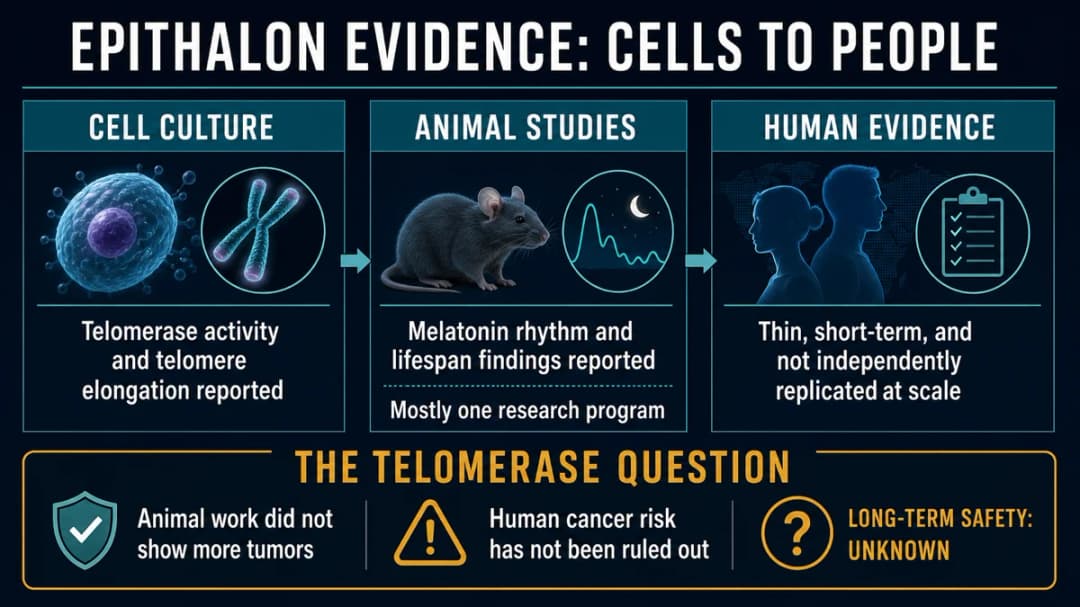
The telomerase and cancer question. This deserves direct treatment rather than a footnote, because it is the only theoretically serious concern. The overwhelming majority of human cancers upregulate telomerase, which is how tumor cells escape replicative limits. A compound whose headline mechanism is telomerase induction therefore invites the obvious question.
The counterargument is that the animal data points the other way. Long-term rodent studies from Khavinson's group reported fewer spontaneous tumors in treated animals, not more. The proposed explanation is that maintaining telomere length in healthy cells reduces the chromosomal instability that short telomeres cause, and that instability is itself a route into malignancy. Short telomeres are a cancer risk factor, not a protection. The reported effect also looks more like restoring a normal level of telomerase activity in aged cells than driving unrestrained expression.
Where that leaves things: the available evidence does not show Epithalon promoting cancer, and some points the opposite direction. But the human dataset is small, short, and not designed to detect cancer incidence. Anyone with an active malignancy or a cancer history sits outside the population this research covers, as does anyone pregnant, breastfeeding, or on immunosuppressive therapy.
What is not reported. Notably absent from the record are water retention, appetite change, blood pressure or heart rate effects, liver or kidney enzyme changes, and disruption of testosterone, estrogen, cortisol, or thyroid markers. That is a different profile from growth hormone secretagogues, which routinely produce bloating and tingling, and from senolytics such as FOXO4-DRI, covered in our FOXO4-DRI peptide guide, where fatigue during pulses is part of the expected picture.
Epithalon Dosage Chart
The figures below are community convention, not doses from a published protocol. The only dose we could verify in the primary literature is 1 microgram per mouse, injected subcutaneously for five days each month (PMID 12428286), and the human trials used epithalamin, the pineal extract, rather than synthetic Epithalon. None of it is a recommendation. There is no established human dose for Epithalon because it has never been through the trial process that would produce one.
| Goal or context | Community-reported range (not a published protocol) | Frequency | Community cycle length |
|---|---|---|---|
| Standard protocol, single daily dose | 5 to 10 mg per day | Once daily, subcutaneous | 10 consecutive days |
| Extended protocol following clinical research | 5 to 10 mg per day | Once daily, subcutaneous | Up to 20 consecutive days |
| Split dosing | 5 mg morning plus 5 mg evening | Twice daily, subcutaneous | 10 days |
| Conservative or first exposure | 5 mg per day | Once daily, subcutaneous | 10 days |
| Cycle spacing between runs | Not applicable | 1 to 2 runs per year | 4 to 6 month gap between cycles |
The cycling is not arbitrary caution. The rationale in the original protocols is that telomerase induction sets off a cellular process continuing after dosing stops, so continuous administration has no obvious purpose, and it has never been studied. The gap between runs also limits total telomerase exposure, a sensible hedge against the theoretical concern above.
Split versus single dosing has no controlled comparison behind it. The argument for splitting is smoother exposure given the short half-life; the argument for a single evening dose is alignment with the melatonin mechanism. Neither has data.
Route is essentially fixed. As a four-residue peptide with no protection against digestive proteases, Epithalon has negligible oral bioavailability, which is why every documented protocol uses subcutaneous injection. Nasal formulations exist but absorption data is scarce enough that dosing equivalence is guesswork.
Note also that these milligram figures are much larger than those for many research peptides, where daily amounts are measured in micrograms. At 5 to 10 mg per day, a single 10 mg vial covers only one or two days, so a full 10-day run consumes several vials. That is a common source of confusion when comparing vial prices against peptides dosed far lower.
Reconstitution and Storage
Epithalon arrives as a lyophilized cake or powder that should be white to off-white. Discoloration, clumping, or an oily appearance are reasons to stop and question the vial.
Reconstitution is standard. Bacteriostatic water is added slowly down the inside wall of the vial rather than jetted onto the powder, and the vial is swirled gently until dissolved. Shaking introduces shear stress that can damage peptide structure and generates foam that makes measurement harder.
Unreconstituted powder is commonly stored at around minus 20 degrees Celsius, and once reconstituted the solution goes in the refrigerator at 2 to 8 degrees Celsius. The stability claims often repeated (long-term stability frozen, usable for three to four weeks refrigerated) come from vendor and community convention, not from a published stability study, so treat them as unverified. Because a full cycle runs through material quickly, shelf life is rarely the binding constraint here.
Stacking
Documentation of Epithalon combinations is thin, so this section is deliberately short.
The pathway argument is the main one. Telomerase induction and pineal stimulation do not overlap mechanistically with growth hormone secretagogues, healing peptides such as BPC-157, or cosmetic peptides such as GHK-Cu, so interaction risk is low on theoretical grounds. That is an absence of expected conflict, not evidence of synergy, and no controlled study has tested these pairings.
Within longevity circles Epithalon is often discussed alongside compounds targeting different aging mechanisms: senolytics that clear damaged cells, covered in our FOXO4-DRI peptide guide; NAD-focused interventions aimed at cellular energy metabolism, covered in our NAD+ peptide guide; and mitochondrial-targeted compounds like the one in our SS-31 peptide guide. Addressing separate hallmarks of aging is the usual rationale for combining them, but no study has evaluated these combinations together.
One practical note with a real mechanistic basis: because Epithalon appears to raise endogenous melatonin, combining it with exogenous melatonin or sedative medication is worth thinking about rather than assuming is neutral.
How to Verify What You Buy
Epithalon's four-residue structure is cheap and easy to synthesize, so the failure modes here are usually underfilled vials or degraded material rather than exotic impurities. Ask for a batch-specific third-party HPLC report matching the lot on the vial you receive, and check that mass spectrometry confirms the expected weight near 390 Da rather than a purity percentage in isolation. Our guide to where to buy Epithalon covers which vendors publish per-lot documentation and which reuse one old certificate, and our Epithalon for sale page tracks current listings and fill sizes.
Looking for the numbers behind this guide? Our epithalon dosage chart sets label and trial doses beside what Reddit users report taking.
Frequently Asked Questions
What does Epithalon peptide do?
Two described actions. It induces telomerase, the enzyme that rebuilds the protective caps at chromosome ends, an effect demonstrated in human cell cultures. And it stimulates the pineal gland to produce more melatonin, the action behind the sleep changes users report within days. The first drives the longevity interest and remains unproven at the organism level in humans. The second is the effect anyone would actually perceive.
Is Epithalon peptide safe?
Within the exposures studied, the documented side effect profile is very mild: injection site reactions, a couple of days of drowsiness, vivid dreams. What does not exist is a large, long-term, controlled human safety study, so the honest position is that short-run tolerability looks good and long-run safety is unknown. The cancer question has not produced a signal in animal work, which reported fewer tumors rather than more, but it has not been formally ruled out in people either. Active cancer, cancer history, pregnancy, breastfeeding, and immunosuppressive therapy all fall outside what the research covers.
How much Epithalon is used in research?
Community protocols cluster at 5 to 10 mg per day subcutaneously for 10 consecutive days, some extending to 20 days, repeated once or twice a year rather than run continuously. Some split the daily amount into morning and evening doses. These are not taken from a published protocol (the only verified dose is 1 microgram per mouse, and human trials used the extract epithalamin), they are not a recommendation, and no regulator has established a human dose for this compound.
Is Epithalon legal?
In the United States, Epithalon is not an approved drug and is not a controlled substance. It is sold legally for laboratory research use only, and it is not legal to market it for human consumption or as a dietary supplement. The FDA has been active on this compound in 2026: press and trade coverage reports an FDA advisory panel vote of 7 to 5 (with one abstention) on 2026-07-24 on its compounding status, and as of 2026-10-11 we found no final FDA decision. Rules differ elsewhere, and competitive athletes should check the current WADA prohibited list rather than assume peptides fall outside standard testing panels.