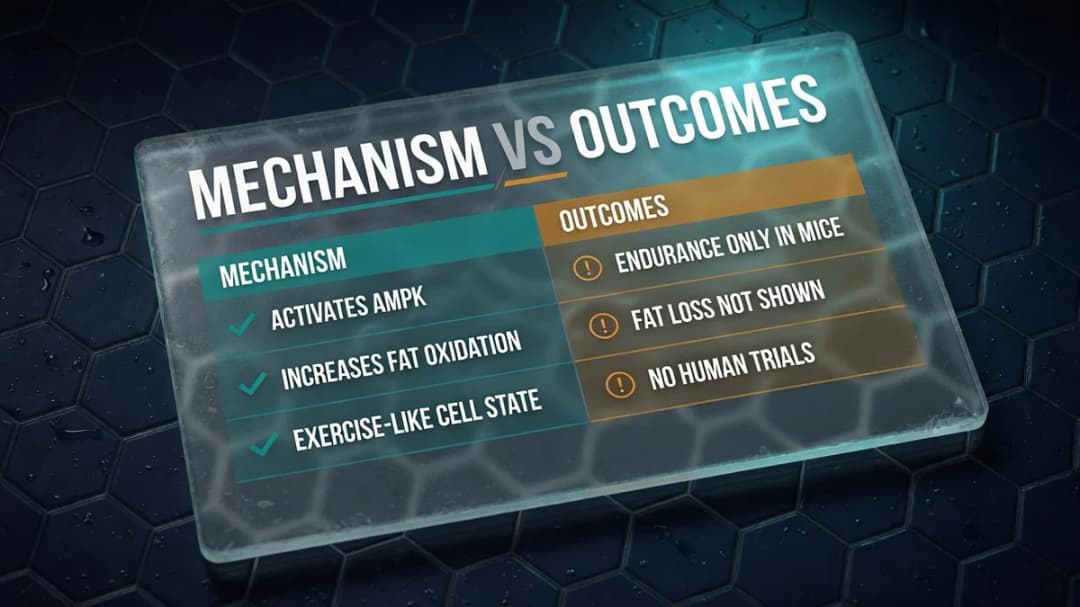
The AICAR peptide benefits people are interested in all descend from one mechanism: it activates AMPK, the enzyme cells use to sense that energy is running low, which triggers the same adaptive programme that sustained exercise does. The problem with the usual list of AICAR peptide benefits is that almost every item on it comes from rodent studies, and the doses used in those studies do not scale into anything a person could practically take.
One correction before anything else. AICAR is not a peptide. It is a nucleoside analogue, a small molecule from the purine synthesis pathway, and it has no amino acids in it. The name has stuck because it is sold alongside peptides in the same market.
How It Works
AICAR enters cells and is converted to ZMP, a molecule that closely resembles AMP. When cellular energy falls, ATP drops and AMP rises, and that ratio is the signal AMPK reads. ZMP fakes that signal, so AMPK activates as though the cell were running low on fuel even when it is not.
Once AMPK is active, a predictable programme follows:
- Glucose uptake into muscle increases
- Fatty acid oxidation increases
- Energy-consuming anabolic processes are suppressed
- Mitochondrial biogenesis is promoted over time
That is a real and well-characterised piece of biochemistry. It is also, roughly, the cellular state produced by sustained aerobic exercise, which is where the exercise mimetic framing comes from.
AICAR Peptide Benefits, Claim by Claim
| Claim | What supports it | How much to believe |
|---|---|---|
| Activates AMPK | Direct biochemistry, extensively demonstrated | Established |
| Increases fatty acid oxidation | Follows from AMPK activation, shown in cells and animals | Established as a mechanism |
| Improves endurance without training | Rodent studies, most famously one where sedentary mice ran substantially further | Real in mice, unproven in humans |
| Increases mitochondrial density | Animal data | Plausible, not shown in people |
| Supports fat loss | Inferred from fat oxidation | Not demonstrated |
| Anti-inflammatory effects | Preclinical work | Early |
| Neuroprotection | Preclinical work | Early |
The pattern is the one that recurs across this whole category of compounds. The mechanism is solid. The outcome claims are extrapolations from animals.
The Endurance Study Everyone Cites
The reason AICAR has a reputation at all is a 2008 study in which sedentary mice given the compound for four weeks ran meaningfully further on a treadmill than untreated sedentary controls, without doing any training. The headline was irresistible: exercise in a syringe.
Three things get lost when that study is repeated online.
It was in mice. Rodent muscle adaptation and human muscle adaptation are not interchangeable, and the history of compounds that worked in mice and did nothing in humans is long.
The comparison was against sedentary animals, not against animals that trained. The finding is that AICAR beats doing nothing, not that it substitutes for training.
The dose does not scale. This is the point that ends most serious discussion of AICAR as a practical compound. The quantities used in animal work, translated to human body weight, come out in grams per day rather than milligrams. AICAR has poor oral bioavailability and a short half-life, which means the practical route is intravenous, in gram quantities, at a cost that makes it prohibitive for anything outside a hospital.
Anyone injecting a few milligrams subcutaneously is not reproducing the study. They are taking a dose several orders of magnitude below the one that produced the result.
What Human Research Exists
AICAR has been studied in humans, though not for endurance or body composition.
It has been investigated in cardiac protection during surgery, and in chronic lymphocytic leukaemia, where AMPK activation has a plausible rationale. Neither line of work established it as a treatment.
What does not exist is a human trial of AICAR for endurance, fat loss or body composition. Nothing in the published record supports the claims that are made about it in the research chemical market.

Anti-Doping Status
AICAR is on the World Anti-Doping Agency prohibited list under metabolic modulators, alongside other compounds that alter the exercise adaptation pathway.
That is worth reading correctly. Being banned is not evidence that a compound works. It reflects a judgement that a compound could work and that its use would be contrary to the spirit of sport. Anti-doping agencies act on plausibility rather than waiting for proof.
For anyone in tested sport, it is off the table regardless.
Practical Reality
Stripped of the mouse study, what remains is this. AICAR reliably activates AMPK. AMPK activation produces the metabolic effects described above. Whether a person can achieve that activation at a dose they can afford, administer and tolerate is unresolved, and the pharmacokinetics argue against it.
There is also a conceptual problem worth sitting with. AMPK activation suppresses anabolic processes, because that is what a cell does when it thinks it is short of energy. That includes protein synthesis. Chronically activating AMPK in someone trying to build or hold muscle is working against the thing they are training for. Exercise produces a pulse of AMPK activation followed by recovery, which is a different signal from continuous activation.
Compounds in the adjacent space, including SLU-PP-332 and MOTS-c, face versions of the same question. See also our piece on where the evidence gets thin for recovery peptides.
Safety
Long-term human safety data does not exist. What is known comes from short clinical exposures in the cardiac and oncology settings.
The theoretical concerns follow from the mechanism rather than from reported harms. AMPK sits at the centre of cellular energy regulation and interacts with cell growth and survival signalling, so chronic pharmacological activation is not something with a well-understood safety profile. Anyone taking metformin, which also influences AMPK signalling, is stacking two things acting on the same system with no data on the combination.
It is sold as a research chemical, with no regulation of purity, identity or sterility, and it is not approved for any use in humans.
FAQ
Is AICAR a peptide?
No. It is a nucleoside analogue, a small molecule with no amino acids in it. It is described as a peptide because it is sold alongside peptides, not because the chemistry supports it.
Does AICAR really replace exercise?
No. A mouse study showed sedentary animals given it out-ran sedentary animals that were not, which is a different claim from matching what training does. No human trial has tested it for endurance.
What is a typical AICAR dose?
There is no established human dose. The figures that produced results in animals scale to grams per day in a person, which combined with poor oral bioavailability makes any realistic self-administered dose far below what was studied.
Does AICAR cause fat loss?
AMPK activation increases fatty acid oxidation, which is the mechanistic argument. Whether that produces measurable fat loss in a person at an achievable dose has not been demonstrated.
Is AICAR banned in sport?
Yes, under the World Anti-Doping Agency's metabolic modulators category. That reflects plausibility and intent rather than proven efficacy.
Can AICAR be taken with metformin?
Both act on AMPK signalling, and nobody has studied the combination. Stacking two things that push the same regulatory system without data is a poor idea, and anyone taking metformin is doing so for a medical reason that deserves a conversation with their doctor first.