The humanin peptide is a 24 amino acid chain encoded not in the cell nucleus but inside mitochondrial DNA, which makes it the first known member of a class called mitochondrial-derived peptides. It was found by accident in 2001, during a screen for anything that could protect neurons from amyloid-beta toxicity, and the humanin peptide has been of interest ever since because of what it does to cell survival, ageing and metabolism.
The honest framing on evidence: this is some of the more genuinely interesting biology in the peptide space, and essentially all of it comes from cells, worms and mice. There are no human trials.
What Is the Humanin Peptide?
Most peptides in the body are encoded by nuclear genes. Humanin is not. It comes from a sequence inside the mitochondrial genome, in a gene otherwise known for encoding ribosomal RNA. That was unexpected enough that its discovery reframed how researchers think about what mitochondria do, moving them from cellular power plants to signalling organelles that talk to the rest of the cell and the rest of the body.
Since then, other mitochondrial-derived peptides have been identified, including MOTS-c. Humanin was the first.
Circulating levels fall with age. They are reported to be lower in Alzheimer's disease, in mitochondrial disorders, and in type 2 diabetes. They are reported to be higher in the children of centenarians than in age-matched controls, which is the observation that pulled humanin into longevity research.
Endogenous humanin also rises with vigorous exercise, which places it in the same conceptual space as other so-called exercise-mimetic signals.
How It Works
Anti-apoptotic action. The core mechanism. Humanin binds and neutralises pro-apoptotic proteins, including BAX, preventing them from initiating the cell death cascade. This is what it was doing in the original Alzheimer's screen: keeping neurons alive under conditions that would otherwise kill them.
Receptor signalling. It also acts on a three-part receptor complex on the cell surface, involving gp130, WSX-1 and CNTFR, which activates survival signalling pathways. That gives it a second route of action independent of the intracellular protein binding.
Autophagy. In nematodes, humanin extends lifespan, and the effect depends on autophagy, the cellular process for clearing damaged components. It is described as the first peptide shown to extend lifespan through that specific route.
Metabolic effects. Preclinical work reports improved insulin sensitivity and protection of pancreatic beta cells, which is why it appears in diabetes research alongside the neuroprotection work.
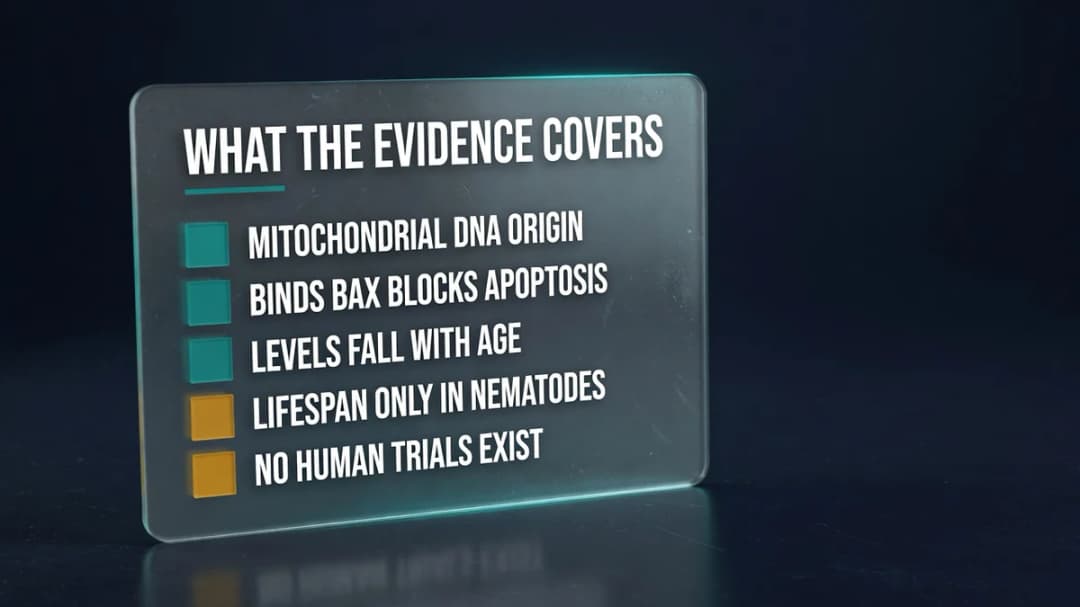
What the Evidence Actually Covers
| Finding | Where it comes from | Confidence for humans |
|---|---|---|
| Encoded in mitochondrial DNA | Molecular biology | Established |
| Binds BAX and blocks apoptosis | Cell studies | Established mechanism |
| Levels fall with age | Human observational data | Reasonably solid observation |
| Higher in offspring of centenarians | Human observational data | An association, not a cause |
| Extends lifespan | Nematodes | Not transferable as stated |
| Neuroprotection against amyloid-beta | Cells and rodents | Preclinical only |
| Beta cell protection, insulin sensitivity | Rodents | Preclinical only |
| Cardioprotection | Rodents | Preclinical only |
| Any benefit in a person | Nothing | No human trials exist |
That last row is the one that matters. Everything above it is a reason to keep studying humanin. None of it is a reason to inject it.
The centenarian observation deserves particular care, because it is the one most often presented as evidence of a longevity effect. Higher humanin in the children of very long-lived people is consistent with humanin contributing to longevity. It is equally consistent with humanin being a marker of whatever else those people have inherited. Observational associations cannot distinguish those.
The HNG Analogue
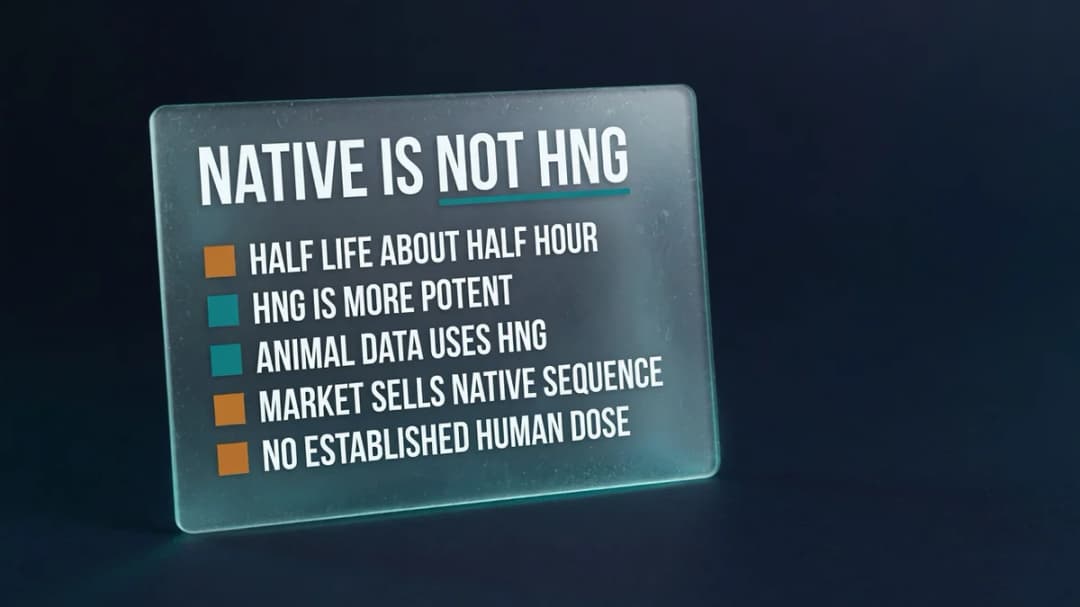
Native humanin has a short plasma half-life, in the region of half an hour, which limits what it can do in a living animal.
Most of the animal research therefore uses HNG, a modified version in which one amino acid is substituted, producing a far more potent and longer-acting analogue. When people read about humanin's effects in mice, the compound in the study is usually HNG rather than humanin itself.
That matters practically. Material sold as humanin in the research market is generally the native sequence, which is not the molecule most of the impressive data was generated with, and would be expected to do considerably less.
Dosing
There is no established dose, in humans or in any clinical context, because no clinical context exists.
Animal studies use figures in milligrams per kilogram, administered by injection, and translating those to a person is exactly the kind of extrapolation that goes wrong. Protocols circulating in the research market are not derived from trial data.
The short half-life of native humanin creates a further practical problem for anyone attempting it: a compound cleared within about half an hour needs either frequent dosing or a modified analogue to maintain any exposure at all.
What Is Not Known
- Whether administered humanin raises tissue levels in a person in any useful way
- Whether raising it produces any clinical effect
- What chronic exposure does. Humanin's core function is preventing cells from dying, and preventing cell death is not universally desirable, since apoptosis is also how the body removes damaged and pre-malignant cells
- How it interacts with anything else
- Anything about long-term safety
That third point is worth stating plainly, because it applies to the whole anti-apoptotic category. A compound whose mechanism is keeping cells alive under stress is doing something that is beneficial in a dying neuron and not obviously beneficial in a cell that should be eliminated. Nobody has characterised where that balance sits.
Where It Sits Among Related Compounds
Humanin belongs with a group of compounds that all rest on mitochondrial biology and all share the same evidential position: interesting mechanism, preclinical data, no human outcome trials. See our guides to MOTS-c, SS-31 and epithalon, and our broader piece on where the evidence gets thin.
The most defensible summary is that mitochondrial signalling is a real and under-explored area of biology, and that being early in a real area is not the same as having something that works.
FAQ
What does the humanin peptide do?
In cells and animals it prevents apoptosis by binding pro-apoptotic proteins, activates survival signalling through a cell surface receptor complex, and in nematodes extends lifespan through autophagy. What it does in a person taking it has not been studied.
Is humanin proven to extend lifespan?
In nematodes, yes. In mammals, no. Lifespan extension in worms is a common early finding that frequently does not survive translation to more complex organisms.
Why is humanin linked to longevity in humans?
Because circulating levels fall with age and are higher in the children of centenarians. That is an association from observational data. It does not establish that raising humanin extends life.
What is HNG?
A modified, more potent and longer-lasting analogue of humanin, created by substituting a single amino acid. Most of the animal data attributed to humanin was generated using HNG rather than the native peptide.
Is there a standard humanin dose?
No. There are no human trials and therefore no established dose. Animal protocols exist but translating them to people is guesswork, and native humanin's very short half-life makes any dosing schedule difficult to justify.
Is humanin safe?
Unknown. There is no human safety data. The theoretical concern is inherent to the mechanism: a compound that stops cells dying is acting on a process the body also uses to clear damaged cells, and nobody has characterised the consequences of doing that chronically.