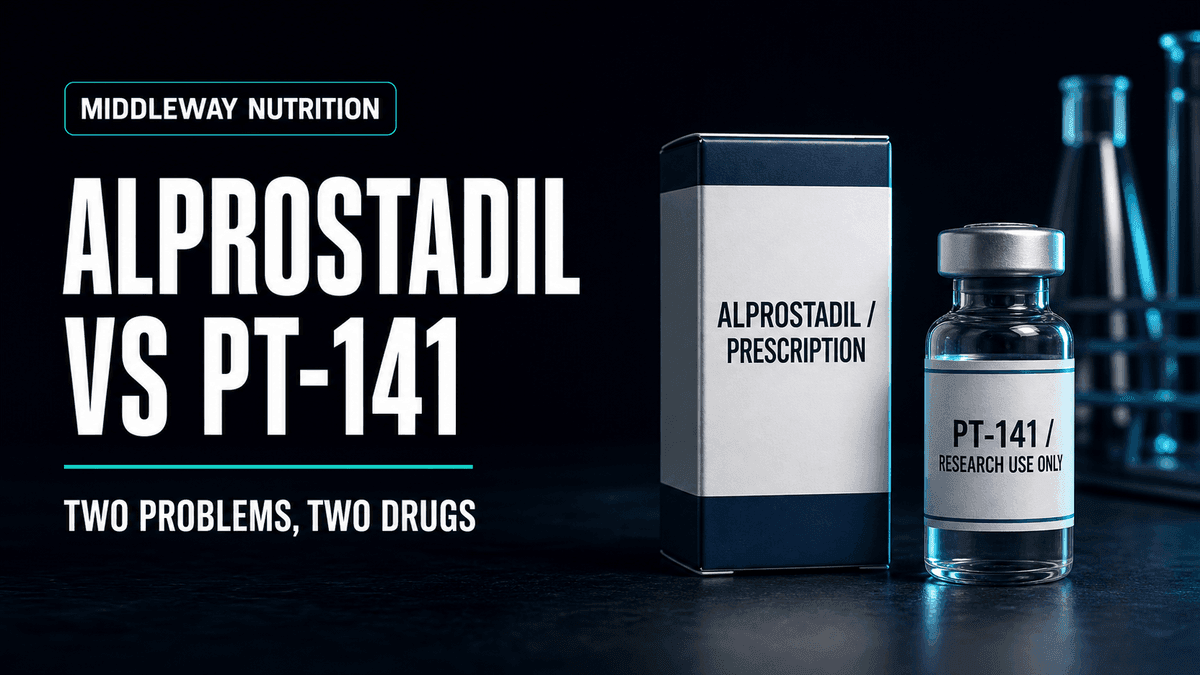
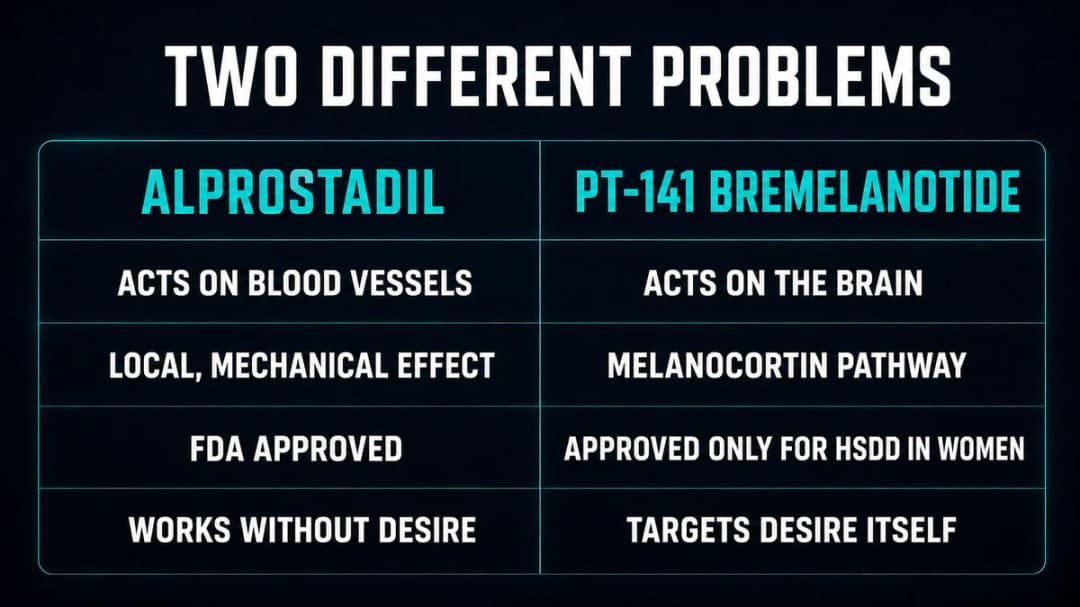
In any Alprostadil vs PT-141 comparison the answer is decided before you look at efficacy: alprostadil creates an erection mechanically, with no arousal required, while PT-141 acts in the brain to raise desire and leaves the plumbing to normal physiology. Framing Alprostadil vs PT-141 as a contest over which works better misses that they treat different failures, and picking the wrong one produces a disappointing result no matter how good the drug is.
Both are real medicines with real approvals, which puts this comparison on firmer ground than most peptide content.
What each one actually is
Alprostadil is a synthetic analogue of prostaglandin E1, approved in the US since the mid-1990s for erectile dysfunction. It binds prostaglandin receptors on the smooth muscle of the corpus cavernosum, raises intracellular cyclic AMP, and relaxes that muscle so blood fills the erectile chambers. The brain is not involved at any point. It is available as an intracavernosal injection under names including Caverject and Edex, and as an intraurethral pellet, MUSE.
PT-141, generic name bremelanotide and marketed as Vyleesi, is a melanocortin-4 receptor agonist approved in 2019 for hypoactive sexual desire disorder in premenopausal women. It acts in the hypothalamus and related limbic structures, where melanocortin signalling feeds into dopamine and oxytocin pathways associated with sexual motivation. It does nothing directly to blood vessels.
The two share an origin only in a loose sense: PT-141 is a derivative of melanotan II, developed after researchers noticed that the tanning peptide had a pronounced effect on arousal.
Alprostadil vs PT-141: head-to-head
| Alprostadil | PT-141 (bremelanotide) | |
|---|---|---|
| Class | Prostaglandin E1 analogue | Melanocortin-4 receptor agonist |
| Site of action | Penile smooth muscle, peripheral | Hypothalamus, central |
| Approval | 1995, male erectile dysfunction | 2019, HSDD in premenopausal women |
| Needs arousal to work? | No | Yes, it amplifies a pathway rather than bypassing it |
| Onset | 5 to 20 minutes | Around 45 minutes or more |
| Addresses desire | No | Yes, that is the mechanism |
| Priapism risk | Yes, roughly 1 to 3% | No |
| Most common complaint | Penile pain at the injection site | Nausea, in the region of 40% of users |
| Administration | Injection into the penis, or urethral pellet | Subcutaneous autoinjector, abdomen or thigh |
The evidence behind each
Alprostadil has an unusually long trail. Response rates in clinical studies have consistently sat above 80% across a range of causes, including men who did not respond to PDE5 inhibitors such as sildenafil, men with erectile dysfunction after prostatectomy, and men with significant vascular disease. The intracavernosal injection outperforms the urethral pellet, which reports lower response rates because delivery to the tissue is less direct.
PT-141's approval rests on the phase 3 RECONNECT programme in premenopausal women with HSDD, which showed statistically significant improvements in desire and in distress related to low desire. The effect size was moderate. It was also the first approved pharmacological option aimed at desire rather than mechanics, which is why a moderate effect was still meaningful.
Male use is a different situation. Phase 2 studies in men with erectile dysfunction produced encouraging results, including responses in men who had failed sildenafil, but the male indication was not carried through to approval. Every use of PT-141 in men is therefore off-label, and the evidence supporting it stops at phase 2.
Side effects, and how they differ in kind
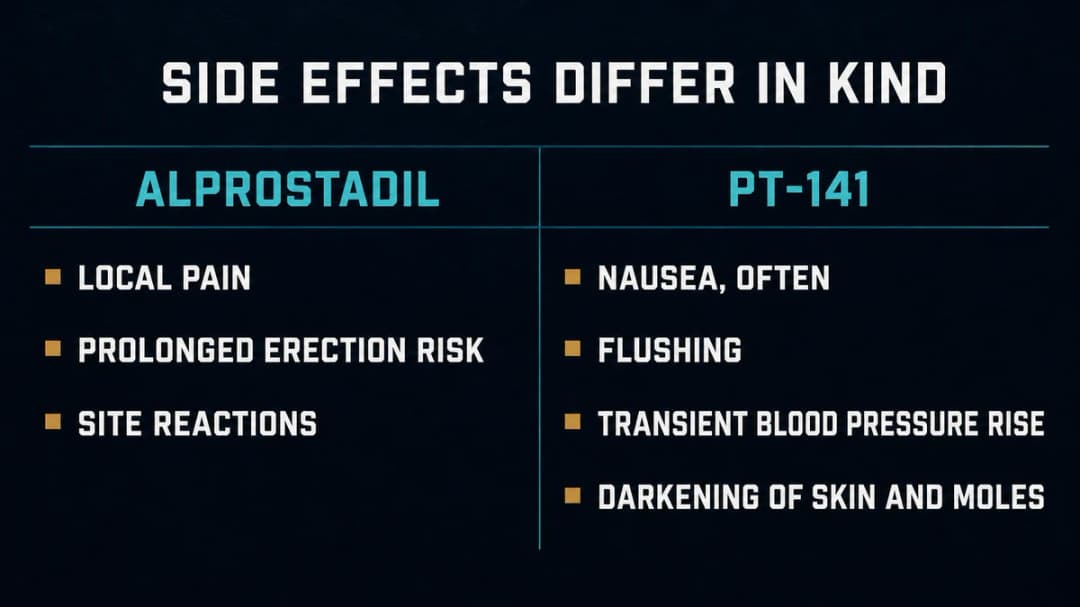
The safety profiles follow the mechanisms almost perfectly. Alprostadil's problems are local; PT-141's are systemic.
Alprostadil. Penile pain at the injection site is the most common complaint and the usual reason people stop. Priapism, an erection lasting beyond four hours, occurs in a small percentage of users and is a genuine emergency, because prolonged ischaemia damages erectile tissue permanently. Long-term injection use is associated with fibrosis and scarring in a minority of users, which can degrade erection quality over time. The urethral pellet causes burning or discomfort in a substantial share of users.
PT-141. Nausea is the headline effect, common enough that managing it is part of using the drug. Facial flushing and headache are frequent. Blood pressure rises transiently, which matters for anyone with hypertension. With repeated use, some people develop darkening of skin or gums, which is an on-target melanocortin effect rather than an unexpected one. The approved label restricts use to no more than eight doses per month.
The single most important asymmetry: alprostadil has an emergency failure mode and PT-141 does not.
Dosing
Alprostadil injection is titrated individually, usually starting very low, in the region of 1.25 to 2.5 mcg, and adjusted upward with medical supervision to whatever produces an adequate response. Training with a clinician before self-injection is standard, and use is limited to a few times weekly with at least a day between doses. The urethral pellet comes in fixed strengths and works within roughly 10 to 20 minutes.
PT-141 as Vyleesi is a fixed 1.75 mg subcutaneous dose from an autoinjector, taken at least 45 minutes before anticipated activity. Nausea is worse on an empty stomach, so eating beforehand is the standard advice. Research-grade PT-141 used off-label is typically described at 1 to 2 mg subcutaneously roughly an hour ahead, with the lower end often chosen specifically to reduce nausea. If you are sourcing the research-grade version, our PT-141 for sale page covers vial sizes and lot verification.
Which fits which problem
Alprostadil is the better fit when the failure is mechanical: confirmed vascular or nerve-related erectile dysfunction, failure of PDE5 inhibitors, erectile dysfunction after prostatectomy, diabetic neuropathy, or any situation where desire is intact and the erection is not. It is also the choice when predictability matters, since the response is pharmacological rather than dependent on mood or context.
PT-141 is the better fit when the failure is upstream: low desire, low sexual motivation, arousal that no longer arrives. It is the approved option for premenopausal women with HSDD. In men it is an off-label option worth discussing with a clinician, particularly for someone who does not want penile injection and whose complaint is drive rather than function.
Post-prostatectomy is the clearest case. Surgery disrupts the nerve signalling that carries arousal to the tissue. A drug that acts on desire has nothing to act through when that circuit is damaged, while a drug that acts directly on smooth muscle does not care. Alprostadil is strongly preferred here.
Combining the two is not an FDA-studied protocol, and both affect blood pressure. If someone has both low desire and mechanical failure, that is a conversation for a physician, not an experiment to run at home.
For more on the peptide itself, see our PT-141 guide, and for its structural relative the melanotan 2 guide.
FAQ
Can alprostadil and PT-141 be used together?
There is no approved combination protocol and no trial testing the pair. In principle they address different dimensions of the same problem, but both influence blood pressure and their combined effect is unpredictable. This is only reasonable under direct medical supervision.
Does PT-141 work as well as alprostadil for erectile dysfunction?
They are not comparable in that way. Alprostadil produces an erection directly and reliably regardless of arousal. PT-141 works by increasing desire, which then drives normal erectile physiology, so it depends on that pathway being intact. No large head-to-head trial has compared them.
Which is better after prostatectomy?
Alprostadil, clearly. Nerve damage from surgery interrupts the route by which central arousal reaches the tissue, so a centrally acting drug has less to work with. Alprostadil bypasses that circuit entirely and has strong evidence in this population.
How serious is the priapism risk with alprostadil?
It occurs in a small percentage of users and is a genuine emergency. Any erection lasting beyond four hours needs immediate treatment, because prolonged lack of blood flow causes permanent damage. Starting at the lowest effective dose under medical guidance is the main way the risk is managed. PT-141 does not carry this risk.
How do you reduce nausea from PT-141?
Eating a light meal beforehand rather than dosing on an empty stomach, staying hydrated, sitting or lying down for the first half hour, and using a lower dose where that is an option. Nausea is usually mild to moderate and transient, but it is common enough that most people need a plan for it.
Is PT-141 available for men?
Not as an approved indication. Its approval covers hypoactive sexual desire disorder in premenopausal women, and any male use is off-label with evidence stopping at phase 2 trials. That is a conversation to have with a clinician rather than a reason to self-source.