PT-141 for women means, in practice, one product: Vyleesi, a 1.75 mg bremelanotide autoinjector the FDA approved in June 2019 for premenopausal women with acquired, generalised hypoactive sexual desire disorder (HSDD). It is used on demand, at least 45 minutes before sex. In its phase 3 trials it raised desire scores and lowered distress more than placebo did, but the gains were small, and around four in ten women felt nauseous.
Most clinic pages ranking for this search skip past how narrow that approval is. Vyleesi is not licensed for postmenopausal women, for general low libido, or for "boosting" sex that is already fine. The research-grade PT-141 sold in vials online is the same molecule but not the same product, and it has none of the approved pen's quality controls.
What Is PT-141 for Women?
PT-141 was the development code for bremelanotide, a synthetic peptide that came out of the same University of Arizona melanocortin research that produced melanotan II. Bremelanotide was built to keep the effect on sexual desire and lose much of the tanning effect. It did not lose all of it, and that comes up again in the side effects section.
When women search "PT-141", they usually land on one of three things:
- Vyleesi, the FDA-approved autoinjector. It is a prescription medicine for a defined diagnosis, made to pharmaceutical standards, and now marketed in the US by Cosette Pharmaceuticals.
- Compounded bremelanotide, which telehealth clinics and wellness practices prescribe, often as a nasal spray. It is made by a compounding pharmacy for an individual prescription and is not an FDA-approved formulation.
- Research-peptide PT-141, sold as a freeze-dried powder labelled for research use only. It is not a medicine at all.
The evidence in this article comes from the first category and does not automatically carry over to the other two.
How Bremelanotide Works on Desire
Bremelanotide activates melanocortin receptors in the brain, mainly the MC4 receptor, in regions of the hypothalamus involved in sexual motivation. It does not work on blood flow the way sildenafil does, and it is not a hormone. It leaves oestrogen and testosterone levels alone and acts on the signalling that makes sex feel wanted in the first place.
That is why it was developed for a desire problem, not an arousal problem. HSDD means low interest plus distress about it, not difficulty with physical response. If the issue is mechanical, a desire drug is aimed at the wrong target, the distinction our comparison of alprostadil and PT-141 is built around.
The same receptor family also governs nausea, blood vessel tone and pigmentation, so the side effects come from the same mechanism as the benefit.
Does PT-141 Work for Women? The RECONNECT Trial Results
The approval rested on RECONNECT: two identical phase 3, randomised, double-blind, placebo-controlled trials, known as Study 301 and Study 302, run between January 2015 and August 2016 (Kingsberg et al., Obstetrics & Gynecology, 2019).
Who was in the trials
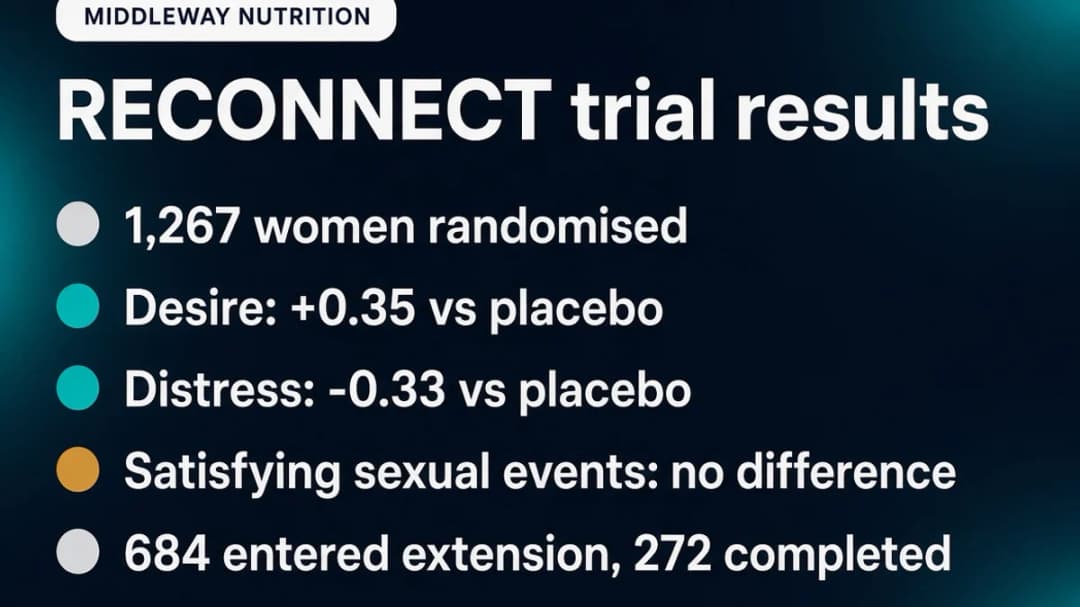
1,267 premenopausal women were randomised. Of those, 1,247 made up the safety population and 1,202 the efficacy population. Their mean age was 39, 85.6% were white and 96.6% were enrolled at US sites. According to the prescribing information, the average HSDD duration was about 4 years and the average relationship length was 12 years. Women used the autoinjector as needed for 24 weeks. The median number of injections over that period was 10, and most women used it two to three times a month.
The two main results
The trials had two co-primary endpoints. The first was sexual desire, measured on the desire domain of the Female Sexual Function Index (FSFI), which runs from 1.2 to 6.0. The second was how bothered women felt by low desire, measured on item 13 of the Female Sexual Distress Scale (FSDS-DAO), which runs from 0 to 4.
| Endpoint | Study 301 | Study 302 | Pooled |
|---|---|---|---|
| FSFI desire, difference vs placebo | +0.30 (P<.001) | +0.42 (P<.001) | +0.35 (P<.001) |
| FSDS-DAO item 13 distress, difference vs placebo | -0.37 (P<.001) | -0.29 (P=.005) | -0.33 (P<.001) |
| Satisfying sexual events per month | No significant difference | No significant difference | Not reported as a benefit |
The label gives the raw changes. In Study 301, desire rose by an average of 0.5 points on bremelanotide and 0.2 on placebo, from a starting score of about 2.1. In Study 302 it was 0.6 against 0.2. Distress fell by 0.7 points on bremelanotide and 0.4 on placebo in both studies.
What those numbers mean in practice
Both results were statistically robust and repeated across two trials. But the change is modest: roughly a third of a point on a 1.2 to 6.0 scale.
The secondary endpoint is the part most summaries leave out. The number of satisfying sexual events per month did not change. The mean change from baseline was 0.0 on bremelanotide in both studies, against -0.1 and 0.0 on placebo, with p-values of 0.76 and 0.70. Women reported wanting sex more and minding low desire less, but on average they did not record more satisfying encounters.
An earlier phase 2b dose-finding trial had pointed the other way (Clayton et al., Women's Health, 2016). With the 1.25 mg and 1.75 mg arms pooled, satisfying events rose by 0.7 a month against 0.2 on placebo. That was a pooled figure from a smaller, 12-week study of 327 women, and phase 3 did not reproduce it.
Long-term data and the critics
684 women went on to a 52-week open-label extension, and 272 completed it (Simon et al., Obstetrics & Gynecology, 2019). Among women who had been on bremelanotide from the start, desire scores ended 1.25 to 1.30 points above their original baseline. There was no placebo group in this phase, so part of that gain is expectation and the passage of time.
A later reanalysis was blunter (Spielmans and Ellefson, Journal of Sex Research, 2024). It found that 8 of the 11 efficacy outcomes registered on ClinicalTrials.gov had not been published. On those outcomes, effect sizes ranged from nil to small, and the authors questioned whether the chosen scales were properly validated in women with HSDD. They called the benefits "statistically modest", which is fair: the drug does something, but for most women it will not be dramatic, and the label says to stop after 8 weeks if nothing has improved. For how user reports compare with the trial data, see our PT-141 review and results.
Who PT-141 Is Approved For, and Who It Isn't
The approved group
Vyleesi is for premenopausal women whose low desire meets all of these conditions:
- It is acquired, meaning it developed after a period of normal desire
- It is generalised, meaning it happens regardless of partner, situation or type of stimulation
- It causes marked distress or difficulty in the relationship
- It is not better explained by another medical or psychiatric condition, a relationship problem, or a medication or drug
The last point matters more than it looks. Low desire is very often a side effect of antidepressants, hormonal contraception, poor sleep, pain during sex, thyroid problems or a strained relationship. Those need dealing with first, and a desire drug does not fix any of them.
Postmenopausal women
The label is explicit: Vyleesi is not indicated for HSDD in postmenopausal women or in men, and it is not indicated to enhance sexual performance. The RECONNECT programme enrolled only premenopausal women, so there is no approval-grade evidence on how well it works or how safe it is after menopause.
A clinician can still prescribe it off-label, and many menopause and wellness clinics now market bremelanotide, usually compounded, to perimenopausal and postmenopausal women. That is legal but not evidence-based in the way the approval is, and blood pressure tends to rise with age, which is the side effect you would least want to add to.
The options for postmenopausal women with HSDD have changed. On 15 December 2025 the FDA extended Addyi (flibanserin) to women under 65, which covers postmenopausal women in that age range. Separately, a 2019 global consensus statement endorsed by the Endocrine Society, the International Menopause Society and others concluded that testosterone at doses that restore premenopausal levels increases satisfying sexual events by an average of one a month over placebo in postmenopausal women with HSDD (Davis et al., Journal of Clinical Endocrinology & Metabolism, 2019). Both have more postmenopausal data behind them than bremelanotide does.
Other groups who shouldn't use it
Vyleesi is contraindicated with uncontrolled high blood pressure or known cardiovascular disease, and is not recommended for anyone at high cardiovascular risk. The label advises effective contraception while using it and stopping it if pregnancy is suspected. It can also sharply lower the amount of oral naltrexone that reaches the bloodstream, so women taking naltrexone for alcohol or opioid dependence should avoid it.
How Vyleesi Is Used: Timing and Limits
The approved regimen is simple:
- Dose: one 1.75 mg injection under the skin of the abdomen or thigh, from a single-use prefilled autoinjector
- Timing: at least 45 minutes before expected sexual activity
- Per 24 hours: no more than one dose
- Per month: more than 8 doses is not recommended
- Review point: stop after 8 weeks if there has been no improvement
The monthly cap exists because each dose briefly raises blood pressure and more frequent use raises the risk of skin darkening.
Reconstitution maths, reported research-context ranges and storage for vial forms are covered in our PT-141 peptide guide and dosage chart. They are not repeated here, because none of that applies to the approved pen.
PT-141 Side Effects in Women
Everything below comes from the Vyleesi prescribing information, based on 627 women on bremelanotide and 620 on placebo in the phase 3 trials. The broader profile, including effects reported by men and research users, is on our PT-141 side effects page.
| Side effect | Bremelanotide | Placebo |
|---|---|---|
| Nausea | 40.0% | 1.3% |
| Flushing | 20.3% | 0.3% |
| Injection site reactions | 13.2% | 8.4% |
| Headache | 11.3% | 1.9% |
| Vomiting | 4.8% | 0.2% |
| Fatigue | 3.2% | 0.5% |
Overall, 18% of women on bremelanotide stopped because of side effects, compared with 2% on placebo.
Nausea
Nausea is the one that decides whether most women keep using it. It was worst with the first dose, when 21% reported it, and dropped to about 3% with later doses. It usually started within an hour and lasted about two hours. 13% of women on bremelanotide took an anti-sickness medicine, and 8% dropped out of the trials because of nausea. The first injection is the one to plan around. Many women find that later doses are much easier.
Skin darkening (focal hyperpigmentation)
This is the effect that surprises people. In the phase 3 trials, 1% of women using up to 8 doses a month developed patches of darker skin, including on the face, gums and breasts. No one on placebo did.
The risk rises steeply with frequent use. In a separate study where women took bremelanotide daily for 8 days, 38% developed focal hyperpigmentation, and 14% more developed new patches over a further 8 days. Women with darker skin were more likely to be affected, and the darkening did not clear in every case after stopping. That is why the monthly limit matters, and it is one of the strongest reasons not to use research-grade PT-141 more often than the approved schedule.
Blood pressure and heart rate
Each dose raises blood pressure for a while. In clinical studies the peak increase was 6 mmHg systolic and 3 mmHg diastolic, reached 2 to 4 hours after the dose, with heart rate falling by up to 5 beats per minute. Both usually returned to baseline within 12 hours. For a healthy woman that is minor, but it is why the drug is ruled out for anyone with uncontrolled hypertension or heart disease, and why one dose per 24 hours is a hard limit rather than a guideline.
Alcohol
Unlike flibanserin, bremelanotide has no alcohol restriction on its label. In a study with the equivalent of about three drinks, alcohol did not change how the drug was absorbed or cleared.
PT-141 vs Addyi (Flibanserin)
Addyi was the first drug approved for HSDD, in August 2015. It works very differently from Vyleesi, and the choice between them is usually about practicalities rather than which one works better.
| Vyleesi (bremelanotide) | Addyi (flibanserin) | |
|---|---|---|
| How it's taken | 1.75 mg injection, on demand | 100 mg tablet, every night at bedtime |
| How it works | Melanocortin receptor agonist | Acts on serotonin receptors |
| Approved for | Premenopausal women with HSDD | Women under 65 with HSDD, including postmenopausal since December 2025 |
| Alcohol | No label restriction | Boxed warning: wait 2 hours after 1 or 2 drinks, skip the dose after 3 or more |
| Main side effects | Nausea, flushing, headache | Dizziness, sleepiness, nausea, fatigue |
| When to stop if no benefit | 8 weeks | 8 weeks |
On efficacy, the two land in a similar place. A meta-analysis of flibanserin trials covering 5,914 women found that the 100 mg dose added 0.49 satisfying sexual events a month over placebo, and 0.27 points on the FSFI desire domain. The authors rated the overall evidence as very low quality (Jaspers et al., JAMA Internal Medicine, 2016). Bremelanotide's pooled FSFI desire gain was 0.35. It is tempting to call that a win for Vyleesi, but these are different trials with different populations and nobody has compared the two drugs head to head. Treat them as roughly comparable in effect.
The practical differences matter more:
- Daily or on demand. Addyi has to be taken every night, whether or not sex is planned. Vyleesi is only used when needed.
- Tolerability. In premenopausal trials, 21% of women on Addyi had sleepiness, sedation or fatigue, compared with 8% on placebo. Vyleesi's main problem is nausea, which is concentrated around the first dose.
- Needles. Some women will not inject, and for them that decides it.
For the wider landscape, including kisspeptin and oxytocin, see best peptides for sexual health.
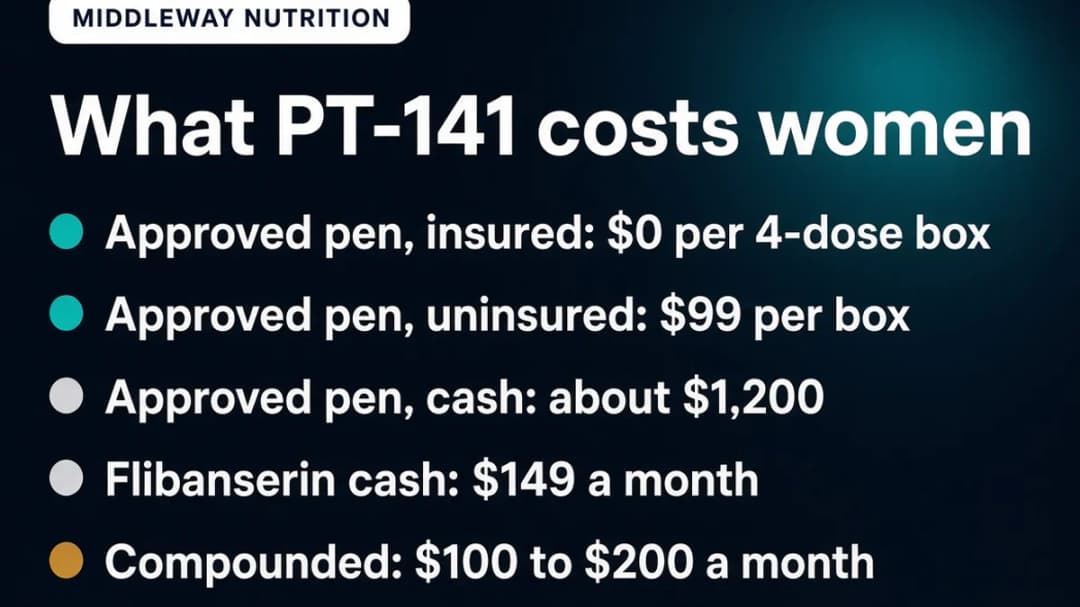
How Much Does PT-141 Cost for Women?
Prices below were taken from the brand websites in September 2026. Savings programmes change often, so check them before relying on them.
| Route | Reported cost | Notes |
|---|---|---|
| Vyleesi, commercially insured, with the manufacturer programme | $0 for a 4-dose box | Up to 2 fills every 30 days; excludes Medicaid and TRICARE |
| Vyleesi, uninsured, with the manufacturer programme | $99 for a 4-dose box | Dispensed through the brand's partner pharmacy |
| Vyleesi, cash without the programme | About $1,200 for 4 autoinjectors | Price-tracking sites' figure, roughly $300 a dose |
| Addyi, insured | As little as $20 a month | Brand website figure |
| Addyi, cash | $149 a month | Through the brand's partner pharmacy |
| Compounded bremelanotide via telehealth | Roughly $100 to $200 a month | Not an FDA-approved formulation |
Getting a prescription
Vyleesi needs a prescription from a clinician who has confirmed HSDD, which means ruling out the other causes of low desire first. The brand runs a telehealth route through a partner service, and gynaecologists can prescribe it directly. Insurance coverage varies, and the savings programme excludes government-funded plans. Everything in this section describes the US market, and readers elsewhere should check whether bremelanotide is licensed locally before assuming a legitimate route exists.
Research-Peptide PT-141 vs the Vyleesi Autoinjector
It is the same molecule, but the two are not interchangeable.
What the approved pen is. Each Vyleesi autoinjector holds 1.75 mg of bremelanotide in 0.3 mL of sterile solution, made under pharmaceutical manufacturing rules and backed by trials in more than 1,200 women. The dose is fixed, so there is no mixing or measuring.
What research PT-141 is. It is sold as freeze-dried powder in a vial, typically 10 mg, and labelled for research use only. Before injecting, the user has to reconstitute it with bacteriostatic water and draw up a fraction of the vial. Several things can go wrong:
- Identity and purity depend entirely on the seller's testing, and third-party certificates vary a lot in how independent they really are
- Sterility is not guaranteed in the way it is for an injectable medicine
- Dose accuracy depends on the user's arithmetic and syringe markings, and mistakes push women towards more nausea and bigger blood pressure spikes
- Frequency discipline tends to slip when the product is cheap and freely available, and more frequent use is exactly what raised the rate of skin darkening from 1% to 38% in the daily-dosing study
Where compounded nasal sprays fit. Much of what telehealth clinics sell to women is intranasal bremelanotide. An intranasal version was tested during development and dropped after blood pressure rises, which led to the switch to the injectable form that became Vyleesi. Compounded sprays are made legitimately by pharmacies, but the formulation has no trial showing how well it works or how safe it is for women with HSDD.
The point is not that research PT-141 is known to be dangerous. It is unknown, and the trial numbers on this page apply to the pen. Research-grade PT-141 is not approved for human use, and this article is not medical advice. Anyone weighing it should do so with a clinician who knows their blood pressure and medical history.
FAQ
Is PT-141 FDA approved for women?
Yes, as Vyleesi, approved in June 2019 for premenopausal women with acquired, generalised hypoactive sexual desire disorder. The approval covers the 1.75 mg autoinjector only. Compounded sprays and research-grade vials are not FDA-approved products.
Can postmenopausal women use PT-141?
Vyleesi's label says it is not indicated for postmenopausal women, and the phase 3 trials enrolled only premenopausal women. A clinician can prescribe it off-label, but there is no approval-grade evidence for this group. Addyi is now approved for postmenopausal women under 65, and testosterone therapy has consensus support for postmenopausal HSDD.
How long before sex should PT-141 be taken?
The Vyleesi label says at least 45 minutes before anticipated sexual activity. Use no more than one dose in 24 hours, and more than 8 doses in a month is not recommended.
How effective is PT-141 for women?
Modestly. In the RECONNECT trials, desire scores rose by 0.35 points more than placebo on a 1.2 to 6.0 scale, and distress about low desire fell by 0.33 points more than placebo. The number of satisfying sexual events did not differ from placebo. Some women respond well, but many notice little, which is why the label says to stop after 8 weeks without improvement.
Does PT-141 cause nausea in women?
It does for many. Nausea affected 40.0% of women on bremelanotide in the phase 3 trials, compared with 1.3% on placebo. It was most common after the first dose (21%) and fell to about 3% with later doses, usually lasting around two hours. About 8% of women stopped treatment because of it.
Can PT-141 darken your skin?
Yes. Patches of darker skin on the face, gums or breasts appeared in 1% of women using up to 8 doses a month, but in 38% of women after 8 days of daily use. Darker skin types are at higher risk, and the change does not always fade after stopping.
Is PT-141 better than Addyi?
Neither has been shown to be better, since there is no head-to-head trial and both produce similar, modest gains in their own studies. Vyleesi suits women who want on-demand use and no alcohol restriction. Addyi suits women who would rather take a nightly tablet than inject, or who are postmenopausal and under 65.