Of all the compounds marketed as the best peptides for sexual health, exactly one has regulatory approval for a sexual indication: PT-141, sold as Vyleesi, approved in 2019 for hypoactive sexual desire disorder in premenopausal women. Every other entry on a list of the best peptides for sexual health is either a research chemical with real safety questions or an investigational compound whose evidence stops well short of clinical use. That is the honest shape of this category, and it is worth knowing before reading further.
The interesting thing about these compounds is not that they work better than existing treatments. It is that they work on a different part of the problem.
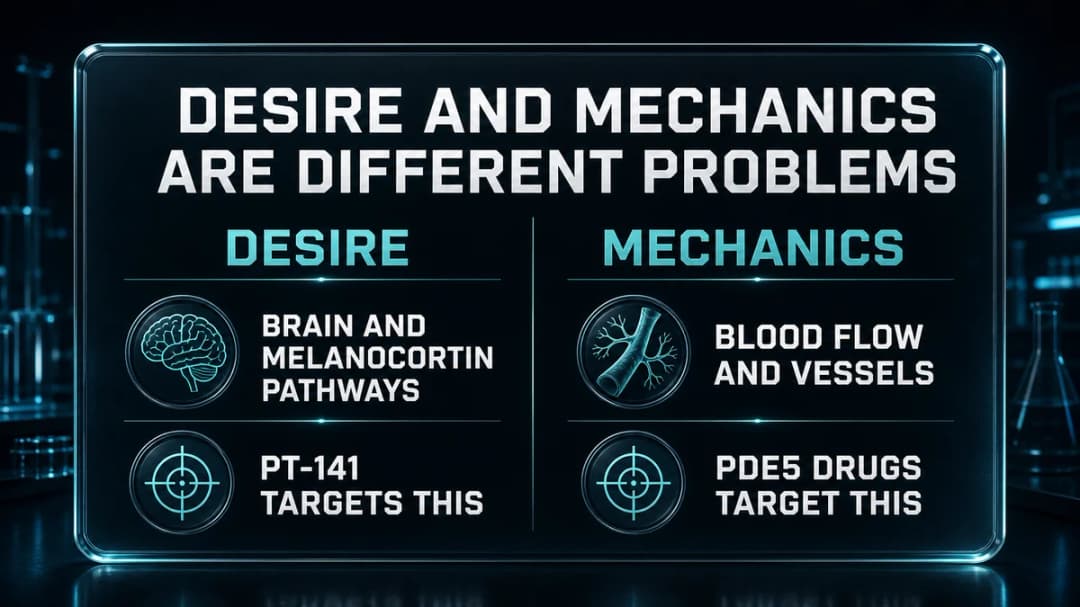
Desire and mechanics are different problems
Sildenafil and its relatives improve blood flow into erectile tissue. They do nothing about whether a person wants sex. For someone with intact desire and a vascular problem, that is exactly the right tool, and it is one of the most successful drug classes ever developed.
Melanocortin peptides work in the opposite direction. They act in the hypothalamus and limbic system, where melanocortin receptor activation feeds into dopamine and oxytocin signalling associated with sexual motivation. The effect is on wanting rather than on plumbing.
That distinction determines everything. Someone whose complaint is mechanical will get very little from a drug that raises desire, and someone whose complaint is absent desire will get very little from a drug that improves blood flow. Working out which problem you have is a clinical question and it comes before choosing anything.
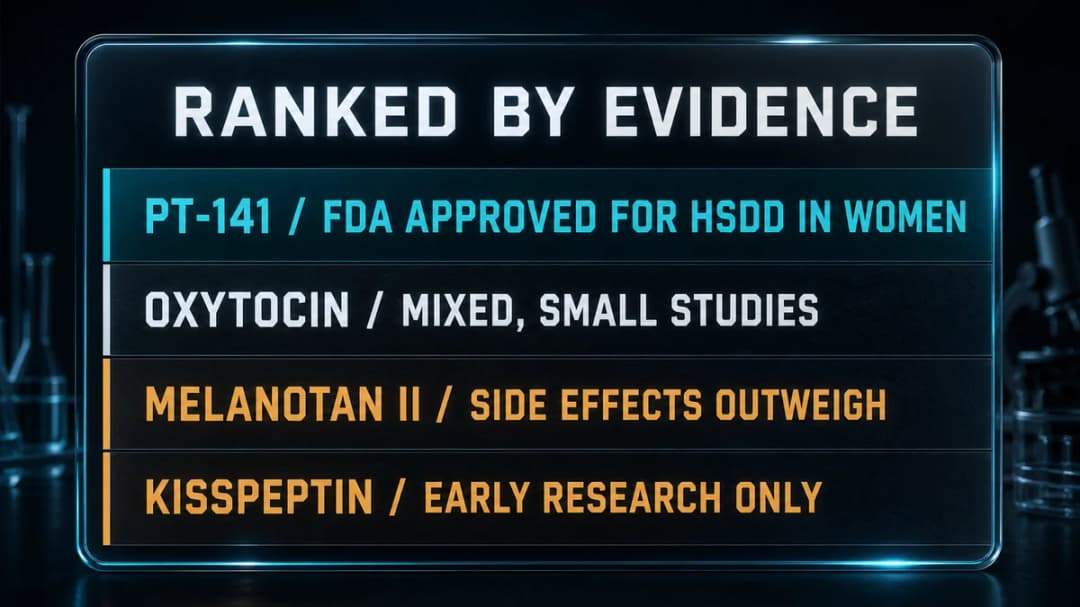
Best peptides for sexual health, ranked by evidence
| Compound | Mechanism | Status | What it addresses | Evidence |
|---|---|---|---|---|
| PT-141 (bremelanotide) | MC4R and MC3R agonist | Approved for HSDD in premenopausal women | Desire | Phase 3, modest but real effect |
| Melanotan II | Non-selective melanocortin agonist | Not approved anywhere | Desire, erection, plus tanning and appetite effects | Small early trials, significant safety concerns |
| Kisspeptin | KISS1R agonist, upstream of GnRH | Investigational | Desire, hormonal axis | Early human imaging and endocrine work |
| Oxytocin | Oxytocin receptor agonist | Approved for obstetric use, not for this | Bonding, intimacy | Mixed and unconvincing for sexual function |
| GH secretagogues | Growth hormone axis | Research compounds | General wellbeing at best | No direct sexual pathway |
PT-141: the only one with an approval
PT-141 is a cyclic peptide that activates melanocortin-4 receptors, and to a lesser degree MC3 receptors, in the central nervous system. It was derived from melanotan II and engineered specifically to keep the sexual effects while shedding the tanning activity.
Approval came from the phase 3 RECONNECT programme, which enrolled over 1,200 premenopausal women with hypoactive sexual desire disorder. The results were statistically robust and clinically modest: desire scores improved by roughly half a point more than placebo on the scale used, distress scores fell somewhat more than placebo, and satisfying sexual events increased by around one per month against roughly half on placebo.
Those numbers deserve to be quoted honestly rather than buried. The drug works. It does not transform anything. Its significance is that nothing else approved targets desire at all, so a modest effect filled a genuine gap.
Practical points: the approved dose is 1.75 mg by subcutaneous autoinjector, taken at least 45 minutes before anticipated activity, with a limit of one dose in 24 hours and eight doses a month. Nausea affects roughly 40% of users, flushing around a fifth, injection site reactions and headache around one in ten. It transiently raises blood pressure and is contraindicated in uncontrolled hypertension or established cardiovascular disease. With repeated use some people develop patches of skin darkening, which is the melanocortin system doing what it does rather than a surprise.
It is not approved for men. Phase 2 work in men with erectile dysfunction was encouraging, including in some who had failed sildenafil, but the male indication was never completed. Male use is off-label. Our PT-141 guide covers the compound in more detail.
Melanotan II: the one to be careful about
Melanotan II is the compound PT-141 came from. Developed as a sunless tanning agent, its pro-sexual effects turned up as an unexpected finding during trials. A small early double-blind study reported erections in the large majority of men who received it compared with a small minority on placebo, which is a striking result for a compound nobody was studying for that purpose.
It was never developed toward approval, and the reason is selectivity. Melanotan II activates melanocortin receptors indiscriminately, which is why it tans, suppresses appetite, affects blood pressure and produces nausea, all at once and to varying degrees in different people.
The safety concerns are not theoretical. Unpredictable pigmentation includes darkening of existing moles, which complicates the one thing dermatologists actually rely on to detect melanoma early. Cardiovascular effects have been reported. Long-term data does not exist. It is not approved anywhere in the world.
If the goal is the sexual effect, PT-141 was designed to deliver it without most of that baggage, which makes melanotan II difficult to justify for this purpose. See our melanotan 2 guide for the fuller picture.
Kisspeptin: genuinely interesting, genuinely early
Kisspeptin works higher up the chain. It activates the KISS1R receptor on GnRH neurons in the hypothalamus, triggering the cascade that produces LH and FSH and, downstream, testosterone and oestrogen.
What made it interesting for sexual function was neuroimaging work in men showing that kisspeptin infusion increased activity in limbic brain regions in response to sexual and romantic stimuli, suggesting it does something to the processing of sexual cues rather than only to hormone levels.
That is a long way from a usable treatment. The research is early, it is mostly in small groups of healthy volunteers, and its more developed clinical application is in fertility protocols rather than in desire disorders. Treat it as a promising line of research rather than an option. Our kisspeptin guide covers where the work stands.
Oxytocin and the rest
Oxytocin gets discussed here because of its role in bonding and orgasm, and intranasal oxytocin has been studied for sexual dysfunction. Results have been mixed and unimpressive. Where it seems to matter is in the emotional and relational dimension rather than in arousal itself, which is a real thing but not what most people are looking for when they search this term.
GnRH analogues such as gonadorelin are relevant only where the underlying problem is hormonal, specifically low testosterone, in which case treating that directly is the sensible route.
Growth hormone secretagogues get listed on these pages with no justification beyond general vitality claims. They do not act on any sexual pathway. See growth hormone secretagogues for what they actually do.
What to do before considering any of this
Sexual dysfunction is frequently the first visible sign of something else. Erectile dysfunction in particular is a recognised early marker of cardiovascular disease, because the vessels involved are small and show trouble first. Low desire is commonly caused by depression, medication, thyroid or testosterone problems, sleep deprivation, alcohol, or a relationship difficulty that no drug addresses.
Working through those is not a preliminary step to skip. It is often the whole treatment, and buying a research peptide instead means treating a symptom while leaving a diagnosis undiscovered.
FAQ
What is the difference between PT-141 and Viagra?
Sildenafil improves blood flow into erectile tissue and does nothing to desire. PT-141 acts in the brain to raise sexual desire and does nothing directly to blood vessels. They address different failures, and someone with a mechanical problem will get little from PT-141.
Is PT-141 approved for men?
No. Its approval covers hypoactive sexual desire disorder in premenopausal women. Phase 2 studies in men were promising but the male indication was never completed, so all male use is off-label.
Why was melanotan II never approved?
Because it activates melanocortin receptors non-selectively, producing unpredictable effects on pigmentation, appetite and cardiovascular function alongside the sexual ones. Darkening of existing moles is a particular concern because it interferes with melanoma surveillance. PT-141 was developed as the more selective alternative.
How quickly does PT-141 work?
The label says at least 45 minutes before anticipated activity. Effects are commonly described as building over one to two hours and persisting for a while afterwards. It is used on demand rather than daily, with a limit of one dose in 24 hours and eight per month.
Does kisspeptin work for low libido?
It is investigational. Early imaging work in men suggests it changes how the brain processes sexual and romantic stimuli, which is interesting, but no clinical trial supports its use for desire disorders and there is no established dose or safety profile.
Are there natural ways to support this pathway?
Nothing activates melanocortin receptors the way these peptides do, but the system is sensitive to general metabolic state. Sleep, exercise, alcohol intake, body composition and stress all influence desire through several routes, and they are usually where the largest available gains are.