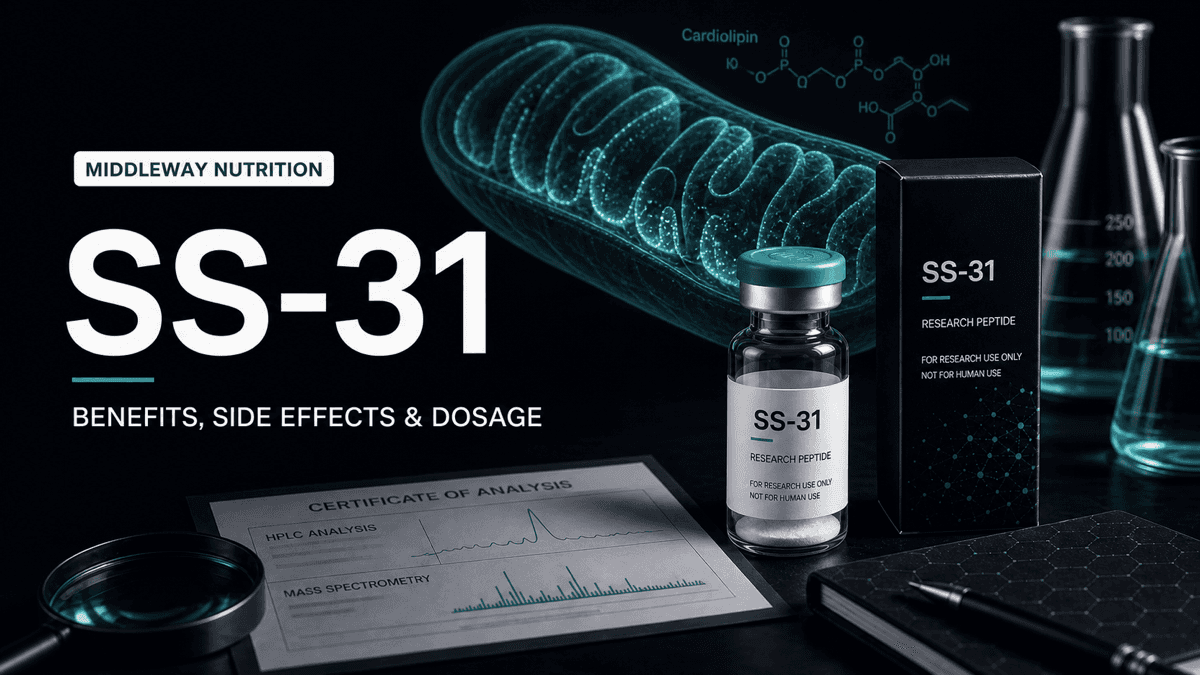
SS-31 peptide benefits cluster around mitochondrial energy output, the side effects reported in trials are mostly injection site reactions, and dosage in published research has ranged from roughly 4 mg to 40 mg daily by subcutaneous injection. That last detail matters more than it sounds, because SS-31 is one of the very few research peptides that has actually been through registered human trials under a pharmaceutical name. Most of what gets sold as a research peptide has never seen a clinical protocol. This one has, which means the honest version of the story is unusually well documented and also unusually mixed.
- SS-31 is a four amino acid aromatic-cationic peptide, also known as elamipretide, Bendavia, and MTP-131, with a molecular weight near 640 daltons.
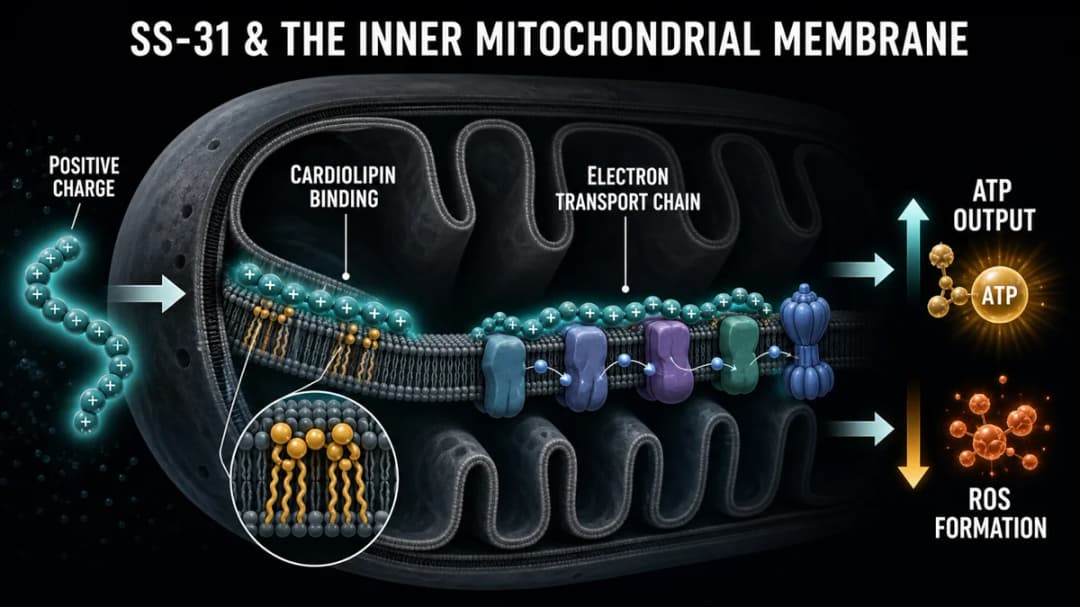
- It concentrates inside the inner mitochondrial membrane and binds cardiolipin, the phospholipid that holds the electron transport chain in working order.
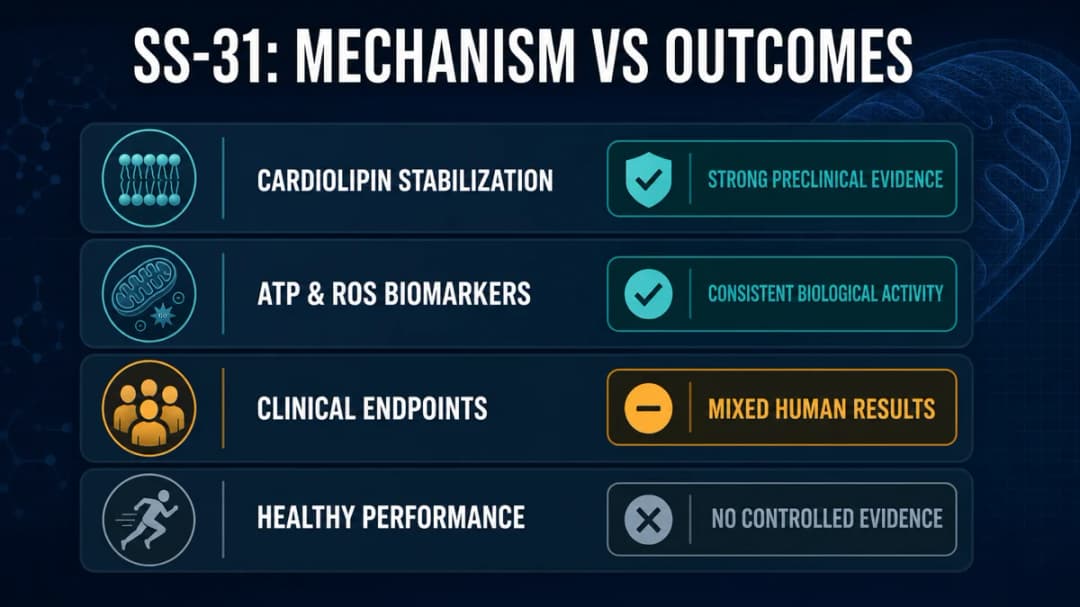
- Human trial data exists but is genuinely mixed: biomarkers often move, clinical endpoints frequently do not.
- Reported research dosing runs from about 4 mg to 40 mg daily subcutaneously, while body-weight protocols around 0.1 to 0.25 mg/kg circulate online but could not be traced to a published subcutaneous protocol.
- Injection site reactions are the dominant reported side effect. Long-term safety data does not exist.
What SS-31 Actually Is
SS-31 belongs to a family of aromatic-cationic peptides sometimes called Szeto-Schiller peptides, after the two researchers who characterized them. The sequence is D-Arg-Dmt-Lys-Phe-NH2, where Dmt stands for 2',6'-dimethyltyrosine, a modified version of tyrosine. Four residues, around 639.8 daltons, water soluble, and carrying a net positive charge.
That charge is the whole trick. Mitochondria hold a strongly negative membrane potential across their inner membrane, on the order of -180 mV, so positively charged molecules get pulled inward and held there. SS-31 does not need a bulky carrier molecule bolted onto it, the way many other mitochondria-directed compounds solve delivery. Its own chemistry does the work, and it ends up concentrated in the inner membrane at concentrations far above those in the surrounding cytoplasm.
Once it is there, the dimethyltyrosine residue interacts with cardiolipin. Cardiolipin is a phospholipid found almost nowhere else in the cell, and it does two jobs: it shapes the folded architecture of the inner membrane, and it helps the electron transport chain complexes assemble and stay assembled. When cells are stressed by injury, disease, or age, cardiolipin oxidizes. The membrane loses its organization, electrons start leaking out of the transport chain instead of moving down it, ATP output falls, reactive oxygen species rise, and the resulting damage oxidizes more cardiolipin. It is a loop that feeds itself.
SS-31 is aimed at that loop rather than its downstream consequences. Conventional antioxidants mostly scavenge free radicals after they have already formed and dispersed. SS-31 is designed to reduce how many form at all, by keeping the membrane that produces them structurally intact. Whether that upstream logic translates into outcomes people can feel is a separate question, and it is the one the clinical program has struggled with.
One status point matters up front. Elamipretide, sold as Forzinity, received FDA accelerated approval on September 19, 2025, for Barth syndrome in patients weighing at least 30 kg; the Forzinity label on DailyMed gives 40 mg subcutaneously once daily, or 20 mg if eGFR is under 30 and the patient is not on dialysis. Outside that indication it remains investigational, and the research-vial SS-31 sold online is not the approved product: it is sold for laboratory research only and has none of the pharmaceutical controls behind Forzinity.
SS-31 Benefits
The mechanistic case for SS-31 is strong and the clinical case is partial. Those two things are worth keeping separate, because vendor copy tends to blend them.
Cardiolipin stabilization and membrane structure. This is the best supported claim, and it is a cellular one. SS-31 binding to cardiolipin and preserving inner-membrane organization has been demonstrated repeatedly in cell and tissue work. Evidence grade: solid, preclinical.
Reduced reactive oxygen species production. Because electron leak drops when the transport chain stays properly arranged, ROS generation falls at the source. This follows directly from the mechanism and shows up consistently in preclinical models. Evidence grade: solid, preclinical.
Improved ATP output. A better organized electron transport chain produces energy more efficiently. Measured in isolated mitochondria and in animal tissue. Whether healthy young mitochondria have any headroom to improve is not established. Evidence grade: good in impaired systems, untested in healthy ones.
Exercise capacity in mitochondrial disease. In people with primary mitochondrial myopathy, trials have looked at walking-test performance and related measures. Some signals of benefit appeared on secondary and biomarker measures, but primary endpoints were not consistently met across the program. The Phase 3 trial, NCT03323749, randomized 218 patients to 40 mg daily or placebo for 24 weeks and missed both co-primary endpoints: the published trial report gives a between-group difference of -3.2 meters on the six-minute walk (95% CI -18.7 to 12.3, p = 0.69) and -0.07 on the PMMSA total fatigue score (p = 0.37). We have not verified claims that the sponsor ended the whole program on that result, so treat that as unconfirmed. That split, movement in the mechanism-adjacent measures without a clean win on the headline one, is the recurring pattern in this compound's clinical history. Evidence grade: mixed human data.
Cardiac function. The heart is the most mitochondria-dependent tissue in the body, so heart failure was an obvious target. Heart failure studies have been run, and the primary endpoints tested there were not met. Evidence grade: negative on the main endpoints tested.
Aging and healthspan. In aged mice, SS-31 has been associated with improved skeletal muscle function, lower oxidative stress markers, and better insulin sensitivity. This is where most of the enthusiasm comes from and where human data is thinnest, because the completed trials all ran in disease populations. That is changing slowly: an open-label, single-arm Phase 2a pilot in healthy adults aged 65 and over, NCT07275424, has been recruiting since November 2025 and plans to give 30 participants four weeks of daily subcutaneous elamipretide. Its endpoint is safety and tolerability, not performance, and no results have been posted. Evidence grade: animal only.
Athletic performance. No controlled study exists in athletes or healthy exercising people, and performance outcomes are notoriously placebo-sensitive. Evidence grade: none.
The pattern is consistent: SS-31 has real, measurable biological activity, and converting that into a clinical endpoint has been the hard part. That is not the same as the compound doing nothing, and it is also not a green light.
The closest mitochondrial sibling is a different animal entirely. Our MOTS-c guide covers a mitochondria-encoded peptide that acts as a signaling molecule, moving to the nucleus and altering gene expression around glucose metabolism. SS-31 does not signal. It sits in a membrane and holds it together.
SS-31 Side Effects
SS-31 has a better documented side effect profile than almost any peptide in the research market, purely because elamipretide went through formal trials with adverse event reporting. That is an advantage. It does not mean the profile is empty.
Injection site reactions. By a wide margin the most frequently reported effect. Redness, pain, itching, or swelling where the subcutaneous injection was given. Generally described as mild and transient, and generally managed in trials by rotating sites.
Headache. Reported by some trial participants, typically mild.
Dizziness. Transient, reported by a minority.
Fatigue. Reported, and reported at the same rate on placebo. In the 24-week controlled period of the Phase 3 myopathy trial, 4 of 109 participants on 40 mg daily reported fatigue and so did 4 of 109 on placebo.
Gastrointestinal effects. Occasional nausea, described in the research as more common at the higher end of the dose range.
The Phase 3 trial posted its full adverse event table to the registry. These counts are participants reporting each event during the 24-week double-blind period at 40 mg daily, the top of the clinical dose range.
| Event | Elamipretide 40 mg (n=109) | Placebo (n=109) |
|---|---|---|
| Injection site erythema | 94 | 31 |
| Injection site pruritus | 82 | 10 |
| Injection site pain | 43 | 20 |
| Injection site swelling | 42 | 7 |
| Headache | 8 | 4 |
| Dizziness | 6 | 3 |
| Nausea | 5 | 8 |
| Fatigue | 4 | 4 |
| Any serious adverse event | 5 | 3 |
Read that table as two separate stories. The injection site rows are not a footnote, they are the dominant experience of taking this compound: 86 percent of the treated group got redness and 75 percent got itching, against 28 percent and 9 percent on placebo. Every systemic complaint below them sits within a few cases of placebo, and nausea was actually more common on placebo. Across published trials, no consistent signal of serious drug-related adverse events emerged. The plausible explanation is specificity: a compound that concentrates in one organelle and binds one phospholipid has limited opportunity for off-target activity.
Now the parts where the data is genuinely thin.
Controlled durations were short, mostly four to twenty-four weeks, and the populations were small. Longer exposure exists but only without a comparator: the Phase 3 trial carried an open-label extension of up to 144 weeks, and a separate open-label extension in 28 myopathy patients ran daily 40 mg for up to 260 weeks. Fatigue was reported by 6 of those 28 over that span and headache by 7, with no placebo group to measure either against. So the honest statement is not that nobody has taken it for years, it is that nobody has taken it for years inside a controlled comparison, and never as a healthy person using it for general enhancement. There is also no pregnancy, pediatric, or drug-interaction data worth citing.
Then there is the quality problem, separate from the pharmacology and often the larger practical risk. Trial-grade elamipretide was made under pharmaceutical controls. A vial from a research chemical supplier was not. Contaminants, incorrect fill weight, degraded material, and outright substitution are documented problems in this market, and none of them appear in a clinical safety table.
SS-31 Dosage Chart
Everything below describes what has been reported in clinical trials and in published research protocols. It is context, not instruction. There is no established dosing standard for SS-31 outside a supervised study, and this guide is not telling you to administer anything.
| Context | Reported range | Frequency | Typical duration |
|---|---|---|---|
| Approved dose (Forzinity, Barth syndrome, 30 kg or more) | 40 mg (20 mg if eGFR under 30, not on dialysis) | Once daily, subcutaneous | Ongoing |
| Upper end of clinical trial dosing | 40 mg | Once daily, subcutaneous | Trial-defined, multi-week |
| Broader clinical trial range | 4 mg to 40 mg | Once daily, subcutaneous | 4 to 12 weeks |
| Conservative body-weight protocol (online convention, unverified) | 0.1 mg/kg (about 7 mg at 70 kg) | Daily or every other day | 4 to 8 weeks |
| Standard body-weight protocol (online convention, unverified) | 0.25 mg/kg (about 17.5 mg at 70 kg) | Daily | 4 to 12 weeks |
| Reported maintenance approach (online convention, unverified) | 0.1 mg/kg | Three times weekly | Ongoing, often cycled |
| Preclinical animal studies | 1 to 5 mg/kg | Varies by model | Varies by model |
A note on the body-weight rows: the mg/kg figures resemble the intravenous infusion rates used in some early trials, which were expressed per kilogram per hour (for example 0.05 mg/kg/h for one hour) rather than as daily subcutaneous doses, and we could not find a published subcutaneous mg/kg protocol, so read those rows as unverified. Four things about the table deserve context.
The 40 mg figure sits at the top of the clinical range and was used in a rare inherited mitochondrial disorder, in patients whose energy metabolism was already measurably impaired. It is a disease-specific trial dose, not a general-purpose number.
The animal figures of 1 to 5 mg/kg do not scale to humans straightforwardly. Interspecies conversion is not linear, and naive multiplication produces doses far above anything tested in people.
Plasma half-life is short, on the order of a couple of hours, which would normally argue for frequent dosing. But SS-31 accumulates in mitochondria far above blood levels and persists there, which is why once-daily dosing was adequate in trials. Plasma pharmacokinetics undersells exposure at the site of action.
Reported cycling patterns, such as eight weeks on and four weeks off, come from self-directed longevity protocols rather than any trial design. They exist because long-term data does not, making cycling a hedge against an unknown rather than a validated schedule.
Reconstitution and Storage
SS-31 ships as a lyophilized powder and has to be reconstituted before use. The handling basics are the same as for most peptides in this class.
Bacteriostatic water is the standard diluent. Direct it slowly down the inside wall of the vial rather than onto the powder cake, which avoids mechanical damage to the peptide. Swirl gently until dissolved. Do not shake or vortex, since agitation can denature peptide material and generate foam that makes measurement harder.
Lyophilized SS-31 stores at -20 degrees Celsius and is stable there for extended periods. Once reconstituted it goes in the refrigerator at 2 to 8 degrees Celsius, protected from light, with reported working windows around three to four weeks. A 10 mg vial is common, which at the higher reported ranges is only one or two administrations, and that is part of why SS-31 is among the more expensive peptides on the market.
Stacking
Genuine stacking data for SS-31 is essentially nonexistent. No controlled study has evaluated it in combination with anything else, so what follows is mechanistic reasoning, and mechanistic reasoning has a poor track record of predicting outcomes.
The most frequently discussed pairing is with NAD+ precursors. The logic is that NAD+ is the coenzyme the electron transport chain depends on to move electrons at all, while SS-31 protects the membrane structure where that transport happens. Fuel and engine, in the usual metaphor. Our NAD+ guide covers what that side of the equation is and is not supported to do. Plausible on paper, untested in combination.
MOTS-c comes up for a similar reason, and the argument is at least coherent: SS-31 acting structurally at the membrane, MOTS-c acting through gene expression, no shared pathway to saturate. Again, nobody has studied the combination in humans. Senolytic-style compounds such as those in our FOXO4-DRI guide appear in the same longevity conversations, though that rationale is looser still and the safety picture considerably less developed.
The practical warning is simple. Stacking several research compounds at once makes it impossible to attribute any effect, good or bad, to any one of them, and it multiplies sourcing risk with every extra vial.
How to Verify What You Buy
SS-31 is expensive per milligram, which makes it a target for underfilled vials and substituted material. Ask for a third-party certificate of analysis tied to the specific lot you are receiving, covering identity by mass spectrometry and purity by HPLC, and treat a supplier who cannot produce one as a supplier who has not tested. Our where to buy SS-31 page walks through which vendors publish lot-matched testing and how to read what they publish.
Looking for the numbers behind this guide? Our SS-31 dosage chart sets label and trial doses beside what Reddit users report taking.
Frequently Asked Questions
What does SS-31 peptide do?
It concentrates inside the inner mitochondrial membrane and binds cardiolipin, the phospholipid that keeps the electron transport chain properly assembled. By stabilizing that structure it is intended to improve the efficiency of ATP production and reduce reactive oxygen species generation at the point where they originate, rather than neutralizing them after they have already formed and spread.
Is SS-31 safe?
Within clinical trials it was reasonably well tolerated, with injection site reactions as the dominant finding and no consistent serious adverse event signal. That is a meaningfully better safety record than most research peptides have. It comes with real limits though: small populations, durations of weeks rather than years, no long-term data, and no data at all on healthy people using it for general enhancement. Material bought outside a trial also carries manufacturing risk that has nothing to do with the peptide itself.
How much SS-31 is used in research?
Clinical trials have used a range of about 4 mg to 40 mg once daily by subcutaneous injection, with 40 mg at the top of that range. Body-weight figures of roughly 0.1 to 0.25 mg/kg circulate online, which lands near 7 mg to 17.5 mg for a 70 kg subject, but we could not trace them to a published subcutaneous protocol and they may be misread intravenous per-hour rates. Study durations mostly ran four to twelve weeks. None of this constitutes a dosing recommendation, because no standard exists for use outside a supervised protocol.
Why do I feel tired a few hours after an SS-31 injection?
No published trial describes a delayed post-dose fatigue effect, and the controlled data argues against one. In the 24-week double-blind period of the Phase 3 myopathy trial, at the 40 mg daily ceiling of the clinical range, fatigue was reported by 4 of 109 participants on elamipretide and by 4 of 109 on placebo. The pharmacology does not predict a crash either: plasma levels fall within hours while the peptide stays concentrated in mitochondria, so there is no sharp on-and-off cycle to feel.
The same trial contains the sharper irony. One of its two co-primary endpoints was a fatigue score, on the reasonable theory that better mitochondrial function should make people less tired. At 24 weeks the published between-group difference on that scale was -0.07 points (p = 0.37), a null result. The compound neither caused fatigue nor relieved it.
That leaves the ordinary explanations, and for material bought outside a trial they matter more than the peptide does. An injection site reaction that aches or itches for several hours is the single most common event in the trial record, at 94 of 109 participants for redness alone, and discomfort of that kind reads as feeling drained. Beyond that, a research-supplier vial whose actual contents were never verified is not a controlled exposure and its effects cannot be predicted from any trial. Tiredness that is new, persistent, or comes with anything else is a reason to stop and talk to a clinician, not to adjust a schedule.
Is SS-31 legal?
Elamipretide is FDA approved as Forzinity (accelerated approval, September 19, 2025) for Barth syndrome in patients weighing at least 30 kg, so it is a prescription drug for that use. Research-vial SS-31 is not that product. It is not a controlled substance in the United States and is sold legally as a research chemical for laboratory use, and selling it for human consumption or marketing it with therapeutic claims is not legal. Buying it for personal use sits in a grey area that varies by jurisdiction, and it is banned in tested sport under the World Anti-Doping Agency's prohibition on non-approved substances.