Ask how to increase IGF-1 naturally and the human research answers with three dull instructions: get enough protein in, defend your deep sleep, and pick up a barbell once you are past sixty. Everything else marketed as a way to increase IGF-1 naturally either works only when you are deficient or does not survive contact with controlled trials. That is a less satisfying answer than a supplement stack, but it happens to be the accurate one.
Before going further, one caveat that most articles on this topic bury: higher IGF-1 is not automatically better.
What IGF-1 is and why it is measured
The liver produces insulin-like growth factor 1, and it does so on instruction from growth hormone. Credit growth hormone with repairing tissue, holding bone density and building muscle protein if you like, but the molecule carrying out most of that work further down the chain is IGF-1.
There is a practical reason blood tests look at IGF-1 rather than growth hormone. GH comes out in bursts, so a single sample tells you almost nothing about a day's output. IGF-1 barely moves across the same day, which makes it a usable stand-in for the state of the whole axis. Teenagers run the highest numbers of anyone, and the decline from there is gradual and lifelong.
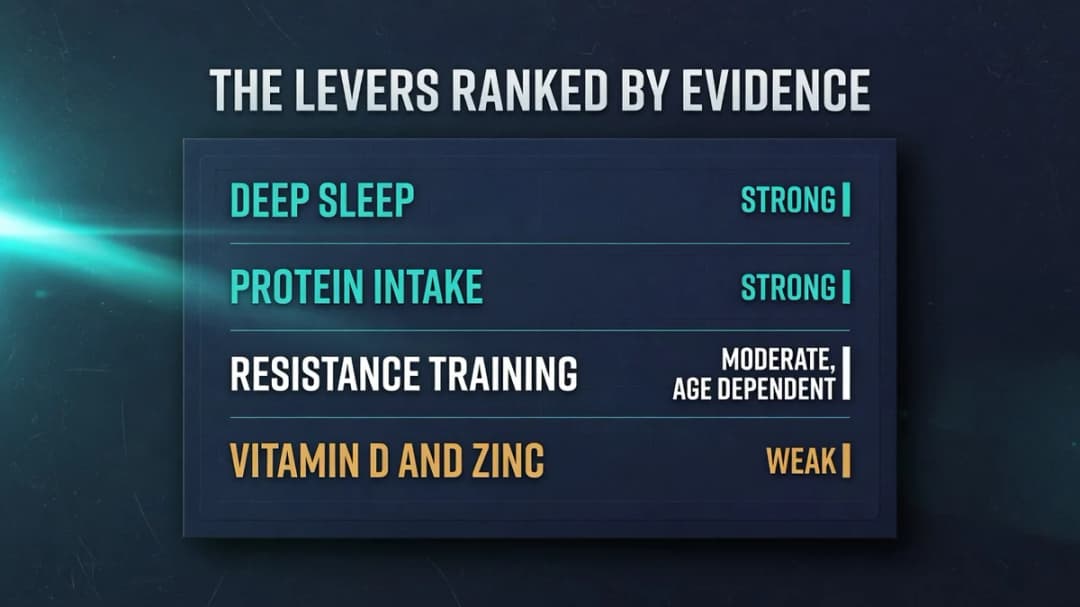
How to Increase IGF-1 Naturally: the levers ranked by evidence
| Lever | The finding in humans | How solid | The move |
|---|---|---|---|
| Deep sleep | The bulk of GH output arrives during slow-wave sleep, and people with chronic insomnia run distinctly lower IGF-1 | Strong | Seven to nine hours on a fixed schedule, with the early night defended |
| Protein intake | Three weeks of reduced protein took IGF-1 down by about a quarter; feeding more of it pushes the number back up | Strong | Between 1.2 and 2.0 g per kg of bodyweight, every day |
| Not staying in a protein deficit | The same trials read from the other direction | Strong | Whatever the diet, do not let protein collapse |
| Resistance training | Dependable gains past 60, close to nothing at rest in younger lifters | Moderate, and it turns on age | Two to four progressive sessions a week |
| Vitamin D, zinc | Nothing dependable in anyone who is not deficient | Weak | Treat a deficiency as a deficiency, and stop there |
Protein does most of the work
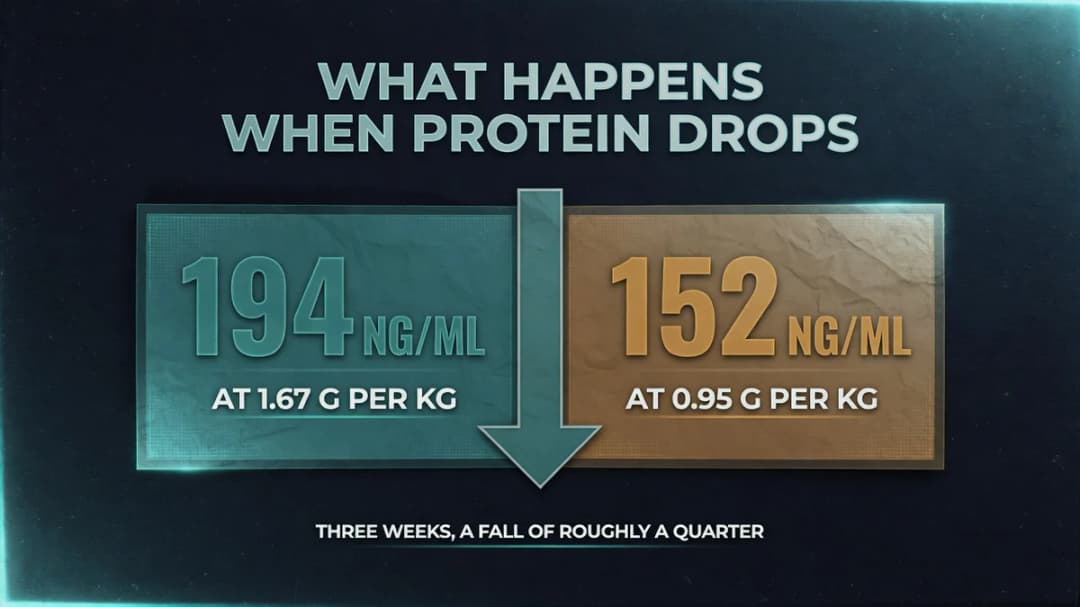
The clearest human evidence came out of work on people who had been restricting calories for years. Twelve months at roughly 20% below maintenance left serum IGF-1 where it started, so long as they kept eating protein. The informative part came next: a subgroup dropped protein from about 1.67 to 0.95 g per kg daily, held that for three weeks, and watched IGF-1 slide from around 194 to around 152 ng/mL, a fall of roughly a quarter.
One comparison, and a widespread assumption collapses. The variable driving this is protein, not energy intake. Pooled trial evidence has since landed in the same place, with more dietary protein lifting circulating IGF-1 and calorie cuts by themselves doing nothing much either way.
That puts the working target between 1.2 and 2.0 g per kg of bodyweight daily. Push toward the top of that band if training is hard, or if age has made holding onto muscle the actual problem.
Does the type of protein matter?
How much you eat outweighs where it comes from, though where it comes from is not nothing. Roughly 12,000 people in the UK Biobank were analysed on this question, and total protein tracked upward with circulating IGF-1. Among the individual sources, dairy protein produced some of the firmest associations, milk and yoghurt in particular, while cheese sat apart from that pattern. Whole grains and fibre also moved in the positive direction. Drinking heavily went the other way.
None of that is causal. It is observational data describing what tends to accompany what. It is still a better reason to pour a glass of milk than anything printed on a supplement tub.
Sleep is the underrated one
Most of a day's growth hormone arrives in bursts locked to slow-wave sleep, and those bursts cluster in the early part of the night. Break up that stretch and the signal telling the liver to make IGF-1 arrives weakened.
The sharpest finding here compares people with chronic insomnia against healthy controls. Serum IGF-1 came out around 162 ng/mL in the insomnia group against roughly 219 ng/mL in controls, and within the data the number moved with how much deep sleep someone actually got.
No capsule replicates any of that. What works is dull and familiar: go to bed and get up at the same times, keep the room cool and dark, put alcohol and screens well before lights out, and give yourself enough hours in bed that the deep sleep happens early instead of being chased at six in the morning. Insomnia that persists deserves treatment in its own right, and any IGF-1 improvement is a bonus rather than the reason.
Training helps, but it depends on your age
Of all the ways to exercise, lifting is the one most reliably associated with higher IGF-1, and how much it does for you turns almost entirely on how old you are. Pull the training trials together and adults over 60 show a dependable increase, larger in older men than older women, averaging somewhere around 10 ng/mL across the literature. Run the same analysis on people under 60, whose baselines sit higher already, and resting IGF-1 stays flat or edges down.
Read plainly, that means lifting earns its place as a natural lever mainly after 60, where it also builds the very muscle IGF-1 exists to defend. At 28 and already under a barbell, no resting bump is coming. Keep training regardless, since IGF-1 was never the best reason to do it.
There is a way to push the number in the wrong direction too. Long endurance sessions on top of a persistent energy deficit can flatten the whole GH and IGF-1 axis. Riding or running hard while underfed cuts against the goal.
The fasting confusion
Almost every popular version of this gets the direction wrong. Restrict calories in a rodent and IGF-1 drops hard, and that result gets carried over to humans as though the species question were settled. Look at the controlled human work and calorie restriction by itself left IGF-1 essentially where it was, provided protein held up.
A fast does move the system while it is happening: growth hormone climbs, IGF-1 signalling drops. Eat again and it goes back. So fasting will not lift a standing IGF-1 level, whereas weeks of eating too little protein will lower one dependably.
Micronutrients: mostly a dead end
Zinc has a legitimate role as a cofactor inside GH and IGF-1 signalling, and giving it to zinc-deficient children improves both their IGF-1 and their growth. Give it to an adult whose zinc status is already fine and there is little reason to expect anything.
Vitamin D is the more instructive warning. When randomised trials of supplementation were pooled, the overall effect on IGF-1 came out as nothing significant. Fixing a genuine deficiency remains worthwhile for bones and immune function. Filing it under IGF-1 strategy is a mistake.
Why higher is not the goal
Two bodies of research point in opposite directions here, and it is worth holding both. Epidemiology has repeatedly linked persistently high IGF-1 with elevated risk of several cancers. Meanwhile, turning IGF-1 signalling down is among the more replicable ways to extend lifespan in animal models.
What most people should want, then, is a healthy number for their age rather than the largest number available. If there is a specific reason to care about yours, measure it and take the result to a clinician instead of optimising in the dark.
Natural levers versus injectable options
Everything above concerns your own production. That is a different category from injecting a modified analogue such as IGF-1 LR3, which produces a supraphysiological signal and carries a different risk profile entirely, including acute hypoglycaemia.
In between sit the compounds that lean on the pituitary to release more of your own growth hormone, which our growth hormone secretagogues overview goes through. Treat those as drugs, because they behave like drugs, complete with genuine risks and a legal position nobody can state cleanly. Nothing on this page belongs in that category, which is precisely why it belongs first. On the training side, peptides for muscle growth sorts the supported claims from the rest.
FAQ
Which natural lever moves IGF-1 quickest?
Protein, without much competition. No other dietary variable maps as closely onto circulating IGF-1, and controlled studies pick up the change inside a few weeks. Run adequate protein alongside reliably deep sleep and you have the strongest combination available short of pharmacology.
Should I fast to raise IGF-1?
It will not do what you want. The GH and IGF-1 system does shift during a fast, but eating again returns it, and a sustained calorie deficit with protein kept up leaves the standing level roughly untouched. Cut protein for long enough, though, and the level genuinely falls.
Is milk worth adding for this?
A large UK cohort found higher IGF-1 travelling with dairy protein, milk and yoghurt especially, though cheese did not follow the same line. Association is not causation here, so read it as supportive rather than conclusive. As a protein source, milk is easy enough to justify on its own terms if it agrees with you.
Are vitamin D or zinc supplements worth taking for IGF-1?
Not unless a blood test says you are short of them. Pooled randomised trials of vitamin D found no meaningful overall effect on IGF-1, and zinc earns its keep in people who are genuinely deficient. Correct a deficiency because it is a deficiency, not because you expect a number to move.
Should I want the highest IGF-1 I can get?
No. Epidemiological work ties very high IGF-1 to raised risk of certain cancers, while animal models consistently associate dampened IGF-1 signalling with living longer. Aiming for a level that suits your age is the defensible position; aiming for the maximum is not.