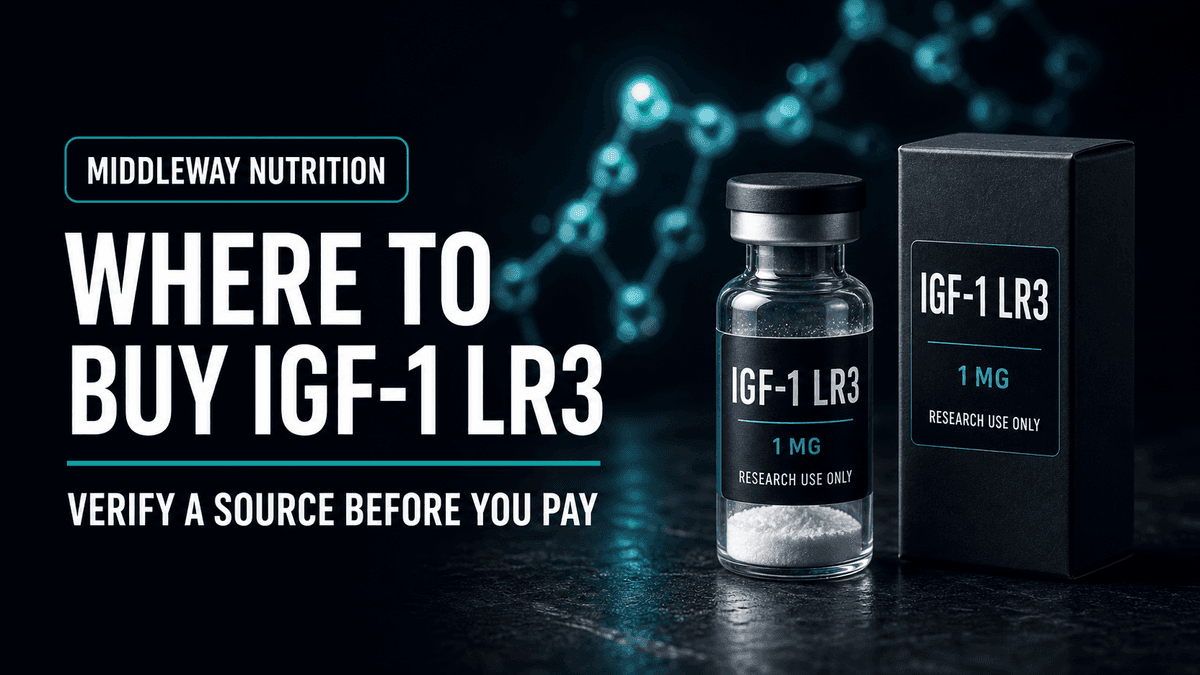
The answer to where to buy IGF-1 LR3 is not a shop name, it is a document: buy only from a source that will show you batch-specific analysis with identity confirmation, matched to the lot number on the vial you receive. Anyone deciding where to buy IGF-1 LR3 on price alone is making a decision about a milligram of white powder they cannot inspect, in a market with no regulator, where relabelled and underfilled inventory is a documented problem.
IGF-1 LR3 is sold as a research chemical. It is not approved for human use anywhere, and it is prohibited in tested sport.
What IGF-1 LR3 is, and the numbers a listing should agree on
IGF-1 LR3 is a lab-made analogue of insulin-like growth factor 1. Specialist listings describe it as a long chain with an arginine substitution at position 3 and an extra 13-amino-acid segment at the start, giving a protein of about 83 residues compared with 70 in native IGF-1. It is much larger than the short peptides most research vendors sell, which is why identity testing matters so much for it.
The identifiers we found repeated across listings on 2026-10-02:
| Identifier | What listings say |
|---|---|
| CAS number | 946870-92-4 on most listings (one lists 143045-27-6) |
| Molecular weight | about 9,111 on most listings (others show 9,117.6 and 9,200) |
| Typical vial | 1 mg, lyophilised powder |
| Residues | about 83, versus 70 in native IGF-1 |
Treat the disagreement as information. Molecular formulas also differ between pages, and some listings appear to copy a specification from elsewhere. A certificate should state the mass actually measured for your batch. If it lists none, or lists a figure far from about 9.1 kDa, ask why.
Where to buy IGF-1 LR3: source types ranked
| Source type | What you can verify | Main risk | Verdict |
|---|---|---|---|
| Specialist peptide vendor with published COAs | Batch, identity, purity, handling policy | Quality varies enormously between vendors | The only sensible starting point |
| Laboratory reagent catalogue | Specification sheet, often a research-use price list | Priced for labs, larger and more expensive units | Fine if the lot document is real |
| General supplement or veterinary marketplace | Seller name, sometimes little else | No accountability, no batch documents | Avoid |
| Overseas bulk supplier | Whatever they choose to publish | Import seizure, no recourse, testing unverifiable | Experienced buyers only, and still a gamble |
| Social media or messaging seller | Nothing | No recourse of any kind | Avoid entirely |
The gap between the top row and the rest is documentation. Everything else, shipping speed, packaging, website polish, is decoration.
Choosing a source
We do not name a house pick for IGF-1 LR3. It is a thinly stocked compound, the vendors listing it change often, and none of the sources we currently vet carry it, so any name printed here would be out of date before it was useful.
That makes the checking your job rather than ours. Verify the current batch document before you pay, from any vendor, no matter how established it looks. Our best peptide vendors page sets out the criteria we apply, and the section below sets out how to read the document once you have it.
How to read an IGF-1 LR3 certificate of analysis
Most buyers glance at a purity percentage and stop. That is the least informative number on the page.
The five checks below show the order we read a document in, and each is explained underneath.
Five things to read on an IGF-1 LR3 certificate, in order
- 1Identity by mass
A measured mass near 9.1 kDa, not plain IGF-1. - 2HPLC purity and trace
The chromatogram, not a number typed into a template. - 3Batch match
The lot on the document is the lot on your vial. - 4Test date
A date that belongs to the batch you received. - 5Extras
Peptide content, water, residual solvents, endotoxin.
Identity first. A purity figure tells you that 98% of the contents is one substance. It does not tell you which substance. Look for mass spectrometry or an equivalent method confirming the molecular weight matches IGF-1 LR3 rather than plain IGF-1, a different analogue, or something unrelated. Relabelling is the single most common form of fraud in this market, and identity testing is what catches it.
Then purity. HPLC with a stated percentage and, ideally, a visible chromatogram rather than a number typed into a template. For a protein this size, purity figures on listings vary: we saw 97.3% stated on one product page, and many listings give only a rounded claim. Take the trace over the headline.
Then the batch match. The lot number on the document must match the lot number printed on the vial in your hand. A vendor who publishes one document covering every batch is telling you they do not test batches.
Then the date. A certificate from two years ago describes a synthesis run you did not receive.
Then the extras. Better documents include peptide content, appearance, water content, residual solvents and endotoxin. None of these are required, but a vendor who runs them is a vendor investing in quality control.
Vial sizes and what the label should say
The common listing for IGF-1 LR3 is a 1 mg vial, which is small compared with most research peptides and reflects how little is used per dose. Some vendors list other sizes, and receptor-grade variants exist that are a different product entirely.
Confirm three things before ordering: the exact amount in the vial, that the label states it, and that the certificate refers to the same figure. Peptide content on a certificate can differ from the labelled amount, and that gap is where underfilling hides. A vial sold as 1 mg that assays at 0.7 mg holds 30% less than it says, which makes every assayed milligram about 43% more expensive than the sticker suggests.
| Labelled 1 mg vial at $70 | Assayed content | Real cost per assayed mg |
|---|---|---|
| Matches label | 1.0 mg | $70.00 |
| 10% under | 0.9 mg | $77.78 |
| 30% under | 0.7 mg | $100.00 |
| 50% under | 0.5 mg | $140.00 |
The $70 figure is an illustration, not a quote. It sits inside the real range below.
The chart below turns the table into bars, so the effect of underfilling is easy to compare.
Real cost per assayed mg of a labelled 1 mg vial at $70
Where to buy IGF-1 LR3: what listings cost
On 2026-10-02 the 1 mg vial listings we looked at ranged from $34.95 to $79.99 per vial at the single-unit price, with several clustering around $70. Multi-vial discounts of 10% to 30% were common, and a few shops offered free shipping above $150. One listing under an equine-supplement heading priced packs of 5 to 100 vials from $200 to $2,400, which tells you how loosely the product is categorised in general marketplaces.
The cheapest price is not the useful number. The useful number is price divided by assayed content, which is why the table above matters more than any sticker.
Shipping, handling and what to ask
Lyophilised peptide is more robust than people assume and will usually survive a few days at room temperature, but that is not a reason to accept vague answers. What matters is whether the vendor has a policy at all.
Listings give different storage advice for the powder: one says a cool, dry, dark place with long-term storage at -20 degrees C, another says 4 degrees C, another says 2 to 8 degrees C. The common thread is dry, dark and cold. Your certificate or label should say which one applies to your batch. See how to store peptides so they actually last for general handling.
Questions worth sending before you pay:
- How is the vial packed, and is anything used to control temperature?
- What happens if a vial arrives cracked, or with a compromised stopper?
- Is there a batch number printed on the label itself, not just on a slip?
- Can support send me the certificate matching the batch currently shipping, before checkout?
- What are the refund and replacement terms?
A vendor who answers all five clearly has systems. A vendor who answers none has a website.
What to check when the package arrives
Do the checking before you open anything. Match the lot number on the label to the certificate. Match the labelled amount to the certificate. Look at the vial: lyophilised material collects at the bottom as a small plug or film, so a vial that looks nearly empty is normal, but a cracked body, loose cap or damp stopper is not. If a detail is off, photograph it and contact the seller before use.
The checklist below puts those steps in order.
Five checks when an IGF-1 LR3 vial arrives
- 1Lot number
The label matches the certificate. - 2Labelled amount
The label matches the certificate. - 3Cap and stopper
Loose cap or damp stopper is not normal. - 4Vial body
No cracks; a small plug or film of powder is normal. - 5Photograph mismatches
Contact the seller before use.
Is it legal to buy IGF-1 LR3?
It is sold as a research chemical rather than a medicine and is not approved for human use. Sellers who follow the rules label it for laboratory use only and say it is not for consumption. Rules on possession and import differ by country and have been tightening, so check your own jurisdiction, and see are peptides legal for the wider picture. It is prohibited in tested sport regardless of where it was purchased.
Price, and where cheap comes from
Comparing IGF-1 LR3 on headline price is the wrong comparison, because the cost differences between vendors mostly reflect what they are not doing. Third-party testing costs money per batch. Real customer support costs money. Replacement policies cost money. A listing that undercuts everyone else has usually removed one of those.
Compare instead on cost per verified milligram: the price divided by the assayed content on a batch document you have actually seen. That number is often less flattering to the cheap option than the sticker price suggests.
Red flags
Walk away from any of these without further thought:
- No batch-specific certificate, or one that arrives only after you ask twice
- Purity claimed on the product page but no document behind it
- A purity badge image with no laboratory named
- No company address, no support email, no phone
- Cryptocurrency or bank transfer only, with no reversible payment option
- Product pages promising physique transformations, which is both a compliance problem and a signal about who is running the business
- Specifications that disagree with each other on the same page, such as a molecular weight that does not match the formula
- Reviews that are uniformly five stars and read identically
- No shipping or breakage policy on a fragile, temperature-relevant product
The first item on that list is the deal-breaker. Everything else is a judgement call; that one is not.
Before you order anything
Understand what you are buying first. IGF-1 LR3 lowers blood glucose, is dosed in micrograms rather than milligrams, and carries risks that are different in kind from most research peptides. Our IGF-1 LR3 page covers the compound, the dosage and side effects guide covers what is reported and where it goes wrong, and the stacking guide covers how it is typically combined.
If your real goal is a higher IGF-1 level rather than this particular compound, read how to increase IGF-1 naturally first. For other growth-axis products and their sourcing, see where to buy MK-677 and where to buy HGH 191aa.
Frequently Asked Questions
What should an IGF-1 LR3 certificate of analysis contain?
Identity confirmation by mass spectrometry or equivalent, an HPLC purity percentage with a visible chromatogram, the batch or lot number matching your vial, the test date, and the laboratory's name. Peptide content, appearance and endotoxin results are welcome additions.
Is cheap IGF-1 LR3 worth buying?
Usually not, because the saving normally comes from skipped batch testing, no support and no replacement policy. Compare cost per assayed milligram against a document you have seen rather than comparing sticker prices.
How much does IGF-1 LR3 cost?
Single 1 mg vial listings we checked on 2026-10-02 ranged from $34.95 to $79.99, with multi-vial discounts of 10% to 30% at some shops. The price that matters is cost per assayed milligram, which depends on the certificate.
What vial size is standard?
Most listings are 1 mg. Sizes vary, so confirm that the label, the product page and the certificate all state the same amount before ordering.
What molecular weight should IGF-1 LR3 show on a certificate?
Most listings give about 9,111, though some pages show slightly different figures. A real identity result reports the mass measured for your batch, and it should sit close to that value rather than the mass of plain IGF-1.
Does IGF-1 LR3 need cold-chain shipping?
Lyophilised powder tolerates transit at ambient temperature better than most buyers expect, and it should be refrigerated on arrival and after reconstitution. What matters more than ice packs is whether the vendor has a stated policy for damaged or heat-exposed deliveries.
Can I buy IGF-1 LR3 on a general marketplace?
You can find listings there, but the seller is usually unverifiable and batch documents are rarely available, which removes the only meaningful quality check. A specialist vendor with published testing is easier to evaluate.
Is it legal to buy IGF-1 LR3?
It is sold as a research chemical rather than a medicine and is not approved for human use. Rules differ by country and have been tightening, so check your own jurisdiction. It is prohibited in tested sport regardless of where it was purchased.
Where to buy IGF-1 LR3: the short version
Where to buy IGF-1 LR3 is answered by paperwork, not by a brand: a lot-matched certificate with a measured mass near 9.1 kDa, an assay that supports the labelled amount, a named laboratory and a seller you can reach. Work out the price per assayed milligram before you compare anything, and read the safety picture first, because a perfectly verified vial is still a compound that can drop blood glucose sharply.