VIP peptide benefits center on inflammation control and immune signaling, the side effects reported most often are flushing and a drop in blood pressure, and research dosing is usually described in the 25 to 50 mcg range delivered intranasally. What follows is a plain reading of what the literature actually supports, what it does not, and how to tell whether the vial you bought contains the molecule on the label.
Key Takeaways
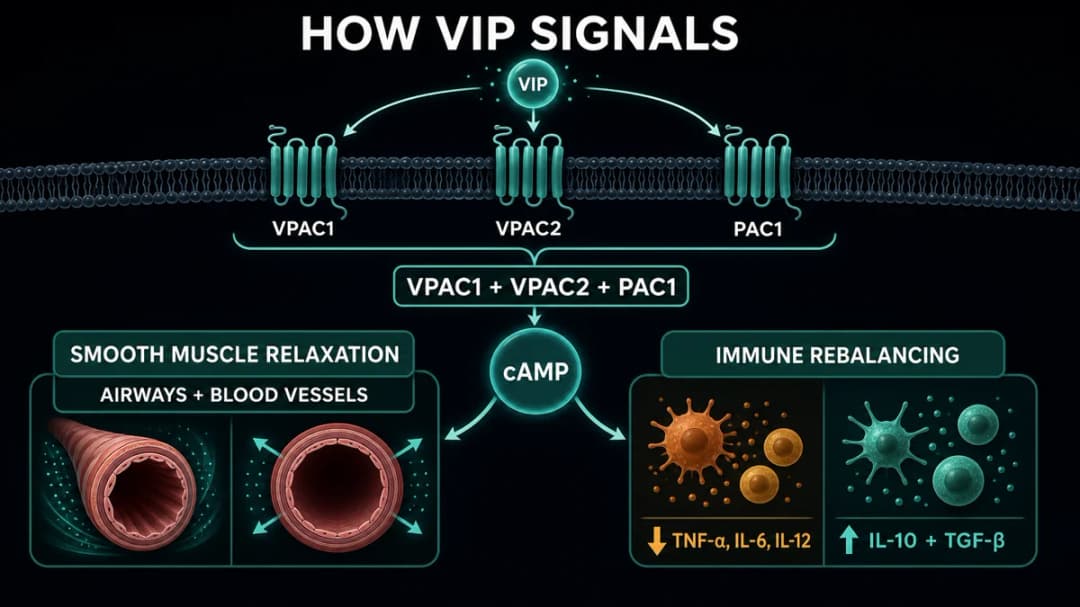
- VIP is a 28-amino acid neuropeptide produced naturally in the gut, lungs, brain, and immune cells, signaling through the VPAC1, VPAC2, and PAC1 receptors.
- Its best-documented action is suppression of pro-inflammatory cytokines such as TNF-alpha, IL-6, and IL-12 alongside increased IL-10 and TGF-beta.
- Native VIP is cleared in roughly one to two minutes, which is why research protocols use frequent dosing and local delivery rather than a single daily injection.
- Human data is thin outside of pulmonary and critical care research. Most autoimmune and neuroprotective findings come from animal models.
- Reported research ranges sit around 25 to 50 mcg intranasally, two to four times daily. There is no approved consumer dosing standard for this compound.
What VIP Actually Is
The name is a historical accident. The molecule was first purified out of pig gut decades ago, and the label stuck even though the gut is only one of the places it operates. VIP is a broadly distributed signaling molecule, present in enteric neurons, peripheral autonomic nerves, lung tissue, the suprachiasmatic nucleus of the hypothalamus, and on several immune cell populations.
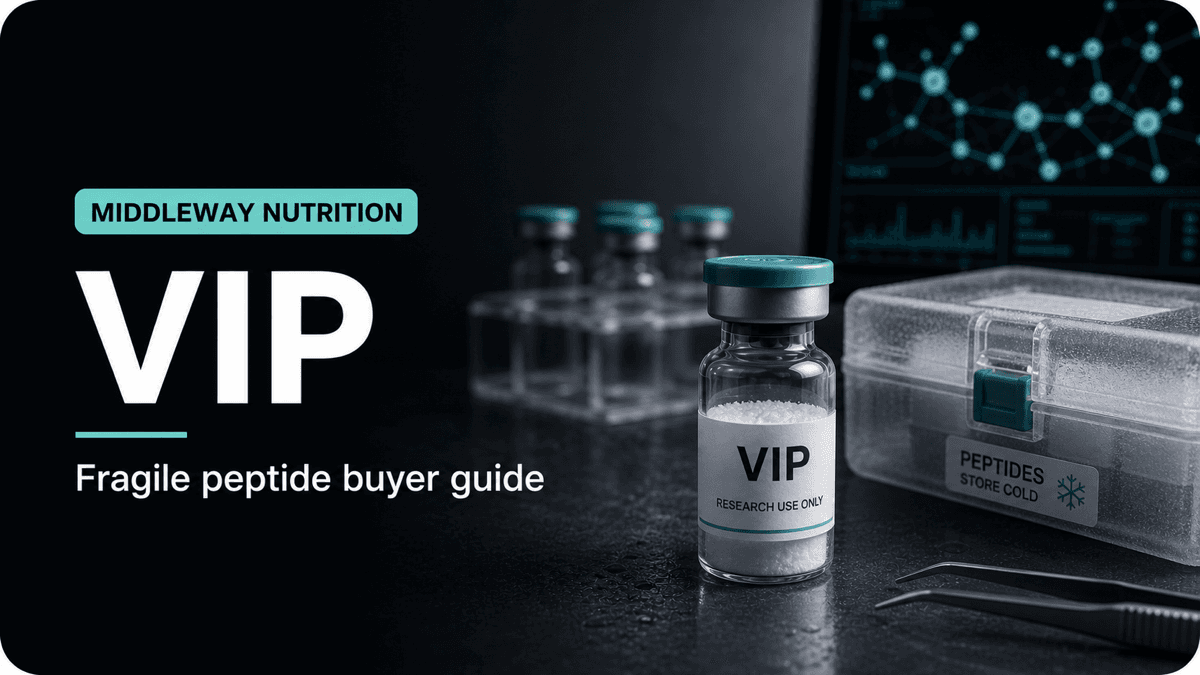
The sequence is His-Ser-Asp-Ala-Val-Phe-Thr-Asp-Asn-Tyr-Thr-Arg-Leu-Arg-Lys-Gln-Met-Ala-Val-Lys-Lys-Tyr-Leu-Asn-Ser-Ile-Leu-Asn-NH2, with an amidated C-terminus, and a molecular weight of about 3,326 Da. Research-grade material is supplied as a white lyophilized powder, typically specified at 95 percent purity or higher.
Mechanistically, VIP binds G-protein coupled receptors and raises intracellular cAMP. Two consequences follow from that single upstream event. Smooth muscle relaxes, which produces vasodilation in the pulmonary vasculature and bronchodilation in the airways. And immune cells shift their output, with dendritic cell maturation dampened, Th1 and Th17 responses reduced, and regulatory T cell activity favored. That dual profile is the reason VIP keeps appearing in such different research literatures, from respiratory medicine to inflammatory bowel disease.
One property deserves emphasis because it shapes everything downstream. Native VIP is degraded within one to two minutes by dipeptidyl peptidase IV and neutral endopeptidases circulating in blood and tissue. That is an extraordinarily short window. It explains why intranasal and inhaled routes dominate the research record, since both deliver peptide close to the tissue of interest rather than relying on systemic exposure. It also explains why a good deal of pharmaceutical effort has gone into stabilized analogs, PEGylation, and nanoparticle encapsulation, which can extend the half-life into the hours.
Everything below describes research findings. VIP is not an approved medicine for the uses discussed here, and material sold as research peptide is not intended for human administration.
VIP Benefits
The honest summary is that VIP has one very well characterized biological action, immunomodulation, and a set of downstream applications whose evidence quality varies enormously by indication.
VIP Benefits at a Glance
Read this table before the sections below it. The pattern that matters is not which benefits are claimed, it is how far each one has actually been tested in people.
| Claimed benefit | What VIP does | Best human evidence to date | Evidence tier |
|---|---|---|---|
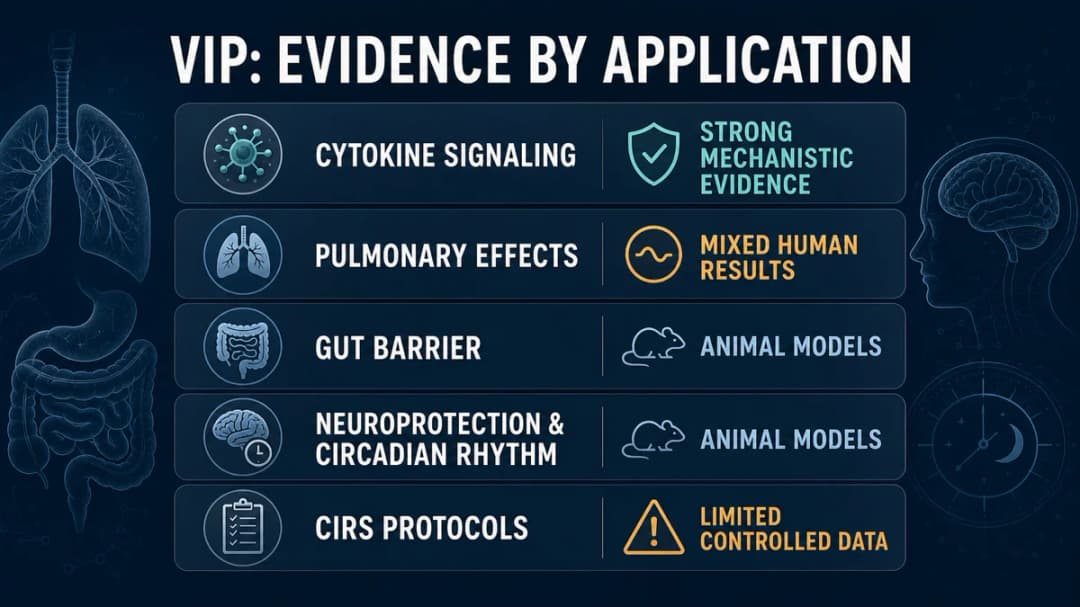
| Cytokine suppression, immune rebalancing | Lowers TNF-alpha, IL-6, IL-12 and IFN-gamma, raises IL-10 and TGF-beta, dampens dendritic cell maturation | None with clinical outcomes. The immunology is animal and cell work | Preclinical |
| Acute lung injury and ARDS | Relaxes airway and pulmonary vascular smooth muscle, and in nonclinical work upregulates surfactant in alveolar type II cells | Two randomized trials of intravenous aviptadil, pooled survival odds ratio 1.01 | Randomized, no survival benefit |
| Post-COVID lung recovery | Same pulmonary mechanism, delivered to the airway rather than systemically | One 80-patient randomized trial of inhaled aviptadil, shorter time to discharge | Randomized, small, single trial |
| Pulmonary arterial hypertension | Pulmonary vasodilation | Small early studies only. No approved VIP product for this use | Preliminary |
| Gut barrier and intestinal inflammation | Enteric neuron signaling, motility, mucosal blood flow, tight junction support | None. Crohn's and colitis data are absent | Preclinical |
| Neuroprotection, circadian stability | Synchronizes clock cells in the suprachiasmatic nucleus, protects dopaminergic neurons in models | None | Preclinical |
| CIRS and biotoxin protocols | Positioned late in the protocol, after exposure removal and binders | Practitioner case series and clinical experience. No randomized trial appears in the indexed literature | Uncontrolled |
Two readings follow from that table. The first is that VIP's immunology is genuinely interesting and genuinely untested as a treatment in people. The second is that the one place VIP has been tested hard, critical care, is the place it underperformed the enthusiasm around it.
Cytokine suppression and immune rebalancing (strong mechanistic evidence, mostly preclinical). This is the core finding and it replicates across many models. VIP lowers TNF-alpha, IL-6, IL-12, and IFN-gamma while raising IL-10 and TGF-beta. What distinguishes it from a simple anti-inflammatory is the second half of the mechanism: rather than only blocking inflammatory signaling, VIP appears to promote tolerance by suppressing dendritic cell maturation and encouraging regulatory T cell phenotypes. Compared with a peptide like KPV, which works largely through blocking NF-kB driven signaling, VIP acts further upstream on the shape of the immune response itself.
Pulmonary effects (the strongest human signal). VIP relaxes pulmonary vascular and airway smooth muscle. Inhaled VIP has been evaluated in pulmonary arterial hypertension, where early studies reported reductions in pulmonary artery pressure and improvements in exercise capacity. A synthetic VIP formulation, aviptadil, was also studied in acute respiratory distress syndrome during the COVID-19 period. Those trials produced mixed results and did not lead to approval, which is worth stating plainly since the compound is sometimes marketed as though the respiratory case is settled. It is not.
Gut barrier and intestinal inflammation (animal models, plus plausible human rationale). VIP is made by enteric neurons and regulates intestinal motility, secretion, and mucosal blood flow. In inflammatory bowel disease models it reduces mucosal cytokine load and supports tight junction integrity. Human trial data for Crohn's disease or ulcerative colitis is essentially absent.
Neuroprotection and circadian signaling (animal models). VIP neurons in the suprachiasmatic nucleus synchronize the firing of neighboring clock cells, and knockout animals show unstable circadian rhythms. Separately, VIP has protected dopaminergic neurons in Parkinson's models and reduced disease severity in experimental autoimmune encephalomyelitis, the standard multiple sclerosis model. These are interesting and consistent findings. They are also mouse findings, and the translation record for neuroprotective compounds is poor.
CIRS protocols (clinical practice, limited controlled data). VIP appears in the chronic inflammatory response syndrome protocol associated with biotoxin and mold illness, where it is positioned as a late-stage step after exposure removal and binder therapy. Practitioners report improvements in inflammatory markers including TGF-beta1 and VEGF. This body of evidence is clinical experience rather than randomized trial data, and readers should weight it accordingly.
For comparison, if the interest is immune restoration rather than broad inflammation control, thymosin alpha-1 has a substantially deeper human clinical record, including approved use in several countries. VIP's advantage is breadth of tissue coverage, not depth of evidence.
What the Human Trials Actually Found
The phrase "mixed results" gets used to describe the aviptadil program, which is vague enough to be useless. Here are the numbers.
Aviptadil, a synthetic form of human VIP, was tested intravenously in patients with COVID-19 respiratory failure in a 196-patient placebo-controlled trial reported in Critical Care Medicine in 2022. Its primary endpoint, being alive and free from respiratory failure at day 60, did not reach statistical significance. A second randomized trial, TESICO, compared intravenous aviptadil with placebo across 28 US sites in patients with COVID-19 acute hypoxaemic respiratory failure and was published in The Lancet Respiratory Medicine in 2023. A 2025 systematic review and meta-analysis that pooled the two randomized trials reported a survival odds ratio of 1.01 for aviptadil versus placebo, 95 percent confidence interval 0.72 to 1.42. That is as close to no effect on survival as a number can get.
The route matters, though, and the inhaled work reads differently. A multicenter, double-blind, placebo-controlled trial of inhaled aviptadil in 80 hospitalized COVID-19 patients reported a mean time to discharge of 7.8 days versus 10.0 days on placebo, greater improvement in CT lung damage score at day 28, and a numerically lower death rate, 5.1 percent versus 12.2 percent, in a trial far too small to test mortality. One trial of 80 patients is a signal to follow, not a settled result.
Nothing in that record maps cleanly onto a 50 mcg intranasal spray. Different formulation, different route, different dose scale, and a critical care population rather than an outpatient one. It neither confirms nor refutes the intranasal protocols, which is precisely the problem: the best-funded human data on VIP was collected somewhere else entirely, and the uses people actually buy VIP for have never been through a controlled trial.
VIP Side Effects
Reported tolerability is good at the small intranasal doses used in research, but the side effect profile follows directly from the mechanism, so it is predictable rather than mysterious.
Documented in human research and clinical use:
- Facial flushing, a direct consequence of vasodilation and the most commonly reported effect.
- Transient hypotension. VIP is a vasodilator, so blood pressure can fall, and the effect is dose dependent. Intravenous administration produces far more pronounced cardiovascular effects than intranasal delivery.
- Headache, frequently reported alongside flushing and likely the same vasodilatory mechanism.
- Diarrhea or loose stools, consistent with VIP's role in stimulating intestinal secretion.
- Local stinging, dryness, or a blocked feeling in the nose. This belongs to the delivery method, not to the molecule, and tends to ease as the tissue adapts.
Reported in practice, less well characterized:
- A short worsening of existing complaints during the first days of a biotoxin protocol. This shows up in practitioner write-ups only, with no controlled documentation behind it.
Where the data is genuinely thin. There is no meaningful long-term safety dataset for VIP in healthy people. Published studies have generally been short, small, and conducted in patient populations with a specific condition. Interactions with antihypertensive and other cardiovascular medications are a reasonable theoretical concern given the vasodilatory action, but this has not been systematically studied. Anyone claiming a clean long-term safety record for this peptide is describing an absence of data, not an absence of risk.
VIP Dosage Chart
There is no approved dosing standard for VIP outside of the specific pharmaceutical formulations studied in respiratory trials. The figures below are ranges reported in research and practitioner protocols. They are documentation of what has been used in study and clinical settings, not a recommendation for anyone to follow.
| Context | Reported range | Route | Frequency | Typical duration |
|---|---|---|---|---|
| CIRS protocol dosing | 50 mcg (50 IU) | Intranasal | 4 times daily | Reassessment commonly at 4 to 12 weeks |
| General anti-inflammatory research use | 25 to 50 mcg | Intranasal | 2 to 4 times daily | Weeks rather than single doses |
| Pulmonary arterial hypertension (clinical study) | 100 mcg | Inhaled | 3 to 4 times daily | Study defined |
Three things about this table are worth reading carefully. First, the dosing frequency is high because the half-life is short, not because more is better. Second, the intranasal figures come from practitioner protocols rather than dose-ranging trials, so the precision implied by "50 mcg" is softer than it looks. Third, the inhaled 100 mcg figure comes from a supervised clinical setting with a specific delivery device and patient population, and it does not transfer to any other context.
Acute effects such as flushing and bronchodilation happen within minutes. Immune and inflammatory effects, where they occur, are described as building over weeks. Nothing in the literature supports expecting a single dose to do anything durable.
Reconstitution and Storage
VIP ships as a lyophilized powder and needs reconstitution before any research handling. Bacteriostatic water is the standard diluent since the benzyl alcohol preservative allows multiple withdrawals from the same vial. Sterile water works for single use but offers no preservation.
Add the diluent slowly down the inner wall of the vial rather than directly onto the powder, then swirl gently until the solution clears. Do not shake. Peptides denature under mechanical stress, and a foaming vial is a damaged vial.
Storage matters more with VIP than with sturdier peptides. Keep lyophilized powder at minus 20 degrees Celsius for long-term storage, where it is stable for months. Once reconstituted, refrigerate at 2 to 8 degrees Celsius and expect a usable window of roughly 7 to 14 days. Protect it from light and avoid repeated freeze-thaw cycles, each of which degrades a fraction of the peptide.
Intranasal research delivery requires a spray atomizer in addition to the vial and diluent, which is worth planning for before ordering.
Stacking
Genuine documentation of VIP combinations is limited, and most stacking advice circulating online is extrapolation rather than evidence. Two pairings have at least a coherent rationale.
VIP alongside LL-37 is discussed in biotoxin illness contexts, where LL-37 targets bacterial colonization and biofilm while VIP addresses residual immune dysregulation. The sequencing matters in those protocols: VIP is positioned after antimicrobial steps, not concurrent with them, on the reasoning that suppressing inflammation while an active infection persists is counterproductive.
VIP with a gut-directed compound such as KPV is the other combination that appears in research discussion, since the two work on different levels of intestinal inflammation. This is mechanistic reasoning, not trial data, and should be treated as such.
How to Verify What You Buy
VIP is a peptide where identity actually matters, since a short 28-mer with an amidated terminus is easy to get wrong in synthesis and impossible to assess by eye. Ask for a third-party certificate of analysis showing both HPLC purity and mass spectrometry confirming a mass near 3,326 Da, and confirm the testing lab is independent of the seller. Our guide to where to buy VIP covers which suppliers publish per-batch testing and which reuse the same document across lots.
Looking for the numbers behind this guide? Our VIP benefits tiers each claimed benefit by the strength of its evidence.
Frequently Asked Questions
What does VIP peptide do?
VIP is a naturally occurring neuropeptide that relaxes smooth muscle and modulates immune activity. In research it lowers pro-inflammatory cytokines, promotes regulatory immune responses, dilates blood vessels and airways, and supports intestinal barrier function. It also has a role in circadian timing through the brain's master clock. The breadth comes from its receptors being present in almost every tissue type.
Which VIP peptide benefits have human trial evidence?
Only the pulmonary ones, and the evidence cuts both ways. Two randomized trials of intravenous aviptadil in COVID-19 respiratory failure produced a pooled survival odds ratio of 1.01, meaning no survival benefit, while a single 80-patient trial of inhaled aviptadil reported a shorter hospital stay, 7.8 days versus 10.0. Every other benefit on the list, cytokine suppression, gut barrier repair, neuroprotection, circadian stability, rests on animal and cell studies. The CIRS protocol use rests on practitioner case reports. That is not the same as those benefits being disproven, but a reader deciding what to expect should treat "shown in mice" and "shown in a randomized trial" as different categories.
Is VIP peptide safe?
Short-term tolerability at intranasal research doses has generally been acceptable, with flushing, headache, and mild blood pressure drops being the usual complaints. But long-term safety data in healthy people does not exist, and the vasodilatory action is a real consideration for anyone with low blood pressure or on cardiovascular medication. VIP is not an approved drug for the uses described here, and this article is not a recommendation to use it.
How much VIP peptide is used in research?
Reported ranges cluster around 25 to 50 mcg intranasally, two to four times daily, with a 100 mcg inhaled dose used in supervised pulmonary studies. The high frequency reflects the one to two minute half-life of the native peptide. These are documented research figures, not a protocol for anyone to follow, and no consumer dosing standard exists.
Is VIP peptide legal?
VIP is legal to buy and possess in the United States when sold and labeled for laboratory research, which is how essentially all vendor supply is offered. It is not approved by the FDA as a treatment, and selling it for human consumption is not permitted. A compounded intranasal VIP prescribed by a licensed physician is a separate legal pathway from research-grade material. Rules vary by country, so check local regulations before importing.