A genuine CJC-1295 before and after is undramatic: sleep and recovery shift first, within a few weeks, and anything visible takes two to four months of consistent use alongside training and adequate protein. Most CJC-1295 before and after comparisons circulating online compress that timeline dramatically, and the gap between the promised result and the actual one is where nearly all disappointment comes from.
Worth saying plainly at the start: there is no controlled trial measuring body composition outcomes from CJC-1295 in healthy adults. What follows is a description of what the mechanism can plausibly produce and what people consistently report, clearly separated from what has been demonstrated.
What Is Actually Established
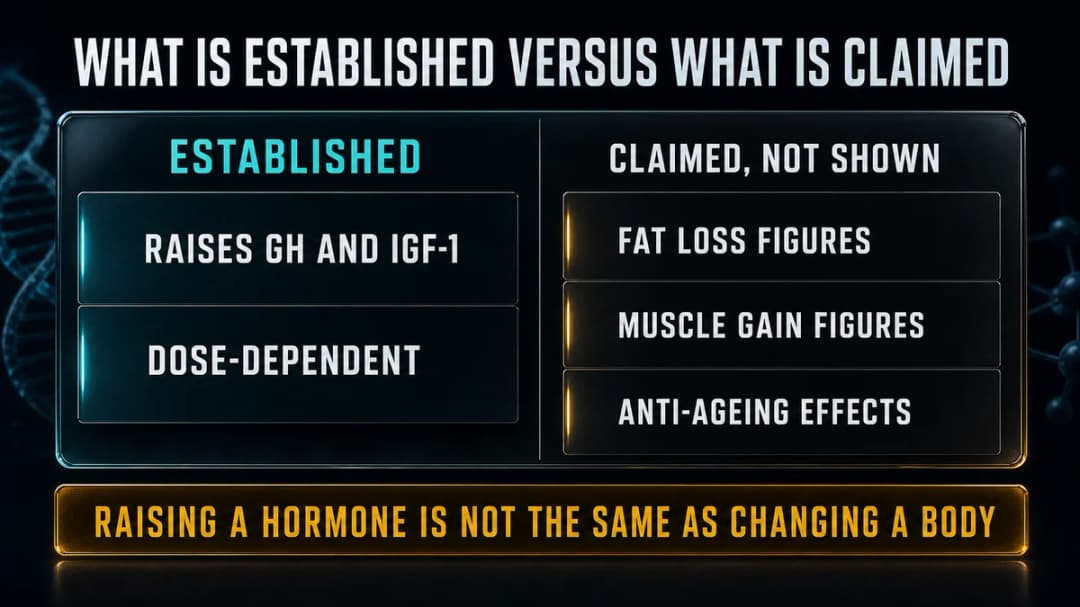
The pharmacology is well characterised. Published early-phase work in healthy adults showed that CJC-1295 in its DAC form raises growth hormone several fold and elevates IGF-1 for days after a single dose, with a half-life measured in days rather than minutes.
What has not been established is the downstream result: how much fat is lost, how much lean mass is retained, or how much recovery improves. Those questions have never been answered in a controlled trial for this compound. Any specific figure you see for pounds lost or body fat percentage changed is an anecdote, not a finding.
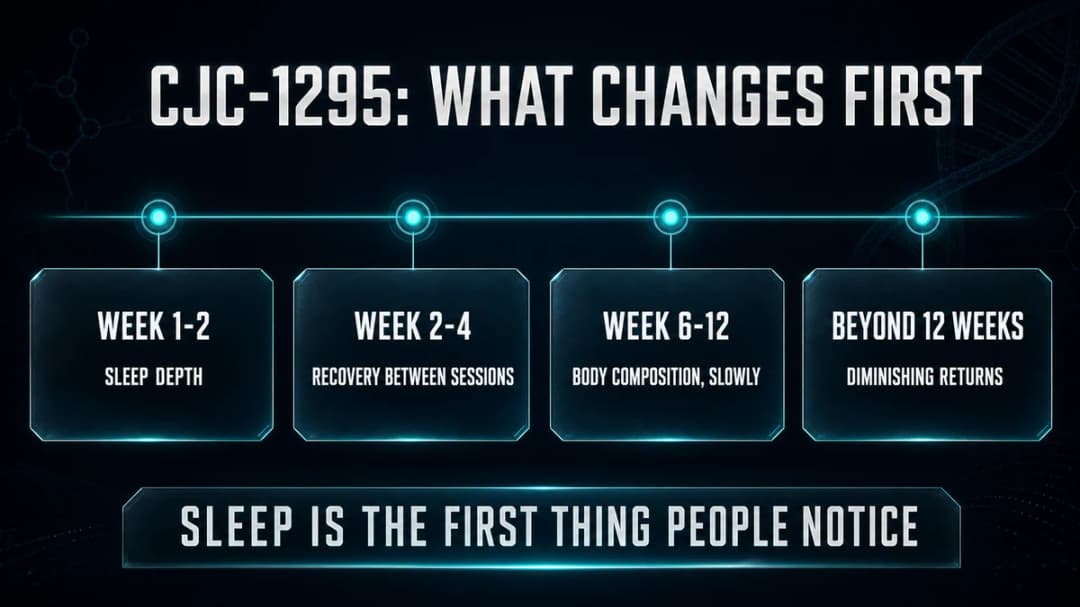
The CJC-1295 Before and After Timeline
| Window | What people commonly report | What is actually verifiable |
|---|---|---|
| Week 1 to 2 | Deeper sleep, vivid dreams, some early fluid retention | Nothing measurable yet beyond scale weight from fluid |
| Week 3 to 4 | Less next-day soreness, easier recovery between sessions | IGF-1 beginning to shift in responders |
| Week 5 to 8 | Better training capacity, subtle changes in how clothes fit | IGF-1 clearly changed or clearly not |
| Week 8 to 16 | First genuinely visible body composition change | Waist measurement, DEXA if tracked |
| Month 4 to 6 | Cumulative changes in leanness and fullness | Same, with more signal above the noise |
| After stopping | Effects fade over weeks | IGF-1 returns toward baseline |
The eight to twelve week point is the decision window. If IGF-1 has not moved by then, the protocol is not doing what it is supposed to and the reason is usually dose, product quality, injection timing or thyroid status.
What Changes First, and Why
Sleep. GHRH signalling is tied to slow-wave sleep, and this is the earliest and most consistently reported change. It is also the most subjective, which is worth holding in mind.
Recovery. Reduced soreness and better readiness for the next session come next. IGF-1 supports repair in muscle and connective tissue, so the mechanism is coherent, though the size of the effect in healthy adults is unmeasured.
Water. Early scale increases are usually fluid, not tissue. This is a growth hormone effect and it tends to settle, or it signals the dose is higher than it needs to be.
Body composition. Last, and slowly. Fat mobilisation and lean mass retention operate over months, and both depend far more on training and protein intake than on the peptide.
Why Before and After Photos Are Unreliable
Three variables change the appearance of a photo far more than any peptide does.
Lighting and posture. A change in overhead lighting alone can produce what looks like a substantial difference in definition.
Glycogen and water. Carbohydrate intake and hydration shift muscle fullness noticeably day to day.
Everything else that changed. Almost nobody starts a peptide protocol in isolation. Training gets more consistent, protein goes up, sleep improves, alcohol goes down. Those changes would produce a visible result on their own over four months.
This is not a reason to dismiss reported results. It is a reason to treat photographic evidence, including your own, as weak evidence.
How to Measure It Properly
IGF-1 before and at week eight to twelve. This is the only objective confirmation that the compound is doing anything at all. Without a baseline the follow-up number is uninterpretable.
Waist circumference weekly, measured at the same landmark, first thing in the morning. It tracks visceral fat change far better than bodyweight does.
Photos under fixed conditions. Same room, same light, same time of day, same posture. If you are going to use photos, make them worth something.
DEXA if you want the real answer. A scan at baseline and again at four to six months separates fat change from lean change, which is exactly what bodyweight cannot do.
Change one variable at a time. Starting the peptide, a new training block and a diet in the same week guarantees you will not know what worked.
Who Sees the Least
Anyone under about 35 with IGF-1 already in the upper part of the age-appropriate range has little headroom, since the pituitary has a ceiling on what it can release. Anyone running a protocol for four to six weeks and stopping is quitting before the mechanism has had time to produce anything visible. And anyone expecting an outcome comparable to injected growth hormone is comparing a stimulus to a replacement, which are not the same intervention.
For more detail, see the CJC-1295 guide, our comparison of the DAC and non-DAC versions, and the growth hormone secretagogue overview for how it sits against the alternatives.
Frequently Asked Questions
How long before CJC-1295 shows results?
Sleep and recovery changes are commonly reported within two to four weeks, and visible body composition change takes eight to sixteen weeks at minimum. Anyone assessing results at week four is measuring expectation rather than physiology. IGF-1 testing at week eight to twelve gives an objective read far earlier than a mirror does.
What results are realistic from CJC-1295 alone?
Modest ones. Without resistance training and adequate protein, a GH secretagogue has little to work with, since its mechanism amplifies a training response rather than replacing it. Realistic expectations are gradual fat reduction, better lean mass retention and improved recovery over several months.
Why am I not seeing any results?
The common explanations are an evaluation window that is too short, a dose too low, injecting too close to a meal since insulin suppresses GH release, untreated hypothyroidism blunting IGF-1 conversion, or poor product quality. An IGF-1 test distinguishes between these quickly.
Do results last after stopping?
The hormonal effects do not. The GH axis returns toward its own set point within weeks and IGF-1 falls back. Body composition changes built during the protocol persist as long as the training and nutrition that produced them continue.
Is the DAC or non-DAC version better for visible results?
Neither has outcome data, so any answer is inference. The DAC version produces greater total exposure and higher sustained IGF-1, which could plausibly mean more effect, and also more fluid retention and glucose impact. The non-DAC version preserves the pulsatile pattern and is far easier to correct if the dose turns out to be too high.