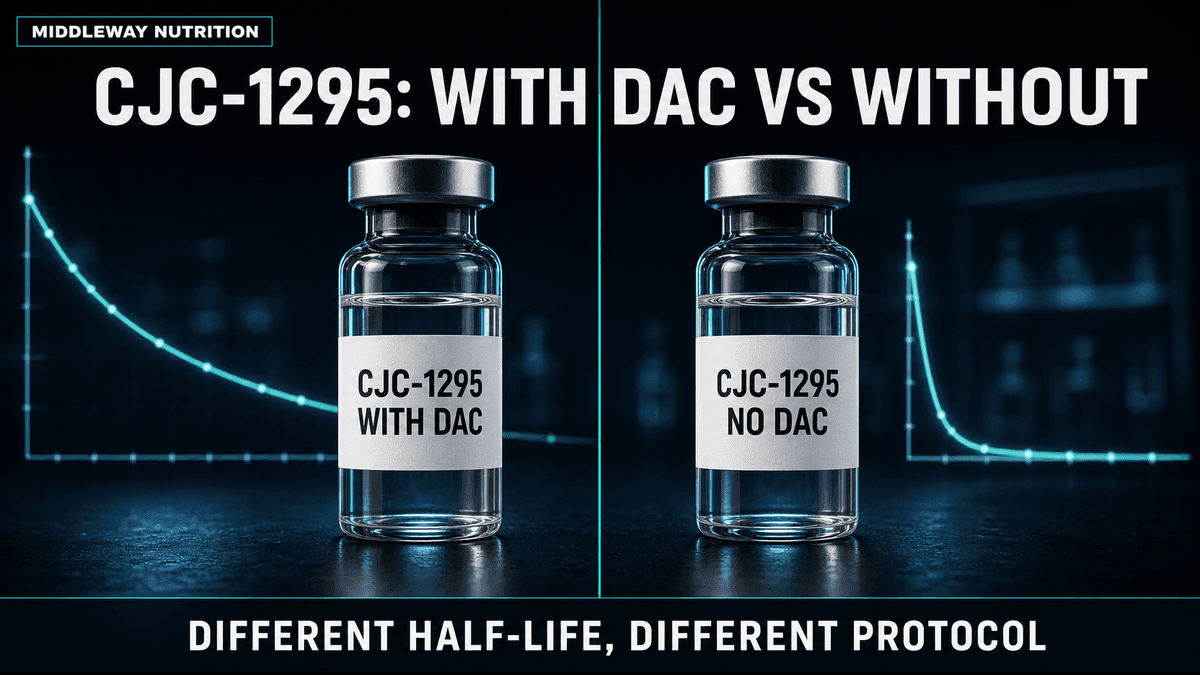
CJC-1295 with DAC vs without DAC is a single chemical difference with large downstream consequences: the DAC version binds covalently to albumin and stays active for around a week, while the version without DAC clears within roughly half an hour. Choosing between CJC-1295 with DAC vs without DAC therefore is not a potency decision, it is a decision about whether you want growth hormone elevated continuously or released in discrete pulses.
That distinction matters more than most comparisons make it sound, because pulsatility is not a cosmetic feature of GH physiology. It is how the system is designed to work.
CJC-1295 with DAC vs Without DAC at a Glance
| Property | With DAC | Without DAC (Mod GRF 1-29) |
|---|---|---|
| Also called | CJC-1295 DAC, DAC:GRF | Modified GRF 1-29, CJC-1295 no DAC |
| Base molecule | Tetrasubstituted GHRH 1-29 | Tetrasubstituted GHRH 1-29 |
| Added modification | Maleimide linker binding albumin covalently | None |
| Half-life | Roughly 6 to 8 days | Roughly 30 minutes |
| GH pattern | Sustained elevation of baseline | Discrete pulses returning to baseline |
| Dosing frequency in reported protocols | Once or twice weekly | One to three times daily |
| Usually paired with a GHRP | Less often | Almost always |
| Human trial data | Early-phase studies only | Very limited |
| Approval status | None | None |
What DAC Actually Is
Both variants start from the same core: the first 29 amino acids of growth hormone releasing hormone, with four amino acid substitutions that resist enzymatic breakdown. Native GHRH is degraded within minutes by dipeptidyl peptidase enzymes, and those substitutions are what buy the molecule its extra time.
The Drug Affinity Complex is a further modification. A reactive maleimide group is attached to the peptide, and after injection it forms a covalent bond with albumin, the most abundant protein in blood plasma. Albumin circulates for roughly three weeks, so the peptide effectively travels with a long-lived carrier instead of being cleared on its own schedule.
The receptor activity does not change. The peptide still binds the GHRH receptor and still tells the pituitary to release growth hormone. What changes is how long that instruction persists, and that is the entire basis of the comparison.
Why Pulsatile Versus Continuous Matters
Natural growth hormone secretion is sharply pulsatile. Output rises in bursts, mainly during early slow-wave sleep, and falls close to zero between them. Those troughs are not idle time. Receptor sensitivity and downstream signalling appear to depend on the pattern, not just the total amount.
The version without DAC preserves that shape. Each injection produces a GH pulse that rises and falls, superimposed on the body's own rhythm.
The DAC version does something structurally different. Continuous receptor stimulation produces a raised GH baseline rather than larger pulses. IGF-1 rises and stays raised. Whether this is a problem or simply a different approach is genuinely unresolved, but the theoretical concern is real: sustained exposure is the pattern associated with GH excess states, and it removes the troughs that the system evolved with.
There is also a practical consequence. With a half-life measured in days, a dose that turns out to be too high cannot be walked back quickly. Fluid retention, joint symptoms or glucose effects persist for the better part of a week regardless of what you do next. A 30 minute half-life is far more forgiving.
Dosing Patterns Reported in Research
These figures describe what appears in research literature and vendor protocols. They are not recommendations, and neither variant is approved for human use.
| Parameter | With DAC | Without DAC |
|---|---|---|
| Reported dose | 1 to 2 mg | 100 to 200 mcg |
| Frequency | Once or twice weekly | One to three times daily |
| Common pairing | Sometimes with a GHRP | Usually with ipamorelin or another GHRP |
| Timing | Not time-critical, given the long half-life | Before sleep, away from food |
| Time to steady state | Roughly two weeks of weekly dosing | Not applicable |
The pairing convention is worth explaining. GHRH analogs and ghrelin-pathway peptides act on different pituitary receptors, and activating both produces a larger GH pulse than either alone. That combination only makes sense when the GHRH signal is itself pulsatile, which is one more reason the short-acting version dominates current protocols.
Which One Do Most Protocols Use?
The shorter-acting version, and the reasoning is consistent: it preserves the physiological release pattern, it stacks coherently with a GHRP, and any dosing error resolves within an hour rather than a week.
The case for DAC rests on convenience. Once or twice weekly injections instead of daily is a real advantage for adherence, and adherence is not a trivial factor over a protocol lasting months.
Both arguments are legitimate. What is not legitimate is presenting either as clinically validated. Human data on CJC-1295 in any form is limited to early-phase work; development never produced an approved medicine, and there is no long-term safety dataset for either variant. Anyone using them is working well ahead of the evidence.
Side Effects and What Differs
The effects overlap, because both act through growth hormone. Injection site reactions, flushing, headache and altered sleep are the common early reports for both.
Where they diverge is the GH-mediated effects that depend on sustained exposure. Fluid retention, joint stiffness, hand tingling and reduced insulin sensitivity are all more plausible with continuous elevation than with intermittent pulses, and they are less easily reversed with a molecule that persists for a week.
Anyone using either should have fasting glucose and IGF-1 checked, since GH opposes insulin and IGF-1 above the age-appropriate range is the practical definition of too much.
For related reading, our CJC-1295 guide covers the compound in general, CJC-1295 explained goes into the IGF-1 and regulatory picture, and the growth hormone secretagogue comparison places both variants against the rest of the class. Vial sizes and current pricing sit in our CJC-1295 for sale listing.
Frequently Asked Questions
Is CJC-1295 with DAC stronger than without DAC?
Not in terms of receptor potency, which is essentially the same. The DAC version produces far greater total exposure because it stays active for days, so it raises IGF-1 more and holds it higher. That is a difference in duration rather than strength, and it brings the side effect profile of sustained GH elevation with it.
Which version should be paired with ipamorelin?
The version without DAC. Pairing a GHRH analog with a ghrelin-pathway peptide works by amplifying a discrete pulse, which requires the GHRH signal to be pulsatile. Combining ipamorelin with a continuously acting GHRH analog loses most of that logic.
How often is each version injected?
Reported protocols use the DAC version once or twice weekly and the version without DAC one to three times daily, usually including a dose before sleep. The dosing gap follows directly from the half-life difference of roughly a week against roughly half an hour.
Is Mod GRF 1-29 the same as CJC-1295 without DAC?
Yes, they are the same molecule under different names: the tetrasubstituted 1-29 fragment of GHRH with no albumin-binding modification. The naming confusion is a marketing artefact rather than a chemical distinction, and it is worth checking what a vendor is actually shipping.
Are either of these approved for human use?
No. Neither variant has regulatory approval anywhere, human data is limited to early-phase studies, and both are prohibited in tested sport. They are sold as research compounds, and long-term safety in humans has not been established for either.