Almost every CJC-1295 side effect is a downstream growth hormone effect rather than toxicity from the peptide itself, which makes the profile predictable: fluid retention, flushing, injection site reactions and headache dominate the reports. The CJC-1295 side effects that deserve attention are the ones tied to sustained exposure, meaning puffiness that does not settle, tingling hands, joint stiffness and a drift upward in fasting glucose.
There is an important structural caveat. Long-term human safety data for CJC-1295 does not exist. It has never been approved, development did not proceed past early-phase studies, and no long-duration safety dataset was ever produced. What follows describes reported experience and known growth hormone pharmacology, not trial-derived incidence rates.
The DAC Question Comes First
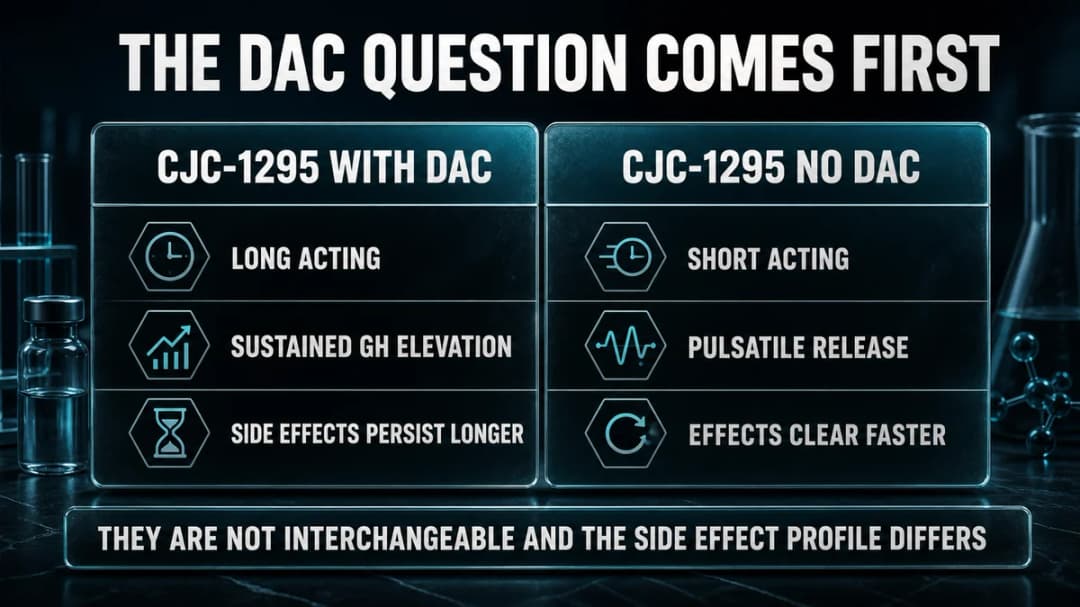
The version matters more than any other variable. CJC-1295 with DAC binds albumin and persists for around a week; the version without DAC clears within roughly half an hour.
That difference changes the side effect picture in two ways. Sustained exposure makes the GH-mediated effects more likely, because they track total exposure rather than peak height. And a dose that turns out to be too high on the DAC version keeps working for days, whereas the short-acting version can be corrected the same evening.
Anyone starting with this compound has a strong practical argument for the shorter-acting form on those grounds alone.
CJC-1295 Side Effects People Actually Report
| Effect | How often | Timing | Usual meaning |
|---|---|---|---|
| Water retention, puffy face or hands | Common, dose-related | First few weeks, or ongoing | Classic GH effect, often signals dose too high |
| Facial flushing, warmth | Common | Within 30 minutes of injecting | Vasodilation, harmless and transient |
| Injection site redness or soreness | Common | Immediately, settles in hours | Normal subcutaneous response |
| Headache | Fairly common | First weeks | Often dose-related, hydration helps |
| Fatigue or drowsiness | Occasional | Early weeks | Usually settles, works in your favour if dosing at night |
| Vivid dreams, deeper sleep | Occasional | Early weeks | Consistent with a stronger GH pulse |
| Tingling or numbness in the hands | Uncommon | Weeks to months | Fluid compressing the median nerve, reduce dose |
| Joint aches or stiffness | Uncommon | Weeks to months | GH-related, reduce dose |
| Rising fasting glucose | Uncommon, only visible on testing | Months | GH opposing insulin, needs review |
| Allergic reaction | Rare | Any time | Stop and seek medical care |
The Ones Worth Managing Carefully
Water retention
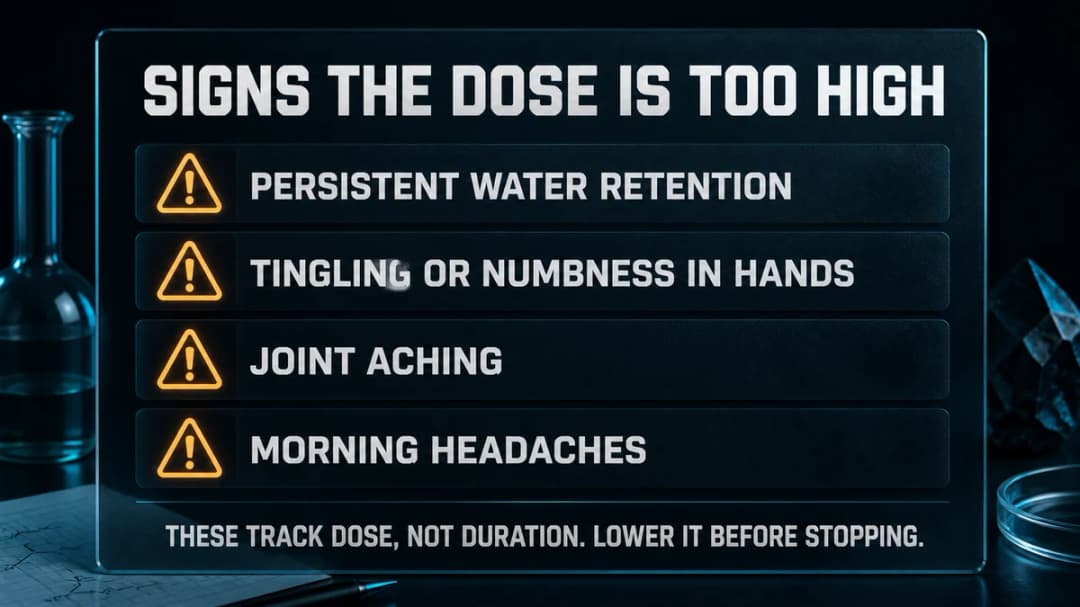
The most common complaint and the most useful signal. Growth hormone promotes sodium and water retention, so puffiness in the face, tight rings or slightly swollen ankles is the body reporting that exposure is higher than it needs to be.
Reducing sodium helps at the margin, but the real fix is a lower dose. On the DAC version, expect the change to take the better part of a week to show, because the compound is still circulating.
Tingling or numbness in the hands
This is fluid-related compression of the median nerve, the same mechanism as carpal tunnel syndrome. It is uncommon at modest doses and reverses when the dose comes down.
It should not be worked through. Persistent nerve compression can cause lasting problems, and there is no version of this protocol worth that trade.
Blood glucose
The effect most likely to go unnoticed, because it produces no symptoms at all. Growth hormone opposes insulin action, and sustained elevation can push fasting glucose and HbA1c upward over months. Continuous exposure from the DAC version is more likely to do this than intermittent pulses.
Anyone with prediabetes, insulin resistance or significant abdominal adiposity should test fasting glucose and HbA1c at baseline and again after a few months. This is the single most useful safety test for the compound.
IGF-1 above range
More is not better. IGF-1 above the age-appropriate reference range is where fluid, joint and glucose effects cluster, and it is a number rather than a feeling, so it has to be tested for. Week eight to twelve is the sensible check.
Reducing Side Effects
Start at the low end and stay there for several weeks. Nearly everything on the list above is dose-related.
Prefer the shorter-acting version while establishing tolerance. Being able to reverse a dosing decision within an hour is a genuine safety feature.
Inject away from food. Insulin suppresses GH release, so a post-meal injection produces less effect at the same exposure.
Rotate injection sites and keep technique clean. Most site problems are technique problems.
Test rather than infer. IGF-1 plus fasting glucose at baseline and at three months catches almost everything that matters.
Who Should Avoid It
- Anyone with an active malignancy, since IGF-1 is a growth signal
- Anyone with untreated pituitary disease
- People who are pregnant or breastfeeding, where no safety data exists
- Athletes in tested sport, where GHRH analogs are prohibited
- Anyone with poorly controlled diabetes, without clinician involvement
For more detail, see the CJC-1295 guide, our breakdown of the DAC and non-DAC versions, and the growth hormone secretagogue comparison for how the side effect profiles differ across this class.
Frequently Asked Questions
Are CJC-1295 side effects dangerous?
The commonly reported ones are not: flushing, injection site reactions, headache and mild fluid retention are self-limiting. The ones that need attention are nerve compression symptoms in the hands and rising blood glucose, both reversible when the dose comes down but easy to miss without testing. Long-term safety has never been established in humans.
Does CJC-1295 cause water retention?
Yes, and it is the most frequently reported effect. Growth hormone promotes sodium and water retention, so puffiness in the face and hands is expected at higher exposures. It usually settles with a dose reduction, and it is a more reliable signal that the dose is too high than any other symptom.
Why does CJC-1295 make my hands tingle?
Fluid retention can compress the median nerve at the wrist, producing carpal tunnel type symptoms. It is a recognised growth hormone effect, uncommon at modest doses, and it resolves when the dose is reduced. It is not something to push through.
Can CJC-1295 raise blood sugar?
It can. Growth hormone opposes insulin, so sustained elevation may raise fasting glucose and HbA1c. The change is often small and produces no symptoms, which is why it needs to be tested for. The DAC version, which keeps GH elevated continuously, is the more likely of the two to do this.
Are side effects worse with the DAC version?
Generally yes, for two reasons. Continuous exposure makes GH-mediated effects more likely than intermittent pulses do, and a half-life measured in days means an excessive dose cannot be corrected quickly. The shorter-acting version is the more forgiving option while working out tolerance.