Dihexa is a peptidomimetic rather than a peptide, and that distinction is the fastest way to understand it. Only two amino acids survive from the parent molecule. Everything else was replaced with non-peptide chemistry to make the compound stable, fat soluble and able to reach the brain. It is not a research peptide in the sense vendors imply by listing it beside injectable compounds.
- Dihexa (PNB-0408, C27H44N4O5, roughly 505 Da) is an angiotensin IV derived peptidomimetic from Washington State University, not a naturally occurring peptide.
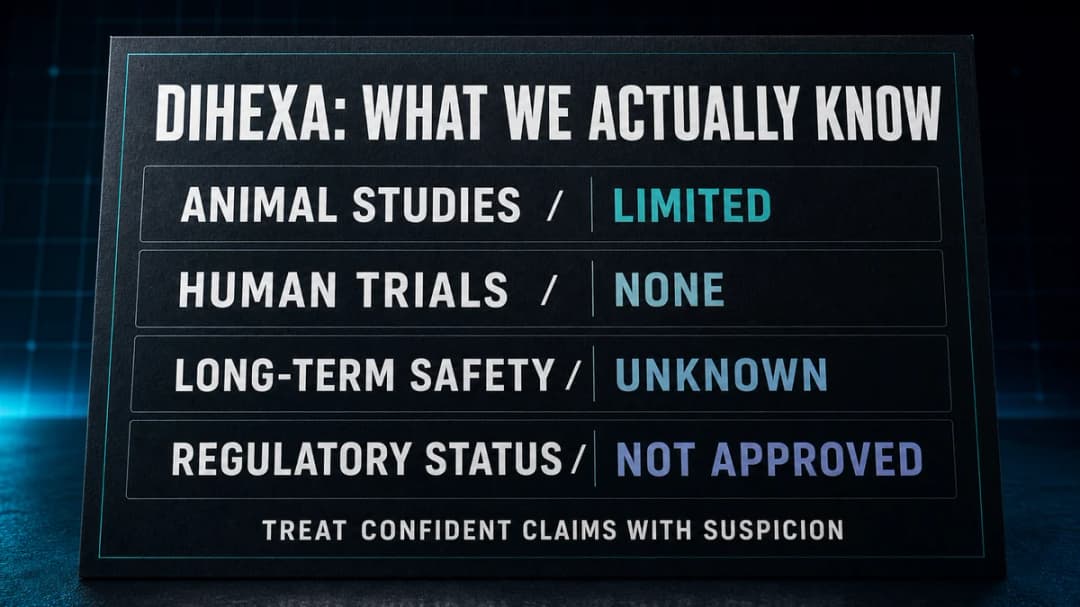
- The headline caveat: Dihexa has never entered a human clinical trial. No human safety data, no human pharmacokinetics, no human efficacy signal.
- The papers establishing its HGF and c-Met synaptogenesis mechanism were retracted in April 2025 after a misconduct investigation. The mechanism is now unsupported rather than disproven.
- A related compound, fosgonimeton, did reach human trials. It missed its primary endpoint in Alzheimer's disease in September 2024, and development was halted after that readout.
- HGF and c-Met signaling is a validated oncology target that approved cancer drugs are built to block. No carcinogenicity study has tested chronic potentiation the other way.
What Is Dihexa, Chemically Speaking
The starting point is angiotensin IV, a six amino acid fragment (Val-Tyr-Ile-His-Pro-Phe) cut from angiotensin II by aminopeptidases. It has a long history in animal cognition research because injecting it into rodent brains improved learning and memory task performance. The problem was the one that kills most short peptides: degraded within minutes, useless orally, poor at crossing the blood brain barrier.
Researchers in the Harding and Wright labs at Washington State University kept the active part and discarded the vulnerable parts. What they arrived at retains only tyrosine and isoleucine, with a hexanoic acid chain capping the N-terminus and a 6-aminohexanoic amide capping the C-terminus. Both caps are fatty, flexible and unrecognizable to peptidases. The result is a lipophilic small molecule of about 505 daltons with a dipeptide buried in the middle of it.
That is what "peptidomimetic" means here: the molecule imitates the presumed pharmacophore of a peptide without behaving like one metabolically. It was reported to be orally active and brain penetrant in rodents, which is the entire reason the design was pursued. It also means standard peptide handling rules do not transfer. It is poorly water soluble, it is not reconstituted in bacteriostatic water, and comparing it to a lyophilized peptide vial is a category error.
| Property | Dihexa |
|---|---|
| Class | Angiotensin IV derived peptidomimetic |
| Systematic name | N-hexanoic-Tyr-Ile-(6)-aminohexanoic amide |
| Development code | PNB-0408 |
| Formula and weight | C27H44N4O5, about 505 Da |
| Residues retained | Two (Tyr-Ile) |
| Solubility | Lipophilic, poor in water, soluble in DMSO |
| Routes studied | Oral and injected, rodents only |
| Human clinical trials | None |
| Regulatory status | Not approved anywhere, not scheduled |
The Proposed HGF and c-Met Mechanism
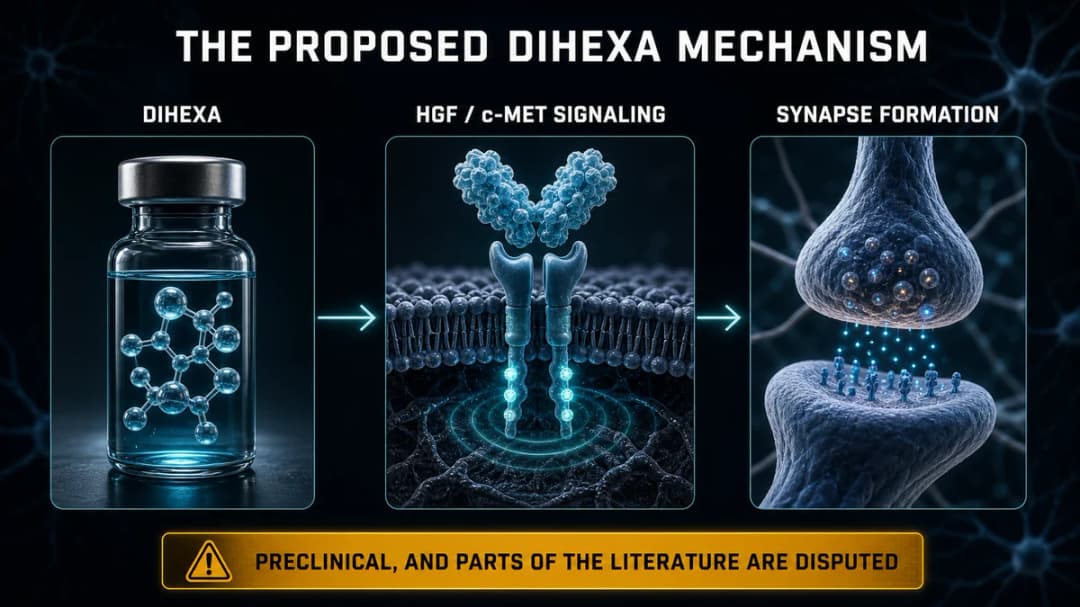
Hepatocyte growth factor has a badly chosen name. Despite the liver reference it is active throughout the body, and in the nervous system it supports neuron survival, axon growth and dendritic spine formation. It signals through a single receptor tyrosine kinase, c-Met, which runs the PI3K and Akt pathway and the MAPK and ERK pathway.
The proposed mechanism for Dihexa was not direct c-Met activation. It was that Dihexa binds hepatocyte growth factor itself and improves how effectively that growth factor engages its receptor: an allosteric potentiator of an endogenous signal rather than a replacement for it. The attraction is obvious. A drug that only amplifies signaling where the body already produces the growth factor should, in theory, be more selective than one that switches the receptor on everywhere.
Cell culture work from the same group reported spine formation at picomolar concentrations, and the widely repeated line comparing that potency to brain derived neurotrophic factor by orders of magnitude comes from this work. Two things are worth saying plainly. Potency in a hippocampal culture assay is not potency in a person. More importantly, the papers that generated those figures no longer stand.
The 2025 Retractions and Why They Matter
In September 2021 the Journal of Pharmacology and Experimental Therapeutics issued expressions of concern on four papers from the Washington State group published between 2011 and 2014, citing possible image manipulation. Those papers are the core of the angiotensin IV analog literature, including the 2014 paper arguing that the procognitive and synaptogenic effects of these compounds depend on HGF and c-Met activation.
Leen Kawas, a co-author and by then chief executive of the company commercializing the work, was placed on leave in June 2021 and resigned that October after an independent investigation found altered images in her doctoral dissertation and at least four publications. The retractions followed in April 2025, with notices citing falsified or fabricated data in specific figures.
Here is the part that matters. The retractions do not prove Dihexa does nothing. Angiotensin IV research in animals predates those figures, and HGF and c-Met signaling in the brain is well characterized by other laboratories. What the retractions remove is the evidentiary chain linking this molecule to that mechanism at those potencies. Every vendor page describing Dihexa as a picomolar HGF potentiator is quoting, at one or two removes, work withdrawn from the record. An unsupported claim is not the same as a refuted one, but it is not a foundation either.
Human Data on Dihexa: There Is None
Dihexa itself never went into people. The commercial vehicle for the work, originally M3 Biotechnology and renamed Athira Pharma in 2019, advanced a different molecule in the same HGF and MET class: fosgonimeton, given subcutaneously. That program is the closest thing to human evidence here.
| Program | What it tested | Outcome |
|---|---|---|
| Dihexa (PNB-0408) | Original Washington State compound | Never entered human trials |
| Fosgonimeton Phase 1 (from 2017) | 88 participants, 2 to 90 mg subcutaneous | Tolerated, dose proportional PK |
| ACT-AD Phase 2 (2021 to 2022) | 77 participants, mild to moderate Alzheimer's | Missed primary endpoint |
| LIFT-AD Phase 2/3 (2020 to 2024) | About 550 participants, 26 weeks | Missed primary and key secondaries, announced September 2024 |
| SHAPE Phase 2 (2022 to 2023) | 28 participants against a target of about 75, Parkinson's dementia and Lewy body dementia | Enrollment halted early, missed primary endpoint |
| ATH-1105 (oral, ALS) | Phase 1 in healthy volunteers | Reported well tolerated |
Two signals sit inside that table. The safety signal is mildly reassuring for the class: repeated dosing in hundreds of older adults produced no catastrophe, and the dominant tolerability problem was injection site reactions, which accounted for a large share of dropouts in the biggest trial. The efficacy signal is not reassuring. Three trials failed to beat placebo on their primary endpoints, twice in Alzheimer's disease and once in the Lewy body spectrum dementias.
None of that is a direct test of Dihexa. Fosgonimeton is a different molecule with a different route. But it is the only human read on the underlying idea, and the idea did not deliver.
Dihexa Side Effects and the Cancer Question
There is no adverse effect profile for Dihexa in humans because there is no human study. What circulates online is uncontrolled self report: headache, irritability, overstimulation, fatigue, disrupted sleep, a paradoxical mental flatness at higher amounts. None of it has a denominator, a placebo arm, or verified product identity behind it.
The mechanistic concern is more serious. c-Met is one of the better established oncogenic drivers in solid tumors. Activating MET alterations are the reason approved kinase inhibitors such as capmatinib and tepotinib exist, and their job is shutting this pathway down in lung cancer. A compound whose selling proposition is chronic potentiation of the same pathway runs against that logic. No carcinogenicity or long term toxicology study has been published on Dihexa in any species. That is not a claim that Dihexa causes cancer. It is a statement that the most obvious question about it has never been asked in a study.
A second risk comes from formulation. Because Dihexa is poorly water soluble, gray market products are frequently supplied in DMSO for transdermal use. DMSO is an aggressive permeation enhancer, so it carries whatever else is in solution through skin along with the intended compound. With an unregulated product of unverified purity, that amplifies contamination risk rather than being a neutral delivery choice.
Where Dihexa Sits Next to the Nootropic Peptides
People usually reach Dihexa after reading about better characterized cognitive peptides, and the contrast is instructive.
Semax is the closest functional comparison. It is a genuine peptide, dosed intranasally in micrograms, holds regulatory approval in Russia, and has a real if geographically limited clinical literature behind it. Its mechanism, largely upregulation of BDNF and NGF expression, is modest next to what Dihexa was claimed to do, but it has not been withdrawn from the record.
Selank targets something different. Where Dihexa was positioned as a structural intervention on synapses, Selank works on anxiety and stress signaling, and much of the cognitive improvement people report from it is anxiety removal rather than enhancement. That is often what a person actually wants, and it has a documented human tolerability profile.
Adamax is the closer cousin in one specific way: both compounds are chemically modified to survive the body better, and both are sold on a story their published record cannot carry. The difference is the shape of the hole. Dihexa had a supporting literature that was withdrawn. Adamax never had one to withdraw.
If the underlying complaint is fatigue rather than cognition, no synaptogenesis compound addresses it. Sleep architecture research points elsewhere, toward compounds such as DSIP.
Reported Forms, Handling and Research Ranges
Dihexa is sold as a powder, in capsules, and as a DMSO or propylene glycol solution for transdermal use. Because it is lipophilic rather than water soluble, the reconstitution arithmetic used for injectable peptides does not apply, and any product sold as an injection ready solution deserves scrutiny about what solvent carries it. Third party HPLC with mass spectrometry is the only way to know what is in a given vial, since no pharmacopeial monograph exists. Our guide to where to buy Dihexa covers how to check a source before paying.
On amounts, no validated dose exists. Rodent work used milligram per kilogram figures that do not translate cleanly to humans, and the numbers circulating in forums and on vendor pages, generally single digit to low tens of milligrams per day orally, have no derivation from any published human study. They are conventions from self experimentation, not findings.
Legally, Dihexa is not an approved drug in the United States, the United Kingdom, Canada or the EU, and is not scheduled in any of them. That leaves the familiar research chemical gray zone: legal to sell when labeled for laboratory use, not legal to market for human consumption, unregulated on purity and labeling.
Frequently Asked Questions
Is Dihexa a peptide?
Not really. Dihexa is a peptidomimetic, designed to imitate the active region of a peptide while replacing the parts that make peptides fragile. Only two residues remain, tyrosine and isoleucine, sandwiched between a hexanoic acid cap and a 6-aminohexanoic amide cap. It behaves as a lipophilic small molecule, which is why it survives oral dosing and why standard peptide handling rules do not apply.
Does Dihexa actually work?
No one can answer that from evidence. Dihexa has never been tested in a human trial, and the papers establishing its proposed HGF and c-Met mechanism were retracted in April 2025 after a misconduct investigation. Separately, a related compound from the same program failed to beat placebo in three human trials across Alzheimer's disease and two other dementias. That is not proof Dihexa is inert, but it is the opposite of supporting evidence.
Is Dihexa safe?
There is no human safety data on Dihexa at all, which is the most important thing to know about it. The concern deserving most weight is that its proposed mechanism amplifies c-Met signaling, a pathway approved cancer drugs are designed to inhibit, and no carcinogenicity or long term toxicology study exists in any species. Transdermal products in DMSO add a separate contamination risk, since the solvent carries impurities through skin.
How much Dihexa is typically used in research?
Rodent studies used milligram per kilogram amounts that do not translate directly to humans, and the oral figures repeated on vendor pages and forums, usually single digit to low tens of milligrams per day, are not derived from any human study. They are conventions rather than findings, and describing them is not the same as recommending them.
Is Dihexa legal to buy?
In most Western jurisdictions Dihexa is neither approved as a medicine nor scheduled as a controlled substance, so it sells openly as a research chemical. That legality says nothing about quality. There is no pharmacopeial standard, no regulator checking the bottle, and no requirement that the label match the contents.