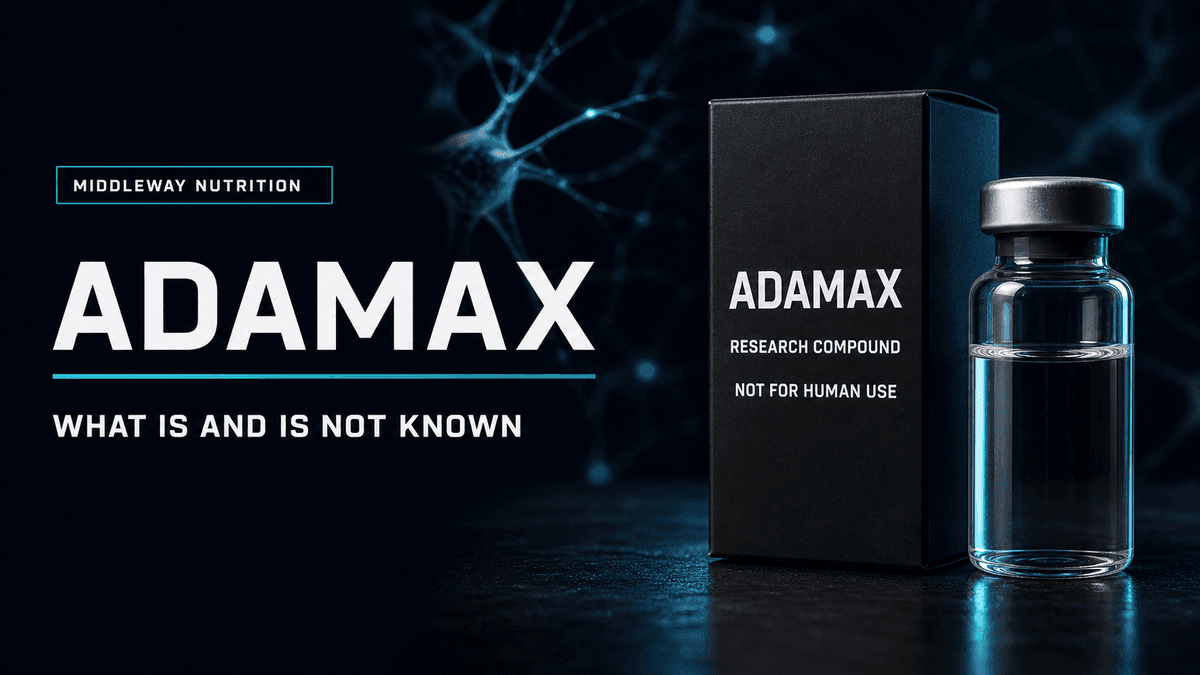
Adamax has almost no published research behind it. That is the single most useful fact a buyer can carry into this category, and it is the detail most product pages walk past on their way to a benefits list. Everything else about this compound is downstream of that gap.
- Adamax is sold as an adamantane-modified peptide in the same market niche as the Russian-developed regulatory peptides Semax and Selank, usually as a lyophilized powder intended for intranasal use.
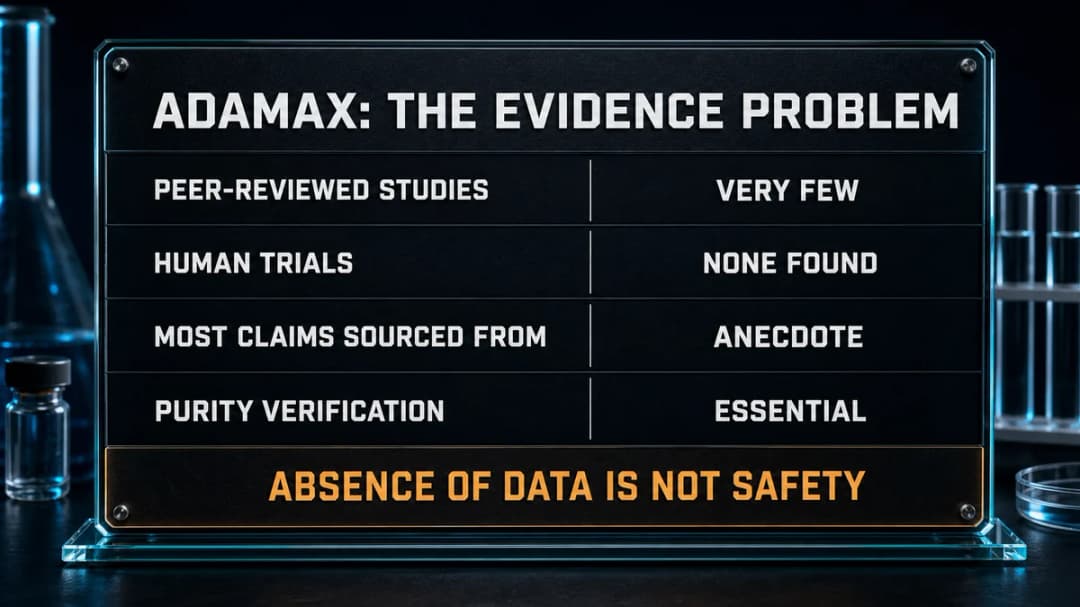
- Peer-reviewed literature published under the name Adamax is close to nonexistent. Nearly everything written about its effects traces back to supplier copy and user reports rather than trials.
- The adamantane cage is genuine medicinal chemistry. Attaching it generally raises lipophilicity and metabolic stability, which is the stated rationale for the modification. A rationale is not a result.
- It is not an approved drug in the United States, Canada, the United Kingdom or the European Union. It is sold strictly as a research chemical.
- Verification is harder here than for most peptides: without a published reference structure and expected mass, a certificate of analysis for Adamax has nothing to be checked against.
What Adamax Peptide Actually Is
Adamax is a market name. It is not an international nonproprietary name, it does not correspond to a compound with a regulatory dossier in any major jurisdiction, and it does not map cleanly onto a single structure published in the open literature. What suppliers broadly agree on is the shape of the description: a short synthetic peptide carrying an adamantane group, positioned as a relative of the family of Russian-developed regulatory peptides that produced Semax and Selank.
Past that point, the descriptions diverge. Some listings present it as an adamantyl-modified version of a Semax-type sequence. Others place it closer to the Selank side of the family. A few say nothing about structure at all and move straight to the effects. When several vendors describe the same product several different ways, the reasonable conclusion is that the market does not have a settled definition of what it is selling, not that one of them has better inside information than the rest.
That matters more than it sounds. With the compound covered in our Semax peptide guide, you can name the sequence and check a certificate against an expected mass. The same is true of the peptide in our Selank peptide guide. With Adamax, most buyers cannot state which molecule they are expecting to receive, which removes the main tool for catching a mislabeled vial.
Everything below describes what has been reported in supplier documentation and user accounts. None of it is a protocol for a person to follow.
Why the Adamantane Group Is the Interesting Part
Adamantane is a rigid, cage-shaped hydrocarbon: ten carbons arranged in a diamond-like lattice. It is bulky, chemically stable and strongly lipophilic. Medicinal chemists have used it for decades as a way of changing how a molecule behaves without changing what it is built to bind. Bolt an adamantyl group onto a scaffold and you generally increase fat solubility, often slow enzymatic breakdown, and sometimes change how the compound distributes through tissue.
This is not a fringe trick. The adamantane cage appears in approved medicines including amantadine and memantine, both of which act in the central nervous system, and in the DPP-4 inhibitors saxagliptin and vildagliptin. The group has a real pharmaceutical track record.
Applied to a short peptide, the logic is easy to follow. Small peptides are cleared quickly by peptidases and cross biological membranes poorly. Semax addressed the durability problem structurally, by capping a hormone fragment with a proline-glycine-proline tail that resists enzymatic cleavage. Hanging a lipophilic cage off a peptide is a different route to a similar set of goals: survive longer, move more easily through lipid environments.
The load-bearing word is rationale. A plausible chemical rationale tells you why somebody made a molecule. It does not tell you that the molecule does what the marketing says, that the modification improved anything measurable, or that the change was neutral with respect to safety. Modifications that improve one property routinely worsen another. Greater lipophilicity can mean broader tissue distribution and slower clearance, and those properties cut in both directions.

What the Evidence Base Actually Looks Like
It helps to see where Adamax sits relative to compounds people put it next to. The table below grades practical evidence, not marketing enthusiasm.
| Compound | Regulatory status | Best documented mechanism | Human clinical data | Practical evidence tier |
|---|---|---|---|---|
| Adamax | Research chemical only, no approval anywhere | Not established in published work; described by suppliers as an adamantane-modified peptide analog | None located under this name | Anecdotal |
| Semax | Approved in Russia for neurological indications; research chemical elsewhere | Reported upregulation of BDNF and NGF expression | Russian clinical use in stroke and brain injury | Moderate, jurisdiction-limited |
| Selank | Developed in Russia as a tuftsin analog; research chemical elsewhere | Anxiolytic activity linked to GABAergic and monoamine modulation | Russian anxiety and stress trials | Moderate, jurisdiction-limited |
| Dihexa | Research chemical only, no approval anywhere | Proposed synaptogenesis via hepatocyte growth factor and c-Met signaling, though the foundational papers were retracted | None; preclinical only | Preclinical animal data, now unsupported |
Three of those four rows point to something outside the vendor ecosystem. The Adamax row does not. That is the entire story of this compound in one line, and it is not a reason to assume the compound is inert. It is a reason to recognize that nobody, including the people selling it, can currently tell you what it does with any confidence.
A related caution: the absence of published work is not the same as a negative result. Plenty of compounds go unstudied because no institution had a reason to fund the work, not because anyone tested them and found nothing. But an unstudied compound and a promising one are not the same category either, and marketing copy tends to blur exactly that distinction.
Reported Dosing and Why the Numbers Deserve Skepticism
Figures circulating in vendor documentation and user reports tend to sit in the low hundreds of micrograms per administration, delivered intranasally, once daily, often described in blocks of a couple of weeks rather than continuous use. Those are reported ranges, and the reporting is weak. Different suppliers publish different numbers, and the underlying source for any of them is rarely stated.
There is a specific reason to distrust those figures beyond the usual. They appear to be borrowed from Semax and Selank practice, where at least some clinical grounding exists. Borrowing a dose across a structural modification is exactly the extrapolation that adamantyl groups break, because changing lipophilicity and metabolic stability is the whole point of adding one. A modification designed to change exposure invalidates dose figures carried over from the unmodified relative.
Vial contents compound the problem. Products in this category are sold in different milligram amounts and sometimes as pre-mixed nasal sprays with concentrations expressed per spray rather than per volume. Reconstitution math done from a number written for a different vial size is a common and entirely avoidable error, and in the microgram range a single misplaced decimal is invisible until the effect is wrong.
Safety: The Honest Answer Is That Nobody Knows
There is no published toxicology under this name, no human safety trial, and no long-term follow-up. The market is small and recent, which means the absence of widely reported harm carries almost no information. Rare and delayed effects only surface with either large numbers of users or systematic monitoring, and this compound has neither.
User accounts mention headache, irritability, overstimulation and nasal irritation. Those are the same complaints reported across the intranasal peptide category generally, so they are not specific enough to characterize this compound in particular. They are worth knowing as a general class pattern and not much more.
The interaction question has no answer at all. Anyone taking prescription medication, particularly anything active in the central nervous system, has no data to consult, because none has been generated. That is a different situation from the supervised clinical use described in our peptide therapy overview, where the compounds involved at least carry a known and manageable interaction profile. It deserves to be treated as more cautious rather than less.
The Sourcing Problem Is Worse Than Usual
The standard advice for research peptides is to demand a batch-specific third-party certificate of analysis carrying HPLC purity and mass spectrometry identity confirmation, with the lot number on the certificate matching the lot on the vial. That advice still applies, but for Adamax the identity half of it partially breaks down.
Mass spectrometry confirms identity by comparing a measured mass against the expected mass for a known structure. If nobody can state the expected structure, the number on the report has nothing meaningful to be compared against. Purity figures still tell you how clean the sample is, but a 99 percent pure sample of the wrong molecule is still the wrong molecule, and a certificate that names only a trade name proves nothing about what is in the vial.
The practical move is to make the vendor commit in writing. Ask for the full sequence including the position and nature of the adamantyl modification, and the expected molecular weight, before ordering. A supplier with a defined product can answer that question in one line. A supplier who cannot is selling a name rather than a molecule, and no amount of certificate paperwork fixes that.
Where Adamax Fits Against Better-Documented Options
If the goal is daytime cognition and focus with the deepest human record available in this family, Semax is the compound with actual clinical use behind it, even though that use sits under a single country's regulatory standards. If the target is anxiety-linked cognitive interference rather than raw focus, Selank is the more relevant read. If the interest is synaptic remodeling specifically, Dihexa has genuine academic origins, but the papers that established its proposed mechanism were retracted after a misconduct investigation, its record is entirely preclinical, and its safety profile in humans is unknown.
Adamax's appeal is novelty and the theoretical appeal of a stability modification. That is an honest reason to be curious about a compound. It is not a reason to treat it as an upgrade over anything, and the language used to sell it frequently implies otherwise. Anyone who would rather start with the better-documented compound can use our guide to where to buy Semax.
Frequently Asked Questions
Is Adamax the same thing as Semax?
No. Suppliers describe Adamax as a modified analog positioned in the same family, not as a form of Semax. Semax has a defined published sequence and a documented history of clinical use in Russia. Adamax has neither. Treating dosing figures, expected effects or safety information from one as applicable to the other is not supportable.
Does Adamax actually work?
There is no published evidence that answers that question either way. Reports of effects come from users and vendors rather than from controlled research, and reports in that setting are unreliable in both directions because expectation is a powerful confound with subjective cognitive endpoints. The truthful position is that the compound is unstudied, not that it is proven or disproven.
Is Adamax legal to buy?
It is not an approved drug in the United States, Canada, the United Kingdom or the European Union, and it is sold as a research chemical rather than as a medicine or supplement. That framing carries specific restrictions on marketing and human use that vary by jurisdiction, and it means no regulator has reviewed the manufacturing, purity or labeling of any product sold under the name.
How is Adamax reported to be used in research settings?
Reported use is intranasal, in the low hundreds of micrograms, typically once daily and in short blocks. Those figures come from supplier documentation and user accounts, not from dose-finding studies, and they appear to be carried over from related peptides rather than derived for this one. They should be read as a description of what circulates, not as guidance.
How does Adamax compare to Dihexa?
Both are research chemicals with no approval anywhere, but their evidence bases differ in kind. Dihexa came out of academic work on angiotensin IV analogs and has a body of preclinical animal research, although the papers that established its proposed mechanism were later retracted. Adamax has essentially nothing published under its name. Neither has human trial data, so the comparison is between compromised preclinical evidence and no evidence at all.