ARA-290 (cibinetide) is one of the most misunderstood peptides on the research market. It is an 11-amino-acid fragment of erythropoietin that was engineered to keep EPO's tissue-protective signaling while stripping out the part that builds red blood cells. That distinction matters, and most product pages selling it barely explain it.
If you have been searching where to buy ARA-290, this guide gives you the honest version. You will learn exactly where ARA-290 is sold in 2026, what a legitimate vendor looks like, how to read a certificate of analysis instead of trusting a marketing number, what reasonable pricing actually is, and the red flags that separate a clean 16mg vial from an underdosed one. ARA-290 is not an FDA-approved drug. Every retail source you find online sells it strictly as a research compound.
Key Takeaways
- ARA-290 is not FDA-approved. It is sold for laboratory research use only, with no prescription or pharmacy pathway
- No single vendor owns this compound. Judge each listing on the same three things: a batch-specific COA, ≥98% HPLC purity, and US domestic shipping
- Demand a batch-specific COA that matches the lot number on your vial, not a recycled product-level certificate
- Expect to pay roughly $48–$95 for a 10–16mg vial. Suspiciously cheap product usually means skipped testing
- Cibinetide is the official (INN) name for ARA-290. Some vendors also list it as HBSP or PH-BSP. They are the same molecule
ARA-290 lives in the "research peptide" lane, which means there is no pharmacy counter, no insurance, and no doctor's script for it. The compound itself is not a controlled substance, but it has never cleared the FDA approval process for any indication, so it can only be sold for research purposes. That puts the entire burden of quality control on you and on the vendor you choose. The good news is that vendor selection is the single biggest lever you control, and it is not hard to get right once you know what to look at.
Best Place to Buy ARA-290: Ascension Peptides
Ascension Peptides is our pick for ARA-290. It lists a 10mg vial at $70.00 USD, as checked on 27 September 2026, and new customers get 50% off with code PEPTIDEDECK.
The reason is the paperwork. Every Ascension batch is independently tested by a third-party lab, currently Kovera Labs, and the certificates cover HPLC purity, LC-MS identity, net content (mg per vial), endotoxin, a rapid sterility screen and heavy metals, with a pass mark of >98% purity. Its 85 batch-specific certificates sit in a public certificate library, and we checked one Kovera report (KVR-2026-410047, for DSIP) against the lab's own records: it matched.
Two limits to know. Ascension ships within the United States only, with free shipping over $250, and all sales are final, with damaged or incorrect items replaced if reported quickly. If you want an alternative, Peptide Warehouse is the other batch-specific option in the comparison table below.
Where to Buy ARA-290 in 2026
There is no legitimate brick-and-mortar option. Local supplement shops and pharmacies do not carry ARA-290, and any that claim to should be treated as a red flag. In practice, every real source is an online research-peptide vendor that ships lyophilized (freeze-dried) powder for laboratory use.
The market breaks down into roughly three tiers.
Tier 1: Vetted, transparent vendors
These are the vendors worth your money. They publish batch-specific COAs from independent analytical labs, hold ARA-290 in stock as 10mg or 16mg vials, ship domestically within the US, and keep their product copy to research context instead of medical claims. You pay a fair price and you can verify what you received. Among the sellers listing ARA-290 today, Ascension Peptides and Peptide Warehouse are the ones whose documentation is batch-specific rather than product-level.
Tier 2: Standard catalog vendors
A large group of peptide sites list ARA-290 at competitive prices with at least some COA documentation. Quality is often fine, but the testing can be product-level rather than batch-level, stock can be inconsistent, and customer support varies. Workable if you verify the paperwork before ordering. Biotech Peptides, Core Peptides and Limitless Biotech all sit here.
Tier 3: Anonymous or too-cheap listings
Sites with no verifiable testing, no lot numbers, no reviews, and prices well below the rest of the market. This is where mislabeled or underdosed product shows up. The savings are not worth it.
When people ask where to buy ARA-290, the honest answer is to stay in Tier 1, occasionally Tier 2 if the COA checks out, and never Tier 3.
What to Demand From Any ARA-290 Vendor
ARA-290 is a thin market, and the vendor list changes from quarter to quarter. Rather than pinning your order to one brand name, use a fixed checklist and let it decide for you. A seller either clears these bars or it does not.
A batch-specific COA, offered before you pay. The certificate has to name the lot number printed on the vial you receive. If a vendor will only show you a generic product-level PDF, or will not send anything until after the order ships, that is your answer.
≥98% purity by HPLC, with mass spec identity. For an 11-amino-acid peptide, that purity level is what keeps research dosing consistent from vial to vial. HPLC alone tells you how pure the sample is, not what it is, so you want the identity confirmation alongside it.
A named lab you can actually check. The certificate should carry a lab name, a certificate ID and a chromatogram, and the lab should have a public portal where that ID resolves.
Clear stock status and domestic shipping. ARA-290 supply gaps are common across this market. A vendor that shows real inventory and ships from within the US saves you both a backorder and a customs gamble.
Research-only framing. Any site that hands you a human dosing protocol for ARA-290 while also calling it a research chemical is talking out of both sides of its mouth. That inconsistency usually says something about the rest of the operation.
Run every candidate in the comparison table below through those five points, and the shortlist gets very short very fast.
What ARA-290 Actually Is
ARA-290, known by its international nonproprietary name cibinetide, is a synthetic peptide derived from the helix B region of erythropoietin (EPO). Its sequence is QEQLERALNSS (the first residue is a pyroglutamate), with a molecular formula of C51H54N16O21 and a molecular weight near 1257 g/mol. Vendors sometimes list it as HBSP (helix B surface peptide) or PH-BSP.
The interesting part is what it does not do. Full EPO drives red blood cell production. ARA-290 was engineered to skip that pathway entirely while keeping EPO's tissue-protective signaling, which is thought to work through the innate repair receptor (a heterocomplex of the EPO receptor and the beta-common, or CD131, receptor). In research models this signaling is associated with anti-inflammatory and anti-apoptotic effects, including reduced pro-inflammatory cytokine activity (IL-6, TNF-alpha) and interaction with the TRPV1 pain channel.
In clinical research, cibinetide has been studied for sarcoidosis-associated small nerve fiber loss. A randomized controlled trial reported that 28 days of ARA-290 improved neuropathic symptoms and increased corneal nerve fiber density (Dahan et al., Mol Med 2013, PMID 24136731), and a later randomized trial again found improvement in corneal nerve fiber abundance in sarcoidosis patients with neuropathic pain (Culver et al., Invest Ophthalmol Vis Sci 2017, PMID 28475703). These are investigational findings, not approved uses, and none of this constitutes medical or dosing advice.
How to Verify ARA-290 Quality: The COA Deep-Dive
Most product pages tell you they are "third-party tested." Far fewer let you confirm it. Here is what actually matters.
Batch-specific vs. product-level COAs
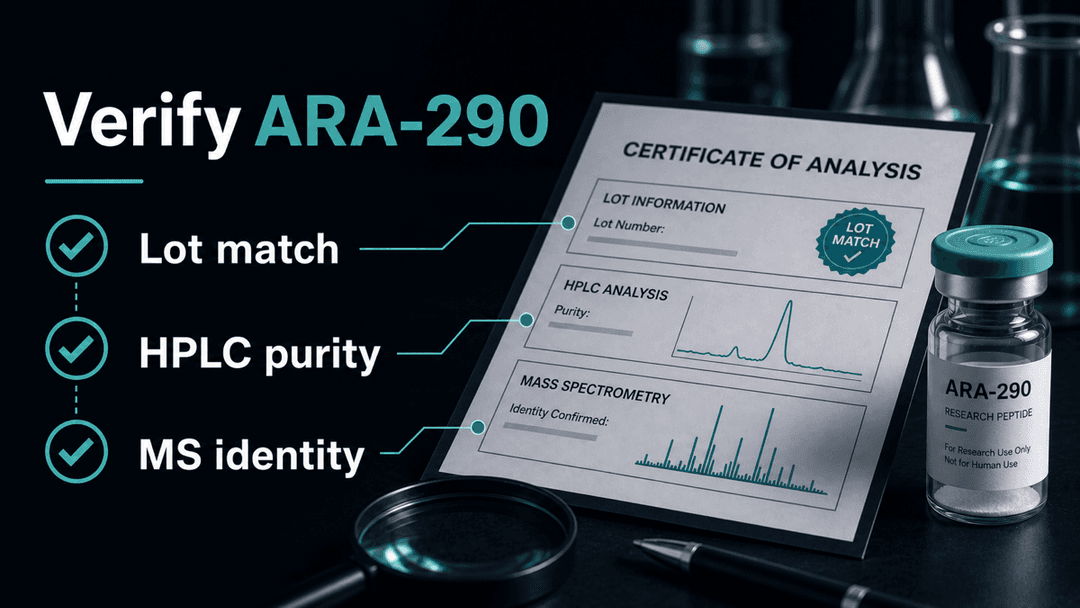
A product-level COA is one certificate that covers a whole product line. It may have been generated on a synthesis run from months ago and tells you little about your specific vial. A batch-specific COA references the exact lot number printed on the vial you received. That is the only certificate that proves anything. When your order arrives, the lot number on the vial should match the lot number on the COA.
HPLC and mass spec
HPLC measures purity, the percentage of the sample that is genuinely ARA-290. Require ≥98%. 95% is borderline; lower is a red flag. Mass spectrometry confirms identity by matching the molecular weight to ARA-290's structure. Ideally you want both, because a sample can be "high purity" of the wrong compound.
Verifiable labs
Labs like Janoshik and Colmaric Analyticals run peptide testing and maintain portals where you can cross-check a certificate ID. If a COA names a lab you cannot find online, or carries no lot number and no chromatogram, treat it as unverified.
What ARA-290 Costs in 2026
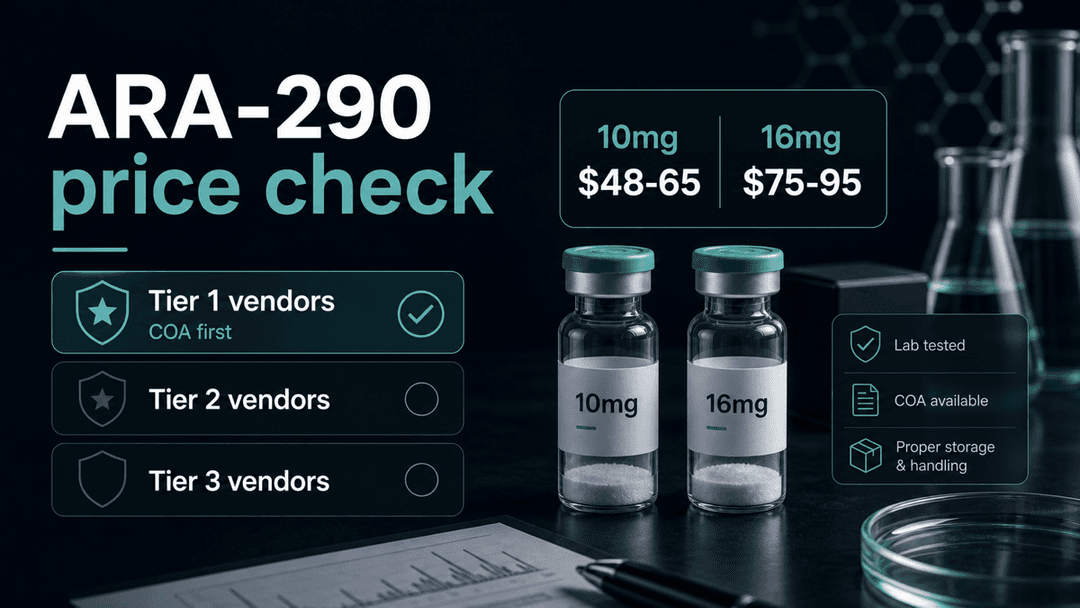
Pricing is fairly tight across reputable vendors. ARA-290 is most commonly sold as a 16mg vial, with some vendors offering 10mg.
- 10mg vial: roughly $48–$65
- 16mg vial: roughly $75–$95
- Multi-vial boxes: lower per-vial cost (often 5–10% off at 5+ units), worthwhile only if the vendor does proper batch testing
For reference, current listings in this market run from about $50 at Peptide Warehouse (10mg) up to roughly $88–$92 for 16mg at Biotech Peptides and Core Peptides, with Limitless and others spanning $51–$97 depending on size.
Is cheaper ever better?
Rarely. Peptide synthesis and proper third-party testing both cost real money. A vendor pricing far below the market is usually cutting the testing step, sometimes the synthesis quality. Spending an extra $15–$25 to get a verifiable batch COA is the cheapest insurance you will buy in this whole process. For background on what the compound actually does before you spend anything, a full ARA-290 guide covers the neuropathy research in more depth.
Red Flags to Avoid When Buying ARA-290
- No batch-specific COA. If they cannot tie a certificate to your lot number, do not order. Full stop.
- Prices far below market. A 16mg vial for $20 with free shipping means a corner got cut somewhere in the supply chain.
- Medical or dosing claims. A vendor that tells you how to dose ARA-290 "for nerve repair" while also calling it a research chemical is talking out of both sides of its mouth.
- No verifiable lab. A COA from a "lab" with no website or no public portal is just a PDF.
- Zero reputation. Check community boards like r/Peptides. Vendors with no track record, good or bad, deserve caution.
- Fake scarcity. Countdown timers and "today only" pressure from unknown sites correlate with lower-quality operations.
How to Get ARA-290
Because ARA-290 is sold for research use and is not an approved medication, there is no prescription involved. The practical process is straightforward.
- Pick a vetted vendor with batch-specific COAs and ≥98% HPLC purity. Work down the comparison table below and start with the batch-tested listings.
- Confirm the COA before paying, and match the lot number when the vial arrives.
- Choose payment. Most peptide vendors take credit card or crypto. Credit card gives you chargeback protection if the product is fraudulent, which is worth keeping until you trust a seller.
- Store it correctly. ARA-290 ships as a lyophilized powder. Keep the unreconstituted vial cold (around 4°C) and out of light. If reconstituted with bacteriostatic water in a lab setting, it is kept refrigerated and protected from UV. No vendor should be giving you a human dosing protocol, and neither will we.
If you came to ARA-290 from the broader recovery and tissue-repair peptide world, our guides to BPC-157 for gut healing and the Wolverine stack cover that adjacent territory.
Vendor Comparison Table
Top Vendors
Ranked by purity, third-party testing, COA availability, and price.
>98% HPLC (COA pass mark) · Kovera Labs, every batch · US only, free over $250
Listed · LC/MS published · Free over $200
>99% · Claimed · Free over $200
Listed · Batch COA · Free over $299
≥98.5% HPLC · Endotoxin/sterility · US shipping
Listed · Claimed · International
Prices are approximate and change frequently. Always verify current pricing and COA availability before purchasing.
Related Buying Guides
Use these next if you are comparing adjacent research-peptide sourcing decisions:
- Where to buy KPV
- Where to buy LL-37
- Where to buy BPC-157
- Where to buy TB-500
- Where to buy Thymosin Alpha-1
Frequently Asked Questions
The Bottom Line on Where to Buy ARA-290
If you came here to figure out where to buy ARA-290, the framework is the same one that protects you with any research peptide: COA first, vendor reputation second, price last. ARA-290 is a genuinely interesting compound with real peer-reviewed clinical research behind its tissue-protective and anti-inflammatory signaling, but the market selling it is uneven, and the cheapest listing is almost never the smart buy.
Beyond our pick, the comparison table above is a shortlist, not an endorsement, so buy on evidence rather than on a brand: batch-specific testing tied to your lot, ≥98% HPLC purity with mass spec identity, a lab whose certificate ID you can look up, and research-only framing on the product page. If a listing cannot clear all four, move to the next one. (Ascension Peptides is where we buy the compounds they stock, and it does list ARA-290, at $70.00 USD for 10mg, which is why it tops the table.)
Medical Disclaimer: The information in this article is for informational purposes only and does not constitute medical advice. ARA-290 (cibinetide) is not FDA-approved and is sold for laboratory research use only. It is not intended to diagnose, treat, cure, or prevent any disease, and nothing here should be taken as a dosing or treatment protocol. Always consult a qualified healthcare provider before considering any new compound. The purchase and use of research peptides carries legal and health risks that vary by jurisdiction and individual circumstances.