ARA-290 peptide benefits cluster almost entirely around nerve repair, the side effects logged in human trials were mild enough that investigators struggled to separate them from placebo, and dosage in those same trials converged on one number rather than a range. That is an unusual position for a research peptide, and it is worth understanding why before you read anything else about it.
- ARA-290, also called cibinetide, is an 11 amino acid peptide copied from a specific surface of erythropoietin. It is not EPO, and it does not do what EPO is famous for doing.
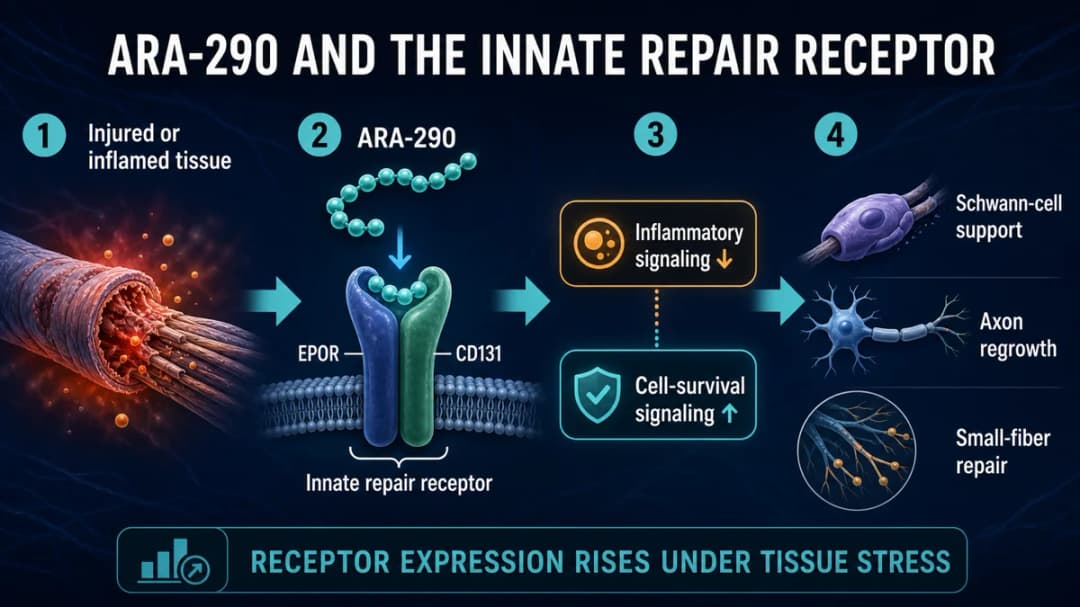
- The target is the innate repair receptor, a pairing of the EPO receptor with CD131. That receptor is only present in meaningful amounts on tissue that is already injured, inflamed, or metabolically stressed.
- Unlike most compounds in this category, ARA-290 has completed Phase 2 human trials, and the primary outcome was an objective structural measurement rather than a symptom questionnaire.
- Trial dosing was 4 mg daily for 28 days. That number is not arbitrary. In the one dose ranging trial that ran 1 mg, 4 mg and 8 mg against placebo, only the 4 mg arm separated from placebo on the primary endpoint.
- It holds Orphan Drug designation for sarcoidosis but no marketing approval anywhere. It is sold as a research chemical, and vendor listings for it are noticeably inconsistent about basic chemistry.
What ARA-290 Actually Is
Two jobs sit inside one hormone. Erythropoietin drives red cell production in bone marrow, and it separately keeps damaged tissue alive. Bundled that way, EPO was useless as a repair drug, because pushing someone's hematocrit up to treat their neuropathy trades a nerve problem for a clotting problem.
The work by Michael Brines and Anthony Cerami established that the two run through different receptors and different parts of the EPO molecule. The tissue protection signal lives on a region called the helix B surface. Copy that region as a short synthetic peptide and you get the repair signal on its own. That copy is ARA-290, also written as cibinetide, and in the older literature as pHBSP, short for pyroglutamate helix B surface peptide.
Chemistry worth checking against your vendor's listing:
- Length: 11 amino acids
- Sequence: pGlu-Glu-Gln-Leu-Glu-Arg-Ala-Leu-Asn-Ser-Ser
- Molecular weight: approximately 1,257 Da
- Form: white lyophilized powder, commonly in 16 mg or 32 mg vials
- Developer: Araim Pharmaceuticals
- Also written as: cibinetide, pHBSP, ARA 290 and ARA290, all the same molecule
One practical warning. Sequence listings for ARA-290 across supplier sites and peptide databases are not consistent, and some catalogs publish an entirely different string of residues under the same name. A vendor that cannot state the sequence correctly on its own product page is not one whose analytical documents mean much.
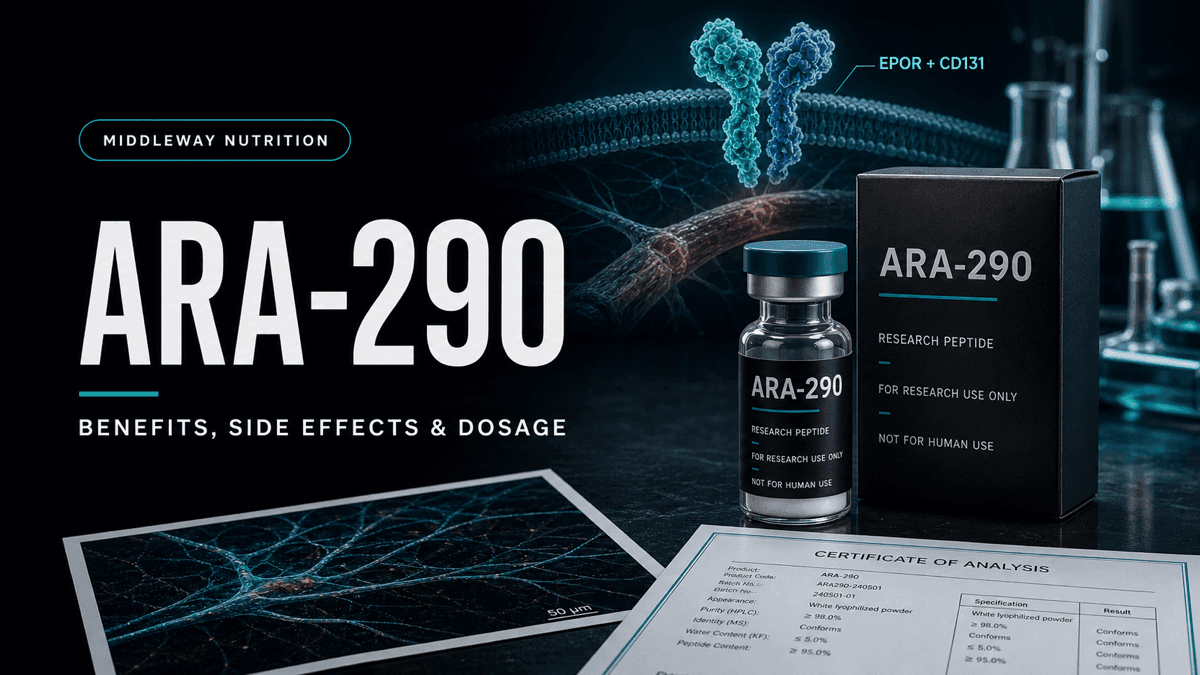
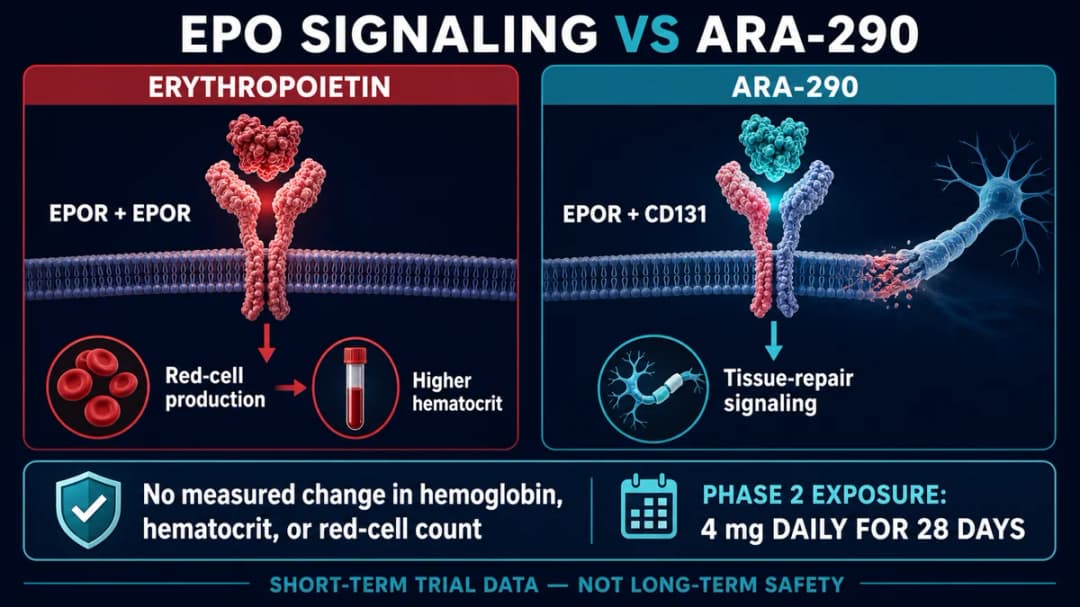
Mechanism. Classical EPO signaling works through a homodimer of two EPO receptor subunits on red cell precursors. ARA-290 does not bind that. It binds the innate repair receptor, or IRR, a mixed complex of one EPO receptor subunit and the common beta receptor, CD131.
The IRR is conditional, and that conditionality is the whole design. Expression of the complex climbs under hypoxia, inflammation, metabolic strain, and nerve damage, and stays low where none of those apply. The result is a compound whose distribution of effect is set by the tissue rather than by the dose: an uninjured organ simply presents no docking site for it.
Reported downstream consequences run in roughly this sequence. Local macrophages shift away from an inflammatory posture toward a repair one. Cytokine output at the injury site falls, TNF-alpha and the interleukin-1 and interleukin-6 arms included. Survival signaling through PI3K/Akt is engaged in cells that would otherwise commit to apoptosis. Schwann cells persist and axons regrow. New capillary formation gets a modest push.
None of that requires the peptide to hang around. Plasma clearance is fast, with renal elimination and a half life that is short but that we could not verify against a primary source (secondary sources say minutes; the diabetes trial's pharmacokinetic work did not report one). Effects outlast the molecule because receptor engagement triggers gene expression changes that continue after clearance, which is the standard explanation for why a 28 day course produced findings still measurable weeks later.
ARA-290 is not approved for human use in any market. Everything below describes what has been reported in research settings, not a protocol for anyone to follow.
ARA-290 Benefits
The evidence base here is narrow, unusually deep in one place, and thin everywhere else. Grading it properly means separating the human work from the animal work, because the gap between them is wide. Vendors and forums spell the name ARA-290, ARA 290 or ARA290 interchangeably, so every benefit list published under any of those spellings is a claim about the same 11 amino acid peptide.
Diabetic peripheral neuropathy (human trial data). The strongest column by some distance. Placebo controlled Phase 2 work in type 2 diabetes patients with neuropathic symptoms ran a 28 day course and tracked small nerve fiber density directly, using objective structural methods rather than a symptom questionnaire. In the published Phase 2 (Brines and colleagues, Molecular Medicine, 2015), 4 mg self administered daily for 28 days improved neuropathic symptom scores on the PainDetect questionnaire, and corneal nerve fiber density rose in the subgroup that started with measurable fiber loss while the placebo group did not move. HbA1c and lipid measures also improved across the 56 day observation window, an effect the trial was not designed to isolate. That structural distinction carries most of the weight here: a count of nerve fibers is much harder to move by expectation than a patient rating their own pain, which is exactly why neuropathy trials that rest on questionnaires alone convince so few people. Pain and sensory measures improved alongside the structural finding.
Sarcoidosis associated small fiber neuropathy (human trial data). This neuropathy responds poorly to conventional analgesia and the population has few options. The Phase 2b trial (64 patients, 28 days, 1 mg, 4 mg or 8 mg daily against placebo, published by Culver and colleagues in Investigative Ophthalmology and Visual Science in 2017) put the primary endpoint on corneal nerve fiber area. The 4 mg arm gained a placebo corrected 697 square micrometers, confidence interval 159 to 1,236, p = 0.012, and regenerating GAP-43 positive fibers in skin biopsies rose in that same arm. An earlier 28 day placebo controlled trial in the same population reported improved neuropathic symptoms, higher corneal nerve fiber density and longer six minute walk distance. Pain fell in every group including placebo, which is the usual problem with pain endpoints, and the placebo corrected pain difference in the 4 mg arm did not reach significance. Fatigue is the symptom patients rank as most disabling, and ARA 290 was one of six interventions examined in a 2017 systematic review of sarcoidosis fatigue treatments, which concluded the trial evidence overall was limited and reserved its support for anti-TNF therapies and neurostimulants. This is the indication behind the Orphan Drug designation.
Beta cell protection and metabolic effects (mostly preclinical). Pancreatic beta cells express the IRR when stressed by high glucose or inflammation, and animal work shows reduced beta cell death under those conditions. The human signal is limited to glycemic improvements seen inside neuropathy trials, which those trials were not designed to test. A hypothesis, not a finding.
Broader anti-inflammatory and organ protection (animal data only). Rodent models cover joint inflammation, sepsis survival, kidney injury, and cardiac ischemia reperfusion, and results are consistently positive. They are also rodent results, and preclinical anti-inflammatory data has a poor historical record of translating. ARA-290 at least has human evidence somewhere in its file, unlike KPV, but not in these applications.
Mood and neuroinflammation (early animal work). Mice under chronic stress showed reduced depression like behavior and lower hippocampal inflammatory markers, which connects to the inflammatory hypothesis of treatment resistant depression. The only registered human work is a 36 person study in healthy volunteers that gave a single 2 mg intravenous dose and measured emotion recognition and information processing, filed under depression as NCT02070783, completed in 2014 with results never posted. No trial has been run in people who have depression. It is a research direction, not a benefit.
What ARA-290 has never demonstrated, and was specifically engineered not to do, is raise red blood cell mass. If a seller markets it for endurance or oxygen carrying capacity, they have misunderstood the entire point of the molecule.
ARA-290 Side Effects
The published safety picture is genuinely mild, and it is worth being precise about why rather than repeating that it is well tolerated.
Documented in human trials:
- Injection site reactions, mild and short lived, the most commonly reported effect
- Mild fatigue, generally in the first days of a course
- Headache, uncommon, usually early
- Gastrointestinal discomfort, rare
- No clinically significant changes in hematology or clinical chemistry were reported in the diabetes trial (the paper gives that statement, not hemoglobin or hematocrit values)
- No thromboembolic or hypertensive signals, in contrast to EPO
- No neutralizing antibody response reported
The absence of hematological effects is the most important safety fact here, and it is a mechanistic consequence rather than a lucky result. Because ARA-290 does not engage the classical EPO receptor homodimer, the pathway that raises blood viscosity is never activated, which removes the stroke and clotting concerns that make chronic EPO use untenable.
The diabetes trial (4 mg daily for 28 days, PMID 25387363) is less tidy than the usual summary suggests. It recorded four serious adverse events in the ARA-290 arm. Two were judged unlikely to be related, including a fatal myocardial infarction in a 70 year old after hospitalization for cellulitis. Two were judged possibly related, and in one of those, a patient on furosemide whose borderline kidney function worsened (creatinine 119 to 159 umol/L), the safety committee stopped ARA-290 dosing. Anti-drug antibodies were negative.
The dose ranging sarcoidosis trial posted its adverse event table to the registry as NCT02039687, covering 28 days of dosing plus 84 days of follow up. Counts are participants reporting each event.
| Event | 1 mg (n=16) | 4 mg (n=16) | 8 mg (n=14) | Placebo (n=16) |
|---|---|---|---|---|
| Headache | 3 | 3 | 2 | 0 |
| Fatigue | 3 | 2 | 0 | 2 |
| Nausea | 2 | 2 | 1 | 0 |
| Diarrhoea | 2 | 1 | 2 | 2 |
| Injection site pain | 1 | 1 | 1 | 4 |
| Any serious adverse event | 2 | 0 | 1 | 0 |
Two details in that table cut against the usual summary of this compound. Headache is the only common event clearly more frequent on drug than on placebo, and injection site pain was reported by more people in the placebo arm than in any active arm, which is what you would expect when everyone is injecting daily and the peptide itself is not the irritant. The serious events were two participants in the 1 mg arm, covering syncope, headache with chest tightness and shortness of breath, and small bowel enteritis, plus one case of suicidal ideation in the 8 mg arm. None occurred at 4 mg or on placebo. With 62 people in the safety population those counts establish nothing about causation, but they are the record, and they are more than the phrase well tolerated conveys.
Where the data is thin, and it is thinner than the safety summaries suggest:
Trial exposure was measured in weeks, not years, and there is no long term human data for the repeated annual cycling that describes actual use outside trials. No human dose escalation toxicity study has been published, so the upper bound of tolerability is unknown rather than established as high.
A theoretical concern also gets glossed over. CD131 is expressed on some tumor cell types, and IRR signaling is an anti-apoptotic survival pathway. Nobody has shown that ARA-290 promotes tumor growth, and nobody has ruled it out. Pregnancy, breastfeeding, and pediatric use have no safety data at all. Combining ARA-290 with erythropoiesis stimulating agents such as EPO or darbepoetin has not been studied.
ARA-290 Dosage Chart
The trial rows below come from published protocols; the rows labeled reported research use are unsourced community figures, not from a published protocol. None of it is a recommendation, and no human dosing standard exists for this compound because no regulator has approved it.
| Context | Reported range | Route | Frequency | Typical cycle |
|---|---|---|---|---|
| Diabetic peripheral neuropathy, Phase 2 | 4 mg | Subcutaneous | Once daily | 28 days |
| Sarcoidosis small fiber neuropathy, pilot (PMID 23168581, 22 patients) | 2 mg | Intravenous | Three times weekly | 4 weeks |
| Sarcoidosis small fiber neuropathy, Phase 2 | 4 mg | Subcutaneous | Once daily | 28 days |
| Sarcoidosis small fiber neuropathy, Phase 2b dose ranging | 1, 4 or 8 mg | Subcutaneous | Once daily | 28 days |
| Diabetic macular edema, Phase 2 (PMID 32674280, 9 patients) | 4 mg | Subcutaneous | Once daily | 12 weeks |
| Reported research use, introductory | 2 to 4 mg | Subcutaneous | Once daily | First 3 to 5 days |
| Reported research use, standard | 4 mg | Subcutaneous | Once daily | 14 to 28 days |
| Reported research use, upper end | Up to 8 mg | Subcutaneous | Once daily | 14 to 28 days |
| Animal models | 10 to 30 mcg/kg | IV or subcutaneous | Varies by study | Varies by study |
| Interval between cycles | Not applicable | Not applicable | Not applicable | 2 to 4 weeks off |
Three things about this table deserve emphasis.
First, 8 mg has been tested, and it lost. In the dose ranging trial the 8 mg arm produced a placebo corrected gain of 431 square micrometers of corneal nerve fiber area with a confidence interval running from minus 130 to 992, against 697 and p = 0.012 at 4 mg. Doubling the dose did not double the effect, and on the endpoint that was measured it did not beat the lower dose at all. Above 8 mg there is no trial basis at all. Those figures circulate through community reports, and because no human dose escalation toxicity study has been published, the safety of that upper band is unknown rather than reassuring. Unknown is not a synonym for fine.
Second, the 4 mg figure has been repeated so widely that it now reads like a general purpose dose. It is not one. It won a three arm comparison in 64 people with one disease, measured on corneal imaging, over 28 days. Nothing in that result says 4 mg is the right quantity for a different indication, for someone with no diagnosed neuropathy, or for a course that runs longer than a month.
Third, the cycling pattern in the last row has no clinical origin whatsoever. Trials ran a single 28 day course and stopped. Repeated cycles separated by washout periods are a practice imported from how other research peptides get used, not something any published ARA-290 protocol tested.
Reconstitution and Storage
ARA-290 ships as a lyophilized powder and has to be reconstituted before use in any injectable research application.
Bacteriostatic water is the standard diluent. Add it slowly against the vial wall rather than onto the powder cake, and swirl rather than shake. Two milliliters into a 16 mg vial lands at 8 mg per mL, which puts a 4 mg quantity at half a milliliter, or the 50 unit mark if you are measuring on a U-100 insulin syringe. Doubling both figures, 4 mL into a 32 mg vial, holds that same concentration and keeps the arithmetic identical.
Supplier storage guidance is consistent on the essentials. Keep sealed lyophilized vials frozen near minus 20 degrees Celsius for long term storage, or refrigerated at 2 to 8 degrees Celsius for shorter periods, and refrigerate once reconstituted. Published shelf life estimates for the reconstituted solution vary widely, from about one week to several weeks, which is a reason to prepare conservatively rather than trust the longest figure you find. Protect from light, never freeze a reconstituted vial, and discard anything cloudy or discolored.
Stacking
Combination data for ARA-290 is close to nonexistent, and no published trial has run it alongside another peptide. What follows is mechanistic reasoning, a weaker basis than it usually gets credit for.
The commonly discussed pairing is with BPC-157, on the logic that the two work through non overlapping pathways: IRR mediated protection of stressed nerve tissue on one side, angiogenic and growth factor driven soft tissue repair on the other. Coherent argument. Untested.
Where inflammation rather than structural injury is the focus, KPV, which acts inside the cell on NF-kB signaling, and LL-37, which works largely through antimicrobial and immune modulating activity, make more sense as comparisons than as additions. Running several inflammation targeting peptides at once makes it impossible to attribute any observed effect to any one of them.
One pairing is worth ruling out flatly: ARA-290 alongside any erythropoiesis stimulating agent. The peptide leaves hematocrit alone by itself, but layering it onto something built to raise red cell mass produces a combined exposure that no published work has examined, and the receptor overlap between the two makes that a genuinely open question rather than a formality.
How to Verify What You Buy
ARA-290 is expensive to synthesize correctly and the market for it is small, exactly the profile that attracts underdosed and mislabeled product. Ask for a batch specific third party certificate of analysis carrying both HPLC purity and mass spectrometry identity, and check that the reported mass lands near 1,257 Da. Our ARA-290 buying guide covers which suppliers publish batch level documents and which reuse one file across lots.
Looking for the numbers behind this guide? Our ARA-290 dosage chart sets label and trial doses beside what Reddit users report taking and our ARA-290 side effects separates documented effects from what users report.
Frequently Asked Questions
What does ARA-290 peptide do?
It activates the innate repair receptor on injured or inflamed tissue, which triggers anti-inflammatory signaling, cell survival pathways, and nerve repair processes. In human trials the measurable result was regrowth of small nerve fibers in patients with diabetic and sarcoidosis related neuropathy. It does not stimulate red blood cell production, despite being derived from erythropoietin.
Is ARA-290 safe?
In published Phase 2 trials most adverse events were mild and similar in frequency to placebo, and the diabetes trial reported no clinically significant hematology changes. That trial also recorded four serious adverse events in the drug arm (see the side effects section), so the record is good but not clean. It is a short term record, but not an established safety profile: exposure lasted weeks, no human dose escalation toxicity study exists, and long term repeated use has never been studied. It is not an approved drug.
How much ARA-290 was used in studies?
Both major Phase 2 programs settled on 4 mg once daily across a 28 day course. Reported use outside trials tracks that same figure, sometimes preceded by a smaller introductory amount and occasionally pushed to 8 mg, though nothing above 4 mg has trial support behind it. Treat all of these as reported ranges rather than instructions, and note that the repeated cycling described in community protocols was never part of any studied schedule.
Is ARA-290 good for granuloma annulare?
Nothing published says it is, and nothing published says it is not. PubMed returns zero results for ARA-290 or cibinetide paired with granuloma annulare, and the ClinicalTrials.gov registry lists no trial of this peptide, or any peptide, in that condition. The association people are making is understandable. Granuloma annulare is a granulomatous skin condition that shows up more often in people with diabetes, and ARA-290 has an Orphan Drug designation in sarcoidosis, another granulomatous disease, plus trial data in diabetic neuropathy. But the sarcoidosis program never went near the granulomas. Its endpoints were corneal nerve fiber area, regenerating fibers in skin biopsies, pain scores and walking distance in patients with small fiber neuropathy. Whether skin lesions cleared, shrank or changed at all was not measured in any published ARA-290 study. A vendor page that lists granuloma annulare among this peptide's uses is inventing that claim.
Is ARA-290 legal?
Scheduling is not the issue with cibinetide, since it sits outside controlled substance frameworks entirely. Approval is the issue. No regulator, the FDA included, has cleared it for any indication, which means selling or marketing it for human use is not lawful anywhere. Distribution runs on laboratory research terms instead, and what an individual may purchase or hold varies considerably from one country to the next.
Everything above is informational and none of it is medical advice. ARA-290 (cibinetide) carries no approval for human use in any jurisdiction, and every dosing figure on this page reflects what research and trial protocols have reported, not a schedule anyone should follow. Anyone weighing a peptide of any kind should raise it with a licensed clinician first. That applies with particular force during pregnancy or breastfeeding, alongside a cancer or clotting history, and for anyone already taking something that stimulates red blood cell production.