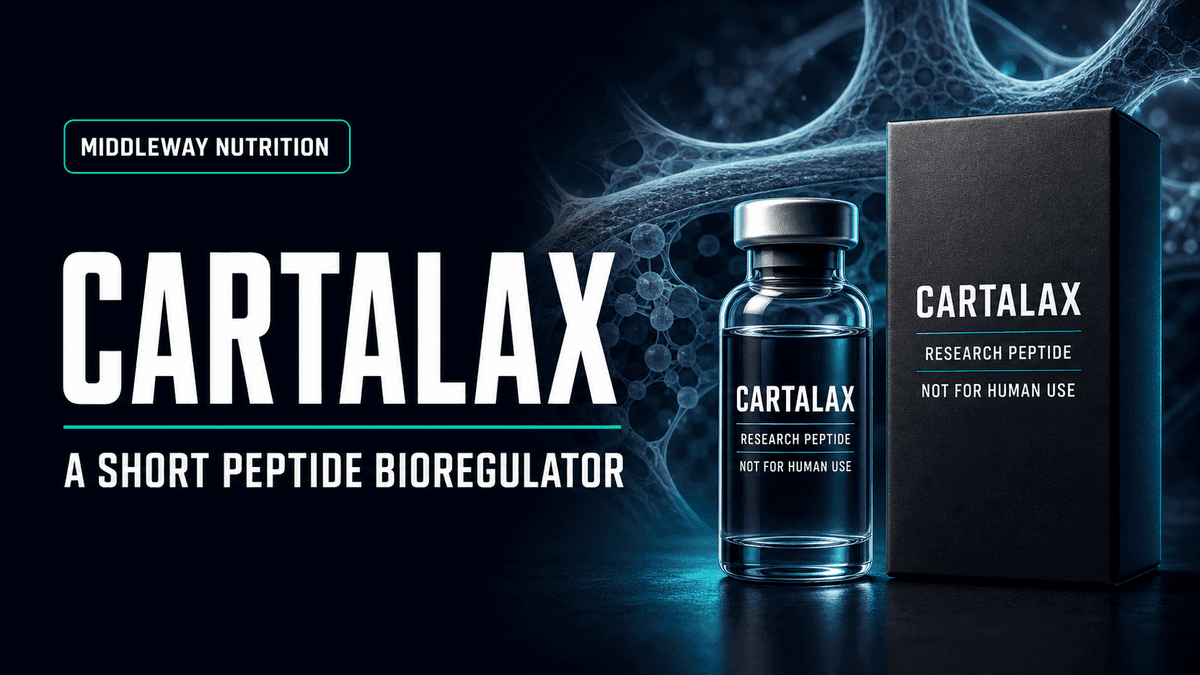
Cartalax is a synthetic tripeptide, alanine-glutamate-aspartate (AED), developed in Russia as a short peptide bioregulator assigned to cartilage and connective tissue. Its evidence base is unusual: the mechanism is coherent, the claimed results are consistent, and almost none of it has been replicated outside the group that created it. That is the whole story, and it belongs up front rather than buried under a benefits list.
Key Takeaways
- Cartalax is Ala-Glu-Asp (AED), three residues, molecular formula C12H19N3O8, molecular weight roughly 333 Da. It is among the shortest sequences in the Khavinson bioregulator family.
- It came out of the St Petersburg Institute of Bioregulation and Gerontology as the synthetic short peptide corresponding to cartilage and connective tissue.
- The proposed mechanism is epigenetic rather than receptor-based: short peptides are described as reaching the nucleus and interacting with promoter regions to shift gene expression.
- The supporting literature sits in one research program and is published largely in Russian-language journals, which makes independent verification difficult. That is a real limitation, not a conspiracy.
- Cartalax is not an approved drug in the US, EU, or UK. Western supply is research-chemical grade, and the oral capsules sold in Russia are a different product format entirely.
What Is Cartalax?
Cartalax is the trade name for the synthetic tripeptide AED: alanine, glutamic acid, aspartic acid, joined by two peptide bonds. Molecular formula C12H19N3O8, molecular weight about 333 daltons, which is smaller than many small-molecule drugs. It ships as a white lyophilized powder in research-chemical form and as an encapsulated powder in the consumer form sold on the Russian market.
The origin matters more than the chemistry. Beginning in the 1970s, a Soviet and later Russian research program led by Vladimir Khavinson extracted peptide fractions from animal organs and reported that each fraction preferentially affected the organ it came from. The program then tried to identify the shortest active sequence inside each extract and synthesize it. That second generation of compounds is what people mean by short peptide bioregulators.
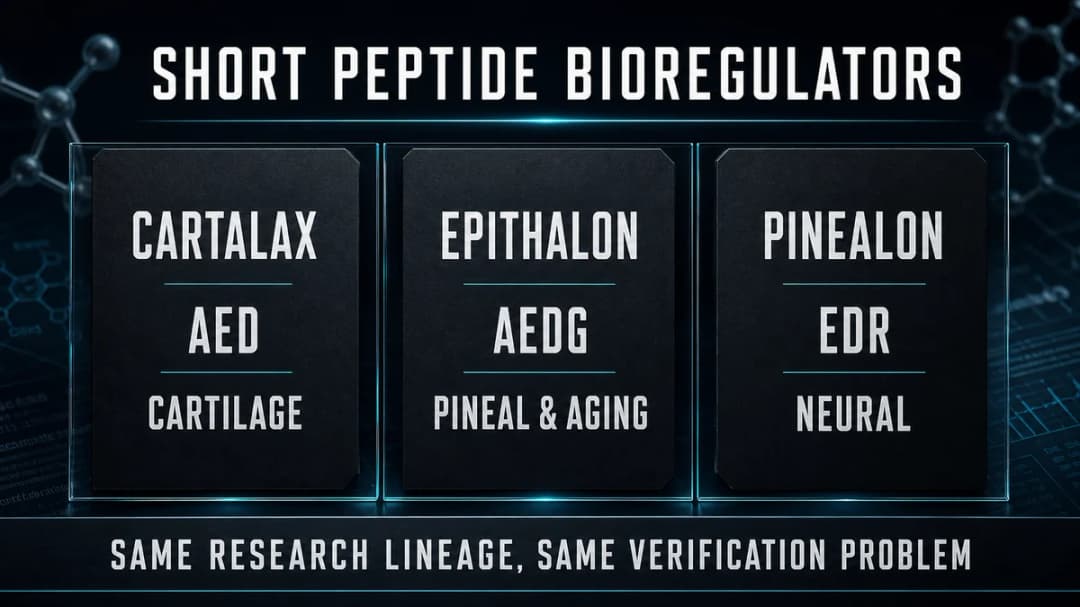
Cartalax occupies the cartilage and connective tissue slot in that catalog, alongside siblings built on the same logic: Epithalon (AEDG) for the pineal gland, Pinealon (EDR) for brain tissue, Vesugen (KED) for vascular tissue. If the family framework holds, Cartalax is the one you reach for when the tissue in question is cartilage, tendon, ligament, or intervertebral disc. The word "if" is doing a lot of work there, and the rest of this article is about how much.
How Cartalax Is Supposed to Work
Most research peptides bind something on the outside of a cell. A receptor gets occupied, a signaling cascade fires, a downstream effect follows. The bioregulator model is different, and that difference is the reason these compounds are interesting at all.
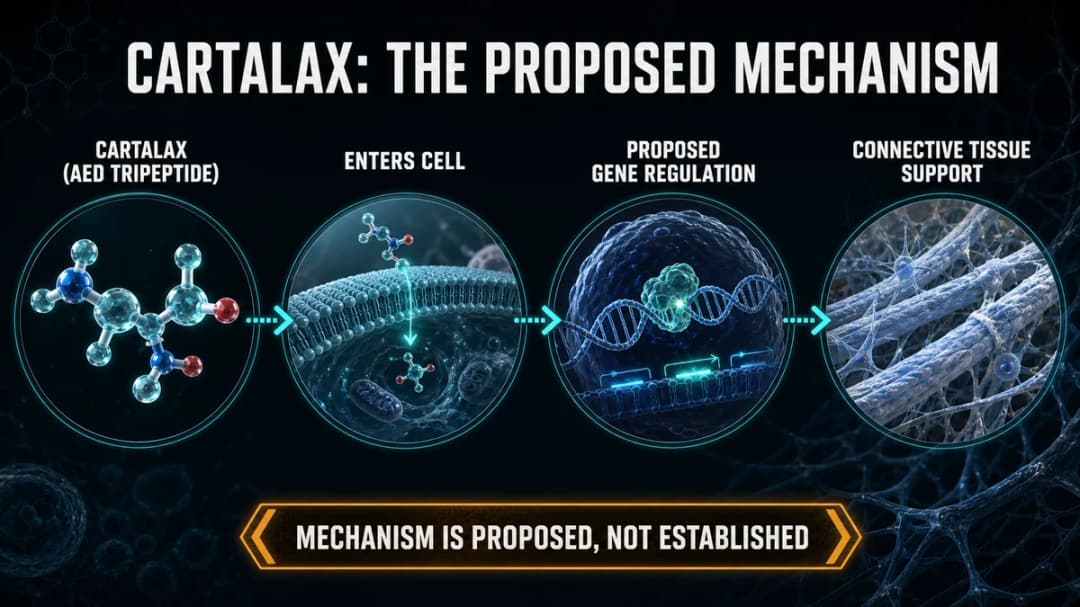
A three or four residue peptide is small enough to cross the cell membrane and then the nuclear pore without a transporter. Once inside, it is proposed to interact with double-stranded DNA in a sequence-preferential way, docking into the major groove at promoter regions and changing how accessible those regions are to transcription machinery. Molecular modeling from the same group described complementarity between short peptide side chains and particular base sequences. In this model the peptide is not a drug in the classical sense. It is a transcription modifier, and tissue specificity comes from which genes happen to be poised for expression in that cell type.
Applied to Cartalax, the claim is that AED reaches chondrocytes and nudges expression of the genes those cells use to build and maintain extracellular matrix, which in cartilage means type II collagen and proteoglycans such as aggrecan. Secondary claims involve dialing down inflammatory signaling in joint tissue.
That outline has several weak links, and honesty requires naming them. Taken orally, the peptide has to survive gastric acid and intestinal peptidases. Injected, it has to survive serum peptidases long enough to distribute. Then it has to enter the right cell type at a concentration high enough to matter against the enormous quantity of DNA-binding proteins already in a nucleus. Each step is testable, and published human pharmacokinetic data for Cartalax in English is not something you can readily find. That absence does not disprove the model. It means the model has not been closed.
What Cartalax Research Claims
Reported findings for AED cluster in a few areas: chondrocyte activity in cell culture, cartilage degeneration models in animals, markers of connective tissue aging, and inflammatory signaling in joint tissue. Some reports extend to bone and spinal tissue. Here is how they grade.
| Claim | Type of evidence reported | Independently replicated? | Practical read |
|---|---|---|---|
| Supports chondrocyte function and matrix gene expression | Cell culture, originating program | Not readily confirmed | The most mechanistically direct claim, and the one worth taking seriously in principle |
| Slows or reverses cartilage degeneration | Animal models, same literature | Not readily confirmed | Induced degeneration models often overstate real-world effects |
| Reduces inflammatory signaling in joint tissue | Marker-level reports | Not readily confirmed | Plausible but nonspecific; many peptides move the same markers |
| Improves connective tissue quality with age | Observational reports from Russian clinical practice | No | Weakest tier; uncontrolled and unblinded |
| Relieves osteoarthritis symptoms in people | Vendor and popular material | No trial you can pull up and read | Treat as marketing until a registered trial says otherwise |
Two things are true at once. The mechanistic tier is interesting and not obviously wrong. The clinical tier is unsupported by anything a skeptical reader can check.
Why the Cartalax Evidence Base Is Hard to Verify
This is the single most useful thing to understand about the compound, and almost nobody writing about Cartalax says it plainly.
The literature is concentrated in one program. Most of what exists traces back to the St Petersburg institute and its collaborators. That is not automatically disqualifying, since new compounds always start with one group. The problem is that replication by an unaffiliated lab is the standard way to separate a real effect from an artifact, and for Cartalax that step largely has not happened.
Language and indexing create a real barrier. Much of the work appears in Russian-language journals, some poorly indexed in the databases most researchers search. A claim you cannot pull up and read is a claim you cannot evaluate. That cuts both ways: do not assume the work is bad, and do not treat it as verified.
Vendor citations tend to loop. Follow the references on a typical Cartalax sales page and they often lead to review articles by the same group, citing earlier reviews, citing the primary work. The citation count looks impressive while the independent base does not grow.
Western regulatory and trial records are essentially empty. No approval, no registered pivotal trial to look up, no regulatory review document to read. For a compound in circulation since the 2000s, that absence is itself informative.
The correct conclusion is not "Cartalax is fake." It is "Cartalax is unverified," which is different and more useful. Plenty of unverified things later turn out to work. The point is that nobody buying it today is acting on established evidence.
Cartalax Compared to Other Connective Tissue Peptides
If the goal is joint or soft tissue, Cartalax is not the only option people consider, and it is by some distance the least studied. BPC-157 is the obvious comparison: a considerably larger published animal literature on tendon, ligament, and muscle healing, produced across more than one laboratory, with described mechanisms including angiogenesis and growth factor receptor upregulation. It is also not an approved drug, but the volume and independence of its preclinical work is not comparable to what exists for AED. TB-500, a thymosin beta-4 fragment described as acting through actin regulation and cell migration, sits in the same bracket: more preclinical soft tissue work behind it than AED has, still no approval and no settled human evidence.
The bioregulator family is worth seeing side by side, because the pattern repeats across all of them.
| Peptide | Sequence | Assigned tissue in the program | Evidence outside the originating group |
|---|---|---|---|
| Cartalax | Ala-Glu-Asp (AED) | Cartilage, connective tissue | Minimal |
| Epithalon | Ala-Glu-Asp-Gly (AEDG) | Pineal gland | Some in vitro follow-up, still thin |
| Pinealon | Glu-Asp-Arg (EDR) | Brain, neural tissue | Minimal |
| Vesugen | Lys-Glu-Asp (KED) | Vascular endothelium | Minimal |
Epithalon is the most discussed of the four in English, and even there the independent base is modest. Cartalax gets less attention again, worth knowing before treating confident claims about it as consensus.
Cartalax Forms and Reported Dosing
Two formats circulate, and conflating them causes most of the confusion online.
Oral capsules. The consumer format sold on the Russian market as a supplement-style bioregulator. Product literature for these lines typically describes daily capsules for a course of roughly 10 to 30 days, repeated a small number of times per year rather than run continuously. Peptide content per capsule is low and combined with excipients, so label milligram figures are not comparable to a research vial.
Lyophilized powder vials. The research-chemical format sold by Western suppliers, a labeled quantity of powder intended for reconstitution. Community-reported use falls in the low milligram per day range on short cycles, mirroring the pattern used with other short bioregulators.
Both of those are reported ranges pulled from vendor material and user discussion, not established doses. No regulator has set a human dose for Cartalax and no published human dose-finding work in English establishes one. Nothing in this section is an instruction.
Safety, Side Effects, and Legal Status
The documented side effect record for Cartalax is sparse, and sparse is not the same as clean. Short peptide bioregulators are generally described as well tolerated at the exposures studied, with injection site reactions the most commonly reported issue. That rests on short courses, small numbers, and reporting that is not systematic.
What does not exist is a controlled human safety study of any size, long-term exposure data, or documented interaction profiling. Anyone with an autoimmune condition, active cancer, or ongoing immunosuppressive therapy falls entirely outside what has been examined, as do pregnancy and breastfeeding.
In the United States, Cartalax is not an approved drug and is not a controlled substance. It is sold for laboratory research use, and it is not legal to market it for human consumption or as a dietary supplement. Competitive athletes should check the current prohibited list for their sport rather than assume an obscure tripeptide falls outside testing.
How to Evaluate a Cartalax Source
A three residue peptide is trivial and cheap to synthesize, which flips the usual risk profile. The concern is not failed chemistry. It is whether the vial contains what the label says in the amount the label says.
Ask for a certificate of analysis tied to the specific batch, not a generic PDF, including HPLC purity and a mass spectrometry result. For AED the mass spec figure should land near 333 Da, and a number far off that is a straightforward identity failure. Check whether the COA comes from an independent lab or from the seller. And treat any vendor page presenting Cartalax as a proven osteoarthritis treatment as unreliable on everything else too, because that claim is not supportable from the record.
Frequently Asked Questions
What is Cartalax used for?
In the research literature it comes from, Cartalax is described as a bioregulator for cartilage and connective tissue, with reported effects on chondrocyte activity and matrix-related gene expression. It has no approved medical use anywhere. People buying it are acting on that framing, not on established clinical evidence.
Is Cartalax the same as Epithalon?
No, though they come from the same program and share the same design logic. Cartalax is the tripeptide Ala-Glu-Asp, assigned to cartilage and connective tissue. Epithalon is the tetrapeptide Ala-Glu-Asp-Gly, assigned to the pineal gland, with the telomerase and melatonin claims attached to it. One glycine separates the sequences, and the claimed target tissues are completely different.
Is Cartalax approved by the FDA?
No. Cartalax has not been approved by the FDA or any comparable Western regulator for any use, and it is not a legal dietary supplement ingredient in the US. It is sold for laboratory research purposes. The oral capsules sold in Russia sit in a different national category, which is not equivalent to approval elsewhere.
Does Cartalax work for joint pain?
There is no controlled clinical trial establishing that it does. The claim circulates because the compound was assigned to cartilage within its originating program and because reported cell and animal work points that way. That makes it unresolved, not effective. Compounds with a larger and more independent preclinical connective tissue literature exist, though none of those are approved either.
Is oral Cartalax the same as the injectable version?
Same peptide, different product, and not interchangeable. Capsules contain a small quantity of peptide with excipients and depend on oral absorption of an intact tripeptide, the least established part of the whole model. Research vials contain lyophilized powder intended for reconstitution. Label milligram figures across the two formats do not translate.